
Ethiopia’s National Dialogue Assembly concludes its 38-day session with landmark recommendations on governance, land ownership, and constitutional reforms
By Staff Writer
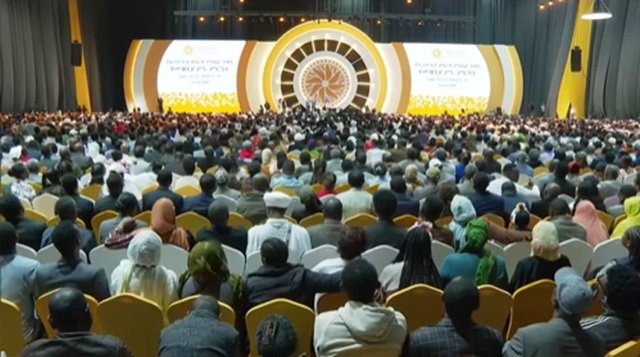
(NAIROBI, Kenya) — After nearly six weeks of intensive deliberations in Addis Ababa, the National Dialogue Assembly wrapped up its primary sessions with recommendations aimed at reshaping Ethiopia’s constitutional structure.
Approximately 4,000 delegates participating in the National Dialogue Assembly reached a series of landmark agreements before concluding their 38-day session, proposing to replace the Prime Minister position with a President, reclassify land ownership, and lower the threshold required for constitutional amendments.
Delegates agreed to abolish the office of the Prime Minister, replacing it with a President who functions as both Head of State and Head of Government. While a majority of participants favored maintaining a parliamentary framework where the ruling party in parliament selects the President, a minority advocated for a directly elected executive in a fully presidential system. Both options were ultimately recorded as dissenting positions.
To address long-standing concerns regarding constitutional rigidity, participants unanimously agreed to modify Article 105 of the Ethiopian Constitution. The current provision—which mandates approval from all regional councils—will be amended to require consent from three-fourths of regional councils, alongside two-thirds approval from both the House of People’s Representatives and the House of Federation.
Additionally, delegates approved a proposal to establish an independent Constitutional Interpretation Court, whose judges will be nominated by the President and confirmed by parliament.
In a major shift regarding property rights, the assembly voted to amend current constitutional provisions that restrict urban and rural land ownership exclusively to the state and public. The new recommendation reclassifies land as state, communal, and private property.
On regional administration and identity, the assembly agreed on several key measures:
- Regional Languages: Regional states will adopt at least one additional working language selected from federally recognized working languages, alongside their primary working language, while expanding legal recognition for minority identities.
- Regional Anthems: Regional anthems must be reviewed and revised to ensure inclusivity and eliminate lyrics containing negative connotations toward other communities.
Addressing historical grievances, delegates recommended that an independent body research national history to produce an inclusive narrative, emphasizing that past atrocities committed by historical regimes or monarchies should not be attributed to any specific nation, nationality, or religious group.
The assembly also called for a comprehensive transitional justice framework based on truth-seeking, prosecution, amnesty, and reconciliation to address historical injustices across all religious groups. The historical scope of this process will extend to the founding of modern Ethiopia, with formal criminal accountability applying to acts committed from 1994/95 G.C. onward.
The Ethiopian National Dialogue Commission will organize and submit the finalized recommendations to appropriate government institutions for formal consideration and implementation.
__
Join our Telegram Channel: t.me/borkena
Like borkena on Facebook
Join the conversation. Follow us on X (formerly Twitter) @zborkena to get the latest Ethiopian news updates regularly. Subscribe to the YouTube channel. To share information or for submission, email info@borkena.com
It is very disappointing to see the outcome of this national dialogue, which has wasted millions of birr that could have been used to help Ethiopia’s impoverished people, only to justify the outdated politics of ethnic hegemony practiced by the former OPDO and the contemporary successor, the Prosperity Party.
There were great men and women who genuinely cared about a true national dialogue and believed it could provide a lasting remedy for the divisions facing our ancient nation, Ethiopia. Sadly, the process ultimately ended in failure, marked by the twisted and confused leadership of Professor Mesfin, with his senior assistant, Hirut Oda, whose conduct was a disgrace to Ethiopian women committed to peace.
Fellow compatriots should never give up. We must continue to demand a genuine national reconciliation process for Ethiopia one that addresses the root causes of our divisions rather than serving the interests of ethnic political organizations that have repeatedly created conflicts and contributed to bloodshed among our own people.
As veteran political analyst Professor Aklog Birara has suggested, Ethiopia needs a genuine national reconciliation process in which ordinary people, who have no basic conflicts with one another, can finally live together in peace and dignity. The Ethiopian people deserve a political system that unites rather than divides them.
Pastor Degone Moretew