
Majoritarian Ethnic Domination and Expansion: The Two Pronged Ways of Exercising Power by the Oromo Prosperity Party
By Yihenew Ewnetu
Sweden
1. Introduction: From Internal Capture to Externalized Expansion
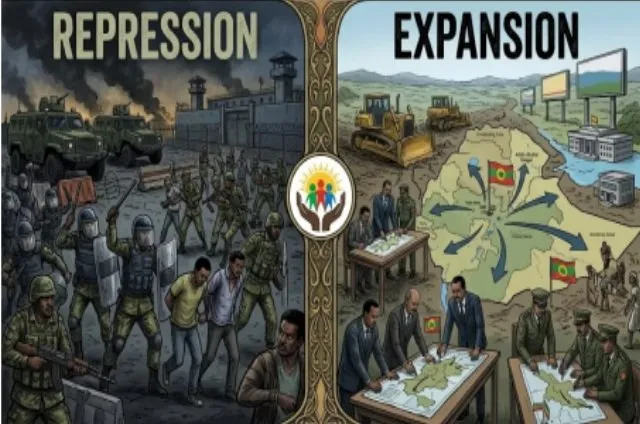
This manuscript constitutes Part II of a two-part academic investigation into the structural transformation of the contemporary Ethiopian state under Prime Minister Abiy Ahmed and the Oromo-led Prosperity Party (PP). Whereas Part I examined the internal architecture of the regime—demonstrating how a single ethno-regional elite captured and fused both sides of the Ethiopian federal saddle to govern simultaneously as the federal national government (Ethiopia) and the regional state apparatus (Oromia)—Part II shifts the analytical lens outward. It examines the externalized, expansionist exercise of that consolidated power: the systematic territorial, demographic, administrative, and cultural projection of Oromia’s dominance across Addis Ababa, Ethiopia’s contiguous regional states, and the wider Horn of Africa.
1.1 Recapitulation of Part I: The Architecture of the Dual State To situate the expansionist dynamics documented in this part, it is necessary to recall the institutional, ideological, and economic foundations established in Part I. Part I demonstrated that Ethiopia’s post-2018 political crisis is rooted in the structural fictions of the 1995 Constitution, which divided a deeply interwoven, multi-ethnic society into rigid ethno-linguistic regional states under the false premise that homogeneous ethnic groups occupy neatly bounded territories (Asnake, 2013, p. 112). This constitutional design institutionalized four interlocking systemic crises: mandatory ethnic profiling through administrative identification documents that exposed targeted populations such as the Amhara to massacres and displacement (Abbink, 2006, p. 153; CMI, 2004, p. 5; Melesse, 2021, p. 2; Yirga, 2026, p. 7); forced assimilation and “mnemonic re-engineering” in contested areas such as Wolkait, Raya, Dera, and Metekel (Tesfaye, 2008, p. 210; Yirga, 2026, p. 9); the systematic subordination of civic Ethiopian identity to ethnic allegiance (John, 2021, p. 11; Melesse, 2021, p. 4); and the reduction of internal minorities to second-class citizens subjected to violent demographic engineering in mixed urban centers (Fisher & Gebrewold, 2022, p. 45). The resulting permanentization of conflict displaced between 5 million people, destroyed agricultural capital through “eco-violence,” and drained the national economy of $1.1 billion to $2 billion annually (Bellizzi et al., 2020, p. 14; Homer-Dixon, 1999, p. 78; IDMC, 2023, p. 12; Makango et al., 2023, p. 8).
Theoretically, Part I synthesized these developments through the dual-state paradigm (Kebede, 2023, p. 42), drawing on Ernst Fraenkel’s (1941, p. xiii) distinction between a formal “normative state” and an extrajudicial “prerogative state,” alongside Oren Yiftachel’s (2006, p. 11) model of ethnocracy. To capture the dynamic mechanics of this takeover, Part I also applied the Parasitoid State Model, tracing how critics argue the post-2018 transition moved sequentially from initial entry under the rhetoric of Medemer (the Injection) to the occupation of core federal institutions (the Consumption), the demographic and administrative targeting of Addis Ababa (Migration to the Head), and the looming threat of systemic state collapse into an ethnocratic Oromo successor state (Decapitation and Emergence) (Abbink, 2022, p. 89).
Empirically, Part I mapped five interconnected pillars through which the Oromo-PP consolidated absolute domestic control following the dissolution of the EPRDF (Tronvoll, 2022, p. 118):
1. Coercive and Proxy Security Architecture: Beginning with tacitly enabled bank raids across Wollega that expropriated hundreds of millions of Birr (Borkena, 2019, p. 2), the regional leadership constructed a heavily armed proxy force that function in coordination with the militarized Oromia Special Force that numbers 200,000 personnel trained not as police force but in commando infantry and motorized force standards (EHRC, 2022, p. 14; EIP, 2021, pp. 12–13). Following the April 2023 federal disbandment directive (Garowe Online, 2023, p. 1), Oromia nominally complied by rebranding its elite paramilitaries into the Gada Commando—reviving historical Gada martial and assimilationist templates such as Raabaa-Doorii, Gaaduu, and Moggaasa (Addis Standard, 2026, p. 1; Bahrey, 1593/1954, p. 121; Gnamo, 2014, p. 34; Hassen, 1990, pp. 18, 63; Horn Observer, n.d., p. 1; Zewde, 2001, p. 17). Part I cataloged how this force operates alongside the Oromia Regular Police (Molla Ewenetu, 2025, p. 1), localized Gaachana Sirnaa kebele militias (EHRCO, 2022, p. 9; UK Home Office, 2026, p. 7), Repi Lola tactical strike squads (Amnesty International, 2020, p. 12; Paravicini, 2024, p. 1), and the clandestine Koree Nageenyaa shadow committee responsible for extrajudicial assassinations, torture, and “ghost prisons” (Amnesty International, 2026, p. 14; EHRC, 2024a, pp. 1–2; Paravicini, 2024, pp. 1–5; Reuters, 2023, p. 3). Complementing these state organs are deniable proxy networks—pseudo Shene, pseudo-Fano, and the 120 Group (Addis Standard, 2023, p. 5; Addis Standard, 2026, p. 12; Human Rights Watch, 2022, p. 31)—as well as a quota-driven forced conscription and police extortion apparatus that has abducted vulnerable civilians, including minors as young as 11 and individuals with disabilities (Addis Standard, 2024, p. 1; EHRC, 2024, p. 4; Ethiopian Policy Institute, 2024, p. 1; UK Home Office, 2026, p. 7; U.S. Department of Labor, 2024, p. 1).
2. Stratified Political Hierarchy: Part I detailed how Abiy Ahmed fused co opted OLF/ODF veterans (Østebø, 2020, p. 112; Tronvoll, 2021, p. 88), legacy
OPDO elders and former Oromia presidents (Africa Confidential, 2024, p. 3; Girma, 2024, p. 32; International Crisis Group, 2023, p. 14), reprocessed TPLF/EPRDF veterans, and hyper-loyal inner-circle Oromo radicals such as Shimelis Abdisa and Adanech Abebe (Bekele, 2025, p. 77; Human Rights Watch, 2023, p. 41) into a disciplined political machine, while traditional Oromo opposition factions frequently converged with the regime whenever overarching ethnic hegemony was perceived to be at stake (Mohammed, 2024, p. 112; OLF Press Release, 2023, p. 2).
3. Military, Surveillance, and Diplomatic Capture: Part I documented the centralization of apex Ethiopian National Defense Force (ENDF) commands, the Ethiopian Air Force, Defense Intelligence, and Logistics under Oromo loyalist officers (Addis Standard, 2026, p. 1; Fana MC English, 2026, p. 14; POA English, 2026, p. 28). This command structure is synchronized with regional enforcement through a high-tech surveillance ecosystem—integrating foreign UAVs, INSA, and the Ethiopian Artificial Intelligence Institute—to execute rapid strikes and warrantless roundups (Borkena, 2026, p. 17; Fana MC English, 2026, p. 2), while strategic embassies in global capitals, the Gulf, and neighboring states are staffed by political heavyweights and military generals to safeguard foreign loans, secure military assistance and supply including drones, and give diplomatic cover to the atrocities and massacres the regime and its proxies commit periodically.
4. Ideological, Religious, and Informational Hegemony: Part I analyzed the regime’s fusion of ethnic politics with the Pentecostal Prosperity Gospel into an emerging ethnocratic theocracy (Group Transition Charter, 2019, p. 2; Østebø, 2025, pp. 1, 12), marked by state interference in the Ethiopian Islamic Affairs Supreme Council (Mejlis) and backing for a breakaway Oromia Orthodox Synod to weaken the Ethiopian Orthodox Tewahedo Church (EOTC) (Amba Professionals Union, 2023, pp. 2–3; Amnesty International, 2023, p. 22; Haustein et al., 2026, p. 322; Plaut, 2023, p. 2). Concurrently, a coercive state-directed “cyber army” and state broadcasters deploy astroturfing, AI-generated disinformation, and internet blackouts to silence critics and obscure human rights abuses (Access Now, 2024, pp. 12, 15; BBC News, 2024, paras. 6, 12–14; Committee to Protect Journalists, 2024, p. 8; UNHRC, 2023, pp. 18, 24).
5. Political Economy of State Capture and Debt Distress: Finally, Part I demonstrated how the regime redirected state procurement, constitutionally state-owned land, and scarce foreign currency toward favored conglomerates such as the OVID Group and the building of luxury vanity resorts (Brill, 2025, p. 43; Human Rights Watch, 2023, pp. 200–202; World Bank, 2018, p. 5). These oligarchic cartels directly finance the war effort—exemplified by OVID’s
1.7 billion Birr apartment transfer to the ENDF—even as unchecked borrowing and internal warfare pushed Ethiopia into official debt distress with public debt exceeding 50 percent of GDP (Capital Ethiopia, 2024, p. 1; Ethiopia Today, 2026, p. 1; IMF, 2025, p. 6; IMF & World Bank, 2025, p. 2; U.S. Department of State, 2024, p. 7).
1.2 The Analytical Pivot: From Domestic Consolidation to Territorial and Regional Expansion
Having established how the Oromo-PP built and financed this bifurcated power center in Part I, Part II investigates what happens when that apparatus is projected outward. Prior to 2018, conflicts involving Oromia were largely defensive reactions against TPLF-dominated federal centralization; post-2018, however, Oromo political elites no longer fight the federal state—they are the federal state (Fisher & Gebrewahd, 2019, p. 32). By shedding its role as a neutral constitutional arbiter and weaponizing federal military, financial, and administrative power in service of regional maximalism, the regime has locked Ethiopia into a permanent cycle of balkanizing conflict (Tronvoll, 2022, p. 118).
Part II traces this externalized expansion across three interlocking spatial arenas from 2018 through October 2026. First, at the political center, it examines the struggle for Addis Ababa (Finfinne) and the surrounding Sheger City municipality, where constitutional ambiguity has been leveraged through violent mob attacks, the forced imposition of regional symbols in multi-ethnic schools, urban land expropriation, and the ethnically targeted demolition of more than 100,000 homes— rendering over 500,000 residents homeless—to engineer demographic and administrative control over the federal capital (Addis Standard, 2022, p. 3; Amnesty International, 2018, p. 12; Amnesty International, 2023, p. 19; Amnesty International, 2026, p. 11; EHRCO, 2023, p. 7; Human Rights Watch, 2020, p. 24; Human Rights Watch, 2024, p. 31).
Second, Part II compiles a systematic, multi-front empirical record of structural violence and territorial contestation across every regional border contiguous with Oromia: the Amhara borderlands of North Shewa, Minjar Shenkora, Dera, and Wollo (ACLED, 2026, p. 4; Amnesty International, 2021, p. 12; EHRC, 2021, p. 8; Human Rights Watch, 2023, p. 28); the Afar pastoralist corridors around Awash and Fentale (Addis Standard, 2021, p. 2; EHRCO, 2023, p. 14; Regional Early Warning Systems Report, 2026, p. 9); the Somali frontier across Moyale, Babile, and Eastern Hararghe, where clashes displaced roughly 1.5 million people (EHRC Special Report, 2026, p. 14; EHRCO, 2022, p. 27; Human Rights Watch, 2019, p. 22); the western frontiers of Benishangul-Gumuz and Gambela (ACLED, 2025, p. 6; ACLED,
2026, p. 7; EHRC, 2019, p. 11; EHRC, 2022, p. 12; EHRCO, 2021, p. 22); the eastern enclaves of Harari and Dire Dawa (Amnesty International, 2018, p. 5; EHRCO, 2020, p. 18); and the southern frontiers encompassing Sidama, South Ethiopia (where the West Guji–Gedeo conflict alone displaced over one million people), Central Ethiopia, and SWEPR (ACLED, 2026, p. 8; Addis Standard, 2022, p. 2; Amnesty International, 2020, p. 15; EHRCO, 2022, p. 33; EHRCO, 2024, p. 12; Refugees International, 2018, p. 5).
Third, Part II situates this territorial drive within a deeper historical-ideological and transnational genealogy. It traces the modern geopolitical concept of “Oromia” back to the 19th-century German missionary Johann Ludwig Krapf, who coined the term in the early 1840s, dubbed the Oromo the “Germans of Africa,” and petitioned British and German powers from Ankober and Mombasa to colonize and Protestantize a contiguous transnational Oromo territory stretching from the Ethiopian highlands deep into Kenya (Beke, 1845, p. 96; Dictionary of African Christian Biography, 2026, p. 1; Feyissa & Haustein, 2023, p. 8; Imberg, 2022, pp. 57, 61; Oromo Studies Association, 2011, p. 16; Sahlberg, 1997, p. 53; Vilhanová, 2006, p. 80). Part II demonstrates how contemporary critics draw direct parallels between Krapf’s colonial-evangelical blueprint and the Abiy administration’s fusion of state Protestantization, EOTC suppression, and regional expansionism (CUNY Graduate Center, 2026, p. 4; Feyissa & Haustein, 2023, p. 23; Rift Valley Institute, 2023, p. 23; WardheerNews, 2026, p. 1)—a dynamic now spilling across international borders in the Moyale conflict, displacing tens of thousands into Kenya’s Marsabit County and triggering national security alarms in Nairobi (AllAfrica, 2026, p. 1; Peace News, 2026, p. 1).
1.3 Aims and Structure of Part II
Building directly upon the institutional diagnosis established in Part I, Part II pursues five primary analytical aims:
1. Trace the Post-2018 Transformation of Conflict: Analyze how the Oromo PP’s capture of the federal state converted historically defensive regional disputes into state-backed, asymmetric ethno-territorial expansionism (Fisher & Gebrewahd, 2019, p. 32; Tronvoll, 2022, p. 118).
2. Document Demographic and Administrative Engineering at the Center: Examine the systematic assertion of exclusive ethno-nationalist control over Addis Ababa (Finfinne) and the creation of Sheger City through forced demolitions, cultural impositions, and urban land expropriation (Amnesty International, 2026, p. 11; Human Rights Watch, 2024, p. 31).
3. Map Multi-Front Borderland Conflicts (2018–2026): Provide a chronological, empirically grounded synthesis of atrocities, displacements, and territorial encroachments along Oromia’s borders with Amhara, Afar, Somali, Benishangul-Gumuz, Gambela, Harari, Dire Dawa, Sidama, and the Southern Regions.
4. Uncover the Historical-Ideological Genealogy of Transnational Expansion: Interrogate the intellectual continuity between Johann Ludwig Krapf’s 19th-century vision of a Protestantized, transnational “Oromia” and contemporary state postures, including the cross-border security spillover into Kenya via Moyale (AllAfrica, 2026, p. 1; Feyissa & Haustein, 2023, p. 23; Imberg, 2022, p. 61).
5. Assess Multidimensional Impacts and Formulate Structural Policy Pathways: Evaluate the cascading social, economic, and political toll of permanentized conflict—including the existential risk of Yugoslav-style balkanization (Tronvoll, 2022, p. 119)—and propose a comprehensive framework of constitutional, institutional, land-tenure, and transitional justice reforms required to dismantle the structural drivers of violence.
2. The Transformation of Conflict Post-2018
The empirical trajectory of Ethiopia’s territorial crises cannot be understood without first recognizing the fundamental structural inversion that occurred in 2018. Before 2018, Oromo political elites and civilian populations were largely excluded from absolute federal state power, which was dominated by the Tigray People’s Liberation Front (TPLF). Consequently, conflicts involving Oromia were predominantly defensive in character—exemplified by the Addis Ababa Master Plan protests—and aimed at resisting federal encroachment.
Since 2018, however, Prime Minister Abiy Ahmed and the Oromo Prosperity Party (PP) have captured the federal state apparatus in its entirety. As a result, the Oromia regional government is no longer fighting the federal state; it is the federal state (Fisher & Gebrewahd, 2019, p. 32). The federal center has ceased to function as a neutral constitutional arbiter and has instead been actively weaponized. By injecting disproportionate federal resources into the Oromia region, tolerating proxy insurgencies such as the Oromo Liberation Army (OLA) when strategically convenient, and deploying the Ethiopian National Defense Force (ENDF) to suppress rival regions, the current regime has locked Ethiopia into a permanent cycle of balkanizing violence (Tronvoll, 2022, p. 118).
3. Structural Expansion and the Permanentization of Conflict Across Contested Regions
Following the consolidation of federal power, this asymmetric dual-state structure manifested across Ethiopia’s internal borders in a wave of coordinated demographic engineering, administrative annexation, and armed confrontation. The subsections below document this multi-front expansion chronologically from 2018 through October 2026, beginning with the federal capital at the geographic center and moving systematically across every contiguous regional state.
3.1 The Struggle for Addis Ababa (Finfinne) and Sheger City Addis Ababa represents the ultimate paradox of Ethiopia’s ethnic federalism: a cosmopolitan, multi-ethnic federal capital entirely enclaved within the Oromia Regional State. Since 2018, constitutional ambiguity surrounding Oromia’s “special interest” in the capital has been leveraged to assert exclusive ethno-nationalist ownership over the city. This campaign has manifested through targeted mob violence on the urban periphery, the forced imposition of the Oromia regional flag and anthem in multi-ethnic public schools, the aggressive expansion of Oromia jurisdiction via the creation of “Sheger City,” and the systematic demolition of homes belonging primarily to non-Oromo residents to alter the metropolitan demographic balance.
Please continue reading in PDF format here
Editor’s Note: Views in the article do not necessarily reflect the views of borkena.com
__
Join our Telegram Channel: t.me/borkena
Like borkena on Facebook
To submit a press release, send the submission to info@borkena.com
Add your business to Ethiopian Business Listing / Ethiopian Business Directory
Join the conversation. Follow us on X (formerly Twitter) @zborkena to get the latest Ethiopian news updates regularly