
By Yihenew Ewnetu
Sweden
1. Introduction: Scope of the Two-Part Study and Analytical Framework
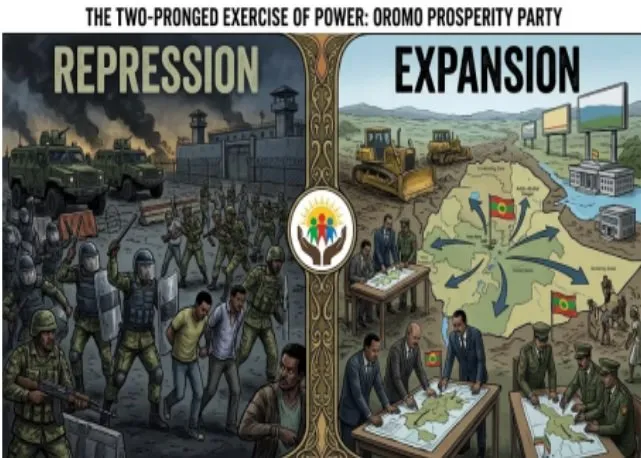
This academic manuscript constitutes Part I of a two-part scholarly investigation into the structural transformation of the contemporary Ethiopian state under Prime Minister Abiy Ahmed and the Oromo-led Prosperity Party (PP). To establish analytical clarity across a vast and interlocking political crisis, the broader study is divided into two complementary volumes:
● Part I (The Present Study): Focuses primarily on the internal organization, institutional capture, and formal and informal echelons of power that straddle a single power saddle on both sides of the Ethiopian federal order—operating simultaneously as the powerholder of the federal national government (Ethiopia) and the regional state apparatus (Oromia). It systematically maps how this bifurcated power center is organized across coercive security forces, party-elite hierarchies, military and diplomatic commands, religious-ideological institutions, digital propaganda networks, and state-captured economic conglomerates.
● Part II (Forthcoming Companion Study): Focuses primarily on the externalized, ethnofascistic expansion of the dual state—examining the territorial, demographic, and administrative expansion of Oromia and the systematic exercise of political, military, and cultural domination across Ethiopia and the wider Horn of Africa.
1.1 The Constitutional Fiction of Ethnic Federalism and Systemic Identity Crises
Understanding how a single ethno-regional elite came to straddle both the federal and regional saddles of power requires returning to the structural foundations of the post-1991 Ethiopian state. Under the 1995 Constitution, Ethiopia embarked on a radical socio-political experiment: dividing a deeply interwoven, multi-ethnic population of over 100 million people into arbitrary, constitutionally defined ethno linguistic regional states. While the ruling Ethiopian People’s Revolutionary Democratic Front (EPRDF) historically justified this system as a mechanism to rectify historical centralization, the foundational premise of ethnic federalism relies on a critical fiction—that distinct, homogenous ethnic groups occupy neatly delineated geographic territories (Asnake, 2013, p. 112). In reality, Ethiopia’s demographic landscape is characterized by centuries of internal migration, intermarriage, urbanization, and fluid identity formation. Consequently, the drawing of ethno regional borders was an inherently artificial and highly politicized exercise.
The rigid imposition of ethnic identity and ethnic borders upon a mixed population has generated four interrelated systemic crises:
● Ethnic Profiling: In post- 1991 Ethiopia, local administrative identification (such as traditional Kebele ID cards) and national databases have been designed to track ethnic identity. The rigid imposition of ethnic identities and ethnic borders upon a mixed population has generated systemic crises in the country (Melesse, 2021, p. 2). Millions of Ethiopians of mixed ethnic heritage have been forced to adopt their paternal ethnicity for official identification (Abbink, 2006, p. 153). Mandatory ethnic labeling, facilitated by documents specifically designed to track ethnic origin (CMI, 2004, p. 5), has enabled ethnic profiling and created systemic vulnerabilities for targeted populations such as the Amhara. Widespread ethnically motivated massacres, kidnappings, and displacement of Amharas have been heavily documented across every region of the country. The official classification system has enabled the easy identification of ethnic Amharas, leading government forces and proxy groups to subject them to targeted mass kidnappings, massacres, and displacement (Yirga, 2026, p. 7).
● Forced Assimilation: Academic studies detail the “mnemonic re engineering” and demographic shifts in Wolkait, Raya, Dera, and Metekel following the 1991 implementation of ethnic federalism. Amharas living in these annexed areas have been coerced into abandoning their language and culture, facing forced assimilation into Tigrayan, Oromo and other identities (Yirga, 2026, p. 9). This was implemented, among others, by banning the Amharic language in courts and schools, forcing the population to learn and use a language and culture other than their own. Forced integration has become the rule rather than the exception for targeted populations and minorities living among dominant ethnic populations (Tesfaye, 2008, p. 210).
● Subordination of Ethiopian Identity: The thesis that a national “Ethiopian identity” has been superseded by an “ethnic identity” is a primary academic critique of the ethno-territorial system established post-1991, which inherently marginalized minorities living outside their designated ethnic zones. Ethiopians who challenge or resist the imposition of ethnic politics face persecution or are driven into exile (John, 2021, p. 11). Ultimately, Ethiopian identity has been systematically subordinated to ethnic allegiances (Melesse, 2021, p. 4).
● Second-Class Citizenship: Individuals residing in regional states constitutionally designated for a single ethnic group to which they do not belong are legally and practically reduced to second-class citizens. They are systematically excluded from local political representation, civil service employment, and secure land tenure. Areas and towns characterized by mixed populations —such as the metropolitan expanse of Addis Ababa—have become structural flashpoints. Because the constitution offers no mechanism for geographic integration, using violence and demographic engineering to claim sovereignty on an area populated by mixed ethnic groups has been the modus operandi of the Oromo -PP (Fisher & Gebrewold, 2022, p. 45).
1.2 Cascading Humanitarian, Legal, and Macroeconomic Consequences The permanentization of conflict through artificially and arbitrarily imposed ethnic identity and ethnic federalism has generated catastrophic cascading effects, fracturing the social fabric and triggering massive internal displacement affecting between 3 and 5 million internally displaced persons (IDPs). The humanitarian safety net collapsed by late 2026 due to donor fatigue, leaving displaced populations severely malnourished as early as 2020 (Bellizzi et al., 2020, p. 14). Politically, the normalization of extrajudicial killings by proxy entities has signaled the total erosion of the rule of law. Furthermore, the systematic destruction of agricultural capital—a calculated tactic of “eco-violence”—ensures surviving minority populations have no economic foundation to return to, forcing them into absolute aid dependency and politically neutralizing them through voter disenfranchisement (Homer-Dixon, 1999, p. 78; IDMC, 2023, p. 12). The aggregate economic impact of this internal displacement costs the national economy between $1.1 billion and $2 billion annually (Makango et al., 2023, p. 8).
1.3 Theoretical Synthesis: The Dual-State Paradigm, Ethnocracy, and the Parasitoid State Model
This manuscript synthesizes these empirical realities through the dual-state paradigm, a theoretical model positing that the current administration under Prime Minister Abiy Ahmed operates two parallel nations—Oromia and the rest of Ethiopia —under a single federal governmental apparatus (Kebede, 2023, p. 42). Conceptually, this framework builds upon Ernst Fraenkel’s (1941, p. xiii) foundational theory of the Dual State, which distinguishes between a formal “normative state” (preserving legal facades, ministries, and diplomatic protocols) and a parallel “prerogative state” (exercising unchecked, extrajudicial violence and arbitrary political will), combined with Oren Yiftachel’s (2006, p. 11) model of ethnocracy, wherein a dominant ethnic group appropriates the state apparatus to institutionalize its demographic, territorial, and political supremacy.
In the Ethiopian context, the collision of constitutional fictions with majoritarian state capture has enabled the Oromo-led Prosperity Party (PP) to reorient the federal state’s economic, military, intelligence, and diplomatic resources to establish an ethnocratic Oromo hegemony—an authoritarian structure dominated by Oromo elites. The external shell of the historical Ethiopian state is preserved for international legitimacy and sovereign borrowing power, while its internal mechanisms are repurposed to incubate and ensure the supremacy of a dominant Oromo state.
To capture the dynamic mechanics of this internal takeover, contemporary political analysts also conceptualize Ethiopia’s structural transformation through the Parasitoid State Model. Drawing a direct biological parallel between the mechanism of the Phorid fly (“zombie fly”) and Ethiopia’s post-2018 political crisis, this model illustrates how critics argue the multi-ethnic, historical fabric of Ethiopia is being hollowed out and replaced from within by an expansionist ethnonationalist state (Abbink, 2022, p. 89):
1. The Injection: In nature, the fly lays eggs inside a host (an ant or bee), using the host’s body to feed its offspring.
○ The Political Parallel (The 2018 Transition): Abiy Ahmed Ali came to power on promises of national unity (Medemer). Critics argue this served as a Trojan horse, embedding ultra-radical ethnonationalist political elites at the center of the federal state.
2. The Consumption: The larva eats the host from within, leaving the exterior intact while altering its behavior.
○ The Political Parallel (Institutional Capture): Key federal institutions— including the military, judiciary, banking sector, and federal ministries— are systematically occupied by Oromo elites. The outer shell of
“Ethiopia” remains intact for external recognition, while its internal mechanisms serve an emerging ethnonationalist hegemony with dominant and expansionist objectives.
3. The Migration to the Head: The larva moves to the brain of the host, inducing “zombie-like” disorientation and loss of control.
○ The Political Parallel (Targeting the Capital and Political Center): The demographic and political push toward Addis Ababa—the historic, cultural, and administrative “head” of the country—alters the multi
ethnic identity of the population through forced displacement via so called corridor development, securing control over the core institutions of the country by dominating the center.
4. Decapitation and Emergence: The host’s head falls off, and the fully matured fly emerges, leaving the host dead.
○ The Political Parallel (Systemic Fragmentation): Critics fear a final stage in which historical Ethiopia collapses into fragmentation, allowing a dominant, ethnocratic Oromo state to fully materialize from the ruins.
1.4 Aims and Structure of Part I
Guided by this theoretical red thread, Part I pursues four primary analytical objectives:
1. Examine the Dual-State Governance Mechanism, tracing how a single Oromo-PP leadership simultaneously straddles the federal government of Ethiopia and the regional state of Oromia.
2. Deconstruct Formal versus Informal Organizational Power, mapping the interplay between formal state institutions (ministries, ENDF, regular police, embassies) and clandestine or proxy networks (Koree Nageenyaa, Repi Lola, Gaachana Sirnaa, pseudo-Shene, pseudo-Fano, and the 120 Group).
3. Analyze the Weaponization of State Resources, examining the capture of military command, high-tech surveillance, diplomatic representation, religious institutions, digital propaganda, and macroeconomic/corporate capital.
4. Establish the Institutional Foundation for Part II, demonstrating how the domestic consolidation of coercive, political, and financial power creates the launchpad for Oromo ethnonationalist expansionism and regional domination explored in Part II.
2. Oromo-Dominated Prosperity Party and the Consolidation of Ethnocratic Hegemony
The ascent of Abiy Ahmed in 2018 marked a decisive paradigm shift: Oromo political elites within the Oromia regional state were no longer fighting the federal state; they became the federal state. Prior to 2018, conflicts involving Oromia were predominantly defensive or anti-state, often driven by weak opponents of the TPLF regime engaged in low-scale armed struggles and social-media campaigns. Following the dissolution of the EPRDF, the Oromo wing of the Prosperity Party captured the federal apparatus (Tronvoll, 2022, p. 118).
This institutional capture was immediately followed by a massive, asymmetrical injection of federal resources into the Oromia region. The government of Abiy Ahmed soon created proxy groups to strengthen its power by assassinating those it deemed actual or potential threats to its political rule, and to execute its planned expansion and domination through mass evictions and atrocities. Concurrently, the Oromo dominated PP government tacitly allowed proxies to execute orchestrated bank raids to finance regional power bases. Between January 2019 and July 2023, hundreds of millions of Birr were expropriated via orchestrated “bank robberies.” The most intense period occurred over a single weekend (January 12–13, 2019), when government proxy groups simultaneously raided 17 bank branches in the Kellem
Wollega and West Wollega zones (Borkena, 2019, p. 2). Across this roughly four and-a-half-year period, over 40 rural banks and financial centers were systematically emptied without any subsequent genuine federal recovery or arrests, causing the government to functionally act as a financier for Oromia-based armed elements.
Simultaneously, the nature of conflicts along Oromia’s borders rapidly transformed into state-sponsored ethnonationalist expansionism. The Oromo-dominated PP accelerated the recruitment, training, and arming of the Oromia Regional Special Forces. Rather than standard three-month police instruction, recruits received six month military-grade training across regional military camps (Ethiopian Institute of Peace, 2021, pp. 11–12). The Oromia Regional State circumvented constitutional boundaries to construct a highly militarized regional army numbering between 150,000 and 200,000 personnel (EHRC, 2022, p. 14). Oromia Regional President Shimelis Abdisa explicitly framed this militarization through the “raw meat” doctrine (“ጥሬ ስጋ እያበላን ያሰለጠነው ኃይል አለን”), symbolizing an aggressive martial vanguard loyal solely to the regional elite—even as Prime Minister Abiy actively hindered the training of non-Oromo forces, notably accusing Amhara officials of illicitly training local police as early as 2019 (Borkena, 2019, p. 4).
3. Taxonomy of Armed Forces in Oromia: Formal, Clandestine, and Proxy Structures
To execute its political and territorial objectives while maintaining plausible deniability during mass atrocities, the dual-state regime operates through an intricate web of formal regional security forces, clandestine state hit squads, and informal proxy militias.
3.1 Formal and Clandestine Regional State Forces
A. The Oromia Special Police Force (Liyu Hail) and the Gada Commando The Oromia Special Police Force (Amharic: Liyu Hail) was established in 2008 with an initial core of only 120 members (European Institute of Peace [EIP], 2021, p. 12). Following the 2018 political transition, under Oromia Regional President Shimelis Abdisa, the force underwent massive expansion. Recruits underwent rigorous six month training programs—double the standard three-month training for regular police and equivalent to Ethiopian National Defense Force (ENDF) infantry training (EIP, 2021, p. 12). By 2021, estimates for the Oromia Special Force had surged to nearly 100,000–150,000 personnel, making it one of the largest and most militarized regional forces in the country (EIP, 2021, p. 13).
In April 2023, Prime Minister Abiy Ahmed’s federal government announced a controversial and sweeping policy to formally disband all regional special forces across Ethiopia’s ethnic-based federal states (Garowe Online, 2023, p. 1). The central government argued that heavily armed regional paramilitaries posed a threat to national unity, fueled inter-regional border conflicts, and undermined the federal state’s monopoly of violence. Under this directive, regional special forces were ordered to be dissolved and integrated into one of three entities:
1. The Ethiopian National Defense Force (ENDF);
2. The Federal Police; or
3. Regular Regional Police forces (Garowe Online, 2023, p. 1).
The Oromia regional government nominally complied with the federal directive; however, rather than relinquishing its elite paramilitary capabilities to the federal army, Oromia integrated the bulk of its special forces into its regional police apparatus, effectively rebranding them (Horn Observer, n.d., p. 1). Following the 2023 disbandment directive, the Oromia region reorganized its most elite and highly trained former special forces personnel into a newly minted unit operating under the regional police framework, dubbed the Gada Commando (Addis Standard, 2026, p. 1).
Historical Roots of the Gada Commando:- Despite modern political attempts to sanitize the term, the historical Gada system was inherently militaristic, functioning as a highly aggressive offensive military machine that drove the massive 16th- and
17th-century Oromo expansions (Hassen, 1990, p. 18). The Gada system rigidly organized society into age-sets and generation grades, centered on the Luba grade (the ruling class) and the Raabaa-Doorii (the warrior class). These classes were structurally mandated to undertake military campaigns, conduct devastating raids, and conquer new territories to prove their martial valor during their eight-year tenure in power (Hassen, 1990, p. 63; OSF Preprints, 2026, p. 3). During the 16th century, Gada warriors utilized highly mobile guerrilla tactics (historically known as Gaaduu) to overrun rival kingdoms and indigenous communities, resulting in immense violence, the destruction of indigenous settlements, and the mass displacement of rival ethnic groups (Zewde, 2001, p. 17). Populations that were not killed or displaced were subjected to Gada institutions of assimilation—namely Moggaasa (forced or coerced collective assimilation) and Gudifacha (adoption)—through which subjugated ethnic groups were structurally stripped of their original identities, forced to adopt Oromo language and culture, and absorbed into Oromo clans to swell the ranks of the Gada military machine (Gnamo, 2014, p. 34). While contemporary Oromo historians emphasize the egalitarian aspects of these institutions, historical chronicles from non-Oromo victims heavily document massacres, cultural erasure, and severe atrocities systematically executed through the Gada military structure (Bahrey, 1593/1954, p. 121). Critics argue that this historical template has been reactivated under the new Raabaa-Doorii leader, Prime Minister Abiy Ahmed, acting as the ultimate chief of the Gada Commando.
Operational Structure and Cross-Border Incursions: The Gada Commando was formed through specialized advanced training to serve as a highly mobile, counter insurgency rapid-response force. While nominally designated as a “police” unit to comply with federal mandates against “special forces,” the Gada Commandos function identically to the former paramilitaries, equipped as a light motorized infantry unit conducting heavy combat operations against the OLA and in contested zones such as East Wollega (EIP, 2021, p. 12; Addis Standard, 2026, p. 1). Its chain of command exemplifies the dual-state saddle: Prime Minister Abiy Ahmed sits at the apex as Commander-in-Chief of the Armed Forces, exercising ultimate oversight over national security architecture; directly beneath him, Oromia Regional President Shimelis Abdisa heads the regional security council, determining strategic deployment and political directives (EIP, 2021, p. 12); and immediate tactical command was exercised by Commissioner General Ararsa Merdasa, overseeing day-to-day deployments across the region’s 20 zones (MultiFactCheck, n.d., p. 1; Oromia Police Commission, n.d., p. 1).
Beyond internal policing, the Gada Commando (and its predecessor, the Oromia Special Forces) has expanded its jurisdiction to conduct cross-border incursions into the Amhara, Sidama, Somali, Central Ethiopia (Gurage), and Benishangul-Gumuz regions. Mirroring 16th-century patterns, these incursions have been characterized by extreme violence aimed at altering demographic and territorial realities and securing resource-rich corridors.
Please continue reading the article in PDF format Here
Editor’s Note: Views in the article do not necessarily reflect the views of borkena.com
__
Join our Telegram Channel: t.me/borkena
Like borkena on Facebook
To submit a press release, send the submission to info@borkena.com
Add your business to Ethiopian Business Listing / Ethiopian Business Directory
Join the conversation. Follow us on X (formerly Twitter) @zborkena to get the latest Ethiopian news updates regularly