
Mohammed Hassen Mohamed (Xareed)
The Timing and Context of the Appointment
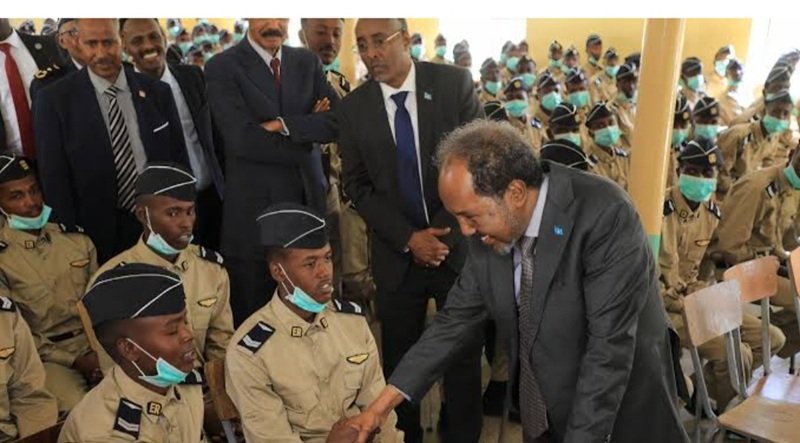
President Hassan Sheikh Mohamud has appointed Brigadier General Abdirisaq—widely associated with the Somali Air Force training program in Eritrea—as the new Commander of the Somali Air Force. This appointment coincides with the completion of a seven-year military training program undertaken by Somali Air Force personnel in Eritrea.
According to information obtained by some International News Agencies, the Air Force units that had been undergoing intensive training in Eritrea have now formally concluded their program. The trained personnel remain temporarily stationed in Eritrea as logistical and operational preparations are finalized for their return to Somalia. The long-term training initiative formed part of a broader national strategy aimed at rebuilding and modernizing Somalia’s air defense capabilities after decades of institutional collapse.
The appointment of Brigadier General Abdirisaq is therefore not incidental; it is a calculated leadership decision designed to ensure structured command, continuity, and operational readiness as the newly trained Air Force personnel transition back into national service.
Rebuilding Somalia’s Air Power: A Strategic Necessity
Somalia’s Air Force, once a formidable component of the national military during the pre-1991 era, effectively disintegrated following the collapse of the central government. For over three decades, the country has lacked a fully operational air wing capable of supporting ground operations, securing airspace, or providing strategic deterrence.
The seven-year training initiative in Eritrea represents one of the most ambitious efforts in Somalia’s post-conflict security sector reform. It reflects a long-term vision to re-establish sovereign control over national airspace and reduce dependence on foreign security partners. The reconstruction of the Air Force is particularly significant given the ongoing counterterrorism operations against Al-Shabaab and the broader objective of transitioning security responsibilities fully to Somali forces.
By appointing a commander at the precise moment when trained personnel are nearing redeployment, the government is signaling institutional consolidation rather than ad hoc militarization. Leadership precedes deployment—a principle critical to disciplined force integration.
The Eritrea Training Program: Political and Geopolitical Dimensions
The Eritrea-based training program has drawn regional attention since its inception. President Hassan Sheikh Mohamud visited the Somali trainees in Eritrea on two separate occasions, underscoring the political weight and strategic importance attached to the initiative.
Eritrea’s role in training Somali forces reflects evolving regional security partnerships within the Horn of Africa. The collaboration suggests an emerging axis of security cooperation aimed at strengthening indigenous military capabilities rather than perpetuating dependency on external actors. At the same time, it illustrates Somalia’s effort to diversify its defense partnerships while rebuilding core institutions.
The completion of the training program marks a milestone in that bilateral relationship and signals the transition from capacity-building abroad to operational deployment at home.
Leadership at a Critical Juncture
Brigadier General Abdirisaq’s appointment is not merely ceremonial. Commanding an Air Force that has been trained abroad for seven years requires strategic acumen, organizational discipline, and political sensitivity. Reintegration of trained forces into Somalia’s evolving military structure will demand careful coordination with ground forces, intelligence services, and international partners.
Moreover, the revival of an Air Force involves more than personnel—it requires infrastructure rehabilitation, aircraft acquisition, maintenance systems, regulatory frameworks, and airspace management protocols. Effective leadership will therefore determine whether the program becomes a symbolic achievement or a transformative milestone.
By placing a senior officer at the helm before the formal redeployment of the trained units, the federal government appears intent on institutional coherence and centralized command authority.
Implications for National Security and State-Building
The reactivation of Somalia’s Air Force carries significant security implications. Air capabilities provide surveillance, rapid mobility, logistical support, and strategic deterrence. In the context of ongoing counterinsurgency operations, even limited air support can dramatically enhance ground effectiveness.
Beyond tactical value, however, the symbolic significance is equally profound. Reclaiming air power represents a psychological restoration of sovereignty. For a state emerging from prolonged fragility, rebuilding a national Air Force signals institutional maturity and strategic ambition.
The appointment and the impending redeployment of trained personnel therefore serve not only military objectives but also state-building narratives—demonstrating that Somalia is transitioning from externally secured stability toward internally sustained security.
Conclusion: From Reconstruction to Strategic Sovereignty.
The appointment of Brigadier General Abdirisaq as Commander of the Somali Air Force is a carefully timed decision aligned with the completion of a historic seven-year training initiative in Eritrea. It reflects strategic planning rather than political improvisation.
As the trained Air Force units prepare to return home, Somalia stands at a critical threshold. The success of this initiative will depend on effective leadership, sustained political will, infrastructure development, and coherent integration within the broader national defense framework.
Rebuilding air power is not simply about aircraft and uniforms; it is about reclaiming sovereignty, reinforcing national confidence, and redefining Somalia’s place within the regional security architecture. If managed wisely, this moment could mark the beginning of a new chapter in Somalia’s defense modernization—one in which the nation not only defends its skies but also strengthens the foundations of lasting peace and institutional resilience.
Editor’s Note : Views in the article do not necessarily reflect the views of borkena.com
__
Support Borkena : https://borkena.com/subscribe-borkena/
Join our Telegram Channel : t.me/borkena
Like borkena on Facebook
Add your business to Ethiopian Business Listing / Ethiopian Business Directory Business Listing Toronto
Join the conversation. Follow us on X (Formerly Twitter) @zborkena to get the latest Ethiopian News updates regularly. Subscribe to YouTube channel To share information or for submission, send e-mail to info@borkena.com
Isaias Afewerki is arguably the laziest and meanest leader in the world. All he did in 60 years of being at helm Eplf-cum-state was to kill of his comrades one by one, instigate conflict in Ethiopia, send mercenaries into Yemen, Sudan, and Congo. He was engaged in smuggling arms, dollar, and minerals in and out of South Sudan, Sudan, Uganda, Congo, Ethiopia, Djibouti, Somalia, Kenya. That’s how made a living. He turned 80 last month. He will soon depart and forgotten. What a waste of opportunity.