
By Staff Writer
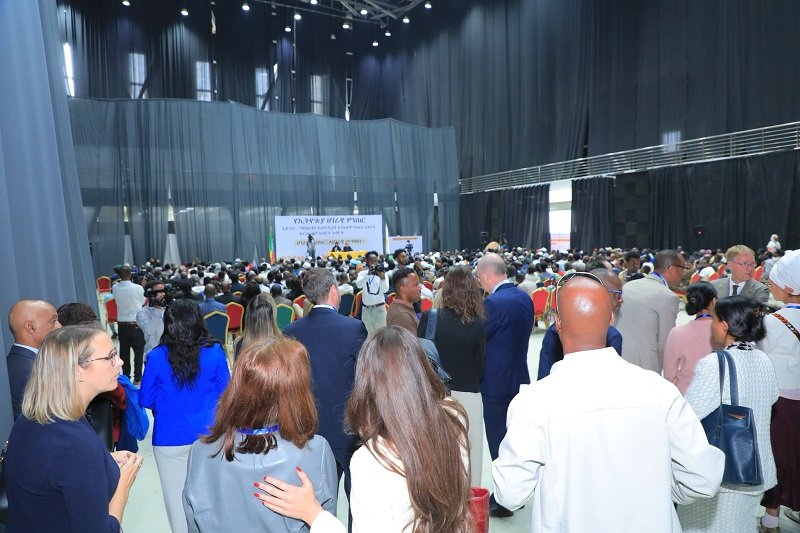
NAIROBI, Kenya — The National Dialogue Assembly, currently on its 37th day, postponed its general assembly after representatives from the Oromia Region lodged a complaint regarding the status of Addis Ababa. Although the Commission announced plans to approve 476 recommendations during the general assembly on August 20, delegates did not hold the session.
On August 19, all 476 finalized recommendations were presented to participants at the working group level. The Commission had previously outlined a decision-making procedure; however, it did not implement those rules. Instead, Commissioners decided that working groups would approve recommendations before submitting them to the general assembly for approval.
Approximately 300 Oromo Region representatives requested a meeting with Commissioners to voice their complaint. They insisted on inserting a constitutional provision explicitly affirming that Addis Ababa is the seat of the Oromia Region as a mandatory recommendation, threatening to withdraw from the dialogue process if Commissioners refused. Participants continued deliberations late into the evening, while Commissioners convened an unscheduled meeting with regional council members.
Separately, Amhara Region representatives submitted complaints challenging the procedural shifts. They argued against disrupting the process, noted the absence of procedures for convening regional assemblies, and maintained that recommendations already approved at the working group level should not face reconsideration. They also warned of a potential withdrawal if the Commission deviated from standard guidelines.
Commissioners meeting with the Amhara representatives denied violating standard procedures, explaining that they convened the regional assembly and mediation panel specifically to address the Oromo delegation’s complaint. They stated that the Commission would not alter the existing recommendations regarding the Addis Ababa-Oromia seat issue, nor would it introduce new recommendations to the general assembly.
Several delegates threatened to pull out of the process if the Commission added or removed any recommendations. Participants are awaiting the final recommendations before determining their next steps.
The Commission formed a committee to outline subsequent steps. A meeting is scheduled for the morning of August 21, with the general assembly expected to convene in the afternoon. However, sources indicate that Commissioners provided varying explanations to different delegate groups, leaving a significant challenge to ensure full participation and complete the process.
__
Join our Telegram Channel: t.me/borkena
Like borkena on Facebook
Join the conversation. Follow us on X (formerly Twitter) @zborkena to get the latest Ethiopian news updates regularly. Subscribe to the YouTube channel. To share information or for submission, email info@borkena.com
If it were to my wishes, I would give chartered cities status to every town that was on the route of the old railway from Hurso all the way to Bishoftu leaving Akaki Kaliti in the hands of the Oromia region as its capital. Those small railway stations used to be the most diversified towns built from scratch by many ethnic groups you can imagine. I remember during my formative years there were Somalis(Issas, Gurguras, Hawiyas, Issacs), Afars, Tigres, Amharas, my own Oromos, Sidamas, Wolayitas and even Arabic speaking Sudanese who were former soldiers in the British force that drove out the Italians from the areas and decided to settle in our small railway station. Fate had it I left the country before I mastered those languages. But most my childhood friends were polyglots. I would make those towns chartered just like Addis/Finfinnee and eventually Dire Dawa.
I just wander where U get the corresponding picture from. I watch EBC TV every evening, I see and listen to common people, young old, intellectualls commoners, workers peasants,… from all parts of Ethiopia speaking about a successfull meeting, I should add for the first in history, indeed issues remain to be resolved and discussions to follow, yet still this was a unique effort to be louded encouraged …it was not an excursion, sort of backwater ethnic groups, to see addis full of fountains as an Ethiopian professor with no shame claimed in an interview few days back … I ask myself such strangeness to ones own homeland can be traced only to uprooted personality often found among aliens in more alien environment…