
By Caleb Ta. (Dr.)
Independent Researcher in African Political Affairs; Human Rights Advocate
Abstract
The alleged mutilation of 19-year-old Fanit Balem Wasse, a female member of the Amhara Fano National Force (AFNF), by soldiers of the Ethiopian National Defense Force (ENDF) has ignited national outrage and renewed scrutiny over Ethiopia’s adherence to international humanitarian law (IHL). According to Fano sources, Wasse’s body was desecrated after capture—her breast mutilated and publicly displayed (Amhara People’s Freedom Front [AFPF], 2025). The Ethiopian government has not commented, while human rights organizations remain silent amid restricted access to conflict zones. This article examines the allegations through the lens of IHL, focusing on the protection of persons hors de combat, the prohibition of unnecessary force, and the humane treatment of captives and the dead. Drawing on international legal instruments, human rights reports, and forensic investigation standards, it situates the case within a broader pattern of systemic abuses in the Amhara region. If verified, this act constitutes a war crime under the Geneva Conventions and the Rome Statute of the International Criminal Court.
Introduction
Ethiopia’s civil war has entered a darker, more brutal phase. For over two years, forces loyal to Prime Minister Abiy Ahmed have waged an all-out campaign against the Amhara population, marked by drone bombardments, mass arrests, and forced displacement (Human Rights Watch, 2024). What began as a counterinsurgency has evolved into what many describe as a war of identity and survival.
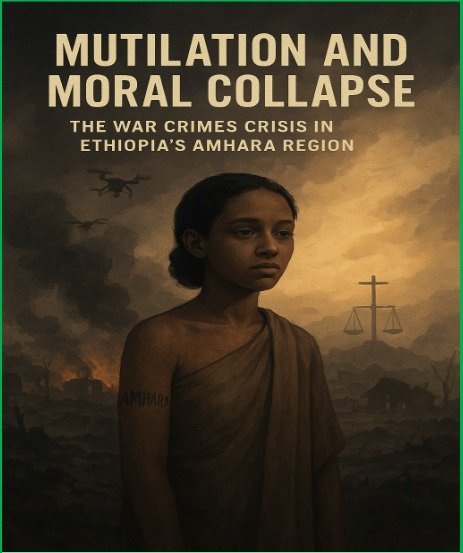
Among the many victims, one name has come to symbolize both courage and atrocity: Fanit Balem Wasse, a 19-year-old commando of the Amhara Fano National Force (AFNF). Reports indicate that she was captured alive after being wounded during clashes in Gojjam. Witnesses allege that Ethiopian soldiers stripped, tortured, and mutilated her body, leaving it on the road while soldiers were seen dancing around it — a grotesque spectacle of triumph over cruelty (AFPF, 2025).
Before the war, Wasse was a bright student from Mankussa, in western Gojjam. Her dream of attending university was interrupted by the government’s crackdown on Amhara communities. Facing mass arrests and disarmament orders, she joined the Fano resistance, driven by what she saw as a moral duty to defend her people — a decision that would ultimately lead to her death (BBC News, 2023; Al Jazeera, 2024).
The Ethiopian government and ENDF have not issued any statement. Major human rights organizations, constrained by censorship and lack of access to conflict zones, have also remained silent (United Nations Human Rights Office, 2024). If verified, Wasse’s mutilation represents not only a war crime but also a moral and civilizational collapse within a state once known for its deep cultural reverence for honor and human dignity.
The Destruction of a Nation’s Wealth and the Human Cost of War
The conflict in the Amhara region has devastated Ethiopia’s economic, social, and moral foundations. Infrastructure, agriculture, and education have crumbled under continuous offensives, blockades, and displacements. As one local leader lamented, “The wealth of the kingdom has been destroyed by the rebellion.”
This destruction, however, extends beyond material losses. It has corroded Ethiopia’s ethical and legal fabric. The mutilation of Fanit Wasse stands as a grotesque metaphor for a state that has turned its weapons not only on its citizens’ bodies but on the nation’s conscience. It exposes a government that has drifted from its moral compass, replacing justice with vengeance and order with terror.
Fanit Balem Wasse: The Incident and Its Symbolism
According to the Amhara People’s Freedom Front (2025), Wasse was executed and mutilated after capture. Their report states:
“Government forces stripped the body of Fanit Balem, pulled a knife, mutilated her breast, skinned her, and threw her breast on the asphalt road.”
Fano’s leadership declared the act a flagrant violation of the Geneva Conventions:
“Let alone a dead body, captured soldiers should be treated humanely and handed over to humanitarian organizations like the Red Cross.”
In contrast, Fano forces reportedly transferred 16 wounded government soldiers to the International Committee of the Red Cross (ICRC) (2025), underscoring their stated commitment to humanitarian norms.
The image of Wasse’s desecrated body, widely circulated on social media, ignited national grief and outrage. Her name has since become a rallying cry for the Amhara resistance and a haunting symbol of gendered violence and the moral collapse of the Ethiopian state. As George (2025) observed in his field reflections from the Fano front, “In her death, the conscience of a nation was torn apart.”
International Humanitarian Law and the Protection of Persons Hors de Combat
International humanitarian law provides explicit protections for those classified as hors de combat — the wounded, sick, or captured who are no longer participating in hostilities (Geneva Convention I, 1949, Art. 15; Additional Protocol I, 1977, Art. 41). These individuals must be treated humanely, afforded medical care, and protected from violence.
The Rome Statute of the International Criminal Court (1998) identifies mutilation and humiliation of such persons as war crimes under Article 8(2)(b)(xxi). Similarly, Article 34 of Additional Protocol I prohibits the despoliation or mutilation of the dead.
By allegedly mutilating and displaying Wasse’s body, ENDF soldiers would have violated these provisions, committing “outrages upon personal dignity,” as defined under Common Article 3 of the Geneva Conventions. These actions also contravene Ethiopia’s obligations under the UN Charter (Arts. 55–56) and the African Charter on Human and Peoples’ Rights (Arts. 4–5).
Such violations erode not only legal order but the moral legitimacy of the Ethiopian state. A government that desecrates its own citizens’ bodies has crossed the threshold from governance into barbarism.
The Broader Pattern: War Crimes and Torture in Ethiopia
The Ethiopian government has faced repeated accusations of war crimes and crimes against humanity in both the Amhara and Oromia regions (Amnesty International, 2022; Human Rights Watch, 2024; U.S. Department of State, 2024). Documented abuses include the execution of civilians and children, systematic destruction of villages, and widespread sexual violence.
Prison reports from Kaliti and Kilinto describe torture, denial of medical care, and obstruction of legal access for detainees (Human Rights Watch, 2023). Within this context, the murder and mutilation of Wasse align with a pattern of dehumanization and the collapse of accountability.
This is not simply a failure of military discipline but a deeper moral corrosion in which violence becomes normalized, and the state’s monopoly on force is transformed into an instrument of terror.
Forensic Standards and the Imperative of Truth
For justice to emerge, independent forensic verification is essential. A credible investigation should include:
- Forensic autopsy and photographic documentation under verified chain-of-custody protocols;
- Geolocation and metadata analysis of circulated images;
- Trauma-informed witness interviews; and
- Oversight by the UN Human Rights Council and the ICRC.
Without such inquiry, the truth remains vulnerable to manipulation. Yet, government silence — amid an established record of human rights violations — only heightens the plausibility of the allegations and deepens the nation’s moral crisis.
Conclusion: Justice Requires Truth
The case of Fanit (Balem) Wasse transcends the realm of personal tragedy to embody the moral and humanitarian breakdown engulfing Ethiopia. Her alleged capture, mutilation, and desecration—if verified—constitute a grave war crime and a profound rupture in the nation’s historical codes of honor, justice, and restraint in warfare. Such acts strike at the very foundation of international humanitarian law and the universal norms that safeguard human dignity even in conflict.
Allowing these violations to pass uninvestigated corrodes the rule of law and emboldens future atrocities. The silence of both the Ethiopian government and the international community perpetuates a dangerous culture of impunity, signaling to victims and perpetrators alike that justice is negotiable. This silence, more than the act itself, marks a deeper moral collapse.
We therefore urge the United Nations and the African Union to fulfill their mandates under the UN Charter and the African Charter on Human and Peoples’ Rights by launching a credible, impartial, and well-resourced international fact-finding mission. Only through transparent investigation and accountability can trust be restored, impunity curtailed, and the rights of all Ethiopians—regardless of affiliation—upheld under international law.
Justice begins with truth. And truth begins with the courage to name the dead and to expose the hands that desecrate them. The legacy of Fanit (Balem) Wasse endures, therefore, not only as a cry for justice but as a moral summons to all nations: to confront atrocity with courage, and to defend humanity before it is lost entirely.
Editor’s Note : Views in the article do not necessarily reflect the views of borkena.com
__
Support Borkena : https://borkena.com/subscribe-borkena/
Borkena Ethiopian News Youtube Channel
Join our Telegram Channel : t.me/borkena
Like borkena on Facebook
To submit Press Release, send submission to info@borkena.com
Add your business to Ethiopian Business Listing / Ethiopian Business Directory
Join the conversation. Follow us on X (Formerly Twitter) @zborkena to get the latest Ethiopian News updates regularly.
1). Jawar’s Anölé 2.0 (!?): Why would the army or any Pro-Abiy do that? How does ‘killing & mutilating’ Amara female help Abiy’s government? Unless it is the Amara Anölé Version, better err on the side of caution and let justice take its course.
2). Misinformation/Disinformation [MD] | Trading in Amara’s Agony [TAG]: MD & TAG are Hallmarks of Amara Diaspora [AD] →70% are beneficiaries of former Self-Appointed Tyrant Regimes. They only want to return to power & rule with impunity.
(i). Had the AD cared about Amaras, why hadn’t they airdropped 100g [10¢] bread for the famine/drought-stricken Amaras ever since the 1970s? Isn’t it their Ineptitude & Greed that made Ethiopia “The World’s Poster Child of Poverty & Famine”?
(ii). Anti-Ethiopia/Anti-Amaras/Anti-Oromos try to pit Amaras against Oromos [or vice-versa] for self-serving motives. If Oromos were as anti-Amara as they spew, why would ≥15 million Amaras live in Oromia [ youtu.be/IXBVqbOe9uY?t=2320 ]?
(iii). As we speak, these Amaras [mostly from Gojjam & Gonder (G&G)] reap social benefits in Oromia [education/jobs/health care/etc.]. Well, no Oromo invited them to Oromia or prevented them from leaving either. Cf.: I have never met any Oromo in G&G.
3). Abiy’s Government | Amara/Oromo Extremism | Domestic Terrorism [DT]:
i). Abiy’s Party/Government was elected under on-site scrutiny by AU/UN/EU/US/etc. Any armed insurrection to topple elected governments is DT anywhere in the world!
ii). Fanno [Misnomer] & OLF-IFLO [Misnomer] are waging armed insurrection with support from Egypt, EPLF/Eritrea, etc. They are Mercenary Domestic Terrorists [DTs].
iii). Double Standard: When ‘Fannos’ kill soldiers, it is Amara Heroism/Patriotism. When Ethiopian soldiers kill ‘Fannos’, it’s ‘Human Rights Violation’. How convenient!
iv). NO Safe Haven for DT & DTs: ‘OLF-IFLO’ also swears by same Playbook! Both ‘Fanno’ & ‘OLF-IFLO’ serve the same masters: Egypt, EPLF/Eritrea. No Safe Haven!