
There is an old saying that the enemy of my enemy is my friend. It is an attractive maxim because it contains an obvious element of political truth. Throughout history, enemies have occasionally found themselves fighting on the same side when a greater or more immediate threat emerged. Yet the maxim is not a rule of politics, and it certainly should not be used as a substitute for strategic thinking. An enemy of my enemy may become my temporary partner, but that does not necessarily make him my friend. The decisive question is not simply whether two actors oppose the same adversary, but whether their interests remain compatible once that common adversary is weakened or defeated.
This distinction has become particularly important for the Amhara people and Fano as cooperation between Fano and Tigrayan forces develops under what is increasingly referred to as Tsimdo. Among Amhara and Fano supporters, there are now two broad positions. One argues that Abiy Ahmed’s government is the immediate and most dangerous enemy of the Amhara people and of Ethiopia and that, consequently, Fano should cooperate with anyone capable of helping to remove him. The other position, which I share, accepts the seriousness of the present threat but asks a different question: if TPLF is itself an adversary whose political and territorial interests may conflict with those of the Amhara people, is strengthening TPLF really in Fano’s long-term interest?
This is not an argument for political passivity, nor is it an argument for supporting Abiy Ahmed. It is an argument about strategy. Opposing Abiy does not require trusting TPLF, just as rejecting TPLF as a strategic ally does not mean accepting Abiy. Fano must be capable of opposing one enemy without surrendering its strategic independence to another.
Some supporters of Tsimdo argue that the TPLF of today is no longer the TPLF of the EPRDF era. This is an important point and should not be dismissed. TPLF no longer controls the Ethiopian federal government, no longer commands the enormous national political and institutional resources it once possessed, and is internally more fragmented than it was during its years of dominance. Figures who once stood together have taken different political paths, and the organisation no longer enjoys the political authority that allowed it to dominate Ethiopia for nearly three decades. At the same time, Fano has grown considerably in military importance and political consciousness. Those who support Tsimdo therefore argue that the relationship is fundamentally different from the relationship between the Amhara political elite and TPLF during the EPRDF period. In their view, Fano is now strong enough to enter an alliance from a position of strength, ensuring that TPLF remains merely a junior partner and cannot repeat its earlier political manipulation.
There is truth in the observation that TPLF is weaker than it once was. However, the conclusion that it is therefore incapable of becoming a strategic threat does not necessarily follow. Political weakness is not the same as strategic irrelevance. An organisation can lose control of a state while retaining military experience, organisational networks, financial resources, a substantial population base, territorial depth, intelligence capabilities and international relationships. The relevant question is therefore not whether TPLF is as powerful as it was at the height of EPRDF rule; it clearly is not. The relevant question is whether it retains sufficient resources and capabilities to influence the balance of power in Ethiopia after the present conflict. Recent developments suggest that it does.
Indeed, if TPLF were truly a dead horse, one should ask why other political actors would be interested in cooperating with it. The willingness of political and military actors to seek its cooperation is not, by itself, proof that TPLF is powerful. Nevertheless, it does indicate that something valuable remains in its possession. That value may lie in its military capability, its experienced commanders, its geographical position, its organisational knowledge, its political networks or its longstanding international relationships. A political organisation does not have to control a government to remain strategically useful.
This is also why the claim that Fano can safely dominate the relationship simply because it is militarily stronger deserves closer examination. Military strength is an important component of political power, but it is not the only one. A movement may possess greater battlefield strength while another possesses greater diplomatic access; one may command more fighters while another has more experienced political operators; one may have greater popular mobilisation while another has established relationships with international actors. The real question is therefore not simply who has more soldiers, but who needs whom and what each side can offer the other.
That question becomes particularly important when we consider the international dimension of the emerging relationship. Zemene Kassie, a senior Fano leader, recently gave an interview to the Swiss newspaper Le Temps, in which he publicly acknowledged that strategic discussions with Tigrayan forces had taken place and that an alliance with them had been decided, alongside discussions with other armed groups. He described the discussions as having taken place over a period of several months. Asres Mare Damtie, identified as a member of the political leadership of the Amhara Fano National Movement, has also written for The Africa Report, giving Fano political arguments exposure to an international readership.
It would be irresponsible, however, to claim without evidence that TPLF or Tsimdo directly organised these media appearances. We do not have sufficient evidence to establish that. Nevertheless, the broader development deserves attention. International visibility is itself a political resource. TPLF has accumulated decades of experience in international diplomacy and political networking, whereas Fano’s emergence as a major political and military force is comparatively recent. If cooperation gives Fano access to international political circles that were previously difficult to reach, while Fano provides Tigrayan forces with military weight and access to a major Ethiopian constituency, then the relationship is more complicated than the simple description of “strong Fano and weak TPLF” suggests.
A weaker partner can still possess something that a stronger partner needs. That is how political bargaining works.
This brings us to the most important weakness in the argument that TPLF can safely be treated as a junior partner: it assumes that power can be measured only by military strength. History repeatedly demonstrates otherwise. Political organisations exercise influence through institutions, diplomacy, information, networks, alliances and the ability to shape the political settlement that follows a conflict. A movement does not need to dominate its partner militarily to become a kingmaker.
There is also a danger that is more subtle than military manipulation: political incentives. Any political arrangement that promises influential opposition leaders a prominent role in a future Ethiopian government inevitably creates incentives. This does not mean that particular Fano leaders have betrayed the Amhara struggle or entered an alliance for personal ambition; such allegations would require evidence and should not be made casually. But it would be naïve to pretend that political actors are immune to the attraction of power. If a coalition offers individuals access to a future government, international legitimacy or political prominence, those benefits can influence how political calculations are made.
How to catch a monkey?
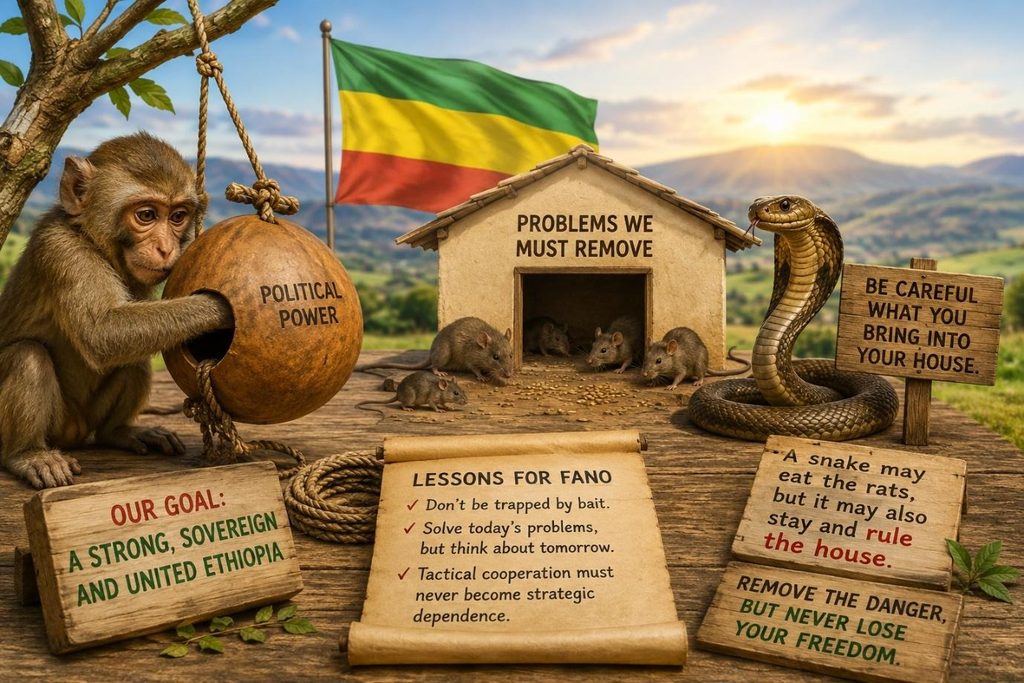
This is where the old story about catching a monkey provides an unexpectedly useful metaphor. According to the traditional story, a trap is made from a hollowed coconut, gourd or similar container, with an opening large enough for the monkey’s open hand but too small for its clenched fist. Bait is placed inside, and the monkey reaches in, grabs it and then finds that it cannot withdraw its hand without releasing what it has taken. The trap succeeds not because the monkey is physically weak, but because it refuses to let go of the bait.
The political lesson is uncomfortable. A trap does not always work through superior force. Sometimes it works because the victim wants what is inside it.
In politics, the bait may be military support, international recognition, diplomatic access, political influence or a place in the government that emerges after a regime falls. Again, this is not an accusation against any particular Fano leader. It is a warning about political incentives. A movement that believes it is entering an alliance from a position of strength can still become constrained if the benefits of the alliance become too attractive to surrender.
What kind of snake?
The same logic applies to the snake metaphor. Imagine a farmer whose house has become infested with rats. The rats are destroying his food and damaging his property, and the problem has become intolerable. Someone proposes an apparently simple solution: introduce a snake into the house because the snake will eat the rats. The farmer agrees that the rats must be removed, but a sensible farmer will ask one further question: what kind of snake is being introduced into his house?
A harmless snake that eats rats and disappears may solve the problem. A cobra or black mamba is an entirely different proposition. If the snake kills the rats but remains in the house, the farmer may simply have replaced one danger with another. The fact that the snake was useful against the rats does not make it safe for the household.
This is the strategic question Fano must ask about Tsimdo. The question is not whether TPLF can help weaken Abiy Ahmed. It can. The question is what TPLF becomes after it has been strengthened through cooperation with Fano, and what political leverage it will possess when the common enemy is no longer the principal concern.
The Wolkait Affairs
This concern cannot be separated from the territorial disputes between Tigray and Amhara. Welkait, Tegede, Telemt, Humera and Raya are not merely names in an old historical dispute. They represent unresolved questions of territory, administration, political authority and security. There is a substantial body of Ethiopian-language literature examining the historical geography and administrative boundaries of these areas, including Achamyeleh Tamiru’s The Wolkait Affairs. The historical record remains contested, and it would be intellectually irresponsible to pretend that every claim made by either side has been conclusively established. But the fact that the history is contested does not mean that the present strategic problem does not exist.
The present situation makes that problem even more difficult to ignore. Recent fighting has demonstrated that Tigrayan forces remain capable of conducting military operations in areas connected to the territorial dispute. ACLED has reported TDF operations in disputed western and southern areas, including Tselemt and Alamata, and has described the TPLF’s intention to seek control over disputed areas including Welkait, Tsegede, Humera and Tselemt. More recently, ACLED reported TDF positions around Merewa in Raya Alamata and subsequent Ethiopian federal drone strikes against TDF forces there.
Whatever political justification individual actors give for these movements, the strategic fact for Fano is straightforward: the territorial question remains unresolved, and armed forces remain involved in it.
Pseudo-comparison: Allied Forces versus Tsimdo
This distinction is particularly important because not every historical example of cooperation between enemies is comparable to the present Ethiopian situation. The Second World War is sometimes used to demonstrate that political enemies can work together when confronted by a common threat. Britain and the Soviet Union were deeply hostile to one another in ideological and political terms, yet they fought together against Nazi Germany. That example is useful only to the limited extent that it demonstrates the possibility of temporary cooperation between fundamentally different political systems. It cannot be transferred mechanically to the Fano–TPLF situation.
The reason is simple. Ideological disagreement and territorial conflict are not the same thing. A capitalist and a communist can regard each other’s political systems as fundamentally wrong while living on opposite sides of the world. Their ideological conflict may be profound, but it does not necessarily involve a direct dispute over who controls a particular piece of land. The Soviet Union did not join Britain in the Second World War while simultaneously claiming that a British region belonged to the Soviet Union. Britain did not have to strengthen Soviet forces while fearing that Soviet forces would later return to settle a territorial dispute with Britain.
A territorial dispute is different because it creates a direct and material conflict of interests. It concerns land, administration, security, political authority and the people who live there. It cannot be resolved simply by saying that two political forces have a common enemy. If two forces claim the same territory, their disagreement remains even when they temporarily cooperate against a third party.
This is precisely why the present relationship between Fano and TPLF requires much greater strategic scrutiny than the simple expression “the enemy of my enemy is my friend” suggests.
That is why I find the comparison with purely ideological rivalries particularly misleading. An ideological dispute can sometimes be postponed because the opposing systems can exist alongside one another. A territorial dispute is different. If two political forces ultimately claim competing authority over the same territory, their disagreement cannot be resolved merely by agreeing that a third actor is their enemy.
Who want to be a junior partner?
This is precisely why the argument that “TPLF is now weak, so it cannot threaten us” is insufficient. Even if TPLF is weaker than Fano militarily, it may still possess enough capability to influence the political settlement after Abiy. And the more important question is not whether TPLF can defeat Fano in a conventional military confrontation. It is whether Fano can strengthen TPLF without simultaneously strengthening a future bargaining opponent whose interests may diverge sharply from its own.
There is an even deeper issue. Suppose Tsimdo succeeds. Suppose Abiy Ahmed’s government is defeated or fundamentally weakened. What happens the morning after? Who controls the federal government? Who controls the armed forces? What happens to regional boundaries? What happens to Welkait? What happens to Raya? What happens to the constitution? Who determines the political status of disputed territories? What happens if Fano and TPLF disagree about the political settlement?
These questions cannot reasonably be postponed until after victory because the answer to them is the meaning of victory itself.
A political movement that concentrates entirely on defeating its immediate enemy can easily win the war and lose the peace. The phrase “first remove Abiy, and we will deal with everything else later” therefore deserves considerable suspicion. Everything else is precisely what determines what comes after Abiy.
The Amhara people cannot afford to enter another political arrangement on the assumption that the future will somehow resolve itself. If Fano has indeed become more politically conscious and more capable than the political forces that preceded it, then that political maturity must be demonstrated through strategic foresight. It must mean thinking not only about today’s battlefield but also about tomorrow’s political order.
This does not mean that Fano must refuse every form of tactical communication or coordination with TPLF. Political actors sometimes have to deal with people they do not trust. Nor does it mean that Fano should somehow make peace with Abiy simply because TPLF remains a strategic adversary. The choice is not between Abiy and TPLF. That is a false choice.
Fano can oppose Abiy while remaining strategically independent of TPLF.
Indeed, that independence may be its greatest source of bargaining power.
The principle should therefore be simple: tactical cooperation must never become strategic dependence. If cooperation is considered necessary, Fano should enter it with clearly defined interests, limits and conditions. It must know what it is trying to achieve, what it is prepared to exchange, and what it will not surrender. Above all, the political settlement that follows the present conflict must be considered before victory rather than after it.
The real test of Fano’s political maturity is therefore not whether it can defeat Abiy with the help of TPLF. The real test is whether it can cooperate with another political force without losing sight of its own strategic interests.
The enemy of my enemy may indeed be useful.
But usefulness is not friendship.
A temporary partner remains a potential adversary if the interests that separated the two sides have not disappeared. And if those interests include territory, political authority and the future structure of the Ethiopian state, the risks are considerably greater than in a simple ideological rivalry.
The farmer with a rat infestation understands this instinctively. He knows that the rats must be eliminated, but he does not introduce a snake into his home merely because the snake eats rats. He asks what kind of snake it is, why it has entered his house and what it will do once the rats are gone.
Likewise, the monkey trap works because the monkey is attracted by the bait. It does not have to be defeated by force; it only has to be persuaded that what it is holding is more valuable than its freedom.
For Fano, the danger is therefore not simply that TPLF may turn out to be stronger than expected. The deeper danger is that Fano may become so focused on defeating today’s enemy or so attracted by the political opportunities created by tomorrow’s Ethiopia, that it fails to notice what it is strengthening in the process.
Abiy may be today’s enemy. TPLF may be today’s temporary partner. But neither fact tells us who will be tomorrow’s adversary.
That is why the question before Fano is not merely whether TPLF can help remove Abiy. It is whether, after Abiy is gone, Fano will still possess enough independence and strength to determine its own future.
Before we feed the snake, we should make absolutely certain that, when the rats are gone, we are still the ones who control the house.
Editor’s Note: Views in the article do not necessarily reflect the views of borkena.com
__
Join our Telegram Channel: t.me/borkena
Like borkena on Facebook
To submit a press release, send the submission to info@borkena.com
Add your business to Ethiopian Business Listing / Ethiopian Business Directory
Join the conversation. Follow us on X (formerly Twitter) @zborkena to get the latest Ethiopian news updates regularly.