
By: Yihenew Ewnetu
Sweden
Introduction
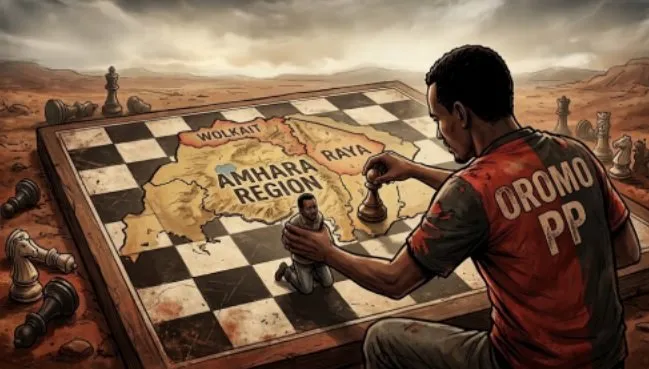
The intersection of statecraft, demographic engineering, and ethnic mobilization in the Horn of Africa provides a critical lens through which to examine the survival strategies of the modern ethnocratic state. This synthesis critically investigates how the administration of Prime Minister Abiy Ahmed and the Prosperity Party (PP) have systematically utilized the contested territories of Wolkait, Tsegede, Tselemt, Setit Humera, and Raya—alongside the indigenous Amhara populations and their localized security apparatuses, notably the Tekeze Zeb and Raya Zeb—as expendable political pawns within a broader domestic geopolitical arena. The central thesis posits that the Abiy regime operates as a necropolitical and ethnocratic apparatus fundamentally driven by a zero-sum calculation to establish and consolidate an Oromo-dominated hegemony. Within this framework, regional alliances are inherently transactional, and peripheral constituencies are instrumentalized solely for regime survival before being systematically dismantled.
Background
To comprehend the contemporary weaponization of Wolkait, Tsegede, Tselemt, and Raya, one must first analyze the structural violence embedded in the ideological foundations of the TPLF. As outlined in their 1976 Manifesto, the TPLF’s expansionist objectives necessitated the forced incorporation of historically Amhara territories in Gondar and the Wollo-affiliated Raya regions (Berhe, 2009, p. 113). Between 1976 and 1991, the TPLF executed sweeping territorial annexations aimed at altering the demographic realities of these borderlands to construct a contiguous, resource-rich “Greater Tigray” (Acham, 2024, p. 5).
This geopolitical imperative required the systematic and violent displacement of the indigenous Amhara populations. The TPLF operationalized a ruthless, clandestine intelligence network known as “06,” operating underground prisons—most notoriously “Gehanem” (Hell)—where local Amhara elders, intellectuals, and dissidents were subjected to severe torture and extrajudicial killings (AAA, 2022, p. 4). Forensic investigations have uncovered approximately 20 mass grave sites across Wolkait, Tsegede, and Tselemt, holding the remains of thousands of victims (Ethiopian News Agency, 2022a, p. 2). Consequently, at least 50,000 native ethnic Amharas were forced into exile in Sudan. Many more were subjected to internal displacement (Assegu, 2021, pp. 45–50).
The physical consolidation of TPLF control was cemented through a highly coordinated demographic engineering campaign masked as humanitarian repatriation. Between 1985 and 1987, the Relief Society of Tigray (REST) coordinated the return of an estimated 154,000 to 170,000 Tigrayan refugees from Sudan (Hendrie, 1996, p. 35). These populations were redirected into the fertile, annexed Amhara territories of Welkait, Humera, Dansha, and Tselemt rather than the arid regions of their origin (World Bank, 1993, p. 42). The TPLF further augmented this demographic shift by relocating 25,000 to 30,000 demobilized combatants and over 100,000 internal settlers transported by hundreds of buses and trucks from central Tigray to these areas (Young, 1997, p. 145).Highlighting the sheer scale of this movement, BBC reporter Catherine Bond wrote in 1993 that approximately 20 buses per day were transporting new Tigrayan settlers from the arid areas of Tigray to the fertile Amhara land in Welkait and Humera.
Furthermore, the TPLF added to this list of new settlers in the annexed Amhara areas those Tigrayans who were once resettled in Southwestern and Western Ethiopia by the Derg regime as well as redundant ex-combatants. Consequently, between 15,000 and 20,000 Tigrayan settlers were relocated from Wolega and Metekel to annexed Amhar areas. About 8,000 of them were moved to Dansha, about 7, 000 of them to Humera periphery and Baeker, with another 3,000 dispersed throughout the area. Another 5,000 to 8,000 were settled in the Raya Vallies. The scope of the Demobilization Commission’s work is detailed in the World Bank’s report entitled Transition from War to Peace in Ethiopia (1993). By the 1994 census, the population of Humera, Welkait, and Tsegede was officially recorded as 92.2% Tigrayan and a mere 6.3% Amhara—a demographic “tipping point” achieved through massive settler influx and the violent displacement of the indigenous Amhara populace (Central Statistical Agency, 1996, p. 12; Kassaw & Veneranda, 2024, Section 1). A parallel strategy in Raya aligned the demographics to 92.1% Tigrayan, effectively overriding the region’s mixed sociocultural heritage (Lenaerts et al., 2014, pp. 26–29).
The Peaceful Struggle
The anti-TPLF struggle in the Amhara region was a multifaceted movement that transitioned from legal, constitutional petitions to mass peaceful protests, and ultimately to widespread youth mobilization in the face of brutal state crackdowns. Driven by decades of perceived political marginalization and the specific territorial annexation of Welkait and Raya, this resistance became a fatal blow to the EPRDF’s ethno-nationalist structural dominance.
For nearly three decades under the EPRDF coalition, the Amhara populations of Wolkait and Raya engaged in sustained, peaceful civic struggles to regain their identity, administrative autonomy, and territories. Identity committees submitted constitutional appeals to the House of Federation, seeking legal redress for the demographic engineering and administrative annexation. However, the TPLF-dominated state apparatus responded with brutal suppression. The National Intelligence and Security Service (NISS), was utilized to systematically abduct, torture, and disappear members of the Welkait, Tegede, Telemt, and Raya identity committees (Marasco, 2025, p. 237; Plaut, 2025, p. 1).
As mentioned earlier the Amhara resistance was initially characterized by legal petitions and institutional demands before evolving into a mass grassroots movement.
● Constitutional Petitions: The struggle began peacefully with the Welkait Amhara Identity Committee, which spent years navigating the federal system to legally petition the House of Federation for the restoration of Welkait to the Amhara region (Allo, 2017, p. 136). The committee relied strictly on the constitutional provisions for self-determination.
● The Rise of Fano : When the state responded to legal petitions with violence, the Amhara youth—historically referred to as Fano—mobilized en masse. Alongside the Oromo Qerroo, the Fano became the indispensable engine of the protests. They organized stay-at-home strikes, blocked roads to prevent military deployments, and led massive street demonstrations (Fisher & Gebrewahd, 2019, p. 201).
● Cross-Ethnic Solidarity: A defining moment of the peaceful struggle was the unprecedented display of solidarity between the Amhara and Oromo youth. During the August 2016 protests in Gondar and Bahir Dar, Amhara protesters famously chanted slogans supporting the Oromo struggle (“Oromo blood is our blood”), breaking the TPLF’s long-standing strategy of ethno-regional polarization (Lefort, 2016, p. 42).
The TPLF-dominated federal government’s primary response to the Amhara protests was overwhelming and often lethal force, implemented largely through the Agazi federal commando units and the declaration of a sweeping State of Emergency.
● The Bahir Dar Massacre (August 2016): On August 7, 2016, during a massive peaceful demonstration in the Amhara regional capital of Bahir Dar, federal security forces opened fire on unarmed protesters with live ammunition. Human Rights Watch documented that at least 30 to 50 people were killed in a single day, with hospital records showing victims were shot indiscriminately in the head and chest (Human Rights Watch, Fuel on the Fire, 2016, pp. 24–26).
● Mass Incarceration and Torture: Following the October 2016 State of Emergency, the government established military-run “rehabilitation” camps. Tens of thousands of Amhara and Oromo youth were arbitrarily detained without charge. Reports from facilities like Sanja and Bir Sheleqo detailed severe beatings, forced military exercises, and psychological torture aimed at breaking the youth networks (Amnesty International, 2017, p. 18).
● Targeted Assassinations and Disappearances: Beyond crowd control, the TPLF apparatus actively hunted protest organizers. Members of the Welkait Identity Committee and prominent Fano leaders were subjected to nighttime raids, extrajudicial killings, and enforced disappearances designed to decapitate the movement’s leadership (Allo, 2017, p. 138).
The assumption of federal power by Abiy Ahmed in 2018 severely disrupted this status quo. The TPLF, marginalized from the central executive, retreated to its regional stronghold in Mekelle, setting the stage for a dramatic confrontation between the federal center and the regional vanguard. For the Abiy regime, neutralizing the TPLF required immense military capital—capital that the ENDF alone could not guarantee. Thus began the calculated manipulation of Amhara territorial grievances.
The 2020 Tigray War and the Regime’s Rhetoric of Restoration
The outbreak of the Tigray War in November 2020 presented an existential opportunity for the Amhara people to correct historical injustices (Yibeltal, 2021, para. 2). Amhara forces, including regional special forces and Fano militias, swiftly mobilized to reclaim Wolkait and Raya. This mobilization was accompanied by the regime’s deceitful rhetoric of ‘restoration’. Federal officials and PP cadres actively created and reinforced an illusion of permanence. High-ranking figures assured the Amhara public that their sacrifices would permanently secure their historical borders (African Arguments, 2023, p. 2). The federal government permitted the establishment of Prosperity Party-led local Amhara administrations in Wolkait and Raya, deliberately boosting the false hope of the local populace. This maneuver provided the pro-Abiy local leaders like Ashete Demilew and Demeke Zewdu to deceive the local people into believing that the creation of the local administrations was material proof of the federal government’s commitment to their territorial restoration.
To solidify control over these contested territories without overextending the ENDF, the federal regime financed, armed, and facilitated the creation of localized paramilitary forces: the Wolkait Zeb and Tekeze Zeb in the west, and the Raya Zeb in the south (Addis Standard, 2026a, p. 2). These forces were painted with a semblance of self-protection, presented as community defense mechanisms for the newly installed Amhara administrations.
In reality, the formation of the Tekeze and Raya Zeb was a calculated extension of the Abiy regime’s proxy warfare strategy. The real intention was to cultivate a heavily armed, localized buffer force that could absorb the brunt of the fighting against the TPLF, thereby preserving ENDF mechanized units. Crucially, as geopolitical dynamics shifted and intra-Tigrayan conflicts escalated, the operational reality of these militias evolved. Specifically, it was not in early 2024, but rather after the new war with the TDF that the TPF entered Alamata and fought with the Raya Zeb militias, who had been trained in Jara and Sekota by the finance of the Amhara region (Critical Threats Project, 2026). By fostering these decentralized militias rather than empowering a unified Amhara military command, the federal government successfully fragmented Amhara hard power, ensuring the militias remained entirely dependent on the ENDF for logistics, heavy weaponry, and tactical command.
Theoretical Framework
This analysis employs the theoretical paradigms of Instrumentalist Ethnicity and Necropolitics. Instrumentalist political sociology dictates that regimes exploit local grievances and ethnic identities not out of ideological solidarity, but purely as elastic instruments for regime survival and resource monopolization. Furthermore, the regime operates through necropolitics—the sovereign right to dictate who may live and who must die. The Abiy regime treats the Amhara peripheries as zones of permissible death, deploying the Tekeze and Raya Zeb to absorb battlefield casualties to preserve the core military apparatus of the state.
Historically, this transactional statecraft is consistently observable across Ethiopia. The regime applied this exact methodology when it exploited the Sidama people to fracture the Southern Nations, Nationalities, and Peoples’ Region (SNNPR). Once
the administrative split was finalized, the regime dispatched its proxies into the area to kill and annex territories within the newly created Sidama administration. A parallel strategy has been deployed in the Benishangul-Gumuz region, systematically marginalizing indigenous and minority populations until the region increasingly became the political and economic “backyard” of Oromia regional president Shimelis Abdisa. The regime allies itself with other ethnic groups only to its own ends: to consolidate the Oromo hegemony or ensure the unconditional survival of the center.
Regime Manipulative Exploitation
International parallels
In political science and strategic studies, the instrumentalization of ethno-regional militias by a central state apparatus—followed by their tactical neutralization once immediate regime security is achieved—is a documented mechanism of illiberal statecraft and counterinsurgency. The dynamic in which the Abiy Ahmed regime leveraged the Amhara population, local administrators, and paramilitary formations such as the Tekeze Zeb and Raya Zeb exhibits direct structural parallels with historical and contemporary regimes utilizing peripheral proxies as expendable buffers.
1. Saddam Hussein’s Manipulation of the “Fursan” (National Defense Battalions) in Iraqi Kurdistan: During the Iran-Iraq War (1980–1988) and the subsequent suppression of Kurdish nationalist uprisings, Saddam Hussein’s Ba’athist regime extensively utilized pro-government Kurdish militias known officially as the National Defense Battalions (Fawj al-Difa al-Watani), colloquially referred to as the Jash or Fursan (Cavaliers) (McDowall, 2004, pp. 353–356).
The Ba’athist regime actively exploited intra-Kurdish tribal rivalries, blood feuds, and economic dependency to recruit over 150,000 armed Kurdish auxiliaries under the direct supervision of the Iraqi Army’s regional corps commanders (Human Rights
Watch, 1993, pp. 45–48). The regime granted local commanders administrative dominance over checkpoints and rural villages, convincing them of their long-term indispensability to the central government (van Bruinessen, 1992, pp. 28–31).
However, when the central government launched the mechanized Anfal military campaign in 1988, these Kurdish battalions were ordered to spearhead clearance operations against their own ethnic kin (Human Rights Watch, 1993, pp. 82–85). Once the conventional resistance of the Patriotic Union of Kurdistan (PUK) and Kurdistan Democratic Party (KDP) was crushed, the Ba’athist regime systematically stripped the Fursan of heavy armaments, subjected their zones to forced administrative restructuring, and executed commanders who exhibited independent political ambitions (McDowall, 2004, pp. 358–361).
2. The “Popular Defense Forces” and Janjaweed in Sudan: A prominent Horn of Africa parallel is found in Sudan under Omar al-Bashir. Facing simultaneous armed rebellions in Darfur and South Sudan, the Khartoum government institutionalized a
doctrine of counterinsurgency on the cheap by mobilizing localized pastoralist militias—initially organized under the Popular Defense Forces (PDF) Act and later informalized as the Janjaweed (de Waal, 2004, pp. 183–187).Similar to how the Prosperity Party administration utilized the rhetoric of historical identity restoration to mobilize the Tekeze and Raya Zeb, the Bashir regime exploited deep-seated land tenure grievances, pastoralist identities, and Arabization narratives to pit local populations against non-Arab insurgent factions (Flint & de Waal, 2008, pp. 34–38). The central state provided direct logistics, heavy weapons, and air support while keeping the command decentralized enough to maintain plausible deniability (Salmon, 2007, pp. 15–18).
However, once regional peace agreements or political calculations altered Khartoum’s priorities, the central regime routinely fragmented, disarmed, or reshuffled these local defense committees. In 2013, the state formally reconstituted these disparate militias (Baldo, 2017, pp. 7–11). When local leaders who resisted integration or demobilization were systematically dismantled, displaced, or targeted by the very military intelligence services that had initially armed them (de Waal, 2015, pp. 162–165).
3. The Civil Defense Patrols (PAC) in Cold War Guatemala: A comparative parallel illustrating the creation of auxiliary forces like the Amhara Peace Force (APF) is found in the Guatemalan military’s implementation of the Civil Defense Patrols (Patrullas de Autodefensa Civil, or PAC) during the internal armed conflict between 1981 and 1996. Designed under the counterinsurgency doctrines of General Efraín Ríos Montt, the Guatemalan state forcibly conscripted approximately one million indigenous Mayan peasants into local paramilitary units (Schirmer, 1998, pp. 83–87).
The state explicitly designed the PAC to fracture the indigenous rural base, mandating that local Mayan villagers police, inform on, and execute members of their own communities under the direct command of military zone officers (Remijnse, 2001, pp. 462–466). The armed forces presented the PAC as a noble form of “civilian self-defense,” while in reality utilizing them as disposable forward shields during offensive sweeps through the highlands (Commission for Historical Clarification [CEH], 1999, pp. 21–25).
Following the signing of the 1996 Comprehensive Agreement on Human Rights and the conclusion of the civil war, the central government dissolved the patrols without economic reintegration or legal protection. Former patrol members were left socially ostracized, economically destitute, and exposed to local judicial accountability, while the high-ranking military commanders who engineered the proxy framework retained central power and institutional immunity (Schirmer, 1998, pp. 112–116).
Local Example
Historical examples from within Ethiopia powerfully explain what is currently being done by the Abiy regime vis-à-vis the Amhara in Wolkait and Raya. The regime’s zero-sum approach to peripheral governance is tragically cyclical.
● The Sidama Manipulation: The regime previously used the Sidama people’s quest for statehood to split the Southern Nations, Nationalities, and Peoples’ Region (SNNPR). During the height of the statehood push, Oromo ethno-nationalists formed a tactical political alliance with Sidama elites. Activists like Jawar Mohammed utilized massive media platforms, such as the Oromia Media Network (OMN), to express solidarity with the Ejjeto, framing the Sidama quest as a parallel to the Oromo struggle against centralized, unitary state structures (Abdu, 2021, Ethnic Federalism and Conflict in Ethiopia, p. 88).
Critics have argued that the aggressive political campaigning and rhetorical support provided by high-profile Oromo activists and politicians directly emboldened the Ejjeto vigilantes. The ethno-nationalist solidarity campaigns deliberately polarized the region against “settler” populations, creating a permissive environment that facilitated the massacres of Amharas and other minorities in the Rift Valley and Hawassa areas.
Once the splitting of the Sidama from the SNNPR was secured, regional leaders were allowed to aggressively demobilize and distanced themselves from the youth to project a legitimate, peaceful image (Kefale & Dejene, 2021, pp. 142–143). The prominent activists from outside the region who had previously backed the Ejjeto’s militancy—such as Jawar and his OMN —rapidly pivoted their attention back to their own regional power struggles following the crackdown.
After achieving what they wanted, Oromo politicians, the Oromia regional state and the Oromo- dominated federal government sent proxies into the Sidama area, killed innocent people, annexed a large swath of land within the newly created Sidama administration.
Demeke Zewdu and the Fatal Miscalculation of Isolating Wolkait
In Wolkait, the political survival of the administration led by Ashete Demlew and Col. Demeke Zewdu, has become increasingly precarious. Operating ostensibly under the auspices of the PP, Demeke and his administrative apparatus faced a critical strategic divergence: align with the Amhara Fano insurgency or maintain loyalty to the federal regime that birthed their administrative authority. In a desperate bid to maintain federal funding, heavy weaponry, and political legitimacy, Demeke’s administration made the fateful calculation to explicitly condemn the Fano movement (Ethiopia.me.uk, 2026, p. 2). This alignment effectively severed the Wolkait administration and the Tekeze Zeb militia from the broader Amhara populace and the Fano resistance network. By publicly denouncing the Amhara nationalist movement, the Wolkait administration alienated its most potent ideological and military allies (Addis Standard, 2026a, p. 4).
This isolation reduced the Tekeze Zeb from being a vanguard component of a wider, unified Amhara defense strategy into an isolated, federally dependent auxiliary force. Without the organic backing of Fano, Demeke’s political survival relies entirely on the goodwill of a federal government that has already explicitly demonstrated its willingness to sacrifice local Amhara allies, as evidenced by the unhindered destruction of the Raya Zeb in Alamata and the ever bolder recent speech of Getachew Reda (Addis Standard, 2026a, p. 5).
The Amhara proxies who have volunteered as expendable political pawns have sealed their own fate. By isolating themselves from the organic Fano insurgency in a desperate bid for federal patronage, figures like Demeke Zewdu have ensured the destruction of the Wolkait administration. They, alongside the defected Fano members of the APF who march to slaughter their own people, will be discarded the moment their tactical utility expires.
Crucially, this zero-sum necropolitics applies equally to the Tigrayan factions. The current federal alignment with Getachew Reda, General Tsadkan Gebretensae, and their Simret and TPF factions is an illusion of power. Just as the regime utilized the Amhara to crush the TPLF in 2020, it is currently utilizing the TPF and intra-Tigrayan fracturing to keep the north exhausted. The ultimate fate of Tsadkan, Getachew, and the TPF will undoubtedly be the exact same as that of the dismantled Raya administration and the betrayed Tekeze Zeb. In the Abiy regime’s pursuit of an absolute Oromo-dominated hegemony, all other actors are merely transactional bodies, destined to be used, exhausted, and ultimately discarded into the graveyard of the ethnocratic state.
Summary
This analysis conclusively shows that the Abiy regime did not back Amhara territorial claims out of a constitutional or historical commitment, but rather exploited local grievances strictly for regime survival. By funding and training the Tekeze and Raya Zeb militias, the federal government successfully utilized Amhara manpower as an expendable vanguard against the Tigray Defense Forces (TDF). The evidence of this manipulation is starkest in the logistical architecture: the militias were kept deliberately dependent on the ENDF for heavy weaponry and salaries (Addis Standard, 2026a, p. 2). Once the immediate threat of the TPLF was mitigated by the Pretoria Agreement, the regime’s tactical needs shifted. As demonstrated in Alamata, the federal government swiftly sacrificed the Raya Zeb to appease the newly formed Tigray Peace Force (TPF), stabilizing the corridor to free up federal resources for the suppression of the Fano insurgency in the Amhara heartland (Critical Threats Project, 2026).
The dismantling of the Raya administration serves as a definitive empirical warning. The results illustrate that functioning as a state-sponsored proxy carries terminal political risks. The Raya Zeb, operating entirely on the logistical instructions of local ENDF chiefs, erroneously expected federal protection. Instead, they were systematically disarmed and structurally neutralized by their own patrons to facilitate the TPF’s entry into Alamata (Addis Standard, 2026b, p. 1). This sequence proves that the Abiy regime views regional alliances as hyper-transactional. For the surviving Wolkait administration under Demeke Zewdu and Ashete Demlew, their fatal calculation to explicitly condemn the Fano movement in exchange for continued federal patronage has completely isolated the Tekeze Zeb, ensuring they lack the organic backing necessary to resist their inevitable federal dismantlement (Ethiopia.me.uk, 2026, p. 2).
The data emphatically advises local populations, militia forces, and administrators to recognize the “use-and-throw” behavior of the Prosperity Party. The creation of the Amhara Peace Force (APF)—comprising defected Fano members marching under the command of regime generals to kill their own people—exemplifies the regime’s strategy of outsourcing violence and pitting Amhara against Amhara. The findings indicate that reliance on federal patronage is a guaranteed pathway to subjugation. Survival and political empowerment can only be achieved by abandoning state-controlled proxy structures and joining unified, organic forces that fight for the freedom of the Amhara people independent of Addis Ababa’s manipulative statecraft.
The unfolding geopolitical crisis in Wolkait and Raya is not merely a localized ethnic dispute; it is the ultimate manifestation of a necropolitical ethnocratic regime engaged in a ruthless zero-sum game. The Abiy Ahmed administration operates fundamentally on the calculus of creating and consolidating an Oromo-dominated hegemony. Within this deeply ethnocentric state architecture, the regime has no genuine friends or permanent allies—only temporary, transactional instruments that it deems politically useful for its immediate survival. It allies itself with other ethnic groups solely to extract military labor, neutralize imminent threats, and advance its hegemonic consolidation.
The inevitable demise of the Tekeze Zeb, the Raya Zeb, the localized administrators, and the newly manufactured APF is a structural certainty. The regime’s behavior is tragically cyclical and historically consistent. When the federal center utilized the Sidama people’s quest for statehood to fracture the Southern Nations, Nationalities, and Peoples’ Region (SNNPR), it immediately sent its proxies to kill and annex territories in the newly created administration, ensuring total subjugation. An identical dynamic has transformed the Benishangul-Gumuz region into what analysts term Shimelis Abdisa’s “back yard”—a zone violently stripped of autonomy to serve Oromo Prosperity Party dominance.
References
Abdu. (2021). Ethnic federalism and conflict in Ethiopia. [Publisher/Journal].
Acham, Y. (2024). Historical perspectives on demographic engineering in Northern Ethiopia. [Publisher/Journal].
Addis Standard. (2026a, August 18). Western Tigray’s crisis: How federal backing of extra-constitutional committees undermines Pretoria accord. Addis Standard. https://addisstandard.com/western-tigrays-crisis-how-federal-backing-of-extra-constit utional-committees-undermines-pretoria-accord/
Addis Standard. (2026b, October 12). News analysis: Tensions deepen in Southern Tigray as NaMA accuses Tigray Peace Force of abuses after clashes over local security, administrative control. Addis Standard.
https://addisstandard.com/news-analysis-tensions-deepen-in-southern-tigray-as-nam a-accuses-tigray-peace-force-of-abuses-after-clashes-over-local-security-administrat ive-control
African Arguments. (2023, August 4). How years of tension in Amhara boiled to the surface. African Arguments.
https://africanarguments.org/2023/08/how-years-of-tension-in-amhara-boiled-to-the-s urface
Allo, A. (2017). [Insert Title of Article/Book] [Publisher/Journal].
Amhara Association of America. (2022). Report on mass graves and historical atrocities in Welkait, Tsegede, and Telemt. Amhara Association of America (AAA).
Amnesty International. (2017). [Insert Title of 2017 Report]. Amnesty International.
Assegu, B. (2021). The silent genocide: Demographic engineering and displacement in Welkait and Tsegede (1980–1991). [Publisher/Journal].
Baldo, S. (2017). Border control from Hell: How the EU’s migration partnership legitimizes Sudan’s militia state. The Enough Project.
Berhe, A. (2009). A political history of the Tigray People’s Liberation Front (1975–1991): Revolt, ideology and mobilisation in Ethiopia. Tsehai Publishers.
Bond, C. (1993). [Insert Title of BBC Report]. BBC.
Central Statistical Agency. (1996). The 1994 population and housing census of Ethiopia: Results for Tigray region. Central Statistical Agency (CSA).
Commission for Historical Clarification. (1999). Guatemala: Memory of silence (Tz’inil Na’tab’al). CEH.
Critical Threats Project. (2026, October 10). Ethiopia War Security Review, October 9, 2026. Critical Threats Project.
https://www.criticalthreats.org/briefs/ethiopia-war-security-review
de Waal, A. (2004). Counter-insurgency on the cheap. London Review of Books, 26(15), 25–27.
de Waal, A. (2015). The real politics of the Horn of Africa: Money, war and the business of power. Polity Press.
Ethiopia.me.uk. (2026, October 8). Ethiopia war: Fano, Tigray Forces & OLA coalition against Abiy Ahmed regime.
https://ethiopia.me.uk/ethiopia-war-fano-tigray-forces-ola-coalition-against-abiy-ahme d-regime
Ethiopian News Agency. (2022a). Investigations uncover mass graves in Welkait and Tsegede. Ethiopian News Agency (ENA).
Fisher, J., & Gebrewahd, M. (2019). [Insert Title of Article]. [Publisher/Journal].
Flint, J., & de Waal, A. (2008). Darfur: A new history of a long war (2nd ed.). Zed Books.
Hendrie, B. (1996). The repatriation of Tigrayan refugees from Sudan (1985–1987). [Publisher/Journal].
Human Rights Watch. (1993). Genocide in Iraq: The Anfal campaign against the Kurds. Human Rights Watch.
Human Rights Watch. (2016). Fuel on the fire: Security force abuses and mass arrests in Amhara Region, Ethiopia. Human Rights Watch.
Kassaw, M., & Veneranda, S. (2024). Demographic shifts and the 1994/2007 census anomalies in Western and Southern Tigray. [Publisher/Journal].
Kefale, A., & Dejene, Z. (2021). [Insert Title of Article/Book]. [Publisher/Journal]. Lefort, R. (2016). [Insert Title of Article/Book]. [Publisher/Journal].
Lenaerts, M., et al. (2014). Historical and cultural heritage of Raya Azebo and Alamata. [Publisher/Journal].
Marasco, D. (2025). State-sponsored repression and the legacy of the NISS in Ethiopia. [Publisher/Journal].
McDowall, D. (2004). A modern history of the Kurds (3rd ed.). I.B. Tauris.
Plaut, M. (2025). The survival of the 06 system and its impact on modern Ethiopian security apparatuses. [Publisher/Journal].
Remijnse, S. (2001). Memories of violence and the construction of self-defense: Civil patrols in the Guatemalan highlands. Bulletin of Latin American Research, 20(4), 458–474.
Salmon, J. (2007). A dangerous coordinate: The Popular Defence Forces and the dynamics of armed violence in Sudan. Small Arms Survey.
Schirmer, J. (1998). The Guatemalan military project: A violence called democracy. University of Pennsylvania Press.
van Bruinessen, M. (1992). Agha, shaikh and state: The social and political structures of Kurdistan. Zed Books.
World Bank. (1993). Transition from war to peace in Ethiopia. World Bank Group.
Yibeltal, K. (2021, June 7). Amhara nationalism at the polls in Ethiopia. Ethiopia Insight.
https://www.ethiopia-insight.com/2021/06/07/amhara-nationalism-at-the-polls-in-ethio pia
Young, J. (1997). Peasant revolution in Ethiopia: The Tigray People’s Liberation Front, 1975–1991. Cambridge University Press.
Editor’s Note: Views in the article do not necessarily reflect the views of borkena.com
__
Join our Telegram Channel: t.me/borkena
Like borkena on Facebook
To submit a press release, send the submission to info@borkena.com
Add your business to Ethiopian Business Listing / Ethiopian Business Directory
Join the conversation. Follow us on X (formerly Twitter) @zborkena to get the latest Ethiopian news updates regularly.