
By Eyob Tilahun Abera
By Eyob Tilahun Abera
Abiy’s regime commits serious crimes by targeting civilians and civilian infrastructures, including hospitals, schools, and religious places through drones and airstrikes, and heavy shelling that violates international law and conventions that Ethiopia signed to protect noncombatants and their properties.
Paths to the war
Soon after, a tragic fight ended in Tigray, and another vicious war broke out in the Amhara region in early 2023 due to Abiy Ahmed’s ill-advised move to disarm the Amhara special forces and Fano.
However, Amhara forces rejected Abiy’s disarmament plan due to threats posed by the state and state-sponsored actors to ethnic Amhara living in Oromia and Addis Abeba, marginalisation of Amhara in the Pretoria agreement and incomplete disarmament of Tigray forces, and the regime’s conspiracy to target Amhara forces to disarm first while strengthening others, such as Oromia special forces and insurgents, responsible for killing Amhara civilians.
Before Amhara raised an arm for a survival struggle, several demonstrations were held to stop the all-rounded ethnic-based targeting such as killings of ethnic Amhara, but all were unsuccessful. Then Amhara lost its trust in the regime and shifted it to an arm.
When Amhara forces rejected disarmament, Abiy deployed massive troops by setting the deadline to disarm through military action instead of negotiation. The regime declared a state of emergency in the Amhara region that technically applied against ethnic Amhara living elsewhere. It was extended multiple times, but nothing changed on the ground except serious crimes committed by the regime.
Extent of abuses
Widespread violations of humanitarian law and international human rights, such as crimes against humanity, genocide, and war crimes carried out by federal forces. The region has been dotted with mass graves and horrifying killings since the start of the conflict. The extent of the devastation is vast, and human rights violations are at record levels but are not well-spoken.
Hundreds of thousands of innocent ethnic Amhara have been mass-killed, disabled, gang-raped, kidnapped, displaced, arbitrarily mass-detained, tortured, and hunger-weaponized; lost property, and had their bank accounts blocked by the regime.
The same fate befalls ethnic Amhara living elsewhere, mostly in Oromia and Addis Ababa. As an example, Mr Christian Tadele, a member of the federal parliament and Yohannes Buayalew – a member of the Amhara regional council who was imprisoned because of their political views and ethnicity have been denied medical care for severe life-threatening illnesses. It violates detainees’ human rights to obtain medical treatment.
The state’s inhumane practices based on ethnicity exposed its hatred against Amhara, fuelling the rage of the Amhara population as a whole to rebel against the regime by unifying itself under an umbrella of Amhara nationalism led by the heroic Fano. It is human nature to respond to any action to survive, and the Amhara are doing just that to avert the real threat that tyranny poses.
Drone and air strikes
Abiy’s troops who were under heavy smashes by Fano left rural areas of the region congregated in key cities, and carried out indiscriminate drone and air strikes in retribution for its accusations that the people supported Fano.
Hundreds of thousands of civilians have been killed by drones and airstrikes in recent months. Amhara region has become the practice ground of cheap Turkey, Emirate and Iran drones. Disappointingly, the regime held drones and airstrikes in crowded civilian residents, cities, and civilian infrastructure such as schools, hospitals, and religious places.
Abiy seems to have grown up with a deep-rooted hatred against Amhara and is now mass-murdering civilians and distracting civilian infrastructures to smash Amhara once and for all. Almost all drones and air sticks targeted civilians and their infrastructure proving the tyrannical nature of hunters against Amhara. However, Fano proved its moral highness in protecting international human rights.
House-to-house search and killings
Abiy’s forces killed hundreds of thousands of civilians in the Amhara region through house-to-house searches after being attacked by Fano, who has been battling Abiy’s forces for more than a year and a half. Women, elders, children, and disabled people who can’t defend themselves are victims of horrific killings. It was committed across all areas of the Amhara region.
Gang-rapes
Being raped by one troop was perceived as trivial when the war sparked in the Amhara region. As the war continued, widespread epidemics of gang-raping including elders, married women and underage females became as normal. There are worse stories of gang-raping committed by Abiy’s forces including gang-gaping wives in front of husbands and daughters in front of their families and then shooting them. Kidnapping females by Abiy’s troops and then gang-rapping is common.
Hundreds of thousands of people are victimised and cut short their lives and others are suffering with tragic traumas and psychological scars. On top of this, survivors have been left without access to medical and mental health care, livelihood assistance and psychological support.
Wielding hunger as a weapon
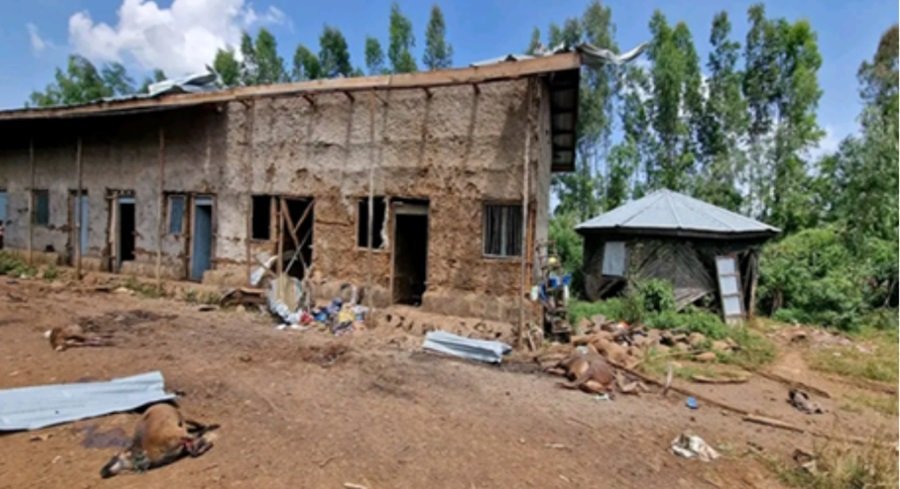
In the twenty-first century, Abiy’s regime broke the record of using hangers as a weapon against the people of Amhara. Abiy’s troops deliberately burnt crops, destroyed grain stocks, and slaughtered cattle in the Amhara region, which Mengistu Haile Mariam was accused of such acts.
The Abiy regime’s inhuman acts are legally and morally unacceptable by any measure. It implemented a hanger as a weapon specifically in Bugna Woreda in North Wollo of Amhara region.
Losses and gains
Fano both politically and militarily defeated Abiy’s regime in the Amhara region. Fano crumpled the tyranny and forced it to leave the rural areas. Technically, Fano is leading the Amhara region because people recognise it as their defender, while the regime is viewed as an enemy.
The Amhara people, who overwhelmingly supported Abiy when he came to power, regardless of his background, are now at war, proving the regime’s betraying and brutal nature. There is no chance for Abiy’s regime to have the root of administration back in the Amhara region.
Media and press freedom
In Ethiopia, journalism is considered a crime, and the regime is the top jailer of journalists in East Africa. Hundreds of ethnic Amhara journalists have been apprehended and fled the country and about 200 Journalists jailed since 2019. Abiy’s regime prohibited journalists from reporting on atrocities it perpetrated against civilians in the Amhara region.
Justice Denied
Ethiopian authorities disregard the rule of law and abuse power to violate human rights. Concentration camps are full of ethnic Amhara who are arbitrarily arrested and denied to appear in court hearings for years. Unfortunately, Western countries and the United States have turned a blind eye because Ethiopia is viewed as a vital ally, indicating a complete failure of human rights protection.
The United Nations Security Council was supposed to protect human rights but was paralysed in the case of ethnic Amhara. Such ignorance disclosed that the council is not upholding human rights and thus gives the green light for dictators such as Abiy to commit additional atrocities.
The way forwards
Abiy’s regime has lost trust and legitimacy and has no more chance of revising it. So, rather than attempting to maintain power through violence, Abiy’s regime should go now. If not, the fate of Abiy’s will not be different from previous dictators in Ethiopia or other parts of the world.
Editor’s note : Views in the article do not necessarily reflect the views of borkena.com
__
To Publish an Article On borkena , please send submission to info@borkena.com for consideration.Join our Telegram Channel : t.me/borkena
Like borkena on Facebook
Add your business to Borkena Business Listing/Business Directory Jobs
Join the conversation. Follow us on X (formerly Twitter ) @zborkena to get the latest Ethiopian news updates regularly. Ethiopia To share information or for submission, send e-mail to info@borkena.com