
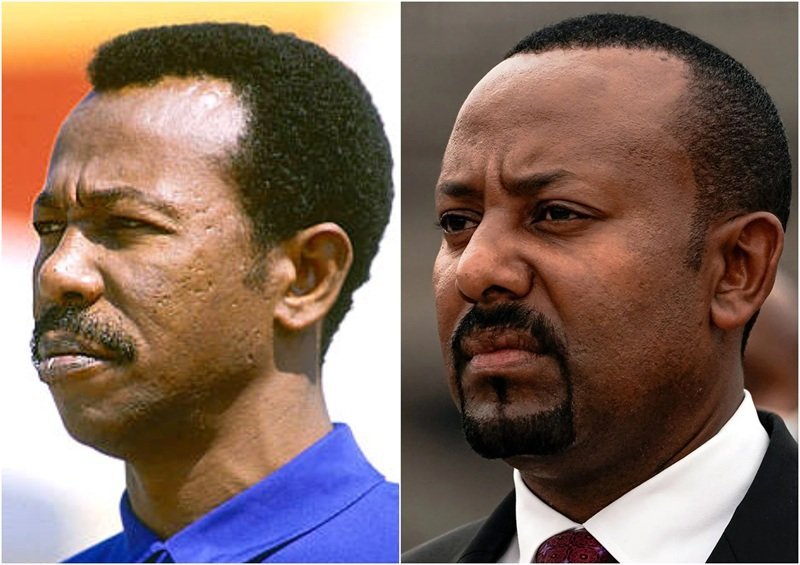
Mengistu Hailemariam wore red. Abiy Ahmed wore a suit. Ethiopia bled under both.
Ethiopia’s modern history is a story of power dressed up in competing ideologies, Marxism – Leninism, Revolutionary Democracy, then Capitalist Prosperity Tyranny, and a people who paid for these experiments with their lives. The leaders changed. The killing did not.
Mengistu Hailemariam ruled from 1977 to 1991 under a Soviet-backed communist junta called the Derg. Abiy Ahmed has ruled since 2018, backed by Gulf capital and Western applause. One invoked class struggle. The other invoked unity and peace, and a Nobel Committee even believed him. Yet between these two men, historians are now documenting one of the most sustained records of state violence in African history: mass executions, deliberate famine, ethnic cleansing, and wars that consumed entire generations. To understand Ethiopia today, you must hold both men in the same frame.
Mengistu and the Red Terror: killing as policy
Mengistu Hailemariam came to power through the Derg, a committee of low-ranking military officers who toppled Emperor Haile Selassie in 1974. By February 1977, he had shot his rivals within the junta during a closed meeting and declared himself chairman. He had not been elected. He had simply survived by killing first.
What followed was the Red Terror, an organized campaign of extermination targeting anyone deemed an enemy of the revolution: students, teachers, intellectuals, union organizers, and members of opposition groups, primarily the Ethiopian People’s Revolutionary Party. In Addis Ababa alone, thousands were dragged from their homes at night. Corpses were dumped on city streets as deliberate displays of power. Families who came to collect the dead were forced to pay a “bullet fee”, a charge for the ammunition used to kill their children, before the bodies were returned. The campaign ran from 1977 to 1978, and conservative estimates place the death toll at around 350,000 people, while several scholars and human rights investigators put the figure closer to 500,000. No full accounting has ever been completed.
Beyond the Terror, Mengistu’s economic ideology became its own instrument of death. In 1975, he nationalized all land, abolishing private ownership overnight. Agricultural output collapsed as peasants were absorbed into state-run collective farms with no incentive and no freedom. When the 1984 drought struck, the country had no functioning rural economy to absorb the shock. The famine that followed killed more than one million people, a number that has entered history. What receives less attention is that the Ethiopian government deliberately diverted international relief food away from Tigray and Wollo, regions where anti-government insurgencies were active. Aid was weaponized. Communities were left to starve as a counterinsurgency tactic.
That same period saw Mengistu launch forced villagization and resettlement programs, displacing approximately 600,000 people from northern Ethiopia to the south at gunpoint. The stated purpose was agricultural efficiency. The real purpose was to drain rebel territory of its civilian base. Survivors described soldiers loading entire villages onto trucks with hours of notice. Tens of thousands died in transit from disease, malnutrition, and violence, deaths that were never officially acknowledged. Meanwhile, Mengistu’s wars consumed up to 50 percent of the national budget every year. The Ogaden War against Somalia from 1977 to 1978 killed tens of thousands of soldiers on both sides. The war against Eritrea’s independence movement continued for his entire seventeen-year rule. When rebel forces finally closed in on Addis Ababa in May 1991, he boarded a plane to Zimbabwe and has lived there ever since. In 2006, an Ethiopian court convicted him of genocide in absentia and sentenced him to death. He has never been extradited.
Abiy Ahmed: a peace prize, then a war without mercy
Abiy Ahmed arrived in April 2018 as everything Mengistu was not. Young, charismatic, and brought to power not through a coup but through a mass popular uprising, particularly from Oromo youth fed up with decades of authoritarian rule. In his first months, he released tens of thousands of political prisoners, invited exiled opposition leaders’ home, and signed a peace agreement with Eritrea that ended a two-decade frozen conflict. In October 2019, the Nobel Committee awarded him the Peace Prize. The world applauded.
The world had not been watching closely enough.
In November 2020, Abiy ordered a full military offensive into the Tigray region following a dispute with the Tigray People’s Liberation Front. What followed was not a law enforcement operation. It was a war of collective punishment conducted against an entire civilian population of roughly seven million people. Eritrean troops, soldiers from the very country Abiy had just made peace with, crossed the border and fought alongside Ethiopian federal forces. Together they carried out massacres in Axum, where hundreds of civilians were killed over a single weekend in November 2020. In Mahbere Dego, over 200 villagers were executed. Dozens of similar atrocities were documented across the region by Amnesty International, Human Rights Watch, and United Nations investigators.
Sexual violence was not incidental; it was systematic and deliberate. The United Nations estimated that more than 120,000 women and girls were subjected to rape and sexual violence during the conflict, with survivors reporting that soldiers explicitly told them the goal was to destroy Tigrayan identity and make the land uninhabitable. At the peak of the war, approximately 2.7 million people had been displaced from their homes across Tigray. By mid-2021, the UN warned that over 500,000 people in the region were facing famine-level conditions, with humanitarian organizations reporting that food convoys were being systematically blocked and aid supplies looted by soldiers. Abiy’s government also cut phone, internet, and banking access to Tigray for extended periods, not to protect civilians, but to prevent the outside world from documenting what was being done to them.
A ceasefire was signed in November 2022, after roughly two years of fighting. Estimates of the death toll range up to 600,000 people, figures that place the Tigray conflict among the deadliest wars anywhere in the world in the 21st century, surpassing many conflicts that received far greater international attention. No senior official has been charged. Abiy did not acknowledge civilian deaths. He declared victory.
Human rights scholars, legal experts, and Tigrayan survivor groups have formally described the campaign as genocide, a systematic attempt to destroy the Tigrayan people through mass killing, starvation, sexual violence, and forced displacement. The UN Commission of Human Rights Experts concluded that crimes against humanity and war crimes were committed. The word genocide remains politically contested by Abiy’s government, but the documented pattern of intent and scale meets the threshold that international law defines.
The pattern then repeated in the Amhara region. In 2023, Abiy turned to federal military force, including drone strikes, against Amhara communities and the Fano youth militias. Towns were blockaded. Civilian areas were bombed. The same men who had been allies became enemies overnight, confirming what observers had long suspected: these wars were never about ideology, security, or unity. They were about removing any power that could challenge the man at the top.
What is unfolding in Amhara today bears the same hallmarks. Mass arrests, extrajudicial killings, drone strikes on civilian areas, and the deliberate targeting of an ethnic population have led human rights organizations to warn that a second genocide is in progress. For a leader who arrived promising to end ethnic violence, Abiy Ahmed has presided over more ethnically targeted mass death than any other Ethiopian leader.
Two ideologies, one outcome
Mengistu told Ethiopians that capitalism was the enemy of the people. Abiy told Ethiopians that ethnic division was the enemy of unity. Both were building narratives to justify the same thing, unchallenged personal rule backed by lethal force. Mengistu’s collectivization did not feed people; it starved them. Abiy’s economic liberalization, megaprojects, and foreign investment deals enriched a connected elite while the communities being bombed had no electricity, no phone lines, and nothing to eat. Both men also shared a profound relationship with impunity. Mengistu fled. Abiy governs. Neither has stood in a court that truly mattered.
Ethiopia’s people did not fail their leaders. Their leaders failed them, repeatedly, deliberately, and at a scale measured in hundreds of thousands of lives. The ideological labels were always costumes. Beneath them was the same machinery: a man at the top, a military at his command, and a population being told that their suffering was necessary for a greater good that never arrived. History will judge both men by the numbers. The numbers are not forgiving.
SOURCES
- Amnesty International — Ethiopia: Massacre of civilians in Axum, Tigray (February 2021)
- Human Rights Watch — They Are Making Us Into Slaves, Not Educating Us & multiple Tigray War reports (2020–2022)
- United Nations Human Rights Council — Report of the International Commission of Human Rights Experts on Ethiopia (September 2022)
- United Nations OCHA — Tigray humanitarian situation reports (2021–2022)
- Physicians for Human Rights — Weaponizing Healthcare in Ethiopia’s Tigray Region (2021)
- Kjetil Tronvoll & Tobias Hagmann — The Ethiopian Crisis: State, Nation and Society, Journal of Eastern African Studies
- Edmond J. Keller — Revolutionary Ethiopia: From Empire to People’s Republic, Indiana University Press (1988)
- Alex de Waal — Evil Days: 30 Years of War and Famine in Ethiopia, Human Rights Watch (1991)
- Ethiopian Special Prosecutor’s Office — Genocide and crimes against humanity verdict against Mengistu Hailemariam (2006)
- Nobel Committee Citation — Abiy Ahmed Ali, Nobel Peace Prize (October 2019)
- BBC News, Reuters, and The Guardian — field reporting on Tigray and Amhara conflicts (2020–2024)
- USAID & World Food Programme — Ethiopia famine and food security historical records (1984–1985)
Abel Tewodros can be reached at: abeltewodrosarticles@gmail.com
Editor’s Note : Views in the article do not necessarily reflect the views of borkena.com
__
Support Borkena : https://borkena.com/subscribe-borkena/
Join our Telegram Channel : t.me/borkena
Like borkena on Facebook
Add your business to Ethiopian Business Listing / Ethiopian Business Directory Business Listing Toronto
Join the conversation. Follow us on X (Formerly Twitter) @zborkena to get the latest Ethiopian News updates regularly. Subscribe to YouTube channel To share information or for submission, send e-mail to info@borkena.com