
By Abel Tewodros
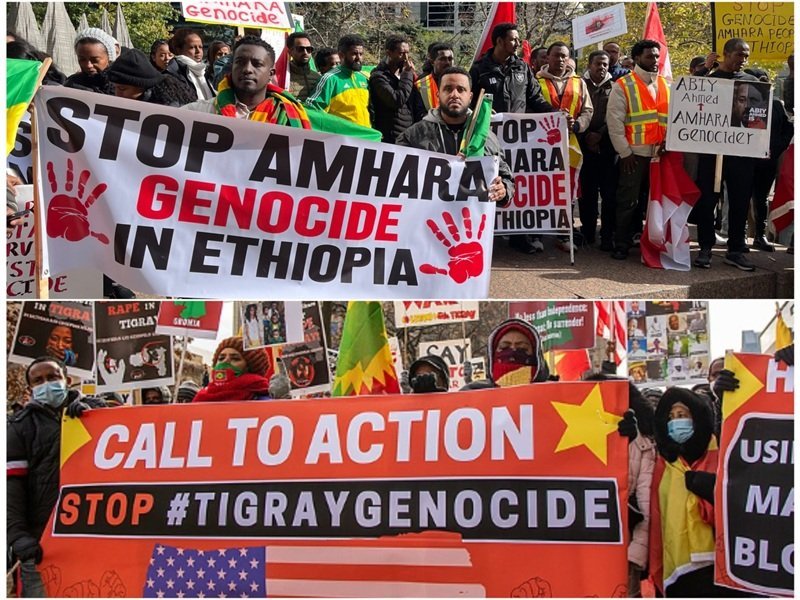
For the past five years, Prime Minister Abiy Ahmed’s administration has faced growing resistance, not only within Ethiopia’s borders but from diaspora communities scattered across the globe. Among the most vocal are the Tigrayan and Amhara diasporas. Both have organized mass protests, launched digital campaigns, and pushed to shape international policy. Yet despite facing comparable humanitarian disasters, the impact of these two movements on the world stage has been far from equal.
The Tigrayan diaspora managed to drive global narratives, capture sustained media coverage, and influence key decision-makers through a level of coordination and professionalism rarely witnessed in Ethiopian political history. The Amhara diaspora, though rapidly mobilizing and deeply motivated, has not yet reached that same threshold of strategic effectiveness.
This piece examines why that gap exists and what the Amhara diaspora must do differently to amplify its voice on the international stage.
The Tigrayan Diaspora: A Blueprint for Effective Activism
When conflict broke out in Tigray in November 2020, the Tigrayan diaspora responded with one of the most disciplined political campaigns Ethiopia’s diaspora politics had ever produced. Their success was built on four critical foundations:
1. Unified Messaging: One Narrative, One Voice
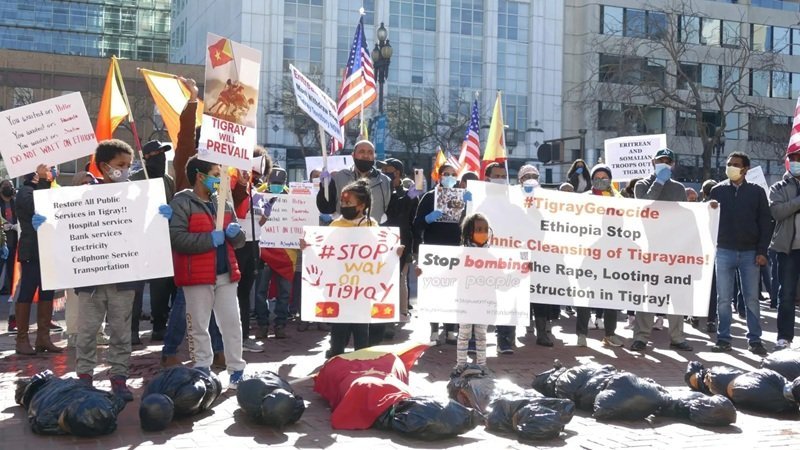
From the very beginning, activists aligned behind a single, powerful demand:
“Stop the Genocide in Tigray.”
This message was:
- Uncomplicated — any outsider could grasp it instantly,
- Morally forceful — it demanded an immediate ethical response,
- Accessible — it required no knowledge of Ethiopian political history to understand.
By framing a deeply layered conflict as a clear humanitarian emergency, the Tigrayan diaspora captured the global conversation early and held it firmly.
2. A Media and Digital Strategy Built for Global Reach
Tigrayan activists excelled at Western-style digital campaigning:
- Sustained, high-impact hashtags such as #TigrayGenocide and #StandWithTigray,
- Professionally produced survivor testimonies, coordinated content releases, and compelling visuals,
- Established relationships with journalists, international NGOs, and influential advocates,
- A synchronized network of YouTube channels and media platforms delivering consistent messaging.
This disciplined communication infrastructure kept Tigray visible in the global spotlight for an extended period far beyond a single news cycle.
3. Formal Lobbying and Direct Political Engagement
Rather than relying solely on street protests, the Tigrayan diaspora constructed professional advocacy institutions that:
- Produced detailed policy documentation submitted to governments and international bodies,
- Organized direct meetings between community members and elected representatives,
- Developed unified talking points shared across the entire network of supporters.
These efforts generated concrete political outcomes, including:
- The U.S. Ethiopia Stabilization, Peace, and Democracy Act,
- The EU’s decision to suspend direct budgetary assistance to Ethiopia.
This level of institutional engagement granted the Tigrayan movement direct access to the centers of international decision-making.
4. Centralized Leadership and Coordinated Action
Despite disagreements within the community, the Tigrayan diaspora functioned largely as a cohesive bloc. Its coordination with TPLF-linked structures, regardless of varying political positions, provided:
- Clear strategic direction,
- Consistent and disciplined public messaging,
- A recognized political entity that foreign governments could formally engage.
That organizational coherence gave the movement a decisive competitive edge.
The Amhara Diaspora: Conviction Without Coordination
The Amhara diaspora rose to action primarily in response to:
- Ethnically targeted killings and mass displacement carried out under the federal government,
- Attacks on Amhara civilians by the Oromo Liberation Army (OLA) across parts of Oromia,
- The federal government’s forcible disarmament of Amhara Special Forces and FANO, which escalated into full-scale armed conflict and drove Fano into organized resistance.
The movement is expanding rapidly but it continues to face serious structural obstacles.
1. A Story That Is Difficult to Compress
Although Amharas are enduring severe atrocities, explaining that reality to an international audience is far more challenging. The Amhara crisis encompasses:
- Ethnically motivated killings,
- Federal military repression,
- OLA armed attacks,
- Political marginalization,
- Deep constitutional disputes over territory and governance.
Unlike the immediacy of “stop the genocide,” this multidimensional reality demands significant background knowledge that most foreign audiences simply do not possess.
2. The Fano Problem: Resistance Without Representation
The Amhara armed resistance is led by Fano, a grassroots, decentralized movement built from communities defending themselves.
But Fano:
- Until recently, it had no internationally recognized political structure,
- Operates with no unified public spokesperson,
- Functions without the formal organization needed for foreign engagement.
With no equivalent to the TPLF’s political infrastructure, the Amhara diaspora has no clear institutional vehicle through which to lobby, a structural disadvantage that significantly limits its international reach.
3. Always Responding, Never Leading
Amhara diaspora activism has largely followed a reactive pattern, mobilizing after tragedies strike rather than shaping the conversation before they do.
This approach:
- Allows others to define the narrative first,
- Creates an impression of fragmentation rather than sustained purpose,
- Prevents the development of long-term, consistent policy demands.
Where the Tigrayan diaspora proactively drove the international agenda, the Amhara movement has frequently found itself responding to a story others have already told.
4. Division and the Absence of Institutional Infrastructure
The Amhara diaspora is politically diverse, divided by:
- Competing visions for Ethiopia’s future,
- Ideological differences between groups and personalities,
- Debates over history, identity, and governance,
- A proliferation of organizations that often work in parallel rather than in partnership.
These divisions:
- Dilute the movement’s collective message,
- Confuse international audiences seeking a clear interlocutor,
- Prevent the concentration of resources into effective institutions.
Without dedicated think tanks, professional lobbying bodies, and shared advocacy platforms, the movement remains fueled by emotion but limited by structure.
Conclusion: The Work Ahead
The Tigrayan diaspora’s effectiveness does not diminish Amhara suffering, nor does it weaken the legitimacy of Amhara demands for justice. What it does is illustrate what becomes possible when a community pairs its pain with:
- A clear, unified narrative,
- Professional institutional infrastructure,
- Coordinated strategic communication,
- Proactive rather than reactive engagement.
For the Amhara diaspora to assert its full weight on the global stage, these are not optional enhancements. They are necessities.
In the arena of international advocacy, grief alone does not move governments. Organization does.
Abel Tewodros can be reached at: abeltewodrosarticles@gmail.com
Editor’s Note : Views in the article do not necessarily reflect the views of borkena.com
__
Support Borkena : https://borkena.com/subscribe-borkena/
Join our Telegram Channel : t.me/borkena
Like borkena on Facebook
Add your business to Ethiopian Business Listing / Ethiopian Business Directory Business Listing Toronto
Join the conversation. Follow us on X (Formerly Twitter) @zborkena to get the latest Ethiopian News updates regularly. Subscribe to YouTube channel To share information or for submission, send e-mail to info@borkena.com
We Ethiopians are in growth crowd not in war crowd.there is no ambition to kill any person even if we are stronger.this strength is to defend ourselves not to attack anyone.Ethiopia will not shoot the first bullet,but Ethiopia will never allow others to shoot the second one!!!