
Sweeping municipal demolition directives target historic commercial hubs and residential neighborhoods across central Addis Ababa to make way for private real estate development
By Staff Writer
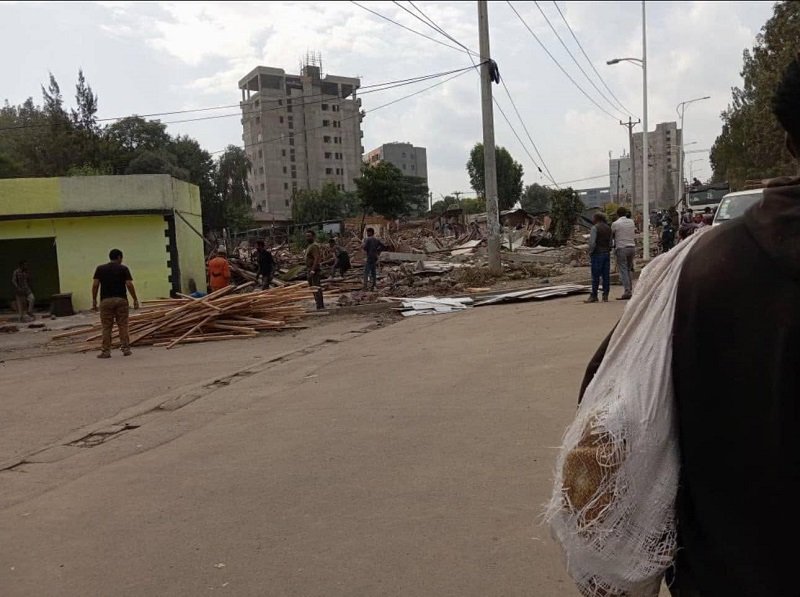
(Nairobi, Kenya) — Across central Addis Ababa, shopkeepers are closing up storefronts and families are packing belongings as city directives clear out some of the capital’s most historic neighborhoods for commercial redevelopment.
Residents across several central districts report receiving verbal notices to vacate their properties following land allocations to private developer Temer Real Estate. Under the verbal instructions issued by municipal representatives, families with independent financial means are expected to secure their own alternative housing immediately. Low-income tenants have been promised temporary shelter arrangements for up to one year, along with verbal assurances that new multi-story residential buildings will eventually be constructed on the cleared land to house displaced residents.
The clearing operations span an extensive area across administrative Kebeles 32, 33, 34, 42, 45, and 47. Heavy machinery has already leveled Kebeles 31 and 44, while demolition crews prepare to move into major commercial markets including Berbere Tera, Gojjam Berenda, American Gibi, Teklehaimanot, and Somali Tera.
The affected perimeter extends deep into residential pockets and commercial lanes across Gola Sefer, Shanta Sefer, Harar Pension, Tikur Anbessa, Amsistagna, Pension Sefer, Police Sefer, and nearby theater venues. Traders in Berbere Tera and Somali Tera—hubs that have anchored wholesale spice, grain, and dry-goods trade across the region for generations—say the sudden clearing directives threaten to dismantle long-standing commercial supply networks overnight.
The current clearing push marks the latest phase of the Addis Ababa City Administration’s broader “urban renewal and corridor development” program – a program that triggered displacement of hundreds of thousands of residents. City officials maintain that large-scale clearing is necessary to overhaul aging infrastructure, expand major roadways, and attract private real estate investment. However, urban planners and community leaders warn that rapid municipal re-zoning continues to fracture closely-knit economic ecosystems and displace vulnerable urban populations. There had been claims from the opposition quarters that the program is politically motivated.
The clearance of historic quarters such as Gojjam Berenda, American Gibi, and Teklehaimanot has also sparked alarm among cultural preservationists. Many of the designated buildings were constructed in the early to mid-twentieth century and represent key architectural chapters in the capital’s growth. Facing immediate displacement, local traders and residents are urging municipal authorities to replace verbal promises with legally binding written commitments regarding compensation terms, temporary housing quality, and guaranteed rights of return once construction concludes.
__
Join our Telegram Channel: t.me/borkena
Like borkena on Facebook
Join the conversation. Follow us on X (formerly Twitter) @zborkena to get the latest Ethiopian news updates regularly. Subscribe to the YouTube channel. To share information or for submission, email info@borkena.com
Another news I read about this city is close to 50% of the vehicles clogging its streets have failed the emission test. That left me sighing with like you young people say these days ‘duh!!!’ I bet you the other 50% passed the test after the usual buttering of the inspectors’ palms. The air pollution in that city has been cited now to be one of the worst in the world. It is discovered that with the lack of proper sanitary facilities like public/residential restrooms and septic systems, millions are defecating in the open air which sent fecal particles into the air residents breathe just as other notoriously known for such foul air like Mexico City, New Delhi and Mumbai. Such fecal particles floating in the air is widespread throughout that country. I remember what one of my merchant relatives who lives in the capital told me about this city and that small former railway station where I spent my formative years. He was there to say hello to relatives on his way back from his business trip to Dire Dawa. When I left that small railway station the population could not be more than 250 inhabitants. But now it has a population of close to 35,000. I asked him about those huts with thatched roofs and occasional tin roofed and told me all those are gone and replaced with wood and mortar.
But there is no such thing as sanitary facilities. What he told me and the way he put it was kinda comical. He told me he saw men residents of that town had this planned group gathering every late afternoon and go the outskirt of the town just to defecate. He found the stench unbearable. So, he told me, you have to watch your move otherwise you may end up stepping on hard to see human feces. He told me this goes as well in the slums of the capital city itself. That reminded me what one of our countrymen here in the Diaspora once told me years ago. He and his wife decided to visit his old country and traveled there during one the holidays. His wife was an recent immigrant from Europe and she was very excited to visit the country she heard so much of it before. So on one occasion they were walking together on a bridge and while she was looking down from the bridge she saw a man by the edge of the river suddenly dropping his pants and defecating. She got nauseated suddenly and they had to rush back to their hotel. They had to cut their vacation plan short and head back to USA. I talked to them after they returned and she told me what she saw. I told her she could have seen the same if she was in countries like India.
It has been the same all along as long as the slums are there. This is the reality in every city, town and village there. This is what you get when people are multiplying like vermins. Remember The Almighty Our Creator told we humans to populate the Good Earth but He Never told us to Overpopulate it. Remember that!!!
.