
By Naod Hailu
Updated on September 27, 2025 at 8: 39 A.M. Toronto time, with request from the author.
Introduction
In their 2023 book Spin Dictators: The Changing Face of Tyranny in the 21st Century, Sergei Guriev and Daniel Treisman unveil how the nature of authoritarian rule is shifting from fear-based dictators to “spin dictator,” which is a more sophisticated way of consolidating power behind the scenes. They argue that spin dictators such as Lee Kuan Yew, Viktor Orbán, and Hugo Chávez adapt subtler, strategic, and manipulative approaches to maintain power, which significantly differ from the old school dictators such as Hitler, Stalin, Mengistu Hailemariam and others, who relied on terror to hold power. Although spin dictators undermine democratic values and aim to extend their tenure in office like the old dictators, their methods are softer and less overtly violent.
Despite this change in the nature of authoritarian rule, Abiy’s technique for prolonging his hold on power resembles the old model. He has employed evil acts to preserve his grip on power, which poses a severe existential threat to the country’s survival. Psychologists who reviewed the biographies of old fear dictators such as Hitler found traits like narcissistic sadism, paranoia, and schizophrenic tendencies. However, Guriev and Treisman argue that violence is not merely an expression of pathological traits; rather, it is deliberately built into the very structure of rule. The same is true of Abiy’s strategy. Abiy cannot survive without creating conditions of upheaval, violence and beating the war drum. It is his only viable means to stay in power (መተዳደሪያዉ ነዉ).
Given that he cannot evade accountability for the crimes he has committed since his seizure of power, it is likely that he will escalate state violence in order to remain in office. As long as he retains power, systematic torture, grave human rights violations, and armed conflict in the Amhara and Oromia regions will persist. Furthermore, renewed hostilities between the Prosperity Party and the Tigray People’s Liberation Front (TPLF) appear imminent. The regime has also signaled preparations for military aggression against Eritrea by incorporating extraterritorial claims into the short range objectives of Ethiopian foreign policy. In addition, a potential genocidal war between Oromo and Amhara people will likely erupt when he begins to portray himself as the bulwark of the Oromo interest in order to maintain his grip on power.
To thwart these, I contend that undergoing nonviolent campaigns primarily spearheaded by the three ethnonational groups-Oromo, Amhara and Tigray is the most viable option to dismantle the warmongering regime and establish a democratic foundation. This raises two questions: Why should this be mainly led by those three ethnic groups? And what makes nonviolent a sound approach? I will begin with the last question and then address the other two.
Nonviolence
Nonviolent resistance is more effective than violent struggle both for dismantling autocratic regimes and for laying foundations for democratization in the post-transition period. After analyzing over 300 major campaigns from 1900 to 2006, Erica Chenoweth and Maria Stephan, who are the two prominent scholars in the field of nonviolent movement, concluded that nonviolent campaigns succeed 53 percent a time compared with a 26 percent success rate for violent struggles. Moreover, nonviolent campaigns have had a substantial positive impact on democratization within five years after the conflict ends. This does not mean nonviolence always works. There are hundreds of methods, and using them inappropriately can cause failure or cause a movement’s momentum to collapse. Regarding duration, the scholars also found that armed struggle takes on average eight years to achieve its stated goals, while nonviolent campaigns take about two years on average.
Most importantly, choosing nonviolence exploits a regime’s weakness. Authoritarian rulers are inept at countering mass nonviolent campaigns. That is why Abiy feared when YeAbrhot Ethiopia and the Virginia Coalition began deliberating about organizing a mainly nonviolent movement to dismantle his regime. Abiy does not want the battlefield to shift from armed struggle to nonviolent resistance, because as Gene Sharp, who was one of pioneering scholars of nonviolent campaign, posited that authoritarian regimes are not adept at the latter.
Alliance between Ye-abronet Ethiopia and the Virginia Coalition
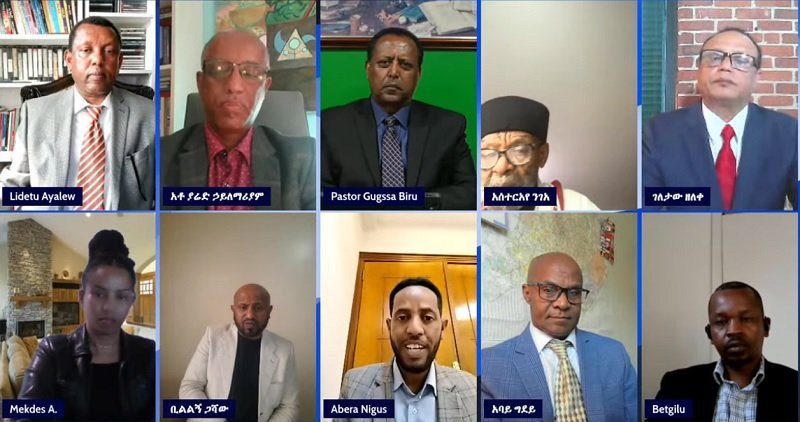
The initiative taken by Ye-Abronet Ethiopia to dismantle the regime, halt the bloody war, and lay the groundwork for lasting peace through nonviolent struggle is commendable. The virtual protest it organized on June 7, 2025, which reportedly attracted over eight hundred thousand participants, was a remarkable achievement. However, I argue that the role of Ye-Abronet Ethiopia should be to create a platform through which the nonviolent movement is primarily spearheaded by the three major ethnonational groups-Oromo, Amhara, and Tigray within the Ethiopian framework.
Two predominant reasons explain why the responsibility should rest primarily with these ethnic groups. First, they are at the center of most of the problems that have engulfed the country; thus, the solution largely depends on their willingness to forgo their hegemonic aspiration. Second, these groups together constitute the majority of the population. Moreover, a strong social base is essential for the success of nonviolent movement, and these groups possess while Ethiopianist forces currently lack such social grounding.
One might argue that as long as megalothymia (the desire for hegemonic recognition and dominance) shapes these groups’ agendas, the effort to form strategic alliances among them is pretty futile. This is a valid concern. Deep-rooted mistrust, mutual conspiratorial thinking, tendencies to blame others, and fear-driven narratives are major obstacles to unity. Historical precedent, however, shows that rival groups can form alliances for common causes. The recent “OroMara” movement (a tactical fusion of Oromo and Amhara actors) is an example, though it was ultimately hijacked by Abiy’s drive for perpetual power. The 1989 Czechoslovak revolution is another example where two historical rivals formed a strategic alliance to topple the communist regime.
Then the question arises: how can the three ethnonational groups organize themselves and lead the campaign? It is indeed a difficult question, but the Virginia Coalition can make a difference. However, members of its leadership committee should initially be drawn from the three ethnonational groups, and most importantly, they must be willing to suppress their hegemonic ambitions. If that is the case, the coalition, in collaboration with Ye-Abronet Ethiopia, can make history by breaking the cycle of violence and laying the groundwork for democratization.
Once the coalition begins conducting a meaningful nonviolent movement, other ethnic groups and social actors will likely be drawn into it over time. Most importantly, as the coalition progresses, armed insurgents such as Fano and OLA could make a strategic shift and join the coalition by declaring a unilateral ceasefire. This is difficult to achieve in a manner that the armed groups must see tangible progress on the ground and be convinced of the coalition’s commitment and determination. If the insurgents join the coalition, the process of dismantling Abiy’s regime would accelerate because these insurgents command strong social bases and can mobilize large numbers to participate in the movement.
Nepal’s 2006 nonviolent movement provides a precedent where an armed insurgency made a historic decision to join a mass nonviolent campaign. The Communist Party of Nepal (Maoist), which had launched an insurgency in 1996 against King Gyanendra and enjoyed a strong rural base, made a strategic shift to join the April 2006 uprising led by an alliance of seven political parties. This helped limit the monarchy’s power in 2006 and led to the formal abolition of the monarchy in 2008. This case illustrates how a well-orchestrated nonviolent movement can terminate armed struggle and is a direct rejoinder to Abiy’s attempt to downplay and insult the Ye-abronet Ethiopia’s role in organizing the virtual protest that brought leaders of armed struggles and other actors together. Maoists and the SPA were enemies, yet they later formed a strategic alliance to fight the monarch. Thus, it is misguided to dismiss initiatives that unite actors with opposing views as inherently irreconcilable.
Therefore, those groups engaged in armed struggle should consider future collaboration with the leaders of nonviolent movements and the option of terminating their armed campaigns. One obstacle is the lack of strong centralized leadership within armed groups. Compared with Fano, OLA is relatively more stable. Fano currently consists of factions that struggle to build a unified Amhara Fano. Establishing centralized leadership for an armed group is a painful process. Despite lack of central leadership and facing Abiy’s loyal forces (which have reportedly received foreign support, notably from the UAE), Fano managed to control an estimated 80 percent of the Amhara region, which is an astonishing achievement within two years. In spite of this gain, they are struggling to foil Abiy’s divide-and-rule strategy. Cognizant of this shortcoming, the faction leaders should be resolutely committed to establishing a strong, centralized leadership to enable future collaboration with other actors, especially the leaders of nonviolent movements.
Conclusion
The argument that a nonviolent movement should be primarily spearheaded by the three ethnonational groups does not betray a civic-based identity. These groups currently possess stronger social power than Ethiopianist forces. Therefore, this approach should be seen as a rescue operation to preclude state disintegration and to lay the foundation for democratization after Abiy. In this context, a strategic alliance between the Virginia Coalition and Ye-Abronet Ethiopia (its role is creating a platform) is crucial to terminate armed struggle and dislodge Abiy’s regime.
Editor’s Note : Views in the article do not necessarily reflect the views of borkena.com
__
Support Borkena : https://borkena.com/subscribe-borkena/
Join our Telegram Channel : t.me/borkena
Like borkena on Facebook
To submit Press Release, send submission to info@borkena.com
Add your business to Ethiopian Business Listing / Ethiopian Business Directory
Join the conversation. Follow us on X (Formerly Twitter) @zborkena to get the latest Ethiopian News updates regularly.