
Can We Put New Wine in an Old Wineskin?
By Eyassu Ephraim G. Hanna
London, UK
Here we go again. Does history repeat itself? Only time will tell. For now, let us observe how events unfold in Ethiopian politics. As before, seven-armed groups have united under TPLF leadership—though, for the sake of political correctness, nominal leadership has been conferred upon the Amhara Fano National Movement (AFNM). Together they have established the Ethiopian People’s Forces Alliance for Survival (hereafter “the Alliance for Survival”) with the stated aim of removing Abiy’s government by military force. The formula is hardly novel. It was employed to overthrow the Derg regime nearly forty years ago, when the TPLF allied with the EPLF and formed a united front with former EPRP members, the OLF and other so-called political organisations, thereby establishing the EPRDF. The TPLF then governed—and plundered—the country for twenty-seven years.
In truth, the TPLF’s gravest sin has been its betrayal of the nation. Its core political philosophy rests upon ethnic politics and so-called self-determination. On this basis, the TPLF established an ethnic- and language-based federal system, thereby sowing the seeds of distraction, perpetual ethnic conflict and social disintegration. It used the Amhara people as a scapegoat for every political failing in Ethiopia. According to the TPLF’s political lexicon, Ethiopia was forged by the Amhara—particularly under Emperor Menelik—a century ago; Ethiopia (Abyssinia), led by Amhara kings, comprised disparate states in the manner of the British, French and other European empires. The Amhara, so the narrative ran, had subjugated all nations and nationalities, denying them political, economic and cultural rights; the Amhara were therefore the enemy of Ethiopia and its people. Consequently, the TPLF pursued a policy of dismantling everything built by previous governments. They altered the national flag; they created new administrative regions based on language; they banned history teaching at university level; they formed a pseudo-Amhara political group known as the NADM to subjugate the Amhara people; they openly declared that they had destroyed the Orthodox Church—the pillar of Amhara society; and they systematically permitted ethnic cleansing across Oromia and elsewhere to displace Amhara communities. All of this is well documented, and even the TPLF cannot deny it.
After protracted suffering, Amhara and Oromo political elites came together and removed the TPLF from power. This Amhara–Oromo alignment became known as Oro-Amhara. Yet once the Oromo assumed power, they too betrayed the nation—particularly the Amhara people. They declared, “It is our turn, and we may do as we please,” and they have done so ever since. Soon after taking office, they began killing Amhara politicians, including Dr Ambachew and Brigadier General Asaminew Tsige and his associates. Indeed, the assassination of Engineer Simegnew Bekele, chief engineer of the Renaissance Dam, sent shockwaves across the nation. General Asaminew Tsige and his associates were killed on Abiy’s orders. As Abiy consolidated power, he expelled Amhara politicians from his circle— among them his former ally in the Oro-Amhara coalition, Dr Gedu Andargachew, a former regional president, minister and adviser, who was exiled, while others were imprisoned.
Meanwhile, the TPLF continued its opposition to Abiy’s government. Soon after losing power, it established a group called “Confederate,” the logic being to construct a new political arrangement based on confederation—a loose alliance of sovereign states or independent groups joining for shared purposes such as defence, trade or foreign policy, while retaining their own supreme authority. To this end, the TPLF mobilised disgruntled political actors across ethnic groups. But the new political order led by Abiy rejected this ideology, and it was swiftly quashed.
The TPLF then returned to the drawing board and devised a new strategy to regain power or topple Abiy. Thus, was born the 2020 Tigray War—a devastating armed conflict that lasted from November 2020 to November 2022 in northern Ethiopia. The TPLF miscalculated the mood of the Ethiopian people, particularly the Amhara. Indeed, one of the TPLF’s political gurus, Getachew Asefa, stated that they had scores to settle with the Amhara people. The war, therefore, was not only against Abiy but against the Amhara people as well. Nor did the TPLF’s miscalculation end there. They fired a few missiles towards Asmara; in doing so, they awakened the monster. Isaias and the Amhara people allied with Abiy, and together they crushed the TPLF. Thanks, however, to America and Alex de Waal’s appeal to the international community, the TPLF was saved from total annihilation—unlike the Liberation Tigers of Tamil Eelam (LTTE) or Nigerian Biafra. The TPLF and the Ethiopian government signed the Ethiopia–Tigray Peace Agreement, known as the Pretoria Agreement, a 2022 treaty that halted large-scale fighting in northern Ethiopia.
Despite the Pretoria Agreement, full peace has not been established between the TPLF and the Prosperity Party. Low-intensity conflict has persisted. Moreover, the Pretoria Agreement has generated a new political problem: Asmara and Addis Ababa have become enemies once again, and the attempt to dismantle the Amhara regional forces provoked a wave of resistance, with most regional forces joining the existing Fano movement. The TPLF now finds itself sandwiched between Amhara Fano forces, Isaias Afwerki and Abiy Ahmed’s regime.
Once again, the core TPLF leadership returned to the drawing board and drafted a new blueprint for survival. The first move was submitted to their godfather, Isaias Afwerki. This action was unthinkable, given that only a few years earlier they had accused Isaias Afwerki’s army before the international community—including the UN, US and EU—of being a genocidal force responsible for mass rape, war crimes and crimes against humanity. Yet TPLF leaders, in their desperation, crossed the Mereb River to kiss Isaias’s feet.
In Addis Ababa, Abiy’s political miscalculations continued. He tells the nation that Ethiopia will soon claim the Red Sea coast by all means necessary. He says he is on a mission to correct historical mistakes and injustices. His generals, politicians, ambassadors and
supporters blew Abiy’s Red Sea trumpet until the dead in the Addis Ababa Trinity Church graveyard awoke. Abiy was emboldened by the Arab emirates and sultanates. But his unwise statement—more rhetoric than actionable policy—created a hostile posture in Asmara towards Addis Ababa. As a godfather and master planner, Isaias created a new group known as Tsimdo. Tsimdo underwent a natural metamorphosis and finally developed wings, claws, teeth and horns. Now it is ready for action under a new name: the Alliance for Survival, or AFS.
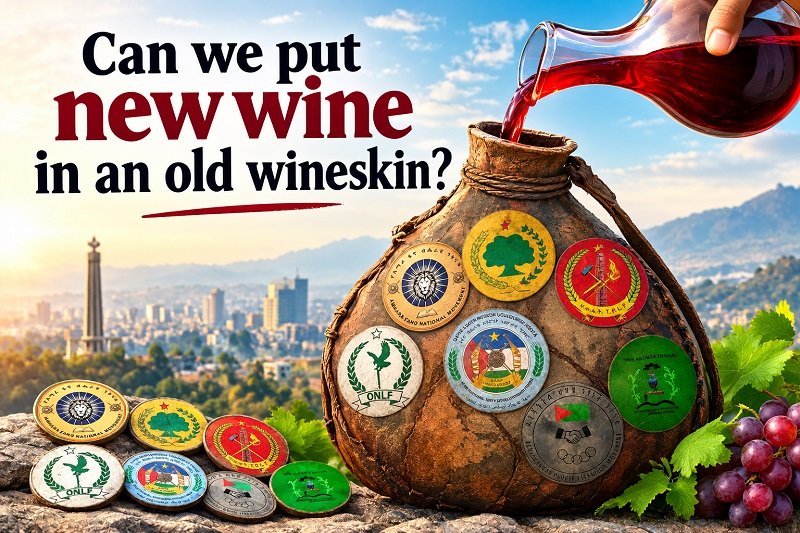
The question now is: will the TPLF be “third time lucky”? According to the AFS announcement by Zemen Kassa, leader of the AFNM, the alliance comprises seven-armed groups: the AFNM, TPLF, OLF (OLA), Ogaden National Liberation Front (ONLF), the Afar Revolutionary Democratic Unity Front (ARDUF, or Ugugumo), the Benishangul Peoples’ Liberation Movement (BPLF), and the Gumuz Peoples’ Democratic Movement (GPDM).
As noted earlier, the TPLF, OLF (OLA) and ONLF stood shoulder to shoulder against Ethiopia—and, by extension, against the Amhara. These political groups were founded upon an ideology antagonistic towards Ethiopia and the Amhara people. Each has Amhara blood on its hands. They are all liberation fronts—liberation from what? From Ethiopia. Thus far, they have not concealed their intentions, political objectives or goals. In a recent statement, the TPLF’s second-in-command indicated that the TPLF will adopt two routes to secure self determination: the Yugoslavian or Czechoslovakian way. The OLF (OLA) has long aspired to establish an Oromia state; its grievance with Abiy amounts to nothing more than a struggle for political power. The ONLF is a Somali nationalist armed and political organisation seeking self-determination for the Somali-inhabited Ogaden.
I keep three political groups outside this analytical framework for the time being—namely ARDUF (or Ugugumo), BPLF and GPDM—in reserve. They may play a significant role, but they do not alter the outcome of this analysis.
Herein lies the political dichotomy and paradox. The Amhara Fano was established to safeguard the Amhara people from the historical assault launched by ethnic politics. The TPLF is the architect of that politics: it conceptualised, developed, implemented and executed it with the help of other liberation fronts—now identified as new partners of the Amhara Fano. The Amhara people have been marginalised, executed, excluded and made to shed blood because of TPLF politics, yet Fano leaders have joined the TPLF and this new alignment to save the Amhara from that very politics. Some may associate this paradox with Stockholm syndrome. It deserves, perhaps, a new political term altogether.
The announcement was welcomed by many, who argue that the new political force will end Abiy’s regime. I understand their point. Here, I and others have no disagreement with the need to remove Abiy and his political enterprise from power. We agree that the country needs peace and a democratic, accountable government. But the question is, as a wise man once said: can we solve the problem with the same mind and framework that created it? Or can we put new wine into old wineskins?
One troubling feature of the current debate is the pressure to treat any criticism of the alliance as proof of support for Abiy’s government. That is an old political tactic: reduce a complex argument to a binary choice and demand loyalty instead of scrutiny. Ethiopians need not choose between Abiyism and the TPLF, or between one-armed camp and another. The country is larger than its political factions, and citizens are entitled to question every movement that seeks power in their name.
As it is your country, Ethiopia is my country too. It is our home. We have no other. Our voices, therefore, are equally valued. The TPLF’s persistent effort may pay off. We cannot know whether the TPLF will succeed for a third time. If it does, at what cost? I have observed a political shift from questioning and criticism to full-throated support; a classic example is the shift of the veteran politician Ephraim Madebo. By his own account, he is thrilled by the new AFS statement. He asks for nothing more.
But history has taught us otherwise. A leopard never changes its spots—nor does the TPLF. Ethnic politics has cost us dearly and brought the country to the brink of disintegration. There are internal and external players who wish to see Ethiopia disintegrate. From Washington to Mekelle, from Dublin to Mekelle, from Oslo to Addis Ababa, from Cairo to Ethiopia, international networks are working in concert while the Ethiopian people suffer.
Now countless people are dancing around the TPLF-led coalition. We have seen this before. When Emperor Haile Selassie was removed from power, Ethiopians rejoiced without questioning what would come next. They called the king countless derogatory names. Next, when the TPLF came to power, it was the Amhara who showed them the road to Addis Ababa and carried TPLF guns all the way. Then, when the TPLF was removed from power, it was the Amhara who said Abiy was our Moses, come to lead us to the Promised Land. Millions gathered at Meskel Square in Addis Ababa to celebrate Abiy, and the same story was repeated across the world—in London, Washington and Berlin. But soon the excitement turned to disappointment. Now the same people rally behind the TPLF and its political enterprise out of desperation. Those who hate ethnic politics, those who loathe TPLF rule, are suddenly falling in love with it. Well, we shall see the outcome—but we must be prepared for anything: from a Somalia- or Sudan-style civil war to Rwanda-style genocide, Libya-style government or Syria-style government. Anything is possible. Or we may welcome Yugoslavia Version II.
So, what should a concerned Ethiopian do? My answer is simple: build and support a political movement that can protect the country from disintegration without reproducing the divisions that brought us here. Ethiopia needs organisation, political imagination and accountability—but it also needs a framework broader than the interests of any single ethnic group or armed organisation. In my view, neither the TPLF nor the Alliance for Survival should be treated as the automatic saviour of Ethiopia merely because they claim they can remove the current government. Removing one government is one political task. Building a stable, democratic and inclusive Ethiopia is another—and far more difficult—task.
Editor’s Note: Views in the article do not necessarily reflect the views of borkena.com
__
Join our Telegram Channel: t.me/borkena
Like borkena on Facebook
To submit a press release, send the submission to info@borkena.com
Add your business to Ethiopian Business Listing / Ethiopian Business Directory
Join the conversation. Follow us on X (formerly Twitter) @zborkena to get the latest Ethiopian news updates regularly.
Dear Eyassu,
You nicely narrated, what we already know about “the biography of TPLF” for months, years, and decades. I know for sure that TPLF did not led this coalition. Moreover, the leadership of Fano within the AFNM establishment is highly capable to analyze the potential risk involved in such a coalition.
Therefore, beyond the lengthy narrative, you did not provide a single viable alternative to the current alliance. What else are you going to do to stop the current “LIVE” genocide taking place on the Amhara people? Stand and watch! This is not an alternative for Amharas in Wellega, Arsi, on in their own region. The 1000 mile journey starts with one step. The formation of the alliance is the first step. No one is going to betray AFNM today. Because, it has over 100,000 well armed fighters across Amhara and Wellega. Amhara has a dynamic military power today. AFNM does not take orders from no one. You are overrating TPLF and underrating AFNM. It is a new era. አዲስ ትውልድ፣ አዲስ አስተሳሳሰብ። ዛሬ አማራ ይመራል እንጂ አይመራም። አብሮ ለመምራትም ዘወትር ዝግጁ ነው።
Your writing is a straightforward description of all sins of TPLF for those who analize things objectively. You mentioned Temsegen Madebo he must have a character of mood swings other than
a political analysis. Inspite of all his political crimes Jawar positions on this topic is reasonable
Dear Eyassu
Thank you for your informative writting.
Déjà Vu
The Derg was a brutal dictatorship, responsible for mass killings and despised by the people.
The TPLF exploited popular grievances and presented itself as an ally in Gondar and Shewa to help overthrow the Derg. Its real agenda, however, was to destroy the Amhara.
In 2026, the TPLF again posed as an ally of Fano in the effort to remove Abiy’s regime. This is the déjà vu: I believe the same project is under way, to dismantle Fano and eliminate the Amhara. My evidence is inference. I am deducing intent from past actions and immutability behavior