
Caleb Ta. (Dr.)
Independent Researcher in African Political Affairs and Human Rights
Abstract
During a recent diplomatic visit to Ethiopia, Luke Malaba, Chief Justice of Zimbabwe, described Ethiopia’s judiciary as “one of the front runners in transformative reforms aimed at enhancing justice.” Such praise raises important questions when examined in light of empirical evidence from international governance indices, human-rights investigations, and comparative constitutional scholarship. This article critically evaluates the condition of Ethiopia’s justice system by analyzing three interconnected issues: the independence of the judiciary, patterns of political repression including arrests of journalists and opposition figures, and accountability for alleged war crimes committed during recent armed conflicts. Data from the World Justice Project Rule of Law Index demonstrate that Ethiopia ranks among the lowest-performing countries in Sub-Saharan Africa in terms of judicial independence and protection of fundamental rights. Meanwhile, United Nations investigations into the conflict in northern Ethiopia have documented serious violations of international humanitarian law by multiple parties. These developments raise substantial concerns regarding the ability of Ethiopia’s judiciary to function as an independent guardian of the rule of law. The article concludes that while Ethiopia has introduced certain institutional reforms, describing its judiciary as a leading example of transformative justice reform remains difficult to reconcile with the available empirical evidence.
Keywords: judicial independence, Ethiopia, rule of law, human rights, war crimes, constitutional law
Introduction
During an official visit to Ethiopia, Luke Malaba, Chief Justice of Zimbabwe, praised Ethiopia’s judiciary as “one of the front runners in transformative reforms aimed at enhancing justice.” The remark followed meetings with senior officials at the Federal Supreme Court of Ethiopia and its president, Tewodros Mihret.
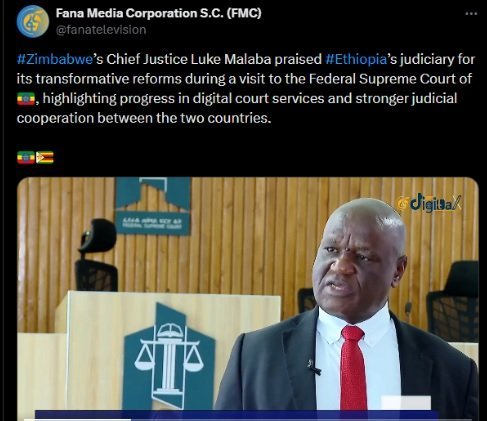
The statement raises an unavoidable question: Which Ethiopia is being praised?
Over the past decade, a growing body of research and international monitoring reports has raised significant concerns regarding Ethiopia’s justice system. Reports by global governance institutions, human-rights organizations, and legal scholars describe a judicial system facing substantial structural constraints, political influence, and limited capacity to enforce constitutional rights.
These concerns are particularly significant given Ethiopia’s recent history of political unrest and armed conflict, including the devastating war in the Tigray region between 2020 and 2022 and ongoing instability in other parts of the country.
This article critically examines the available empirical evidence in order to assess whether Ethiopia’s judiciary can credibly be described as a leading example of judicial transformation. The analysis focuses on three areas: the independence of the judiciary, patterns of repression affecting journalists and political actors, and the role of the justice system in addressing alleged war crimes committed during recent conflicts.
Judicial Independence and Political Influence
Judicial independence is widely recognized as a cornerstone of democratic governance. Courts must be able to operate free from political pressure in order to protect constitutional rights and ensure accountability for abuses of power.
In Ethiopia, however, the independence of the judiciary has long been the subject of concern among legal scholars and international observers.
Research examining Ethiopia’s judicial institutions indicates that both institutional and personal independence of judges remain weakly protected, limiting the ability of courts to act as effective guardians of constitutional rights. Political pressures and executive influence over judicial processes have been identified as persistent challenges within the Ethiopian legal system.
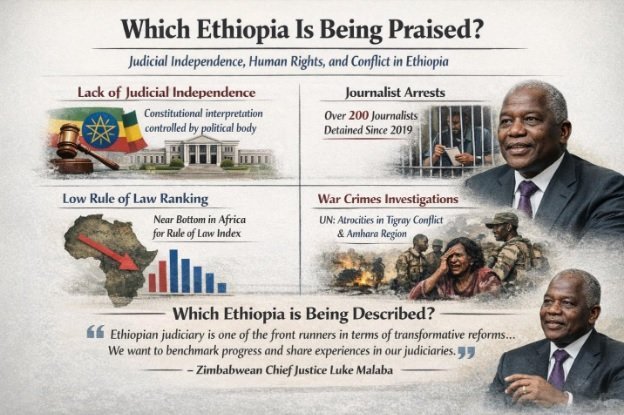
A particularly significant structural limitation arises from Ethiopia’s constitutional framework. Unlike many democratic systems where courts possess final authority to interpret the constitution, Ethiopia assigns this power to the House of the Federation, a political body composed of representatives from regional states.
Although a legal advisory body—the Council of Constitutional Inquiry—provides recommendations, the final authority to interpret constitutional disputes rests with a political institution rather than an independent judiciary.
This arrangement significantly weakens the judiciary’s capacity to act as a check on executive power and reduces its ability to protect constitutional rights.
Ethiopia in the Global Rule of Law Index
Empirical governance indicators provide an additional perspective on the condition of Ethiopia’s judicial institutions.
According to the World Justice Project Rule of Law Index, Ethiopia ranks among the lowest-performing countries in Sub-Saharan Africa in terms of rule-of-law performance. In the 2025 index, Ethiopia ranked near the bottom globally, reflecting weaknesses in constraints on government power, protection of fundamental rights, and the functioning of criminal justice institutions.
In contrast, several African countries demonstrate significantly stronger rule-of-law performance. Countries such as Mauritius, Namibia, Botswana, Ghana, Rwanda, and South Africa consistently rank among the top performers on the continent.
These countries generally possess stronger judicial institutions with clearer constitutional authority to review government actions and enforce fundamental rights.
Ethiopia’s comparatively low ranking suggests that its justice system continues to face significant structural and institutional challenges.
Arrests of Journalists and Restrictions on Press Freedom
Freedom of expression and press freedom are critical indicators of judicial independence and democratic governance. However, Ethiopia has experienced a notable deterioration in media freedom over the past decade.
According to press-freedom organizations, more than 200 journalists have been arrested in Ethiopia since 2019, with at least 244 documented arrests involving journalists and media workers during this period.
Many of these arrests have occurred in connection with reporting on politically sensitive issues, including armed conflicts, ethnic tensions, and government policies. Journalists have frequently been charged under national security or anti-terrorism legislation.
Reports indicate that detained journalists often face prolonged pre-trial detention and limited access to legal counsel. Such conditions raise serious concerns regarding the ability of the judiciary to safeguard constitutional protections for freedom of expression.
War Crimes Allegations and the Tigray Conflict
The conflict in northern Ethiopia between 2020 and 2022 represents one of the most devastating crises in the country’s recent history.
Investigations conducted by the International Commission of Human Rights Experts on Ethiopia, established by the United Nations Human Rights Council, documented widespread violations of international humanitarian law by multiple parties involved in the conflict.
The commission concluded that war crimes were committed by all major parties, including extrajudicial killings, torture, sexual violence, and attacks against civilians. In addition, investigators found that Ethiopian federal forces and allied Eritrean forces committed acts that may constitute crimes against humanity, including murder, rape, and persecution targeting civilian populations.
Independent research has also documented extensive patterns of sexual violence during the conflict, including rape, forced pregnancy, and sexual torture.
The humanitarian consequences were catastrophic. Estimates from researchers and humanitarian organizations suggest that hundreds of thousands of people may have died during the conflict due to violence, starvation, and the destruction of critical infrastructure.
Despite these findings, international observers have expressed concern regarding the lack of effective accountability mechanisms within Ethiopia’s domestic justice system.
Ongoing War Crimes Against the Amhara people in the Amhara region and Oromia
Although the peace agreement signed in late 2022 formally ended the war in Tigray, violence has continued in other regions of Ethiopia.
In the Amhara region, clashes between federal forces and FANO have resulted in widespread civilian displacement, mass arrests, and restrictions on civil liberties during states of emergency.
Human-rights organizations warn that the persistence of armed conflicts across multiple regions continues to pose serious risks to civilian populations and raises urgent questions about the capacity of Ethiopia’s justice system to ensure accountability for human-rights violations.
Public Confidence in the Judiciary
Public trust is one of the most important indicators of judicial legitimacy. Surveys conducted by governance research organizations indicate that public confidence in Ethiopia’s courts remains relatively low, with only a minority of citizens expressing trust in judicial institutions.
Observers attribute this lack of trust to several factors, including perceptions of political interference, corruption, and inconsistent judicial decisions.
Barriers to access to justice also remain significant. Language barriers, limited availability of legal representation, and procedural delays can make it difficult for many citizens—particularly those from marginalized communities—to effectively pursue legal remedies.
Which Ethiopia Is Being Praised?
Against this backdrop, the praise offered by Chief Justice Luke Malaba invites legitimate scrutiny.
When a country ranks near the bottom of global rule-of-law indicators, when journalists face repeated arrests, and when international investigators document widespread war crimes during armed conflict, describing the judiciary as a leading example of transformative reform becomes difficult to reconcile with the available evidence.
Constructive international engagement between judicial institutions can play an important role in promoting legal reform. However, genuine recognition of judicial progress must ultimately be grounded in measurable improvements in institutional independence, protection of fundamental rights, and accountability for abuses of power.
Until such improvements are clearly demonstrated, the question remains unavoidable: Which Ethiopia is being described??
Editor’s Note : Views in the article do not necessarily reflect the views of borkena.com
__
Support Borkena : https://borkena.com/subscribe-borkena/
Join our Telegram Channel : t.me/borkena
Like borkena on Facebook
Add your business to Ethiopian Business Listing / Ethiopian Business Directory Business Listing Toronto
Join the conversation. Follow us on X (Formerly Twitter) @zborkena to get the latest Ethiopian News updates regularly. Subscribe to YouTube channel To share information or for submission, send e-mail to info@borkena.com