
By Peter Paul
At the start of his rise to power, most Ethiopians were excited about the new man in 4-Kilo. This euphoria also swept through the evangelical community — including the Lutherans, Pentecostals, Charismatics, Neo-Charismatics or “Third Wave” churches, and even the recent self-proclaimed prophet- and apostle-led movements.
In fact, Abiy Ahmed Ali portrayed himself as a mainstream evangelical when he assumed office. It appears he calculated that, in order to fulfill the prophecy his mother told him as a child — that he would become the “seventh king” of the country — it might be advantageous to shift from Islam to Christianity. No one knows exactly how the prophecy of the seventh king is counted, but he arranged for the display of six former leaders’ portraits in Unity Park, leaving space for himself as the seventh.
He even married a woman from Gondar, in the Amhara region, possibly to gain acceptance among the two largest ethnic groups in the country. According to one analyst on social media, the couple had separated, and she was living in the United States with their children. It was only through the involvement of the U.S. government that she returned to Ethiopia to play the role of a respectable first lady — and, by extension, to symbolically represent the Amhara ethnic group through marriage.
She has played this role well, and some of her relatives from Gondar have consistently performed a symbolic “አማችነት” role throughout this difficult period. In short, everything seems calculated — even the change of religion. The saddest part of this story is how evangelicals were misled like any other Ethiopians. Some of these groups continue to support him to this day.
Abiy as the head of the Ethiopian Council of Gospel Believers’ Churches
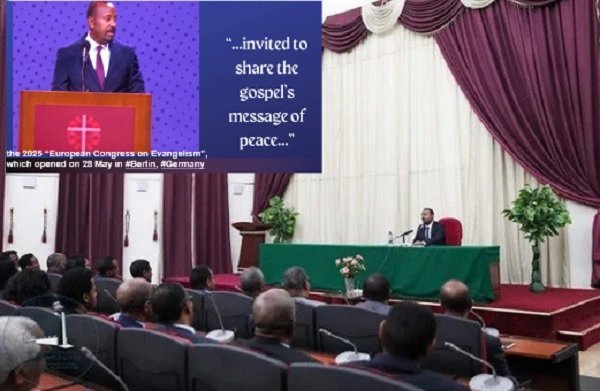
After he came to power, evangelical pastors and leaders were gathered at 4-Kilo to meet with the new prime minister. During that discussion, many issues were raised, and Abiy promised to solve those problems. He gave the impression that he belonged to their community and expected unwavering commitment and support from the group. In fact, he appointed many evangelicals to positions within his government. This disproportional representation was even noted and criticized by members of other religious groups. There are videos circulating on social media showing Abiy praying with others and receiving so-called prophetic messages. It is also rumored that he regularly attended small group prayer meetings, kneeling and praying alongside other believers. Praying is a good thing — if one is genuinely seeking God and repenting from their evil deeds. But if, after prayer, one goes out and orders disasters upon the country, as has happened since he came to power, then something is clearly wrong. That behavior does not align with the message of the gospel or with the teachings of the Bible.
His allegiance to the evangelical community is not hidden. He even gave one of his awards publicly to a controversial pastor who referred to poor people as “ants.” It is also rumored that he donated 50 million birr to help complete the construction of a prominent church building at the start of his premiership. Doing good deeds can be a sign of a true believer, but when those actions are paired with displacing hundreds of thousands of people from their places, it becomes clear that this is mere manipulation. In fact, his plan appears to have been to unify all the dispersed evangelical groups under one organization — under his control. A committee composed of representatives from 15 different evangelical groupings was formed to establish what is now known as the Ethiopian Council of Gospel Believers’ Churches. According to its website, the council claims to represent 32 million Ethiopians — approximately 25% of the country’s population. Abiy’s goal was to align all these people under one umbrella organization, which he now claims as his electoral base.
During the formation of this council, a debate arose among the 15 representatives who were tasked with drafting a governing document (መተዳደሪያ ደንብ) for the new organization. One clause reportedly stated something to the effect of: “The Prime Minister will be the head of the council.” In other words, the council would report directly to Abiy.
Fourteen of the fifteen members signed the document, except one who objected, saying, “The head of the Church is Christ,” not a prime minister. The others argued that this was not a church but a council, and thus should be governed by the law of the land — which, technically, is true. However, in practice, when an organization that claims to represent 32 million people is directly subordinated to the Prime Minister in all respects, it raises serious concerns about the separation of church and state — a principle upheld in many democratic nations. Does this mean that all 32 million people are represented by “their man” and are therefore accountable for the disasters caused by his leadership? Far from it. The Bible teaches that the Church belongs to Jesus Christ, who gave Himself for it. No man can stand as the representative of the Church. True believers belong to their Savior and Redeemer — not to any political figure. Those 14 individuals who signed the document effectively handed over the people of God to a man whose actions have caused great suffering — a man seemingly more concerned with power and kingship than with justice or truth. Some of these leaders quote passages such as:
“Everyone must submit himself to the governing authorities…” (Romans 13:1)
“Submit yourselves for the Lord’s sake to every authority…” (1 Peter 2:13)
They argue that Christians are obligated to obey rulers. They even point out that Paul wrote these words during the reign of Emperor Nero, who notoriously persecuted Christians and tried to extinguish the faith. But nowhere do Paul or Peter instruct believers to support or endorse an evil ruler. Submission to authority does not mean aligning oneself with injustice, nor does it imply becoming complicit in evil.
The True Image Abiy
These days, the true image of Abiy Ahmed Ali has been revealed in many ways. Dr. Gedu Andargachew — former Foreign Minister and President of the Amhara Region — and the prominent Oromo opposition leader Jawar Mohammed have both come forward and said in detail about Abiy Ahmed Ali’s actions. Most notably, Taye Dendea — a former minister now imprisoned by Abiy — and Dr. Milkesa Midhaga, another former minister, who is exiled, have publicly exposed the true character of Abiy over the past seven years. Both were key figures in the founding of the Prosperity Party (PP). They describe in detail how Abiy devastated the Oromo population in Wellega and parts of southern Ethiopia, how he masterminded and initiated the Tigray war, how he fueled the conflict between the Oromo and Amhara communities, and how he orchestrated the killing of prominent generals and politicians, as well as the imprisonment of many opponents. These are firsthand accounts. Their testimonies should be evaluated with discernment, as they are all politicians and may have their own biases. However, the undeniable fact is this: they cannot all be lying. In fact, their accounts have shed light on many of the questions that Ethiopians have been asking over the past seven years. Much is now clearer — and indeed, the king is naked, or in other words: “ He has been engaged in another bloody war with Fano for over two years in the Amhara region, using drones and heavy artillery to kill civilians — simply because he cannot defeat the guerrilla fighters.
The Church and believers belong to Christ
The word church — a collective noun — literally means “the called-out,” and in the Bible, it refers to those called out by God: men and women who respond in obedience to the call of the gospel (2 Thess. 2:14). This is foundational knowledge in Christianity. Christ said, “I will build my church” (Matt. 16:18), and Scripture teaches that He purchased it with His own blood (Acts 20:28). Christ is the head of His Church — His body (Eph. 1:22ff; 4:4–6).
Therefore, no person can claim ownership over what belongs to God. Present-day church leaders must be careful to teach and act in line with this truth. Being invited to the table of an earthly king, visiting the palace, or having access to the corridors of power does not give anyone the right to hand over the Church to a power-hungry and bloodstained ruler — one like the country has not seen in generations. If the Church is persecuted for preaching the gospel, that is part of the Christian calling: “Blessed are those who are persecuted for righteousness’ sake, for theirs is the kingdom of heaven” (Matthew 5:10–12). However, the Church is not called to be the chief political supporter and advocate of a leader responsible for instigating conflicts, wars, and the deaths of millions. Let this be far from the Church!
Even now, many evangelical leaders are not willing to admit their mistake. They remain silent in the face of injustice, war, displacement, hunger, and political chaos in the country. The silence is deafening. It is not only silence — some are still actively praying for the success of this man and his government, even when the country is clearly falling apart. How long will it take for them to realize that standing with the oppressor is not the same as obeying God? Prayers and prophecies cannot be detached from truth, justice, and the well-being of the people. When worship is used to cover complicity or silence in the face of evil, it becomes a form of idolatry. God is not mocked. The cries of the displaced, the grieving, and the oppressed will reach heaven — and no amount of political allegiance or selective quoting of Scripture can cover up injustice. The Church must remember its first allegiance is to Jesus Christ, not to any political figure or government. True prophets stand with truth, even when it costs them. True pastors speak out, even when it’s uncomfortable. True believers cannot remain neutral when evil prevails.
To all People of Ethiopia and Ethiopian Politicians
Just because Shimelis Abdisa’s and Adanech Abebe’s prophecies claim they are evangelicals — and even though many false preachers who call themselves prophets and apostles openly support an evildoer without discernment, as they themselves are corrupted — this does not mean that all 32 million believers and Christians support these evil-doers. In fact, some who began to warn God’s people have been identified and imprisoned for opposing the mad king. People across Ethiopia — including most politicians — were deceived by this man. Ethiopian evangelical believers were no exception. Abiy used them to stabilize his power. They, too, are victims, except for a very few thieves who enriched themselves during his reign. Having said that, it is now time for Ethiopian evangelical leaders to clearly separate themselves from this wicked man in power and all his cohorts. May God save Ethiopia and all the people in Ethiopia.
Editor’s Note : Views in the article do not necessarily reflect the views of borkena.com
__
Subscribe : https://borkena.com/subscribe-borkena/
Join our Telegram Channel : t.me/borkena
Like borkena on Facebook
Add your business to Ethiopian Business Listing / Ethiopian Business Directory Business Listing Toronto
Join the conversation. Follow us on X (Formerly Twitter) @zborkena to get the latest Ethiopian News updates regularly. Subscribe to YouTube channel To share information or for submission, send e-mail to info@borkena.com