
We crossed the Atlantic to get away from our homeland’s sorrow for a few days. Instead, we found an inheritance, and a responsibility, which followed us all the way there and all the way home
Amsal Woreta
“Ethiopia! Ras Tafari! Rasta!”
That is what the immigration officer at Curaçao’s airport called out the moment he saw our country’s name on our papers.
A few minutes before that, my husband and I were sure our vacation was about to go wrong. We had filled out Curaçao’s visitor applications at home, just as we were supposed to, but the first officer could not find them anywhere in the system. He asked us to follow him. We walked past what felt like hundreds of passengers to a second office, where another official went through our documents without saying a word.
Then he got to the word Ethiopia, and his whole face changed.
He stamped our forms. We were in. My husband and I looked at each other and smiled, partly from relief and partly because, honestly, it was funny. It lasted only a moment, but I kept thinking about it for the rest of the trip. Why would a stranger on a Caribbean island, so far from the Horn of Africa, light up like that at the name of our country?
It hit me so hard because Ethiopia was the one thing we had hoped to put down for a few days.
For months, the news from home had been unbearable. Massacres. Families drive from their homes. Fighting, division, and whole communities wiped out. Living across the Atlantic did not protect us from any of it. We still watched, every day, as the country we love kept bleeding. We had planned trips before and canceled them. It never felt right to go relax somewhere while so many of our people were suffering.
In the end, we were simply too tired to keep going without a break. We did not want to forget Ethiopia. We just needed room to breathe.
So, I looked for a Caribbean island neither of us had ever visited, and Curaçao came up. I booked the flights, reserved the hotel, and hoped for a little quiet.
I never expected Ethiopia to be waiting for us at the airport.
A Country Remembered Across an Ocean
That greeting turned out to be just the start. At the hotel, some of the staff became noticeably warmer once they found out where we were from.
They did not know anything about us. Not our story, not our work, not our politics. But the word Ethiopia clearly meant something to them. I started to wonder if we were being given respect, we had not earned ourselves, one passed down from the generations who lived, struggled, and defended our country long before we were born.
What did our forefathers and foremothers leave behind that people still honor on the other side of an ocean?
I started to find an answer somewhere I never would have looked: the Kurá Hulanda Museum, in Otrobanda, the old historic district of Willemstad.
The museum covers African civilizations, European colonialism, and the transatlantic slave trade. It does not soften anything. You walk through one of the darkest chapters in human history: millions of Africans taken from their homes, families torn apart, people treated as property, and the long, stubborn fight to hold on to who they were. It moved me deeply.
And then, right in the middle of all that, I found Ethiopia.
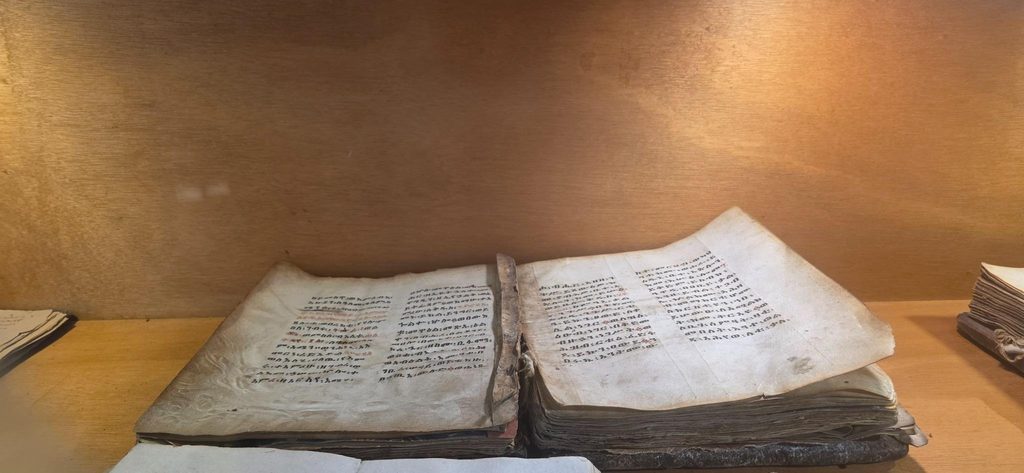
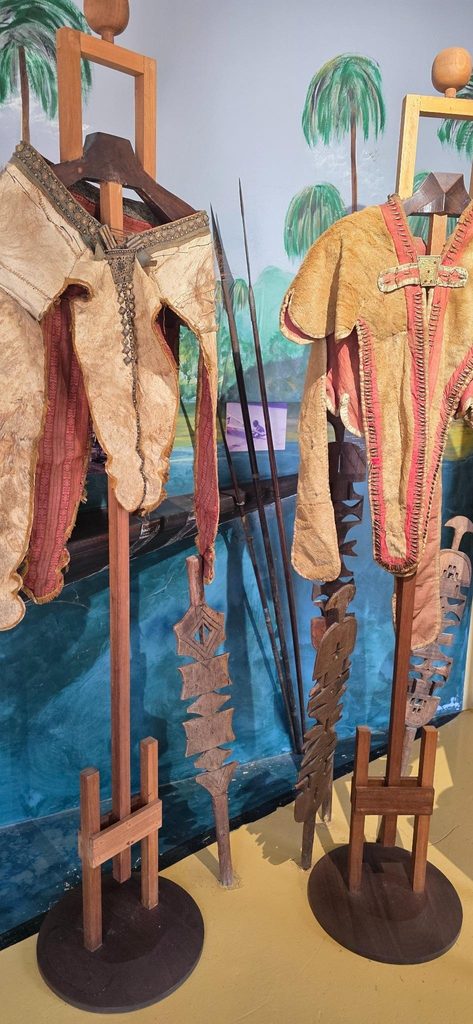
I do not mean just the name on a sign. I mean real things. In a wooden display cabinet, there were Ethiopian clay pots. Close by were traditional garments made of hide, beautifully decorated, along with spears, crosses, and religious paintings. Then I saw an old manuscript, its pages covered in neat, careful Ethiopic letters.
I stopped walking.
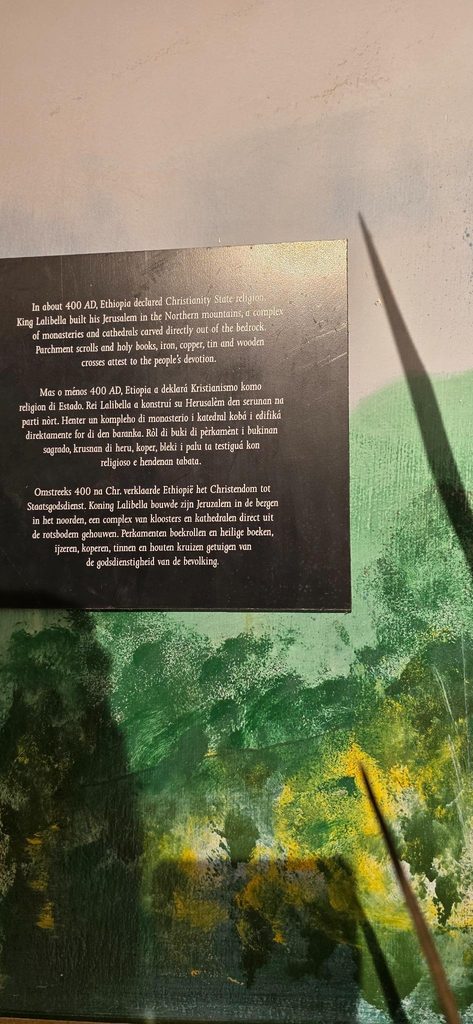
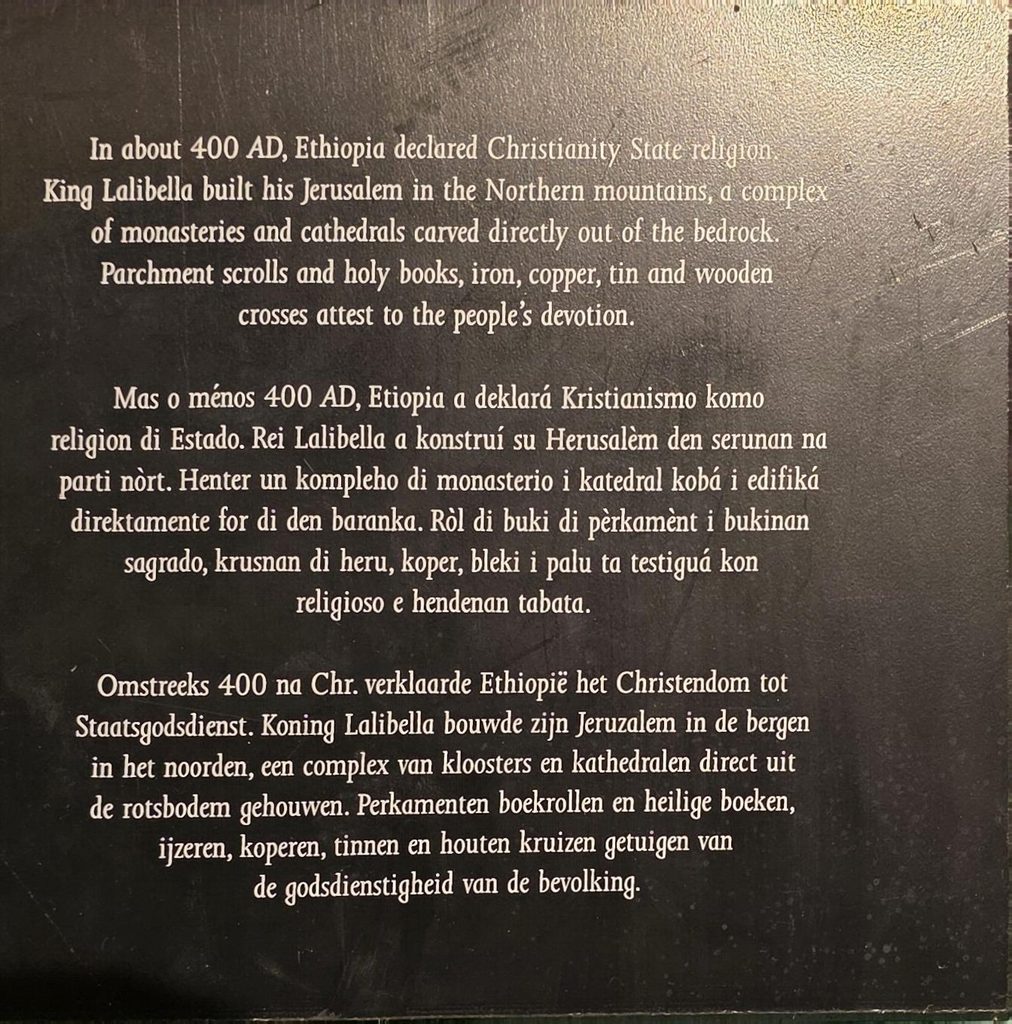
Here I was, thousands of miles from home, looking at a script that had been written for centuries. A panel nearby told the story of Ethiopia’s early Christianity, the rock-hewn churches of Lalibela, and the parchment books and crosses left by generations of believers. The objects came from many different eras. The Aksumite kingdom took up Christianity in the fourth century; the churches linked to King Lalibela came many centuries later, in the medieval period.
I pulled out my phone and started taking pictures. The pots. The garments. The crosses. The paintings. The manuscript. I had no idea how each piece had made its way to this museum. But for a few minutes I was not a tourist anymore. I was an Ethiopian who had stumbled onto a piece of home in the last place I would have looked for it.
I thought about the people whose hands made these things, and the people who used them. They are long gone. So are the kings and governments of their day. And yet something they made was still there, kept behind glass safe on the other side of the Atlantic.
I felt proud, quietly. And right away, I felt sad.
Ethiopia in a Museum of African Suffering
Finding Ethiopia in a museum so focused on the transatlantic slave trade felt significant to me.
Ethiopia was not one of the main places Africans were taken from to be shipped across the Atlantic. Most came from West and West-Central Africa. Our part of the continent had its own history of slavery, connected to the Red Sea and the Indian Ocean, and Ethiopia’s past is not free of that. But in the minds of Africans scattered across the world, Ethiopia came to stand for something else.
While the European powers were dividing Africa among themselves, Ethiopia did what many thought could not be done. On March 1, 1896, Ethiopian forces under Emperor Menelik II defeated the invading Italian army at Adwa. Italy’s colonial plans were stopped, and the victory became a symbol of African resistance far beyond our borders.
Fascist Italy came back later, invading and occupying the country from 1936 to 1941. Even so, Adwa, and Ethiopia’s return to independence, never lost their meaning across Africa or among people of African descent abroad. For people living under colonial rule or racism, Ethiopia was proof of something simple and powerful: Africans could defend their freedom and their dignity.
That memory traveled across the ocean. It found its way into the politics, culture, and faith of communities in the Americas and the Caribbean. Emperor Haile Selassie, called Ras Tafari before he was crowned, became central to Rastafarian belief, especially in Jamaica.
Suddenly, the officer at the airport made sense.
“Ethiopia! Ras Tafari! Rasta!”
I cannot say for sure what was on his mind, or in the minds of the hotel staff. But they made me see a reputation that a lot of us Ethiopians take for granted. And standing in Kurá Hulanda, I understood that the museum was not only telling the story of Africans as victims. It was also showing what Africans made, what they believed, what they fought for, and what they passed on. Ethiopia’s objects were part of that bigger story.
Then a painful thought came to me, and it has not left.
Strangers thousands of miles away were carefully keeping pieces of Ethiopia’s heritage, while Ethiopia itself was tearing apart its own people and its own future.
The Contradictions of Our History
Standing there, I thought about the generations who built Ethiopia. They left us our faiths, our languages, manuscripts, monuments, art, institutions, and memories going back centuries. They also left us a history of resistance that people far beyond our borders are proud of.
But being proud of the past does not mean we get to ignore the painful parts.
Like most countries, Ethiopia did not become what it is today peacefully. Its history has wars and expansion, conquest and resistance, alliances, and long stretches of domination and inequality. Different communities lived through those events in quite diverse ways, and they remember them differently. To some, the nineteenth century is when a state was built that was strong enough to stand up to colonialism. To others, that same century means conquest, being pushed down, and having their culture sidelined.
Both memories deserve to be taken seriously. We cannot understand Ethiopia by celebrating only the victories. And no one should be told to let go of a memory of injustice just because it makes someone else uncomfortable.
Still, history must help us answer a harder question, too.
When does remembering an injustice turn into inheriting a permanent grudge?
Plenty of nations were formed through war, force, compromise, and sometimes terrible injustice. Some of them still managed to find stability and learned to live together. It was not because every mistake was paid back, or because everyone agreed on the past, or because the old suffering stopped mattering. It was because they built institutions, laws, and habits of citizenship that let different communities share a future while still disagreeing.
A child born today never led a nineteenth-century army. A farmer working on his land never drew an empire’s borders. A mother holding her baby never wrote the policies of emperors, military governments, or political movements.
People who commit crimes must be held to account. Past injustices must be acknowledged, and victims deserve recognition and, where it is possible, repair. But guilt is not something you inherit at birth.
Remembering an injustice is one thing. Inheriting an enemy is something else entirely.
If we lose sight of that difference, the past turns into a punishment that never ends, handed to people who had nothing to do with it. And history becomes a weapon.
When History Becomes Inherited Conflict
From the past, my mind went to the present.
Amhara civilians have been massacred, displaced, and badly abused. Tigrayan communities suffered catastrophically during and after the war in the north. People in Oromia have lived with years of insecurity and violence. Communities in Afar, Benishangul-Gumuz, Somali, and other regions have had their own tragedies.
The situations are different, and so is the responsibility, and every case needs to be carefully investigated. But none of that makes any victim less human.
No old grievance gives anyone the right to murder an innocent family. No political goal justifies burning people’s homes or driving them out because of who they are. And no child should be to blame for crimes committed before they were born.
I kept coming back to Adwa.
The people who faced Italy’s army were not all the same. They came from different regions, spoke different languages, had different traditions, and brought their own rivalries and interests with them. But now that mattered, enough of them saw the same danger and stood together. Their unity did not erase their differences. It lets them act together. More than a hundred years later, people across an ocean still remember them for it.
It would be a tragedy if a country that inspired so many others to resist domination were finally broken because its own people could not live together.
Ethiopia is standing near the edge of a cliff. It is not for lack of history or civilization; Kurá Hulanda reminded me of how much we have. It is not for lack of courage; our history is full of it. The danger is that we forget how to see each other as human beings first, before ethnicity, region, religion, or party.
A country can stay on the map and still lose the trust its people need to share a future. When children inherit enemies, they have never met, when one community shrugs off another’s grief, when old wrongs become an excuse for new cruelty, the idea of shared citizenship starts to crumble. No civilization is so old that it can take its survival for granted.
Ethiopia’s biggest unfinished job is not only nation-building. It is nation-healing.
Nation-healing does not mean forgetting history, silencing grievances, or forcing everyone to accept a single version of the past. It means building a country where truth, accountability, equal citizenship, cultural dignity, and the protection of human life are everyone’s responsibility. It means an Amhara family’s pain should matter to an Oromo, and an Oromo child’s pain should matter to an Amhara. It means grieving with Tigrayan, Afar, Somali, Gurage, Sidama, Gambella, and every other Ethiopian community, without first checking whether the victims are “ours.”
What it asks of us is simple, and incredibly hard: to see another Ethiopian’s suffering as human suffering.
What Survives Beyond Us?
Before we left, I went back to the manuscript and wondered about the person who wrote it. What was their world like? What did they worry about for their children? What did they think the future would look like?
I could not learn its history just by looking at it. But I knew the tradition it came from had outlasted generations of rulers and regimes. Governments change. Leaders come and go. The arguments that consume one generation become something historians write about in the next. A civilization only survives when each generation keeps enough of its knowledge, traditions, institutions, and living communities to hand them down.
We did not build Ethiopia from scratch. We inherited a long and complicated story of people, languages, faiths, art, achievements, injustices, and shared experiences. Our ancestors were not perfect. They were human, with all the courage, ambition, and failure that comes with that. The real question is what we will do with what they left in our hands.
And the most precious part of that inheritance is not the monuments, the manuscripts, the churches, the mosques, or the archaeological sites. It is the living people who carry those traditions forward.
What good is it to save an ancient manuscript if the children who could one day read it cannot go to school? What does it mean to celebrate a historic church or mosque if the people around it have been driven away or live in fear? How can we honor the unity of Adwa if we cannot protect innocent lives today?
You cannot separate preserving culture from protecting human dignity. When a community is destroyed or scattered, it loses more than houses and land. It loses the languages, stories, and everyday habits that carry a heritage from parents to children. You can save a beautiful object and still lose the living tradition that gave it meaning.
The Weight I Carried Home
When we got home, I realized the trip had not taken Ethiopia’s weight off my shoulders. If anything, it felt heavier. But it was not only grief and exhaustion anymore. It had turned into a sense of responsibility.
I keep asking myself what I can do, even in a small way, to help Ethiopians see the inheritance we share before we lose more of it.
Could historians, teachers, writers, religious institutions, cultural organizations, community leaders, and those of us in the diaspora work together to document and protect our historical treasures? Could we build real partnerships with museums, universities, archives, and preservation experts to save endangered manuscripts, buildings, archaeological sites, sacred objects, languages, and oral histories? Could we encourage young Ethiopians to learn not just their own community’s history, but the histories of the people they share a country with?
I do not believe that restoring a church, saving a manuscript, or putting on an exhibition will end Ethiopia’s conflicts by itself. Peace takes justice, institutions people can hold accountable, protection for civilians, and the slow work of rebuilding trust. But we should not underestimate the kind of work that brings people together around something bigger than what divides them.
Historians from different communities could work side by side on the most contested parts of our past. Ethiopian scholars and cultural groups could team up to protect endangered collections and make trustworthy history available to young people. Those of us in the diaspora, with our access to libraries, universities, museums, and international networks, could offer money, time, and expertise. And communities that disagree about what the past means might still find common ground in protecting a manuscript, a historic site, a language, a school, or the dignity of a displaced family.
Next to the size of Ethiopia’s suffering, these are small beginnings. But civilizations have never survived because of emperors and battles alone. They survived because ordinary people taught their children, guarded manuscripts, kept places of worship standing, told the old stories, kept their languages alive, and refused to let their ancestors’ knowledge disappear.
Every one of us has something to give. Some of us can research, write, and teach. Others can help with preservation, community work, humanitarian aid, or create space for dialogue. And some can simply teach their children that another Ethiopian’s history is something to understand, not something to fear.
I do not have an organization ready to go, or a finished plan. What I have is a question, and the hope of bringing together people who want to look for the answer with me.
How do we turn our love for Ethiopia from pride in the past into a shared responsibility for its future?
That question is not only for politicians and intellectuals. It belongs to families, teachers, young people, cultural and religious institutions, and Ethiopians all over the diaspora. Our country does not belong to any one generation. We are only looking after it for a while, holding an inheritance that was here long before us and should be here long after we are gone.
A Child Not Yet Born
I still think about that officer’s delighted shout, the kindness of the hotel staff, and the quiet of that room at Kurá Hulanda.
One day, a child who has not been born yet may stand in that same museum and discover Ethiopia through an old manuscript, a cross, or a plain clay pot. I hope that child feels the same wonder I felt. Even more, I hope that child comes from an Ethiopia where people can learn about and celebrate their different histories without being afraid of each other. An Ethiopia where grievances are met with truth and justice, not inherited revenge. Where no one grows up believing another Ethiopian is their enemy because of the identity they were born with.
I hope future generations learn about Adwa not just as a victory over a foreign army, but as proof that people with different histories and interests can see a common responsibility when their country’s future is on the line. And I hope that when they look back at these hard years, they will see that we did more than grieve. That we tried to protect our people, save our treasures, and leave them the chance of a peaceful life together.
We cannot choose the history we inherit. We cannot undo every mistake done by those who came before us. But we can choose whether to pass that bitterness on to our children, or to work for a future where they do not inherit our enemies.
What will our generation leave behind?
Another chapter of division, destruction, and old grudges? Or the start of a different story, one where Ethiopians, without denying their own histories, protect their shared humanity and the civilization that was entrusted to them?
I do not know if I will live to see that future. But I know the work of getting there belongs to us, and it starts now.
I crossed the Atlantic hoping to escape the weight of Ethiopia’s suffering. I came home carrying the weight of Ethiopia’s future.
And that was the most unexpected gift Curaçao could have given me.
__
Support Borkena : https://borkena.com/subscribe-borkena/
Join our Telegram Channel : t.me/borkena
Travel
Like borkena on Facebook
To submit Press Release, send submission to info@borkena.com
Add your business to Ethiopian Business Listing / Ethiopian Business Directory
Join the conversation. Follow us on X (Formerly Twitter) @zborkena to get the latest Ethiopian News updates regularly.