 to Today's Addis Ababa: Lessons of History, Deep-Rooted Marginalization, and the Youth's Struggle for Survival. Read.)
From June 8, 2005 (Sene 1, 1997 E.C.) to Today’s Addis Ababa: Lessons of History, Deep-Rooted Marginalization, and the Youth’s Struggle for Survival

by Mesfin Yohannes Haile
The early days of June (Sene) in the registry of Ethiopian politics are not just pages of a calendar that pass by idly. Especially for the youth of Addis Ababa, this period is a historical curtain marked by the footprints of blood, resilience, freedom, and the clash with intensifying authoritarianism. Today, remembering Sene 1 is not only about commemorating the blood of the youth that was spilled on the city’s streets two decades ago, but it must also be about comparing, analyzing, and examining the current existential struggle of the youth against the complex and distressing realities facing Addis Ababa today.
The Blood print of Sene 1, 1997 E.C. and a Historical Reminder
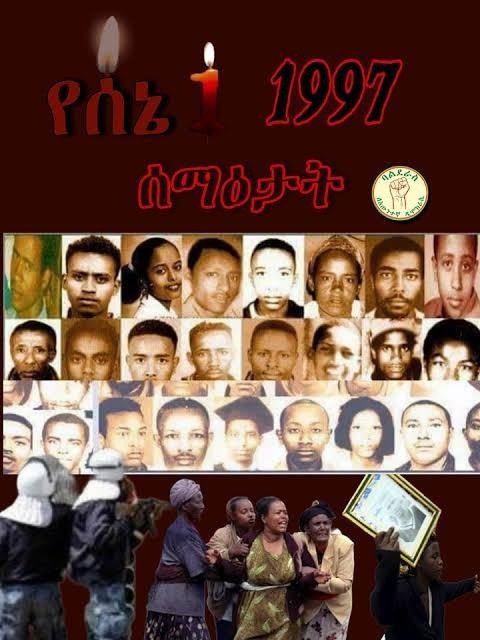
Following the historic and controversial national election held in May 2005 (1997 E.C.), our city’s youth took to the streets in a peaceful and civilized manner to demand democracy, truth, and justice. Especially in Piassa, Merkato, Churchill Road, and various neighborhoods of the city, the desire and courage of the youth for change was unmatched. However, the response given by the ruling regime of the time to this peaceful and democratic question was brutal bullets and a mass massacre.
On that dark day, numerous youth lost their lives in public squares; their dreams and hopes were scattered across the streets. Those who survived the day’s massacre were rounded up by the thousands and packed into military training camps like Tolay, Shewa Robit, and Zway, where they faced severe torture and harassment. The sacrifice made by that generation left behind a great historical lesson showing how identical and cruel the structure of oppression can remain, even when rulers change their names and appearances.
What is Happening in Addis Ababa Today? The Omnipresent Face of Systemic Marginalization
As the saying goes, “history repeats itself,” and today, Addis Ababa and its youth are becoming victims of an authoritarianism rebuilt in another form, marginalization, and an all-encompassing crisis. Currently, the city is rapidly changing its face under the name of “Corridor Development.” While urban beautification, road expansion, and modernization works have positive aspects as development in their own right, the approach currently being implemented steps on the tears and human rights of the people, harboring bitter and dangerous realities behind it:
1. Social Crisis and “Displacement” Without Adequate Preparation
A structural campaign is underway that tears apart the lifelong social psychology and social fabric (Edir, Equb, and neighborliness) of its residents, destroying the ancient and historic heritages of the city. Evicting the established community that raised this youth from their beloved locales without adequate compensation, without prior preparation, and in a manner that violates human dignity has become a daily routine. Historical neighborhoods including Piassa and Merkato, where the youth of 2005(1997 ዓ.ም) raised their voices and spilled their blood, are being leveled to the ground today in a way that erases the identity and historical footprint of their residents.
2. Alienation of Identity and Ownership
The youth of Addis Ababa are increasingly becoming strangers in their own city. In educational, cultural, and social forums, the established values of the city are being systematically pushed aside, loading a heavy psychological burden on the youth. This deliberate exclusion makes them feel as if they have no country or city, rendering them mere guests and bystanders in their own villas, historical streets, and public squares. The city is ceasing to belong to its residents, becoming instead a playground for a few officials and investors.
3. The Burden of Severe Unemployment and Economic Stagnation
The city’s youth are languishing under an unprecedentedly high cost of living and brutal inflation. Youth unemployment has reached an extremely alarming, catastrophic level. Even when the youth learn, graduate, or acquire a profession, the opportunities to support themselves and their families are rapidly narrowing. Instead, the current socioeconomic environment seems aligned to purposefully drive them toward systemic marginalization, migration, addiction, and despair. In a situation where the economic capacity of the youth is intentionally weakened, losing the physical ownership of their homes and land feels like a systematic, structural eviction from the city itself.
4. The Collapse of a Generation and the Danger of Despair
The suffering of the youth seen on the streets of Addis Ababa today is no less dangerous than the threat of being gunned down in 2005 (1997 ዓ.ም). The loss of future hope, the absolute absence of justice, the suppression of freedom of thought, and the political gambling seen in every direction are costing the young generation dearly, threatening the very survival of their identity.
The Resilient Spirit of the Youth and Today’s Direction of Struggle
The sacrifice and martyrdom of the 2005 (1997 ዓ.ም) youth taught and left behind a massive, uncompromised homework assignment for today’s generation: That we can and must be a voice for our city and our community!Authoritarianism, marginalization, ignorance, and oppression may change their appearance, coming disguised under flashy names and grand “development” projects; however, the youth’s spirit of resilience, search for justice, and historical identity can never be changed, bought, or defeated.
Even today, confronting the structural injustices visibly apparent in our Addis Ababa and fighting against them is the non-negotiable historical obligation of this generation:
- Fighting Injustice: Confronting mass displacements, forced evictions, and systemic exclusions that completely disregard the law, human rights, and equitable resource distribution through organized ideas, digital advocacy, and legal avenues.
- Confronting Ignorance (and the failure to understand the people’s feelings): Boldly exposing the arrogance of officials who look at the tears, cries, and deep suffering of the displaced with utter indifference, and who systematically devalue our historical and identity assets. We counter this ignorance using knowledge, writing, documentation, and structured intellectual arguments.
- Opposing Bad Governance (which fails to center the public): Resisting through all peaceful, civilized means an administration that completely lacks transparency, accountability, and genuine public participation, and is driven entirely by single-headed, top-down authoritarianism.
This struggle is not a struggle of violence, destruction, chaos, or bloodshed. Just like the heroic youth of 2005 (1997 ዓ.ም), it is a sophisticated struggle for truth, identity, history, and urban ownership carried out through civilized, mature, digital activism, structural exposure, and unshakeable moral resilience.
Conclusion: The Trust of History and Resilience
We hold the highest honor and profound gratitude for our brothers, sisters, and martyrs of 2005 (1997 ዓ.ም) who lost their lives for the sake of justice, truth, and democracy for their country and city. The greatest, most living memorial we can offer them today is to refuse to watch the injustice happening to our city in silence. We honor them by standing firmly for justice and by demonstrating our unyielding sense of ownership for Addis Ababa through concrete action.
Addis Ababa must not be reduced to a gated villa for the select few, a superficial photo display, or a sterile, humanless corridor. It must remain the vibrant home of its rightful residents, the living stage of our rich history, and a reliable, promising anchor for its youth. We struggled yesterday, we struggle today, and tomorrow we will never hand over our city’s soul to authoritarianism!
We do not forget history, nor do we betray the trust! 🏙️💪🏾
Editor’s Note : Views in the article do not necessarily reflect the views of borkena.com
__
Join our Telegram Channel : t.me/borkena
Like borkena on Facebook
To submit Press Release, send submission to info@borkena.com
Add your business to Ethiopian Business Listing / Ethiopian Business Directory
Join the conversation. Follow us on X (Formerly Twitter) @zborkenato get the latest Ethiopian News updates regularly.
To Support Borkena : https://borkena.com/subscribe-borkena/ – one time support or small monthly options available. Inquire information about it : info@borkena.com