
By Alebel Gembere
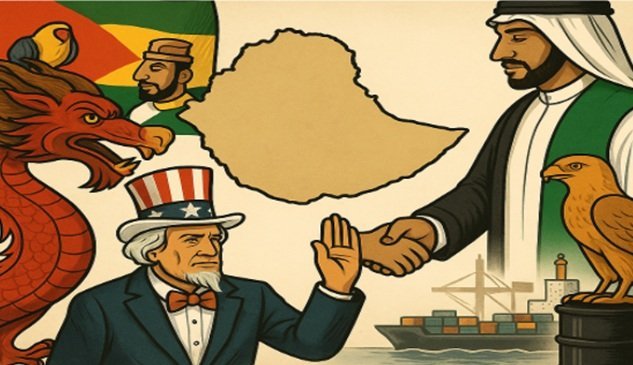
According to Henry Kissinger, the German-born American diplomat and political scientist who played a key role in shaping U.S. foreign policy during the first Cold War while serving as Secretary of State and National Security Advisor under Presidents Nixon and Ford, the world is now experiencing a new kind of Cold War—an economic one. This modern conflict is represented by two poles: the United States and China. The first Cold War was an ideological conflict between the U.S. and the former Soviet Union, characterized by a capitalist-versus-communist world order. In contrast, the current rivalry is an economically driven conflict between the U.S. and China. The U.S. leads the traditional Western-dominated global economy, while China leads a bloc known as BRICS, which now includes 21 countries, among them the United Arab Emirates (UAE) and Ethiopia.
It is reported that the late Meles Zenawi, was a staunch ally of Western powers, fighting proxy wars on behalf of the U.S.-led bloc to dismantle the Soviet-backed Derg regime in Ethiopia. Later, Meles remained a strong supporter of the Western order in the fight against terrorism, which is why he sent troops to Somalia to combat Al-Shabaab. However, he faced opposition from the West when he began opening Africa to growing Chinese influence economically. This shift was symbolized by the construction of the African Union headquarters in Addis Ababa—built by China—as well as the Belt and Road Initiative expanding across Africa, a landmark project that underscored China’s rising dominance on the continent. Some even attribute his death to his controversial role at the United Nations Climate Change Conference (COP15) in Copenhagen, where he served as chief negotiator and spokesperson for Africa challenging the western order, and to his initiation of the Grand Ethiopian Renaissance Dam (GERD), which went against the interests of the Western-backed Egyptian position. That may be one of the main reasons why the Western nations move their embassies and activities to Nairobi, away from Addis Ababa, to maintain their influence across eastern Africa, and hence Africa.
UAE influence in Ethiopia
The UAE has been expanding its influence in Eastern Africa over the past couple of decades through a combination of economic, political, military, and diplomatic efforts. Its influence in the region can be categorized as follows: (i) Economic influence – through investments, trade, control of ports and logistics, as well as aid and development assistance; (ii) Political and diplomatic influence; (iii) Military and security presence; and (iv) Cultural and religious influence. This expansion is largely enabled by the UAE’s substantial financial resources and its ambitious leader to dominate the middle east and beyond. Given Ethiopia’s strategic importance as a gateway to Africa—hosting the headquarters of the African Union and having the largest population in Eastern Africa (accounting for almost 27% of the 16 East African nations, or 84% of the Horn of Africa countries)—the UAE has increasingly targeted Ethiopia in its efforts to compete with Saudi Arabia and China for regional dominance.
Since coming to power seven years ago, Abiy Ahmed Ali has heavily relied on the UAE for various forms of support. He has reportedly received billions of dollars on several occasions from the UAE leader, Sheikh Mohamed bin Zayed Al Nahyan. However, this support has not come without conditions. Over time, the economic inflow—and consequently the influence—of the UAE in Ethiopia has grown significantly. Reports suggest that Abiy has ceded the Al-Fashaga land, located in the northwestern part of the country along the border with Sudan, to the UAE for agricultural use. There are also claims that Abiy is attempting to gain access to the Red Sea by pursuing control over Eritrean ports such as Assab and Massawa, potentially through military means. Additionally, it is reported that he has sought control over a port in Somaliland by signing a memorandum of understanding (MoU) with the internationally unrecognized state. Furthermore, there are reports indicating that many of the new buildings in Addis Ababa have been sold to UAE investors. Even his palace is built from the money Abiy partly got from UAE. Hence UAE is owning and controlling Ethiopia economically. That means BRICS is controlling Ethiopia.
Abiy Ahmed has reportedly used advanced drones provided by the UAE to target and dismantle more than 650,000 young soldiers from Tigray during the two-year civil war. It has also been reported that these drones have been used to carry out attacks on civilians in several areas across the Amhara region over the past two years. Similar drone strikes have been documented in various parts of the Oromia region over the past four years. Now, the UAE is reportedly supplying more drones to Abiy in preparation for potential conflict with Eritrea and other parts of the region. Just as the UAE has been accused of contributing to instability in Yemen and Sudan, it is now playing a destabilizing role in Ethiopia—a nation of over 135 million people. This suggests that the UAE is using Ethiopia as a platform for proxy warfare. Furthermore, the UAE appears to be pursuing broader ambitions to exert control over Eastern Africa, with its influence extending as far south as Tanzania.
Is the West sleeping or deliberately UAE to do so?
Now the question is: Is the West allowing this willingly by design, or is it already beyond their control? There are two theories. The first theory is that the Western order has started dismantling and weakening nations through a third country – a new proxy war method. They do this by boosting small nations like the UAE and Qatar economically, allowing them to become wealthy through their petroleum resources. Emirati nationals number only about 1.44 million out of the country’s total population of 11.06 million, and in Qatar, approximately 370,000 of the 3.1 million residents are Qatari citizens. In principle, having petroleum means your country is supposed to be rich, but in reality this does not guarantee wealth. Just look at Venezuela. If a global power structure does not allow you to be wealthy, you cannot effectively use these resources. If this theory is correct, it means Western nations are allowing the UAE to create havoc and disorder in Ethiopia, Sudan, and Yemen. The second theory is that Western nations are losing their robust power to dominate and control the world. In this power vacuum, even small nations like the UAE are using their economic muscle to dominate economically disadvantaged, but resource-rich, continents like Africa. Especially with the rise of Trump, America and its allies have become weaker, and the West is no longer in control of the world as it used to be in the past.
Now, which theory is correct? Is the West sleeping, or is it empowering the UAE to do whatever it wants in Ethiopia? Whichever theory is working; Ethiopia is on the verge of disintegration. Abiy and his allies have a distorted view of the world. They are so conflicted in their souls that they cannot lead the 135 million-strong nation peacefully. They are incompetent, inflicted by corruption, and unstable. They lack the capacity to govern. They have no understanding of governance or the rule of law, nor do they grasp what sustainability means. They cannot comprehend the UN’s Sustainable Development Goals (SDGs). They are acting like terrorists to their own people. They have sent the national army to fight against their own people in the Wellega, Tigray, and Amhara regions. They continuously create division and instability across the nation and neighboring countries. If this continues, there could be a flood of refugees fleeing the country in the coming years. The Army Chief has openly called for one region to secede. No Army chief has never said such words openly to its country. But the army chief was speaking of what Abiy Ahmed Ali said many times- “If I can not rule this country – I will destroy it.”
Way out from the trouble – Send the third envoy ?
Abiy must go. He is unfit and incompetent to lead a nation of more than 86 ethnic groups. For this to happen, the UAE must stop financially and militarily supporting him—especially by providing drones, which Abiy often boasts about using. Western powers should impose sanctions on him through the IMF and World Bank; only then will his grip on power weaken. Ethiopians can come together to form a new transitional government. The Fano forces are dismantling military power in the Amhara region at an alarming rate. Rebels in Oromia continue to fight government forces, and the Tigray Defense Forces (TDF) are reorganizing to resume hostilities. The army chief recently spoke openly about the possibility of a fourth round of war with Tigray forces. Several prominent political figures from various ethnic groups—along with scholars in the diaspora—have reached a common understanding and are actively engaging in meaningful discourse. There is a growing consensus that Ethiopia can be saved from disintegration by building a broad coalition of forces. This must be the way forward.
The Western world has sent two Special Envoys for the Horn of Africa since 2021. The first was Jeffrey Feltman. Abiy negotiated with him to stay in power after claiming victory in the second war with the Tigray forces. Later, the U.S. appointed Ambassador Mike Hammer as Special Envoy. He participated as one of four mediators—alongside Olusegun Obasanjo, Uhuru Kenyatta, and Phumzile Mlambo-Ngcuka—in the AU-led negotiations held in Pretoria in late October and early November 2022, resulting in a peace agreement between the Ethiopian government and the TPLF. But Abiy later systematically undermined the Pretoria Agreement by making a separate deal—known as the Halal Kela agreement—with TPLF leaders. He was supposed to create stability through the Pretoria Agreement. Instead, he betrayed the African Union, undermined U.S. initiatives, and—most importantly—betrayed the Ethiopian people. He can no longer be trusted. He has exhausted all benefit of the doubt. He must go. It is time for a third Special Envoy for the Horn of Africa—but this time, without Abiy. This effort must involve the active forces on the ground and the political elites and scholars who are now willing to come together to stop the growing danger the country is facing.
Editor’s Note : Views in the article do not necessarily reflect the views of borkena.com
__
Support Borkena : https://borkena.com/subscribe-borkena/
Join our Telegram Channel : t.me/borkena
Like borkena on Facebook
Add your business to Ethiopian Business Listing / Ethiopian Business Directory Business Listing Toronto
Join the conversation. Follow us on X (Formerly Twitter) @zborkena to get the latest Ethiopian News updates regularly. Subscribe to YouTube channel To share information or for submission, send e-mail to info@borkena.com