
Daniel Kassahun
The Modern-Day Handshake
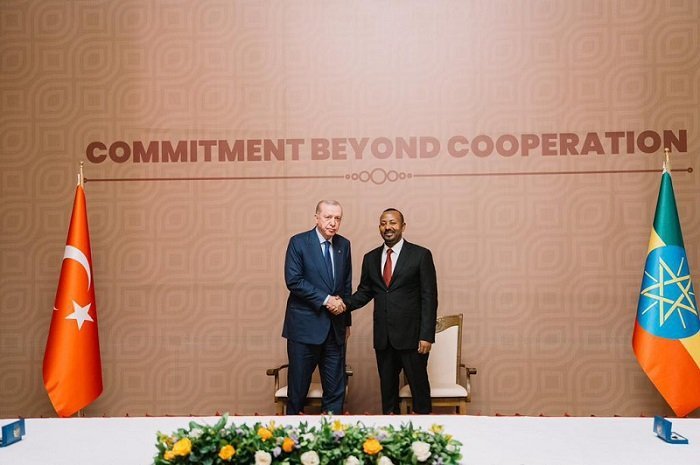
On February 17, 2026, President Recep Tayyip Erdoğan arrived in Addis Ababa—his first visit in eleven years. The ceremonial handshake between the two nations carried the weight of diplomatic optimism. A new memorandum of understanding on energy cooperation was signed, signaling a commitment to deeper ties. The capital buzzed with talk of opportunity. Yet in the Horn of Africa, history has a way of recycling itself—old dynamics wearing the costumes of something new.
Supporters of the administration hailed the visit as a masterstroke of diplomatic theater. For them, attracting the Turkish titan to Addis was a signal of strength—a deepening of trade ties and a bold elevation of Ethiopia’s standing on the global stage. It was a narrative of progress, profit, and partnership. Opposition voices, however, peered through the pageantry and saw a different shadow. To them, the visit was a subtle, soft-spoken warning. They interpreted Ankara’s presence as a calculated move to chill any renewed fever for confrontation with Eritrea and to keep a lid on the simmering tensions of the Horn.
Both sides of the aisle remain locked in a struggle for immediate political leverage. They parse every word of the communique for local advantage, yet neither side seems to zoom out. Neither side looks past the handshake to see the five-hundred-year-old ghost standing in the room. They are busy counting the coins of today while ignoring the debt of history.
From Cannons to Drones
History in the Horn of Africa does not march in a straight line; it circles back on itself. During the 2020–2022 Tigray conflict, Turkey supplied the Ethiopian government with the Bayraktar TB2—now a modern emblem of Ankara’s expanding reach. Satellite imagery eventually confirmed what the battlefield had already revealed: Turkish drones were helping dictate the tempo of the war, reversing the dangerous advances of the Tigray Defense Forces toward Addis Ababa.
Yet this episode was not merely about battlefield technology. It illuminated something deeper—a structural unease embedded in the Ethiopian state. Military partnerships, particularly with Turkey, often surface most visibly in moments of internal strain. And beneath those moments lies a persistent geopolitical anxiety: the question of access to the sea.
For half a century, the Red Sea has undergone a striking transformation in Ethiopia’s political imagination. It has been praised as a “vital artery,” dismissed as a “watering hole for camels,” and resurrected once again as a “breath of life.” The coastline itself has not moved. But its symbolic weight has expanded and contracted with the country’s political fortunes. Each rhetorical swing reflects more than policy debate; it reflects a national mood oscillating between defiance and vulnerability.
The reliance on external military support and the longing for maritime access are not separate stories. They are threads of the same fabric.
The Shared Sacred Map
What began with gunpowder now resonates in the realm of faith and memory. Beyond drones and treaties, Türkiye occupies a place in the Ethiopian imagination as a land of sacred echoes. Christians trace the missionary journeys of Paul across Anatolia and gaze toward Mount Ararat, the legendary resting place of Noah’s Ark. For Muslims, Istanbul’s historic mosques and the enduring shadow of the Ottoman Caliphate hold a deep spiritual pull. Centuries before ink ever sealed a treaty, this was a bond written in faith.
Prisoners of Geography
Stand atop the jagged peaks of the Ethiopian highlands and the paradox becomes almost poetic. The sea feels close—close enough, perhaps, to imagine the faint scent of salt carried inland by the wind. Yet for five centuries, that shoreline has remained beyond reach: visible on the map, absent in sovereignty. It is a coastline remembered more in history than experienced in practice. A mountain civilization without a harbor. Kings of altitude without a dock.
In contemporary debate, the phrase Prisoners of Geography, popularized by Tim Marshall, has become shorthand for Ethiopia’s predicament—a large nation confined by the hard lines of the map. The metaphor resonates because it captures something real: geography can constrain ambition.
But geography alone does not build prisons. Coastlines are lost through power, not plate tectonics.
So the deeper question lingers—less frequently asked, but historically unavoidable: who laid the first stones of these walls? For many, the answer leads back through centuries of imperial rivalry to the expanding reach of Ottoman power along the Red Sea coast.
Cannons at the Shore
In the sixteenth century, the Horn of Africa became a battleground in a wider imperial rivalry. As Portugal expanded into the Indian Ocean, the Ottoman Empire moved to contain it. The Red Sea was fortified, ports such as Zeila and Massawa militarized, and firearms funneled to regional actors willing to challenge the Ethiopian highland kingdom. The aim was strategic: prevent a strong inland ally of Portugal from consolidating power.
Ethiopia’s sovereignty became entangled in this global contest.
Ethiopian historian Tekletsadik Mekuria recounts how figures like Mahfuz of Harar were not simply local commanders but players in a larger geopolitical design. Modern firearms did not arrive randomly; they arrived with purpose. During the reign of Emperor Lebna Dengel, Ottoman-backed weaponry strengthened Ahmed ibn Ibrahim al-Ghazi’s campaigns, shifting the military balance.
The turning point came at the Battle of Shimbra Kure in 1529. Gunpowder disrupted traditional warfare, imperial forces faltered, and the emperor withdrew into the northern highlands. What followed was not merely defeat but destabilization. Internal divisions widened, provincial loyalties fractured, and civil war intensified—now fueled by the resources of distant empires.
Later, Emperor Sarsa Dengel pushed Ottoman forces back toward the coast in 1589. Yet control proved elusive. Ottoman troops withdrew into fortified ports and the Dahlak Archipelago, sustained by naval power. Geography reinforced strategy: highland armies, formidable in cool mountain air, struggled to endure the punishing heat and disease of the lowlands. They could reach the shore—but they could not hold it.
In countering Portugal, Ottoman involvement became one of several forces shaping Ethiopia’s internal instability, interacting with local dynamics and broader regional rivalries. The cannons at the coast did not just defend an empire; they reverberated inland, deepening fractures and reshaping Ethiopia’s political trajectory for generations.
What We Sit On, Wear, and Watch
The relationship is no longer confined to war rooms or high-stakes signing ceremonies. It has migrated from the battlefield into the sanctuary of the living room, weaving itself into the very fabric of daily life.
Turkish television dramas, dubbed into the melodic flow of Amharic, now dominate Ethiopian screens. For many households, the winding, fictional alleys of Istanbul feel more intimate and familiar than the streets of neighboring African capitals. It is a masterful pincer movement of influence: Hard Power secures the state’s borders, while Soft Power—dressed in Istanbul high-fashion and romantic intrigue—remodels the Ethiopian dream from the inside out. Ankara is no longer just a partner; it is a roommate.
Meanwhile, Turkish furniture has flooded the showrooms of Addis Ababa, turning local homes into galleries of Anatolian style. Turkish textiles and garments have claimed the markets, outshining cheaper alternatives through a seductive blend of durability and aesthetic flair. In quiet but undeniable ways, Türkiye has become the architect of the Ethiopian domestic experience. It influences what they sit on, what they wear, and what they watch. Hard Power and Soft Power often reinforce each other, shaping influence in complementary ways.
The drone in the sky and the sofa in the salon are part of the same grand design.
A 3,500-Kilometer Shadow
Ankara sits roughly 3,500 kilometers from Addis Ababa—a distance that spans half the continent, roughly equivalent to the flight path from Addis to Lagos. Geographically, Türkiye is satiated; it is a maritime titan with the Mediterranean at its feet and the Black Sea at its back. It is not a power gasping for air or seeking relief from a landlocked cage. And yet, the Red Sea continues to pull at Ankara like a tide.
Turk’s engagement with Red Sea has remained strikingly, almost unnervingly, consistent for five centuries. The tools of influence have evolved, but the hand remains the same: from the wooden hulls of Ottoman fleets to modern coastal fortifications; from the roar of naval artillery to the quiet whispers of diplomatic mediation. The strategic arc is not a jagged line of accidents, but a smooth, continuous curve. Türkiye’s presence in the Horn is not an episode. It is not a temporary headline or a fleeting interest. It is a historical constant.
The Art of Selective Memory
Government-aligned scholars often weave history like skilled artisans, threading stories of shared heritage and cooperation. They highlight Harar’s Ottoman echoes and portray Türkiye as a modern partner and stabilizing force. These threads contain truth. But every tapestry is defined as much by what it omits as by what it displays. History becomes a curated gallery—some paintings illuminated, others left in shadow.
Notably, it is unsurprising that Türkiyewas among the first states to recognize Eritrea’s independence in 1993. Some analysts interpret this early recognition as evidence of Ankara’s desire to cultivate strategic influence in the Red Sea region and recalibrate long-standing regional balances. Others view it as a standard act of diplomatic engagement with a newly sovereign state. Either way, the episode illustrates Ankara’s persistent interest in the Red Sea and the Horn of Africa—reflecting a durable strategic posture rather than a transient diplomatic gesture.
Far less attention is given to the sixteenth-century militarization of the coastline. Naval fortifications that once constrained Ethiopian autonomy—effectively turning the highland kingdom into a landlocked fortress—are rarely discussed. The long legacy of maritime vulnerability that followed the introduction of Ottoman gunpowder has faded from public memory. This is not always deliberate erasure; it is often a prioritization of convenience.
In the current political climate, it is easier to celebrate the drone that patrols the sky than to recall the cannon that once closed the gate. Yet a future built on silence risks resting on unstable ground.
The Ultimate Question
Türkiye’s ambition is nothing if not coherent. Its engagement with the Red Sea is not a series of disjointed events, but a masterclass in long-term strategy. From the thunder of Ottoman artillery to the high-altitude whir of Bayraktar drones, and from the stone walls of coastal fortresses to the digital ink of energy memoranda, the strategic through-line is unmistakable.
Ankara knows exactly where it stands; the question is, do we?
Can Ethiopia truly claim that sea access is an “existential” necessity while fastidiously avoiding the very history that explains our isolation? Can a partnership ever truly flourish if it is rooted in a convenient, collective amnesia? Is it possible to build a future with the very power that helped forge the locks on our geographic prison without first demanding historical clarity?
The Ottoman cannons are silent now, replaced by the low hum of drones overhead. Yet Turkey’s influence in Ethiopia extends far beyond the geopolitical arena. Its cultural and economic footprints are woven into everyday life. Ethiopians watch the romance of Istanbul unfold on their screens, reclined on Turkish velvet. Many travel for medical tourism—hair transplants, cosmetic procedures, and specialized care—seeking treatment in Turkish clinics. These connections are real and meaningful.
But they also carry a subtle irony. The same nation whose drones now help shape Ethiopia’s security landscape is the successor to an empire that once helped close the maritime gateways that defined our historical vulnerability. The hand that today extends partnership and opportunity once played a role—directly or indirectly—in a longer historical process that left Ethiopia landlocked and searching for access to the sea. History is rarely simple. It moves in layers, and those layers deserve honest reflection.
Geopolitics does not reset; it accumulates. It is a slow, heavy layering of influence, debt, and design. And five centuries is a massive accumulation to ignore.
The past isn’t dead; it is simply sitting in our living rooms.
================================
Daniel Kassahun (PhD) is an associate professor who occasionally writes on the geographical dimensions of Ethiopia’s contemporary challenges.
Editor’s Note : Views in the article do not necessarily reflect the views of borkena.com
__
Support Borkena : https://borkena.com/subscribe-borkena/
Join our Telegram Channel : t.me/borkena
Like borkena on Facebook
Add your business to Ethiopian Business Listing / Ethiopian Business Directory Business Listing Toronto
Join the conversation. Follow us on X (Formerly Twitter) @zborkena to get the latest Ethiopian News updates regularly. Subscribe to YouTube channel To share information or for submission, send e-mail to info@borkena.com