
Eyassu Epheraim G Hanna
London UK
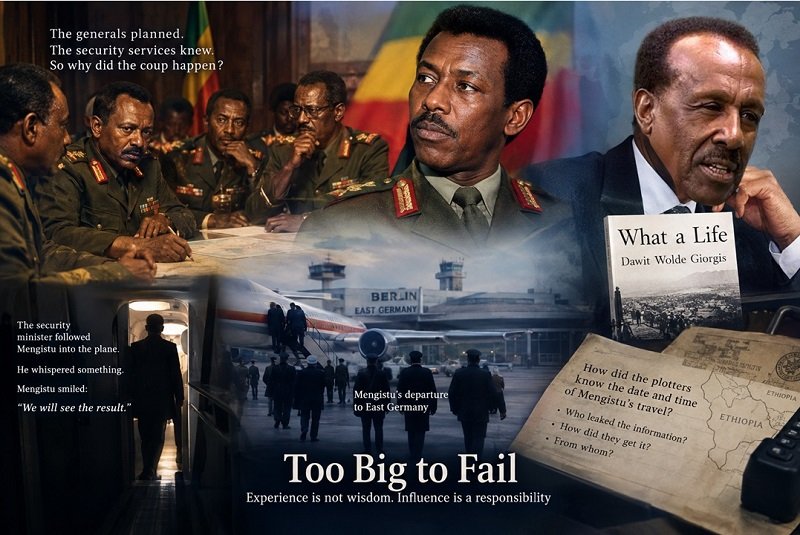
The phrase ‘too big to fail’ became famous during the financial crisis of 2008. It described institutions whose collapse could damage the wider system so severely that governments were forced to treat their survival as a matter of national interest. I have borrowed the phrase for a different purpose. Ethiopia, too, has produced people whose reputations, experience and influence have become so great that their mistakes cannot be treated as merely personal. When such people make political judgements, the consequences can travel much further than their own lives. Their words can influence movements, their reputations can shape the decisions of younger people, and their mistakes can become part of the history inherited by another generation.
Dawit Wolde Giorgis is one of those people. For many Ethiopians, his name carries the weight of a long political life: a military officer, governor of Eritrea before independence, senior public servant, international consultant, author and commentator. He has lived through several of the decisive periods of modern Ethiopian history and has spent decades speaking and writing about the country’s politics, security and international affairs. For many younger Ethiopians, including myself, that background creates an expectation of something more than knowledge. It creates an expectation of wisdom. That is why I find some of his recent political interventions so troubling. My concern is not that he has changed his mind. Political circumstances change and intelligent people are entitled to revise their views. My concern is that a man whose judgement carries such weight should be prepared to explain major changes in that judgement, because the consequences of his political advice are not confined to himself.
The recent debate over Tsimdo brought that concern back to me. On 13 August, Dawit argued publicly that Amhara Fano did not need an alliance with the TPLF and should remain on its own course. Less than a month later, on 5 September, he welcomed an alliance involving Fano and the TPLF and called for full support for the initiative. Perhaps he had learned something new. Perhaps the circumstances had changed. Perhaps he had information unavailable to the public. All of those explanations are possible. But a dramatic political reversal from a figure of his stature raises a simple question: what changed, and why should the people who have trusted his judgement continue to trust it? That question becomes even more serious when we look back at the decisions he describes in his own memoir.
I have been reading the section of Dawit’s book, What a Life, dealing with the events surrounding the failed military coup of May 1989, particularly pages 96 to 116. I am not attempting here to write a complete history of the coup, or to settle every dispute about what happened. What interests me is the quality of political judgement revealed by Dawit’s own account. His narrative says that his first indication of a possible coup came through his discussions with General Fanta Belay. After completing his work at Princeton, he became involved in efforts to contact Ethiopian officers and to consider what might follow the removal of Mengistu. The proposed transition was not conceived simply as one group of military officers replacing another. Dawit’s account describes an effort to engage the armed opposition and to think about a wider political settlement.
That is where I begin to ask uncomfortable questions. Dawit describes discussions with the EPLF in Washington and London and says that his understanding was that ‘whatever the EPLF agreed to, the TPLF would comply’. He then describes a meeting with Isaias Afwerki in New York at the World Council of Churches. The passage is striking because Dawit openly acknowledges how hostile he had previously been towards Isaias. He writes that he had used every word available to him in English, Amharic and Tigrinya to demonise and vilify him. There is nothing inherently wrong with a former enemy deciding to negotiate. Politics often requires people to sit across the table from those they once regarded as enemies. In itself, that could be a sign of maturity. The question is different: what strategic calculation lay behind the decision to involve the EPLF in a project whose success depended on secrecy, and whose outcome could alter the political and military balance of Ethiopia?
If I place myself, hypothetically, in the position of one of the plotters, I would distinguish between approaching an armed movement about a future political settlement and revealing sensitive information about an active military conspiracy. I might need to know whether an organisation would accept a transitional government after Mengistu, but I would also have to ask whether its interests were aligned with mine and what it stood to gain if the operation succeeded or failed. The EPLF and TPLF had their own political and military objectives. Their interests could overlap with those of Ethiopian officers seeking to remove Mengistu, but they could also diverge sharply. A successful coup might have opened the door to negotiations and political transition. It might also have produced a new nationalist military leadership capable of stabilising the state and making the armed struggle considerably more difficult. We cannot know which future would have emerged. But that uncertainty is precisely why the calculation mattered.
Dawit’s own account makes the question more troubling. He writes about Berhe Habte Giorgis, a member of his team who had previously worked with him and had been involved in the planning. Dawit says that they came to suspect Berhe and removed him from the planning, only later discovering, according to Dawit’s account, that Berhe had been connected to the EPLF all along. Whatever one thinks of Berhe or of the accuracy of every part of that recollection, the episode tells us something important about the environment in which Dawit was operating: he knew that political and intelligence loyalties could be hidden, and he knew that the secrecy of the project was vulnerable. Yet he continued to engage the EPLF leadership at a high level. That does not prove that he acted irresponsibly. It does, however, justify a serious question about his judgement: what did he believe the EPLF would do with the knowledge it received, and what measures did he take to prevent the political project from becoming a security liability?
I am not claiming that the EPLF betrayed the coup, and I am not claiming that the TPLF deliberately exposed it to Mengistu. I do not have sufficient evidence to make either accusation. My point is narrower and, I think, more difficult to dismiss. A person taking responsibility for a project as consequential as the removal of a government by military means must assess not only his own intentions but the incentives of everyone around him. Wisdom in politics is partly the ability to understand that other actors are not simply supporting characters in one’s own plan. They have plans of their own. They may cooperate today and compete tomorrow. They may agree with the broad objective while opposing the means. They may calculate that your failure serves them better than your success. The central question is therefore not whether Dawit had good intentions. It is whether his judgement was equal to the complexity of the situation in which he had placed himself.
This is where the wider history of the coup becomes difficult to ignore. The operation failed, and senior military officers were subsequently killed in Addis Ababa and Asmara by forces loyal to the
Mengistu regime. In his own account, Dawit records the deaths of more than twenty-nine high ranking military officers associated with the coup. We cannot know with certainty what Ethiopia would have looked like had the coup succeeded. Perhaps those officers would have established another military regime. Perhaps they would have created a genuine transitional government. Perhaps they would have negotiated with the armed opposition. Perhaps they would have consolidated the army and made the war against the EPLF and TPLF more difficult. The counterfactual cannot be proved. But one fact remains: Ethiopia lost a substantial group of experienced senior officers at a critical moment in its history, and the country never had the opportunity to discover what that leadership might have done.
My own memory of that period makes the question of secrecy even more difficult for me. I was in Addis Ababa at the time, working for Médecins Sans Frontières Belgium. I was not a soldier, not a security officer and not a political insider. I was an ordinary citizen working for a humanitarian organisation, yet information about the possibility of a coup had reached our mission leadership well before the operation took place. I remember knowing about it in advance. My experience does not prove what Mengistu’s security services knew, nor does it establish how widely the information had travelled. But it does make one question difficult to avoid: if an ordinary person working for an NGO could hear about the possibility of a coup in advance, how secure was the conspiracy really, and what did the regime’s intelligence services know before the generals moved?
This question becomes more intriguing when read alongside Tesfaye Riste’s testimony in ምስክርነት: በባለሥልጣናቱ አንደበት, particularly the account on pages 163 and 164. Tesfaye raises the question of how the plotters could have known the timing of Mengistu’s confidential journey to East Germany. He records the suspicion that the information may have come from a senior officer connected to the National Information Centre. He also records a remarkable conversation relayed by a security officer who was travelling with Mengistu. According to that testimony, the National Security Minister followed Mengistu into the aircraft, approached him while he was seated, and whispered something to him. Mengistu responded with a smile, saying, ‘We will see the result.’ The minister then left the aircraft, the door was closed and the plane departed for East Germany.
I do not claim that this proves Mengistu deliberately allowed the coup to proceed. It does not. But it raises a historical possibility that deserves consideration. When a security apparatus knows that a conspiracy exists but does not yet know the full network of conspirators, there can be a strategic reason not to act immediately. An old principle of deception and intelligence is that one does not always strike at the first sign of movement; sometimes one allows the waters to become disturbed so that the actors beneath the surface reveal themselves. The phrase is older than any modern writer who has popularised it. In that sense, the question is not whether Mengistu had read a particular book on the ‘laws of power’. The question is whether his behaviour can be interpreted as the behaviour of a ruler who had decided to let the conspiracy expose itself. The evidence is not sufficient for a conclusion, but it is sufficient for a question.
And that question returns me to Dawit. If the regime’s security services already suspected a conspiracy, if confidential information about Mengistu’s travel had somehow reached the plotters, if people inside the wider political network could have divided loyalties, and if the coup planners were simultaneously approaching armed movements with their own strategic interests, then the margin for error was extremely small. Dawit was not an inexperienced observer standing at the edge of these events. By his own account, he was an important intermediary between the military plotters and the armed opposition. That position carried an extraordinary burden of judgement. He had to decide
whom to trust, what to disclose, what the different actors wanted and what would happen if the plan failed. The destruction that followed was therefore not an abstract political setback. It involved the loss of experienced military leadership and a dramatic alteration of Ethiopia’s political trajectory.
This is why I do not think the central question is whether Dawit should be called a hero or a failure. History is rarely so simple, and I have no interest in denying the achievements of a long public career. The more important question is whether the reputation we attach to experience sometimes prevents us from examining judgement closely enough. Dawit has spent decades accumulating knowledge, contacts, authority and historical credibility. Those achievements deserve recognition. But they also create a greater obligation. The more people trust a person, the more carefully that person must exercise and explain his political judgement.
The same principle applies to his recent political statements. I do not ask that Dawit never change his mind. I ask that, when he does, he explains the reasoning behind the change. When a person has become an important reference point for younger Ethiopians, a political reversal without explanation creates confusion that extends beyond the individual. It is not unreasonable to ask what new information produced the change, what previous assumptions proved wrong, and why the new position deserves confidence. To ask those questions is not disrespectful. It is accountability.
Perhaps that is the real meaning of ‘too big to fail’ when applied to political figures. It does not mean it is too important to criticize. It means too influential for failure to be treated as merely personal. A person may survive a bad political decision; the country may not be able to escape its consequences. A reputation can survive a contradiction; a political movement may not. An individual can move on from a failed calculation; a generation may inherit the consequences of that calculation for decades.
I have therefore come to think about Dawit less as a man who should be placed beyond criticism and more as a man whose stature makes criticism necessary. His own account of 1989 raises difficult questions about secrecy, trust, strategic calculation and political judgement. His recent political reversals raise a related question about accountability. In both cases, I return to the same principle: experience is valuable, but experience by itself is not wisdom. Wisdom is the ability to use experience to judge complexity, anticipate consequences, recognise limits and explain one’s decisions honestly.
There may be answers to the questions I have raised that I do not yet know. Dawit may have explanations for why he approached the EPLF, why he believed the TPLF would follow the EPLF’s decision, how he assessed the risks to the coup, and why he considered those risks acceptable. Perhaps there is information in private archives or in other testimonies that would change our understanding of the events. I am not pretending that this article has solved that history. I am saying that Dawit’s own memoir gives us enough material to ask whether the judgement behind those decisions deserves the unqualified respect that his reputation has often received.
That is ultimately why the title matters to me. The danger is not that influential people are incapable of failure. The danger is that we treat their influence as a reason not to examine failure seriously. Ethiopia has produced many politicians, generals, academics, religious leaders, businessmen and intellectuals whose reputations have crossed generations. We should honour achievement, but we should not confuse longevity with wisdom, status with judgement or reputation with accountability. People who have accumulated extraordinary influence have also accumulated extraordinary responsibility. When they succeed, they can help build a country for generations. When
they fail, the consequences can last just as long. They may therefore become ‘too big to fail’ in the only sense that really matters: their mistakes can become larger than themselves.
Dawit Wolde Giorgis may well have reasons for the decisions he has made throughout his long political life. I would like to hear them. But I also believe that a man who has spent so many years asking Ethiopia to listen to him must be willing to listen when Ethiopia asks difficult questions in return. That is not an attack on his age, his achievements or his place in history. It is an insistence that influence carries responsibility. And when a person has become important enough that his decisions can shape the expectations and choices of generations, we should never be afraid to ask the simplest question of all: was his judgement equal to the trust that was placed in him?
Editor’s Note: Views in the article do not necessarily reflect the views of borkena.com
__
Join our Telegram Channel: t.me/borkena
Like borkena on Facebook
To submit a press release, send the submission to info@borkena.com
Add your business to Ethiopian Business Listing / Ethiopian Business Directory
Join the conversation. Follow us on X (formerly Twitter) @zborkena to get the latest Ethiopian news updates regularly.
Dear Eyasu,
I sincerely appreciate your feedback and critique. I have always maintained that a key mark of a good manager, speaker, writer, or politician is the willingness to embrace criticism rather than shun it. It is in this spirit that I welcome your very constructive and decent critique.
These days, I often receive more insults and quick judgments than genuine concerns from colleagues and others. Many seem more interested in attacking someone’s image than in seeking real answers. Because of this, I was pleasantly surprised to learn that you have actually read my books and articles. Very few people take the time to read these days, yet those who don’t read are often the quickest to harshly criticize or insult those who are doing their best.
I am an old man now. Looking back on my journey, as I explained in my book, I have lived a life of trying and never giving up. In truth, I have tried far more times than I have succeeded. To me, real achievement is trying, even when you don’t get what you want. Certainly, my failures outnumber my successes because I have wished to do and be so many things; to me, the only true failure is not trying at all. Achieving a specific goal may fail for many reasons beyond our control, but the effort we put in is entirely up to us.
Yes, Eyasu, I have faced many failures. But I can assure you of one thing: though certain actions may look wrong in hindsight, I made every attempt in absolute good faith, given the circumstances at the time. In the introduction of my book, I spoke about conscience and my father’s advice. My guide—my North Star—has always been a clear conscience.
I have explanations for each issue you raised (particularly the Tismdo debacle), but I chose not to elaborate for good reasons. They were deliberate, considered acts. Bringing them up here would only spark another endless debate. I am glad I took the actions I did; I feel at peace with them.
Berehe was a distinguished Ethiopian officer and a graduate of the Military Academy. We had many Eritrean officers then who fought gallantly until the end. They were comrades in arms, among the finest. I had no reason to believe Berehe was not one of them. In all fairness, none of us suspected him. I believed he converted when the balance of power shifted toward the EPLF. It was more an opportunistic calculation than a commitment to the cause.
Regarding the secrecy surrounding the attempted coup: we took immense personal risks doing what we did and going to Naqfa. We were a small group and didn’t have the capacity or resources to verify much. Furthermore, they never told us exactly how they planned to remove Mengistu. We were not involved in the planning at all. We heard about it only afterward. If there was really a leak, it came from the other side, not this side, because our information on their plans was very limited. EPLF could have its own sources and information, but they did not get details from us.
Once again, thank you very much Dawit
Dear Major Dawit W/Giorgis,
I have carefully read the very respectful and instructive response you gave to Mr. Iyasu Efrem’s lengthy criticism. I found your response to be thoughtful and educational—not only for him, but for all of us—and a good example for others as well.
I feel that much of the information Iyasu presented in support of the conclusion he reached does not have a sufficient connection to that conclusion.
In particular, his comments regarding the cooperation and coordination among the military forces operating in Ethiopia appear to me to be based largely on assumptions made from the outside, without knowledge of the significant efforts, numerous meetings, and discussions that have taken place internally.
Therefore, my advice to him for the future would be to write and criticize based only on matters he knows accurately and for which he has sufficient information. This would make the discussion more constructive, balanced, and meaningful.
As for you, we deeply respect and appreciate the tremendous efforts you have made for the people and the country for more than fifty years, without becoming tired or discouraged. Your long years of dedication and service are an inspiring example to many.
With our deepest respect, we wish you a long life, good health, peace, and continued strength.