
“Political Oromummaa, in its dominant radical form, has become a closed ideological system that compromises the long-term mental health of new generations to short-term political mobilization,” Yonas Biru
“During our struggle as an Oromo liberation front, we systematically deconstructed Ethiopia in order to construct Oromo,” Lencho Bati, Founding member of the Oromo Liberation Front.
“Our problem is that we are unable to change our old strategy and evolve with changing local, regional, and global realities,” Lencho Bati, former, Deputy Secretary-General of the OLF.
This is the concluding installment of a three-part series. It begins with a caveat.
Oromummaa has two dimensions: social and political. The social ethos represents a commitment to Oromo cultural identity and pride, encompassing communal values, hospitality, and a sense of justice and welfare. In contrast, political Oromummaa particularly its radical wing advances an exclusionary, and at times, supremacist objectives. Nothing in this article denies the legitimacy of historical Oromo grievances, despite the politically-driven distortions embedded in its radical wing narratives.
This article focuses exclusively on the radical ethno-nationalist camp that currently dominates Oromo political space. Within that scope, it examines two interrelated issues that have been conspicuously avoided in Oromummaa discourse:
First, it examines why the dominant wing of Oromummaa consistently avoids evidence-based dialogue, relying instead on ad hominem attacks and a closed system that resists intellectual and political evolution.
Second, it explores the cumulative effects of decades-long historical distortions, cultural revisionism, and multigenerational ideological indoctrination that have sullied the psychology, worldview, and behavior of successive generations of Oromo political activists. This does not arise from Oromo identity, but from the sustained political weaponization of its history, culture and trauma narratives.
The discussion proceeds in three parts:
Part I examines the anatomy and the historical trajectory of Oromummaa and traces its path to radicalization.
Part II analyzes how leading Oromummaa scholars, despite sharply divergent in historical interpretations, converge in lockstep behind a common political agenda.
Part III explores how this convergence can be explained by multigenerational psychological conditioning, identity-political indoctrination, and grievance-mobilization dynamics.
Taken together, these sections illuminate how intergenerational myth-making, psychological conditioning, and trauma-based identity politics have shaped the Oromummaa movement and how a proud cultural identity has been disfigured into a trauma narrative. The danger is not merely political, but also psychological and possibly even epigenetic.
The Anatomy and Evolution of Oromummaa
The genealogy of Oromummaa has three key phases:
- The European missionary genesis of the late 19th and early 20th century;
- Eritrean writers who revived the original genesis beginning in 1973; and
- the radicalization of the Oromo liberation movement
Addressing these phases in order helps investigate whether the Oromo liberation movement, framed in a “colonizer vs. colony” paradigm, is an organic response to legitimate Oromo historical grievances, a product of 19th and early 20th-century colonial framing, or a hybrid of the two.
Johann Ludwig Krapf and Martial de Salviac, a German Protestant and a French Catholic missionary, respectively, are the two most influential early authors whose works laid the conceptual foundations of modern Oromummaa. Asmarom Legesse later provided the anthropological scaffolding, Asafa Jalata transformed it into a militant ideological doctrine, Mohammed Hassen and Ezekiel Gebissa supplied historical legitimacy, and Jawar Mohammed operationalized it through social media mobilization tools.
Johann Ludwig Krapf (1837–1843)
Krapf’s Travels, Researches and Missionary Labours in Eastern Africa (1860) viewed the Oromo through the Eurocentric framework of the day, describing them as “noble savages” yet paradoxically portraying them as “the most intellectual people of Eastern Africa,” with the potential to become the “Germans of Africa” if converted to Christianity.
He coined and popularized “Ormania” (by analogy to Germania) to describe a unified Oromo geographic domain. European missionaries and writers embraced this construct and framed the Oromo as a unified grand nation that could become a strategic field for Protestant mission activity and, in some cases, European political interest. Several historians, including Mohammed Hassen, note that Krapf was the first major European writer to systematically name Oromo territory as a single coherent region.
His Ormania construct later provided intellectual scaffolding for Oromo nationalist discourse, including the framing of Oromo territory as a colonized land vis-à-vis Ethiopian state expansion.
Martial de Salviac (1880s–1901)
De Salviac’s book, Un Peuple Antique au Pays de Ménélik, Les Galla (1901), written after his expulsion by Menelik II, birthed the duality of Oromummaa’s mythology: the romanticization of Gadaa and the demonization of Menelik.
Like Krapf, he praised the Oromo as a “Grand Nation,” celebrated Gadaa as an advanced egalitarian democracy, and still cast the Oromo as “pagans” awaiting salvation. He not only advocated for a free Oromo but also designated France as the liberating patron and the French Catholic as the anointed ministry for their salvation.
Parallel to this romanticism, he portrayed Menelik as a genocidal tyrant responsible for the loss of “five million” Oromos. The figure is repeated and megaphoned in modern radical discourse despite the fact that his exaggerated casualty claims are methodologically untenable and have been rejected by many scholars including Mohammed Hassen and Ezekiel Gebissa.
Writers such as Brian J. Yates and Donald L. Donham, among others, reference de Salviac extensively, while critiquing his ideological bias on grounds of its Eurocentric framing, colonial advocacy, evangelical zeal, and opposition to the rival power of the Ethiopian Orthodox monarchy.
While Krapf and de Salviac were undeniably products of 19th-century European racial and missionary imagination, their writings were selectively appropriated and repurposed a century later to serve a new political agenda.
Eritrean Influence: Reviving European Narratives
Asmarom Legesse’s works (1973 and 2000) revived and amplified de Salviac’s dual mythology. His 1973 work cites both Krapf and de Salviac as ethnographic foundations. His 2000 work put de Salviac’s vilification of Menelik on steroids.
Tesfaye Gebreab’s 1999 book የቡርቃ ዝምታ – የታሪካዊ ልብ ወለድ ድርሰት (The Silence of Burqa: A Fictional History Essay) played a major role in transforming the Anole mutilation narrative into a politically mobilizing national grievance. His work fused fiction with historical claim-making in ways that intensified interethnic hostility.
The Rise of Radical Oromummaa
The Oromo Liberation Movement began in earnest in the 1960s with the Macha-Tulama movement. The movement was originally framed as a struggle for equality, dignity, and democratic inclusion within Ethiopia. In 1967, the Haile Selassie government banned the movement and imprisoned its leaders, leading the Oromo diaspora in Germany, Saudi Arabia, and London to pick up the mantle.
This period marked the beginning of the radicalization of the Oromo liberation question. In 1973, the OLF emerged with an armed secessionist agenda supported by Eritrea and Saudi Arabia. Its ideology and operating principles were influenced by post-1960s anti-imperial movements and Marxist-Leninist student ideology.
In the late 1990s and early 2000s, a radical form of the Oromummaa movement gained momentum under the leadership of Asafa Jalata. Followers of the movement embraced its requirement to accept that the Oromo nation is a victim of:
- “Externally imposed cultural and religious identities.” More specifically, from Islam and Christianity whom Asafa calls “colonialist institutions.”
- “[Ethiopia is a colony of] “Ethio-Amhara colonialists who have imposed Ethiopianism ideology on the Oromo via physical coercion, including terrorism, mental genocide …”
Jalata characterized Oromos rejecting these claims as: “Biologically and culturally assimilated former Oromos, like their Habasha masters, are the defenders of Habasha culture, religion, and the Amharic language and the haters of Oromo history, culture, institutions, and Afaan Oromo.”
In 2010, Jawar Mohammed, who had been an Ethiopianist Oromo reformist, pivoted toward Jalata’s camp, condemning the OLF as a “complete failure” and announcing himself as an adherent of Jalata’s two litmus tests for Oromummaa advocates. He announced his first and foremost allegiance was to his identity as an Oromo, even over his allegiance to his religion. He disavowed his Ethiopian identity, claiming it was “imposed” on him by colonizing Ethiopia.
The torch thus passed from OLF insurgency to Oromummaa ideology empowered by Jawar’s organizational prowess. De Salviac’s century-old dual mythology of romanticizing Gadaa and demonizing Menelik got a new lease on life and became the movement’s unifying narrative with digital-age mobilization campaign.
Oromummaa’s Political Conformity amid Substantive Historical Disagreement
The modern Oromummaa movement rests on six mutually reinforcing myths:
- The myth of a Pan-Oromo nation during the 16th-century Gadaa expansion.
- The myth that this nation was governed by an egalitarian Gadaa, allegedly rooted in the universal moral codes of safuu (ethics) and nagaa (peace).
- The myth of Menelik II as a foreign colonial genocider who destroyed the Oromo nation, dismantled Gadaa, and decimated 5 million of its 10 million population.
- The myth of Irreechaa as an ancient, organic, Pan-Oromo culture, shared uniformly across all Oromo territories and confessions.
- The myth that the northern part of Ethiopia, including Wello, is Oromo ancestral land.
Together these myths: (1) create moral asymmetry by presenting Gadaa leaders as noble and Ethiopian governments as evil; (2) legitimize the Oromummaa narrative that the Oromo were a nation run by a pan-Oromo Gadaa with a unique unifying culture before Menelik II’s conquest decimated it; and (3) assert that the Oromo have the historical and moral right to restore themselves as a sovereign nation.
The striking paradox is that leading Oromummaa intellectuals disagree profoundly on the historical validity of these load-bearing myths and yet converge absolutely on the Oromummaa political project built upon them. This ideological conformity is maintained by restricting internal debate and ostracizing dissenters.
If the five load-bearing mythologies falter under counter-evidentiary scrutiny, the entire edifice of Oromummaa’s moral, political, and historical claims collapses. This essay takes up that task by interrogating them.
Was the Gadaa System Egalitarian and Democratic or Hierarchical and Subjugative?
In “Gadaa as the Fountain of Oromummaa and the Theoretical Base of Oromo Liberation”, Jalata wrote:
“Oromummaa that is based on the best elements of the Gadaa civilization, worldview, egalitarian democracy, and justice for all can help Oromo nationalists to overcome the ideological and theoretical confusions that attempt to hijack or abort the Oromo struggle for liberation, sovereignty, peace, and security.”
Jalata goes a step further to stress that Gadaa as an egalitarian democracy is not merely structural but also morally and ethically grounded in safuu (moral order) and nagaa (peace).
In “Politico-Cultural Prerequisites for Protecting the Oromo National Interest”, he further asserts:
“The foundations of national Oromummaa are individual and collective freedom, justice, popular democracy, and human liberation, which are built on the concept of safuu (Oromo moral and ethical order) and are enshrined in gadaa/siiqqee principles.”
By contrast, Mohammed Hassen, in his widely praised book “The Oromo of Ethiopia: A History, 1570-1860” (Cambridge University Press, 1990), offers a radically different picture. He documents the exploitative and subjugative aspects of Gadaa expansion:
“The Oromo raids resulted in large-scale displacement, absorption, and enslavement of conquered peoples. The Oromo term for the conquered people was Gabaro (‘those who serve’). Most of the conquered people… were no longer equal members of a clan within which they were incorporated, but slaves who were used as gifts and commodities for sale.”
Hassen also notes that the process of “adoption” as “sons” of a clan often masked a system of coerced servitude. His account is corroborated by Asmarom Legesse and other scholars.
Furthermore, there is broad consensus in historical records documented by, among others, Mohammed Hassen (1990, 2015), Marco Bassi (2005), and P.T.W. Baxter (1994), establishing that (1) safuu and nagaa were creeds applicable to “pure” Oromos only, and (2) the Gabbaros were violently subjugated and enslaved.
Far from being an innocent victim of Ethiopia’s state formation experience, Oromo was party in the endeavor. Mohammed makes this clear, stating: “the Oromo assimilated more than they were assimilated by others.” This included absorbing defeated tribes “as clients or serfs (gabbaro) into the [Oromo] tribal structure.” The assimilation process culminated with an oath taking ceremony led by an Oromo Aba Gadaa, repeating: “I hate what you hate, I like what you like, I fight whom you fight, I go where you go, I chase whom you chase.”
Those whose culture, identity and culture was decimated by this process included: Gafat, Maya, Harla, Hinnare, Doba, Busaasee, Werji (Tigri-Werji), Damot, Bizamo, Ganz, Fatagar, Dawaro, Waj, Sharka, Gedman, Angot, Waleka, Bosha, Gabato, Mucucoo, Agadi, Kaza, Warago, Gangaa, Konchii (Konch), Shat, Gumar, Masango (Majang), Galila, Chebo, Abado, Malima, Hadiyya, Bushe, and Garre.
Oromo expansion was not uniquely violent. It followed the same pattern of raiding, forceful assimilation, and dominance characteristic of state formation throughout the region. What is unique is the Oromummaa narrative that constructs the Oromo as an inherently innocent, peaceful, and righteous victim of aggression.
Was there an Oromo Nation Governed by a Pan-Oromo Gadaa System?
In “The Battle Between Ethiopianism and Oromummaa: From the Thirteenth Century to Today” (2025), Jalata asserts there was a unified “Oromo country called Oromia today” as far back as 1522. He further claims that during the 16th-century Gadaa wars “many Oromo branches were under one Gadaa government.” These claims align with his prior writings like Oromia & Ethiopia: State Formation and Ethnonational Conflict (2005), where he argues the wars addressed “territorial dispossession” from medieval expansions by Abyssinian rulers.
Historical consensus holds that the Oromo did not possess a centralized state or unified polity in the pre-19th century period. Their institutions were autonomous and clan-based. Nor was there a Pan-Oromo Gadaa. Tulama, Macha, Guji, Arsi, and Ituu were autonomous polities (moieties). Each had its own assembly (Gumii) and an Abba Gadaa elected according to separate ritual calendars and age-set sequences, reigning over a sovereign territorial domain. Neither an egalitarian Gadaa nor a Pan-Oromo nation existed as the Oromummaa ideology portrays. This is documented by Legesse (1973, 2006), Hassen (1990, 2015), Bassi (2005), and Baxter (1994).
Hassen provides the Gibe states as an example:
“The Gibe [states] were interlocked through political marriages and secret alliances. Though these states shared cultural homogeneity, language, religion, commercial contacts, and administrative systems, they failed to coalesce into a single political entity.”
He suggests that a process of state formation only began in the 19th century:
“Over decades during the seventeenth and early eighteenth centuries, changes in production and settlement set the stage for the formation of the five Oromo Gibe states around the beginning of the nineteenth century.”
Did Menelik Decimate the Oromo Nation and the Gadaa System?
No reasonable person denies the atrocities of war wrought on the Oromo people during Menelik’s territorial expansion and power consolidation campaign, nor the subsequent historical political marginalization and cultural suppression the Oromo endured.
The myth this article highlights is the claim that Menelik decimated the Oromo population by “five million,” destroyed the Oromo nation, and dismantled the Gadaa democratic system.
The claim that Menelik reduced the Oromo population from 10 million to 5 million between 1870 and 1900 is mathematically impossible. Contemporary estimates by Enrico Baudi de Vesme (1890), Alexander Bulatovich (1897), and the 1930s Italian colonial census all place the total Oromo population between 3 and 4 million during that period.
The claim that Menelik’s conquest reduced the Oromo population from 10 million to 5 million lacks any primary-source corroboration and is rejected by the overwhelming majority of academic historians—including critical Oromo scholars such as Mohammed Hassen and Ezekiel Gebissa—who place total excess mortality (from warfare, famine, disease, and reprisals) in the low-to-mid hundreds of thousands across all southern peoples combined.
The accusation that Menelik II destroyed the Oromo nation and a Pan-Oromo Gadaa is equally bizarre. There was no such thing as an Oromo nation, and the Gadaa governance and military order had run its lifecycle two to three centuries before Menelik’s conquest.
Endalkachew Lelisa Duressa and Jawar Mohammed acknowledge the Gadaa system had declined centuries before Menelik’s expansion due to internal factors. This is consistent with Hassen’s observation that the primary cause of Gadaa’s demise was internal revolt, leading to gabbaro uprisings in 1681, nearly three centuries before Menelik.
“The Oromization of the conquered did not exclude their subjection to extractive and exploitative relations despite the fact that they were incorporated in the gada system… The conquered people, whose pride was humbled in the dust of slavery, and whose number was reduced through sale, realized that the only hope of safety was open rebellion against their arrogant masters… Gada governance was not able to resolve its internal contradictions, which, for example, led to the gabbaro uprising of 1618, and eventually to the demise of gada governance…”
This myth functions as Oromummaa’s core trauma narrative that legitimizes permanent mobilization, emotional arousal, and an identity born out of collective grievance.
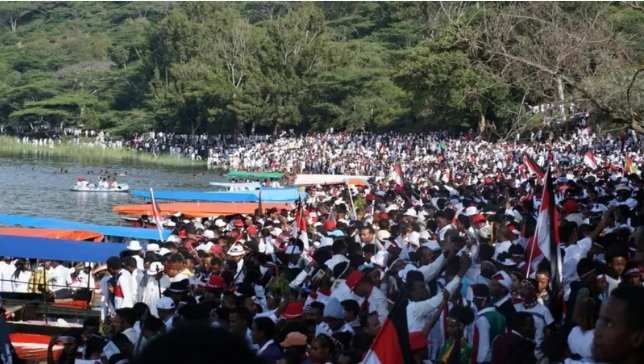
Is Irreechaa a Pan-Oromo Culture or a Political Artifact?
The Irreechaa narrative is contentious within the Oromummaa intellectual colony. In “Irreechaa – The colors, the identity and the pride of Oromo nation,” Alemayehu Diro states:
“Irreechaa constitutes one of the several religious and cultural practices defining the hallmark of the entire Oromo life.” Jawar Mohammed sees it as non-sectarian cultural heritage. Awol Allo concurs, describing it as “cultural self-affirmation.”
On the other hand, Gemechu Megersa markets it as a religious practice and berates those who oppose his views as “አቃጣሪ” (heretic). In line with Megersa, Asebe Regassa asserts Irreechaa “has been understood and practiced within the context of the Oromo religion, Waaqeffanna – a belief in one supernatural power called Waaqaa (God).” Similarly, a government run website describes Irreechaa as a religious celebration where Oromos worship Waaqaa at rivers and mountains, believed to host His governing spirit.
A Tourist website provides a clearer picture: “Oromo people travel to the shore of Lake Hora, near Debre Zeyit, to thank their god and to request good fortune, health, and fertility for the coming sowing season. Perfumes and butter are smeared on trunks of ancient fig trees.”
Muslims and Christians account for 95% of the Oromo population. In contrast, Waaqeffanna, of which Irreechaa is a part, represents only 3.3% of the Oromo population. Many Muslims and Christians do not see Irreechaa as a unifying Oromo culture because at its core it involves practices that violate the core principles and tenets of the two Abrahamic religions.
In her 2019 book, Locating Politics in Ethiopia’s Irreechaa Ritual, Serawit Bekele Debel demonstrates that the Irreechaa festival, originally a local ritual, has become a central site of political expression and contestation in contemporary Ethiopia. She shows how Irreechaa has evolved since the 1990s into a large-scale event that is intertwined with Oromo national identity and political mobilization, involving both state actors and diverse Oromo constituencies.
Was the Northern Part of Ethiopia, Including Wello, Oromo Ancestral Land?
Asafa Jalata argues that 16th-century Gadaa wars were the result of the progress of the Gadaa system that “enabled them to recover their lost territories and accommodate their increased population and stock.” He further states: “The Oromo fought twelve butta wars between 1522 and 1618, recovering and reestablishing the Oromo country called Oromia today.”
This stands in direct conflict with Mohammed Hassen’s historical account in The Oromo of Ethiopia: A History 1570–1860 (1990), which is consistent with other reputable historical studies. The following depicts Hassen’s chronological highlights:
- Pre-14th century: The Oromo were indigenous to southern Ethiopia, especially the southern lowlands around the Borana–Guji region.
- 14th–15th century: Some references indicate an initial (though limited) Oromo presence along the southeastern frontiers of the Christian kingdom, but not major settlements in the central or northern highlands.
- 16th century: After the Adal–Christian wars devastated much of the highland state, a political and military vacuum emerged. This enabled a rapid and large-scale Oromo movement (the “Oromo expansion”) into the central and northern highlands. Oromo presence spread through stages of seasonal encampments, permanent settlements, and gradual movement into areas such as Shawa, Wollo, and the fringes of Gojjam.
- 16th–17th centuries: Oromo groups settled permanently, intermarried with local populations, and in many cases converted to Christianity. Over time, many became integrated into the Amhara Christian socio-political order. Some prominent Wollo leaders in later centuries were of Oromo origin, but they functioned within the imperial political framework rather than as leaders of Oromo institutions. As Mohammed Hassen notes, Oromo elites in northern regions became part of the Amhara feudal aristocracy.
Fundamentally Different, But Politically Identical
Jalata and Hassen could not be more different in their historical accounts of the five foundational narratives of Oromummaa ideology.
Historically, Hassen rejects “the Oromo ancestral land” claim. His lifelong work also confirms there was no Oromo nation in the 16th century. Jalata’s narrative of an “Oromo nation” contradicts Hassen’s historical account. It is a construct of retroactive imagination to justify a political agenda.
Ironically, Hassen marches in perfect conformity to the drumbeat of Jalata’s political directive. For example, Jalata’s agenda includes reclaiming Wello from Ethiopia, alleging it was Oromo ancestral land. Jalata is a representative of the Oromo Liberation Army (OLA) that fights to reclaim Wello and rebuild the ancient “Oromo nation” that Hassen’s historical account suggests did not exist.
Evidently, the five load-bearing mythologies falter under the counter-evidentiary historical account documented by none other than Hassen himself.
From Political Mythology to an Escalating Fantastical Folklore
Oromummaa’s unmitigated myth-making (1) has led to a race to the bottom of fringe crackpottery as its true believers one-up each other with tantalizing and often bizarre myths, and (2) entrenched a trauma-based identity with dire consequences.
As Jalata’s mythologized framework percolated into contemporary Abba Gadaa offices and activist-intellectuals, the race to the bottom of myth-making accelerated.
Some present-day Abba Gadaas assert that Irreechaa has been celebrated “for a million years,” while Shimeles Abdisa, the president of the Oromia region, has claimed the Gadaa system is “thousands of years old,” despite the consensus among historians that its institutional form crystallized in the 16th century.
In a 2019 interview with OMN, Jawar Mohammed warned his community about the danger of “exaggerated stories from our history that fuel anger without building unity” and stressed the need to move toward pragmatic politics. But his concern was to no avail. Some in the radical wing claim Axum’s civilization is Oromo’s civilization. Still others have gone further to that Moses was Oromo, and that the Jesus’ teachings were based on the tenets of Waaqeffanna.
These escalating assertions illustrate how Oromummaa has transformed legitimate pride in Oromo culture and history into a closed belief system that resists correction by evidence. The end result is not only tarnishing the rich heritage of the Oromo culture, but also causing a detrimental long term is being pushed into the realm of fringe crackpottery.
From Political Mythology to Identity Conditioning: The Psychological Dimension
This section examines how politically engineered and prolonged narratives of historical trauma especially those propagated through media and immortalized in statues can function as emotional programming with profound intergenerational effects.
Comparative research on trauma-based identity systems suggests that long-term exposure to catastrophic narratives may have intergenerational psychological or even epigenetic effects. Yael Danieli’s 1998 book International Handbook on Multigenerational Legacies of Trauma and N. P. F. Kellermann’s 2001 work Transmission of Holocaust trauma: An integrative view are the two authoritative sources on transgenerational trauma across many survivor populations.
Additional research has even identified altered stress-hormone regulation and FKBP5 methylation changes in the children of Holocaust survivors, demonstrating biological transmission of trauma vulnerability (Yehuda et al., Biological Psychiatry, 2016).
A useful way to understand this is by looking at how modern armies train soldiers for war. Combat training involves reshaping the mind. Human beings have a natural inhibition against killing, so militaries must suppress that instinct.
The first stage is persistent “us vs. them” framing, portraying the enemy as an existential threat, stripping away their humanity while strengthening internal bonds within the military unit.
The second stage is desensitization—exposure to violent imagery, simulations, and drills that gradually numb emotional hesitation.
The third phase suppresses personal moral judgment altogether. Soldiers are conditioned to react instantly, reflexively, without pausing to ask whether the command before them aligns with their conscience.
This psychological conditioning works in war—but it becomes dangerous when that same mindset is carried into civilian life. Veterans often struggle to “switch off” the warrior psyche, leading to hypervigilance, emotional blunting, and persistent perceptions of threat known as as Post-Traumatic Stress Disorder (PTSD).
A similar pattern appears in the political world when a movement frames itself in permanent existential struggle. Oromummaa, as promoted in its more militant discourse, has developed exactly this style of conditioning. The Ethiopian state is painted not just as a political adversary, but as a sworn enemy engaged in generational extermination. Activist literature repeats contrived historical claims, including the assertion that five million Oromos were massacred by Menilik’s army.
Typical examples include declarations that:
These statements are not mere political narratives; they are engineered to form the emotional backbone of the movement’s foot soldiers. And then there are the statues in public squares to create a visual imprint in their mind. Young people grow up walking past images of suffering and extermination, absorbing them not as distant history but as a living reminder of who they are supposed to fear and hate.What happens over decades is predictable: a community develops a political identity shaped not by aspiration but by traumatic grievance. Emotional reflexes harden into political positions.
Holocaust research shows how severe trauma can transmit vulnerability across generations. A population steeped for decades in narratives of existential threat will begin to behave as if danger is permanently at the door.
Tragically, Oromummaa leaders weaponize traumatic narrative from the past to keep new generations emotionally locked inside it. In the name of liberating the Oromo, this trauma-centered storytelling has produced a generation living with psychological trauma. A political project that was set out to “deconstruct Ethiopia” has, in the process, begun to deconstruct the moral grounding and emotional well-being of the very community it claims to defend.
Conclusion: The Costs of a Mythic Identity and Traumatic Narrative
The Oromummaa movement may have proven extraordinarily successful in mobilizing identity-based politics, but at the cost of historical accuracy, political pragmatism and unmitigated conflict that has ravaged not only Ethiopia at large, but also the Oromo community itself. The fight between the Oromo-led federal government and the Oromo regional government against the Oromo Liberation Army (OLA) is a war between two factions of Oromo divided not by different world views on democratic ideals but by ideological clash on the Oromo question.
When political identity is born out of wounded memory of traumatic narrative, the result is neither liberation nor pride, but psychological captivity. Until this reckoning occurs, the movement will be locked into a closed system that is resistant to evidence-based dialogue and internal reform.
Political Oromummaa, in its dominant radical form, has become a closed ideological system that compromises the long-term mental health of new generations to short-term political mobilization. Its commissars may sincerely believe the myths they retail, or they may even be victims of traumatic narratives. Either way, the human cost is undeniable: hundreds of thousands dead, millions displaced, and an entire generation of Oromo youth conditioned to see reconciliation as betrayal and coexistence as surrender. A liberation ideology that began with legitimate grievances has ended by imprisoning the very people it claims to free.
It warrants repeating that this critique of radical political Oromummaa is not a rejection of Oromo identity or the legitimate pursuit of self-determination. A healthy, inclusive Oromo politics—rooted in social Oromummaa—would celebrate cultural heritage without demanding ideological purity, advocate for justice without fabricating historical grievances, and seek equitable power within Ethiopia without dehumanizing other peoples.
It would be forward-looking, grounded in evidence, and open to dialogue, recognizing that a proud identity built on aspiration and shared humanity is far more liberating and sustainable than one forged in the furnace of perpetual victimhood and mythological war. The tragedy of the current path is that it sacrifices this potential for an authentic and empowered future on the altar of a weaponized and traumatic past.
Editor’s Note : Views in the article do not necessarily reflect the views of borkena.com
__
Support Borkena : https://borkena.com/subscribe-borkena/
Join our Telegram Channel : t.me/borkena
Like borkena on Facebook
Borkena Ethiopian News Youtube Channel
To submit Press Release, send submission to info@borkena.com
Add your business to Ethiopian Business Listing / Ethiopian Business Directory
Join the conversation. Follow us on X (Formerly Twitter) @zborkena to get the latest Ethiopian News updates regularly.
I concur and titled your writing as ” Demystifying the political history of Oromouma for Dummies ” .if one reads the historical account book in which a left-handed an Adal borne Mohammed ibn Ibrahim invasion of Abysinia kingdom 14th century no Oromo identities were to be found .In the book the locations of many places were noted Bale,Hadia ,Harare, Guragge, Dukem river . Could the Cadres of Oromouma explain to us the mysterious incident?
There were many others who were not mentioned in the account you described. it doesnt mean those mentioned were the only people who lived ln those areas you mentioned. The Amhars and Tegarus were not mentioned in the writing of the axumites, but they claim it is about them.