 says Afdheer should not be condemned to another cycle of promises, plans, and postponements. Read.)
Afdheer’s Unfinished Promise of Connectivity
By: Mohammed Hassen Mohamed (Xareed)
An informed expository article on infrastructure neglect, public accountability, and the cost of isolation in Ethiopia’s Somali Region
A Region Held at the Edge
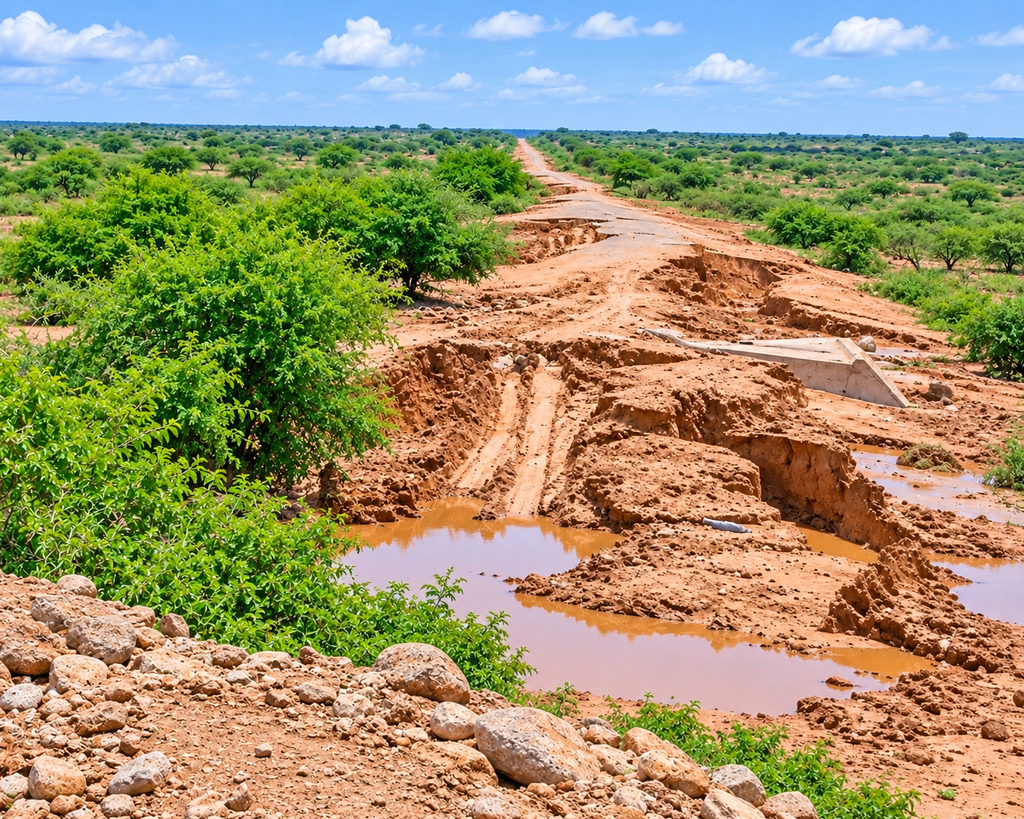
Afdheer is not a region without people, potential, or purpose. Its communities possess resilience, local knowledge, economic activity, and natural resources. Yet the promise of development remains constrained by a basic deficiency: dependable roads. Where roads are absent, weak, or seasonally impassable, distance becomes more than geography—it becomes a barrier to healthcare, education, trade, public services, and opportunity.
The road question in Afdheer is therefore not a narrow engineering concern. It is a question of equal citizenship and whether the benefits of public development reach communities beyond the most connected centres. A region cannot be meaningfully integrated into a wider economy when its people and goods struggle to move safely and predictably.
When Distance Becomes a Danger
For a woman in labour, a road that cannot be travelled may turn an urgent journey to a health facility into a perilous delay. For a family seeking treatment, transport difficulties can add cost, uncertainty, and lost time. Students, teachers, health workers, and public employees also depend on reliable access. Road infrastructure is not a luxury added after social development; it is one of the conditions that makes social services reachable.
These effects are not confined to emergencies. Poor connectivity can undermine school attendance, complicate the delivery of medicines and supplies, and make it harder for skilled workers to serve remote communities. The burden is borne most heavily by households with the fewest alternatives.
Trade, Investment, and the Price of Isolation
A road is an economic artery. When transport is unreliable, traders face higher operating costs, longer journeys, vehicle damage, uncertain delivery schedules, and reduced access to markets. Producers may receive lower prices for their goods while consumers pay more for items brought in from elsewhere. Businesses considering investment must factor in the difficulty of moving people, equipment, and products.
This creates a self-reinforcing cycle: weak roads discourage investment; limited investment restricts job creation; and fewer economic opportunities deepen the region’s dependence on a narrow range of activities. Young people are left with fewer pathways into employment and enterprise. Connectivity cannot guarantee prosperity, but without it, the region’s economic potential is unnecessarily restrained.
Promises, Plans, and the Missing Road
Public statements about road construction, development plans, and proposed allocations can raise legitimate expectations. Yet communities ultimately judge government not by announcements but by completed, usable infrastructure. A promise that is repeatedly renewed without visible milestones risks becoming a substitute for action.
A serious public examination must ask: Which Afdheer road corridors have been formally prioritised? What feasibility studies and engineering designs have been completed? Which projects have secured approved funding, and how much has actually been released and spent? What procurement, contractor, land, security, or technical obstacles have delayed implementation? What are the contract timelines, and who is responsible for monitoring them?
It is important to distinguish a budget proposal from an approved appropriation, an appropriation from a cash release, and a release from actual expenditure. Likewise, a project listed in a plan is not proof that construction has begun or that the road will be completed. Without publicly available project-level records, claims that a specific amount was allocated and then neglected cannot responsibly be presented as established fact. That evidentiary gap itself underscores the need for transparent reporting.
Federal and Regional Responsibilities
The federal government and the Somali Regional State administration have distinct but connected responsibilities in Ethiopia’s infrastructure system. Depending on the road’s classification and jurisdiction, planning, financing, construction, and maintenance may involve federal road institutions, regional authorities, woreda administrations, or contracted firms. Coordination is essential; responsibility should not disappear between levels of government.
Federal priorities should be assessed by whether national connectivity programmes reach underserved areas and whether the relevant institutions provide technical and financial support where needed. Regional leadership, in turn, should demonstrate that Afdheer’s needs are reflected in its development priorities, annual plans, budget submissions, implementation schedules, and oversight mechanisms. Local administrations should identify the most critical corridors and communicate community needs with documented evidence.
If road projects have been announced but not delivered, authorities should explain the reasons in concrete terms and publish a corrective plan. If funding is insufficient, they should disclose the shortfall and the steps being taken to close it. If contractors have failed to meet obligations, contract supervision and enforcement should be visible. If projects have not been prioritised, the criteria behind that decision deserve public scrutiny.
Budgeting Is a Choice; Execution Is a Duty
The public debate must move beyond the general assertion that ‘a budget was allocated.’ Responsible accountability requires examining the approved budget, project name and location, planned amount, actual disbursement, expenditure, procurement status, physical progress, and completion date. These records should be made accessible in a format communities can understand.
Afdheer’s road needs should be reflected in a specific, cost, and time-bound road development programme. Such a programme should identify priority routes, establish realistic phases, provide for maintenance as well as construction, and name the institutions accountable for delivery. Budget execution should be reviewed regularly—not only at the end of a fiscal year, when delays may already have cost communities another season.
Public oversight can include periodic progress reports, independent technical inspections, community consultations, and clear channels for reporting non-performance. Accountability is not an accusation by default; it is a basic safeguard for public resources and a way to distinguish genuine constraints from avoidable delay.
From Complaint to a Practical Roadmap
A workable response should begin with a public inventory of Afdheer’s road network: which links are passable year-round, which become inaccessible during rains, which connect health facilities and markets, and which gaps create the greatest social and economic harm. Prioritisation should use transparent criteria such as population served, emergency access, trade potential, cost, engineering feasibility, and equity.
The administration should then publish a phased action plan with project designs, funding sources, procurement milestones, implementation dates, maintenance arrangements, and responsible offices. Where a full paved road cannot be delivered immediately, reliable interim measures—such as drainage, culverts, grading, and all-weather access improvements—may reduce hardship while longer-term construction proceeds.
The community, civil society, local representatives, and relevant professional bodies should be included in monitoring. Their role is not to replace public institutions, but to help ensure that decisions reflect actual conditions and that progress is measured on the ground.
A Call to the Authorities
The Somali Regional State administration, Afdheer’s local authorities, and the relevant federal institutions should treat road connectivity as an urgent development priority rather than a recurring talking point. They should disclose what has been promised, what has been budgeted, what has been spent, what has been built, and what remains delayed. They should also set a clear timetable for action and report against it.
Afdheer’s residents are not asking for rhetoric in place of infrastructure. They are asking for roads that allow mothers to access healthcare, traders to reach markets, students and workers to travel, and young people to see opportunities in their own region. The measure of leadership is not the number of plans announced, but the distance those plans have actually covered.
Conclusion: The Road Must Become Real
Afdheer should not be condemned to another cycle of promises, plans, and postponements. Its road crisis demands coordinated responsibility, transparent budgeting, timely implementation, and firm public accountability. Development is not achieved by allocating words to a document; it is achieved when resources become roads and roads become access, safety, and opportunity.
The road that Afdheer needs is more than a strip of asphalt or graded earth. It is a link to dignity and a bridge out of isolation. The federal and regional administrations must turn commitments into measurable action—at the right time, in the right place, and under the scrutiny of the people they serve.
About the author
Mohamed Hassan Mohamed (Xareed), an MBA graduate of distinguished merit, is a seasoned academic and lecturer whose expertise spans scientific economic management, business information systems, human development, and a range of interdisciplinary domains. His intellectual contributions—marked by a fusion of advanced scholarly inquiry and strategic analysis—primarily explore the intricate dynamics of geo-economics competition and regional conflict across the Horn of Africa. Can be reached at : xareedmo45@gmail.com
Editor’s Note: Views in the article do not necessarily reflect the views of borkena.com
__
Join our Telegram Channel: t.me/borkena
Like borkena on Facebook
To submit a press release, send the submission to info@borkena.com
Add your business to Ethiopian Business Listing / Ethiopian Business Directory
Join the conversation. Follow us on X (formerly Twitter) @zborkena to get the latest Ethiopian news updates regularly.