
A Joy Killer for Those Preparing to Celebrate the Victory of Adwa Ethiopia stands at a perilous crossroads, teetering on the edge of a fate eerily reminiscent of Humpty Dumpty—once broken, impossible to restore.
By Andargachew Tsege
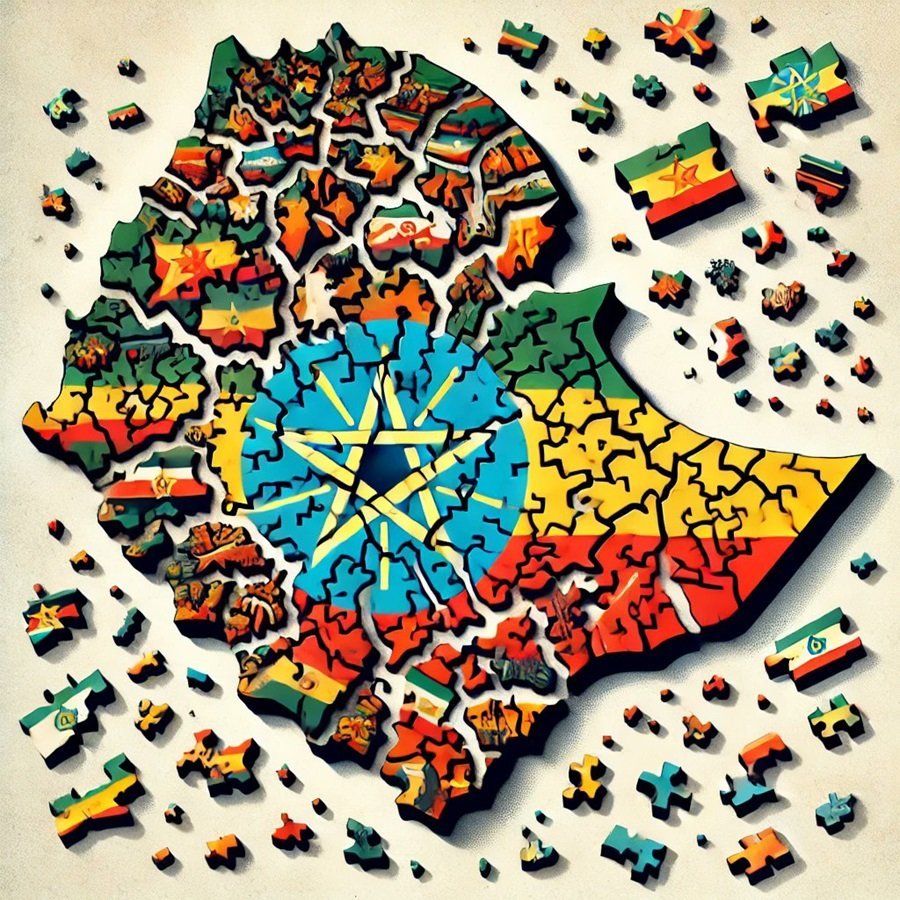
Ethiopia stands at a perilous crossroads, teetering on the edge of a fate eerily reminiscent of Humpty Dumpty—once broken, impossible to restore. The country’s complex ethnic, religious, and cultural landscape makes it uniquely difficult to reunite once fragmentation begins, with consequences far more severe than those seen in other fractured states.
In analysing Ethiopia’s current political scenario, the ongoing conflict between Abiy Ahmed’s regime and various rebel forces is unlikely to have a decisive resolution. Realistically, there are only two probable outcomes. One is the overthrow of Abiy Ahmed by the forces fighting him, leading to the installation of a new regime. The other is a prolonged stalemate where no one emerges victorious, deepening Ethiopia’s descent into chaos.
Some believe in a third possibility—that Abiy Ahmed could defeat all rebel groups and reassert full control over Ethiopia. However, this is an unlikely scenario. Abiy lacks the political acumen, military strength, public support, and economic resources to achieve such a total victory.
Those who cite his past military triumph over TDF (Tigray Defence Forces) as proof of his ability to crush dissent overlook the vastly different conditions of that conflict. At the time, Abiy enjoyed widespread national support, a relatively stable economy, and backing from Ethiopia’s neighbours. Now, all of that is gone.
On the other hand, and as it is, the absence of a unified command within the rebel Fano movement, divisions within the Tigray People’s Liberation Front (TPLF), and the extreme Oromo nationalism associated with the Oromo Liberation Army (OLA) reduce the likelihood of these rebel forces uniting to defeat Abiy to zero.
The most probable outcome is not an outright victory for any side but a prolonged, grinding conflict. As the government loses control beyond key cities, Ethiopia risks fragmenting into a patchwork of warlord-controlled territories—far more numerous and smaller in size than they are today.
Not only will the country fracture, but even individual regions will splinter into ever-smaller sub-regions. The Fano movement’s reluctance to establish a unified leadership, the breakup of the TPLF’s central command, and the persistent regionalism within the OLA are not signs of forces coalescing but clear indicators of further fragmentation.
Abiy regime’s influence would be reduced to isolated urban centers, Abiy becoming just another warlord among many. Meanwhile, various armed groups would assert dominance over different sub-regions, pushing the country into an era of ungovernable fiefdoms.
If this most likely scenario is allowed to unfold, the devastation will not be confined to Ethiopia alone. It will drag the already fragile and unstable East Africa into colossal chaos. Once the genie of fragmentation is out of the bottle, there is no magic to put it back.
Unlike Somalia, which—despite its divisions—has a common language, religion, and cultural identity, Ethiopia is a mosaic of deeply entrenched ethnic, religious, and cultural-linguistic groups, each with its own real or perceived grievances. If Ethiopia fractures, the forces pulling it apart will far outweigh any push for unity. The competing interests of its warlords, backed by regional and international actors, would make reunification an insurmountable challenge.
Even Somalia, with its underlying cultural unity, has struggled for decades to rebuild a cohesive state. Ethiopia, with its far more complex social fabric, faces an even bleaker reality. The risk is not just political instability but a prolonged cycle of war, economic devastation, and humanitarian crisis. If the country descends into a full-scale warlord era, the Ethiopian state as it exists today may become nothing more than a historical memory—shattered beyond repair, like Humpty Dumpty.
To avoid such a fate, those with intellectual and military influence, who share the common view that a negotiated deal with Abiy Ahmed is unacceptable, must navigate their deep divisions carefully. They should prioritize creating unified leadership within each rebel group, fostering dialogue across these groups, and collectively charting a path to remove Abiy Ahmed.
Additionally, they must prepare for a soft landing for the country after Abiy’s fall. Otherwise, like Humpty Dumpty, once Ethiopia falls, no power—internal or external—will be able to put it back together again.
Editor’s Note : Views in the article do not necessarily reflect the views of borkena.com
__
Subscribe: https://borkena.com/subscribe-borkena/
Join our Telegram Channel : t.me/borkena
Like borkena on Facebook
Add your business to Ethiopian Business Listing / Ethiopian Business Directory
Join the conversation. Follow us on X (Formerly Twitter) @zborkena to get the latest Ethiopian News updates regularly. Subscribe to YouTube channel To share information or for submission, send e-mail to info@borkena.com
The incipient warlordism that we are observing more and more will only lead to the disintegration of the Ethiopian state. Abiy has a lot to do with the current state of affairs. By losing credibility in Ethiopia and on the world stage, no promise he makes will be taken seriously any longer. And thus, he cannot make any alliance to save himself or Ethiopia. The only solution has to come from the vastly fragmented opposition: all, including the TPLF, must come together to avoid the disintegration of Ethiopia that will, as the author maintains rightly, be irreversible. Thus, we can only prevent Ethiopia from descending into an interminable war by convincing the armed opposition to chart a new way forward.
Despite their major grievance the Amhara Fano’s movement has not developed a political skill to form a united front. The movement’s origin is rural and culturally combative in nature hard for any political comprise in Ethiopia’s ethnic conflicts. Its fates will be Like EDU aka the Ethiopian Democratic Union a resistance movement of northern Ethiopia against: “Mengistu Haile Mariam” regime 5 decades ago.