

Girma Berhanu (Professor)
Introduction and Summary
The crisis confronting the Amhara population in Ethiopia constitutes far more than an armed conflict. It is a profound humanitarian and human rights crisis marked by civilian insecurity, forced displacement, targeted violence, and the erosion of fundamental rights. Peace is meaningless when people cannot live without fear, send their children to school, access healthcare, obtain food, or sustain their livelihoods. The central concern of this article is whether the Ethiopian state and the international community are fulfilling their fundamental obligations to protect civilians, uphold equal citizenship, and ensure accountability, irrespective of ethnic identity or political affiliation.
Particular attention is given to reports of deadly attacks against Ethiopian Orthodox Tewahedo Christians, many of whom are reportedly of Amhara identity, in Arsi Zone, Oromia. According to a statement attributed to the Ethiopian Orthodox Tewahedo Church’s Holy Synod, 60 people were killed between 20 and 25 October 2026, 20 homes were destroyed, and more than 20 people sustained serious injuries. These allegations demand urgent, independent, and impartial investigation. The protection of civilians, the provision of humanitarian assistance, and the prosecution of those responsible must not be subordinated to political calculations or ethnic considerations.
Developments reported as this article was being finalized raise further serious concerns. According to eyewitness accounts and local residents, more than 50 people—including doctors and other healthcare professionals who reportedly treated victims of the attacks—were allegedly arrested by Oromia security forces. Those reportedly detained also include relatives of victims and individuals who attended funeral ceremonies or helped bury the dead. These arrests would raise grave questions about the treatment of medical personnel, bereaved families, and community members providing essential humanitarian assistance. Detaining individuals for treating the wounded, mourning the dead, or assisting with burials would represent a deeply troubling violation of fundamental humanitarian and human rights principles.
The article also interrogates the apparent disparity between the suffering reported in Amhara and the degree of international media coverage, diplomatic engagement, and institutional attention it receives compared with other conflicts, including the war in Tigray. Drawing on the author’s advocacy and communications with diplomats, international organisations, and media representatives, it highlights the gap between expressions of concern and demonstrable action. This disparity raises legitimate questions about whose suffering becomes internationally visible, whose experiences remain marginalised, and whether human rights principles are applied consistently. The extent, causes, and consequences of any such disparity require systematic empirical investigation; nevertheless, the obligation to protect civilians cannot depend on the visibility of their suffering.
A further dimension concerns the historical narratives and political representations through which the Amhara are understood. Drawing on writings by Desalegn Birara and Adamu Walelign, the article examines how broad ethnic generalisations and portrayals of the Amhara as a collectively culpable historical group may contribute to stereotyping, marginalisation, and the diminished recognition of contemporary suffering. Ethiopia’s resistance to European colonialism, particularly its victory at the Battle of Adwa in 1896, provides an important historical context, but it does not negate the complexity of Ethiopia’s internal history or the need to examine historical inequalities critically. Historical responsibility must be established through evidence and contextual analysis, not assigned collectively to an entire ethnic community. Neither historical grievances nor present political conflicts can justify discrimination, collective punishment, or the denial of equal rights.
The humanitarian consequences extend well beyond immediate violence. Displacement undermines educational continuity, healthcare access, food security, family stability, and the capacity of communities to recover. The resulting insecurity threatens not only individual lives but also the social foundations necessary for lasting peace. Addressing the crisis therefore requires more than statements of concern: it demands effective civilian protection, safe and sustained humanitarian access, support for displaced families, restoration of essential services, credible investigations into alleged abuses, and accountability consistent with international human rights standards.
Ultimately, this article argues that the Amhara crisis must be understood as a fundamental test of civilian protection, equal citizenship, human dignity, and the universality of human rights. The Ethiopian government bears responsibility for protecting people within its jurisdiction and investigating credible allegations of abuse. The international community, in turn, must respond impartially, scrutinise credible reports, support independent investigations, and resist the selective application of humanitarian concern. No community should be rendered invisible, denied protection, or deprived of justice because of its ethnic identity or perceived political significance. Sustainable peace in Ethiopia requires an unequivocal commitment to protecting every civilian, recognising every victim, investigating every credible allegation, and holding perpetrators accountable without discrimination.
Central Argument
The Amhara crisis is not merely a question of armed conflict; it is a test of whether equal citizenship and universal human rights have practical meaning in Ethiopia. When civilians face violence, displacement, deprivation, and potentially arbitrary detention, the response must be grounded in evidence, impartiality, and accountability—not ethnic prejudice, political expediency, or selective international attention. The protection of human life is not conditional on ethnicity, political affiliation, or international visibility. Without credible investigations, effective civilian protection, humanitarian assistance, and accountability for abuses, sustainable peace and democratic coexistence will remain unattainable.
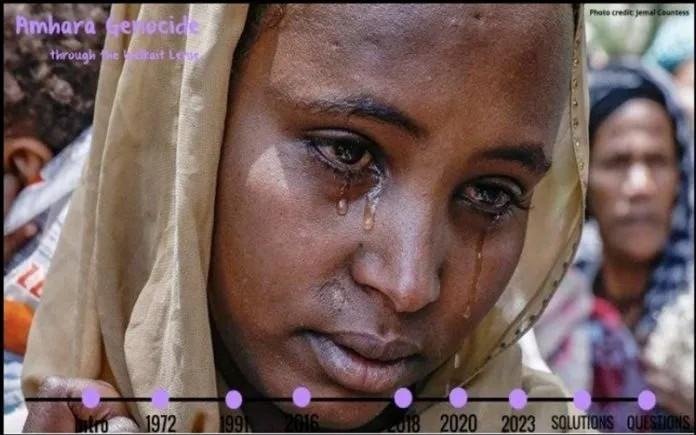
When Survival Becomes a Daily Struggle
Over the past eight years, since Abiy Ahmed came to power as Prime Minister of Ethiopia, the situation of the Amhara population has deteriorated dramatically. Persistent armed conflict, civilian insecurity, forced displacement, and humanitarian hardship have placed millions of people under immense pressure. Many Amharas fear that government policies and military operations threaten their collective security and survival. The central issue is not simply the continuation of armed conflict; it is the failure to guarantee civilians the fundamental rights to life, security, dignity, and justice. Targeted violence and deliberate persecution require independent investigation rather than dismissal, denial, or political silence. For ordinary people, peace is not an abstract political promise. It means being able to walk to the market without fear, send children to school, seek medical care, cultivate land, and return home safely. In Ethiopia’s Amhara region, prolonged conflict and insecurity have severely undermined these basic conditions of human existence. When people cannot carry out the ordinary activities necessary for survival, peace has ceased to be a meaningful reality in their lives. The crisis also extends beyond the Amhara region. Amhara communities living in Oromia, particularly in the Arsi Zone, have reportedly endured repeated killings and targeted attacks. The recurrence of such violence raises urgent questions about civilian protection, the prevention of ethnically targeted abuses, and the accountability of those responsible. Recent disturbing reports have attracted international attention, but episodic concern is insufficient in the face of persistent allegations of serious abuses.
The central argument is that the Amhara crisis must be understood not merely as a consequence of armed conflict, but as a profound crisis of civilian protection, equal citizenship, and accountability. No population should be left to endure recurring violence because of its ethnic identity, political marginalisation, or geographical location. The Ethiopian government has a fundamental responsibility to protect all civilians without discrimination, investigate credible allegations of abuses, and ensure that those responsible are held accountable. The international community, too, must move beyond expressions of concern towards sustained scrutiny, independent monitoring, humanitarian engagement, and support for credible investigations. Without these measures, calls for peace and national reconciliation risk becoming empty rhetoric, detached from the lived realities of those whose lives and dignity remain under threat.
The situation in Arsi Zone, Oromia region, points to a deeply concerning pattern of targeted violence against Ethiopian Orthodox Tewahedo Christians, particularly those of Amhara identity. Reports suggest that victims are being targeted on the basis of both their ethnic identity and religious affiliation. Serious allegations have also been raised regarding the involvement of armed forces operating in the Oromia region and the government’s awareness of these attacks. These allegations warrant a thorough, independent, and impartial investigation.
According to an announcement by the Holy Synod of the Ethiopian Orthodox Tewahedo Church, 60 faithful were killed in a series of violent attacks between October 20 and 25, 2026, in the Merti and Shirka woredas of Arsi Zone. The Holy Synod reported that 14 people were killed in the Gora Silingo area of Merti Woreda on October 20. A further 46 people were killed in attacks on October 24 in the Tiruta, Chole, and Birbo areas of Shirka Woreda. The reported violence also resulted in the complete destruction of 20 residential homes, while more than 20 people sustained severe injuries and remained hospitalized in critical condition, according to the Holy Synod. The Synod characterized these incidents as part of an escalating and sustained pattern of targeted violence, forced displacement, and property destruction affecting Orthodox Tewahedo Christians in Arsi Zone and other parts of Ethiopia. These reports raise urgent concerns about civilian protection, state responsibility, and the persistent failure to ensure the safety of vulnerable communities. Attacks targeting individuals because of their ethnicity or religious beliefs constitute a grave violation of fundamental rights and undermine the principles of equality, security, and peaceful coexistence. The Ethiopian government must fulfil its obligation to protect all civilians, regardless of ethnicity or religion. This requires immediate and effective measures to prevent further attacks, ensure the safety of affected communities, facilitate humanitarian assistance, and establish accountability through independent and impartial investigations. Those responsible must be held accountable in accordance with the law. Silence and impunity risk allowing this pattern of violence and displacement to continue. Protecting civilians and securing justice for victims must be an urgent national priority.
The Amhara Crisis and the Limits of International Attention
I have personally worked to raise public awareness of reported atrocities against the Amhara people in Ethiopia. In this capacity, I have communicated my concerns to numerous groups, diplomats, international organisations, current and former ambassadors, and major international media outlets. While some have expressed concern, I have seen limited evidence of sustained international engagement or media coverage commensurate with the seriousness of the allegations I have sought to bring to their attention. This experience has prompted me to examine a fundamental question: why has the suffering of the Amhara people received comparatively limited international attention, and what factors might explain the gap between reports of violence and the international response?
Reports of killings, forced displacement, destruction of property, and other forms of violence against Amhara civilians warrant systematic investigation and serious international scrutiny. Yet, based on my experience of advocacy and outreach, efforts to draw attention to these reports have often generated expressions of concern without the level of sustained public debate, diplomatic engagement, and institutional response that I had hoped to see. Although my experience cannot, by itself, establish the extent of international neglect, it raises important questions about how humanitarian crises are recognised, reported, and prioritised.
A comparison with international responses to the war in Tigray is relevant, provided that differences in the conflicts, their chronology, and the available evidence are taken into account. The war in Tigray attracted substantial international media coverage, diplomatic engagement, and public discussion. Why, then, have reports of violence affecting Amhara communities not consistently generated a comparable level of international attention? Addressing this question requires examining differences in media access, the availability and verification of information, diplomatic priorities, geopolitical interests, advocacy networks, and the capacity of affected communities to bring their experiences to international audiences.
Another important issue concerns the role of political narratives and public perceptions. How are the Amhara people represented in Ethiopian political discourse and international reporting? Do established narratives about Ethiopia’s history, ethnic relations, and political conflicts influence which victims receive recognition and which accounts are considered credible? To what extent, if any, do political alliances, competing interpretations of the conflict, or entrenched stereotypes contribute to the underrepresentation of Amhara suffering? These are questions for empirical investigation rather than conclusions that should be assumed in advance.
The consequences of delayed recognition can be profound. When allegations of serious human rights violations receive insufficient scrutiny, opportunities for prevention, independent investigation, humanitarian assistance, and accountability may be lost. The international community should therefore ensure that reports concerning the Amhara are assessed according to the same transparent evidentiary standards and human rights principles applied to other populations affected by conflict. This requires independent fact-finding, credible documentation, responsible journalism, and consistent diplomatic engagement.
The comparison with the 1994 genocide against the Tutsi in Rwanda raises a broader concern about the international community’s capacity to respond to warning signs before violence escalates further. The historical lesson is not that different conflicts should be treated as identical, but that the verification of credible warnings and timely preventive action are essential to protecting civilian populations.
Ultimately, the issue is one of consistency, accountability, and equal recognition of human suffering. The experiences of the Amhara people deserve rigorous documentation and serious international consideration, just as the experiences of other communities affected by violence do. The key question is whether international institutions, governments, and media organisations are applying consistent standards of attention and scrutiny to credible reports of atrocities, regardless of the identity of the victims or the political sensitivities involved.
Answering this question requires more than expressions of concern. It requires examining the available evidence, identifying gaps in reporting and response, and determining what practical measures can protect civilians and establish accountability. The objective should be neither to minimise the suffering of one community nor to diminish that of another, but to ensure that no population’s suffering is overlooked because it is politically inconvenient, insufficiently represented, or difficult to investigate.
The consequences extend beyond the immediate battlefield. Families have been uprooted, children’s education interrupted, healthcare services strained, and livelihoods destroyed. For displaced people, the danger of the conflict is often followed by a different struggle: finding shelter, securing food, accessing medical care, and protecting family members in unfamiliar surroundings. Understanding the Amhara crisis requires more than counting casualties or describing military confrontations. It requires examining how insecurity affects the fundamental rights of civilians, why displacement becomes prolonged, how accountability can be strengthened, and what measures are necessary to protect lives without deepening the suffering of the population.
The Amhara Crisis: International Silence, Historical Narratives, and the Politics of Recognition
Why Has the World Forgotten the Amhara People Amid Massacres? The question is painful because it goes beyond the violence itself. It asks why civilian suffering can continue while international attention remains limited, why reports of serious abuses do not always translate into meaningful protection, and why some communities struggle to make their experiences heard. These questions are particularly urgent in light of the recent reports of violence in Arsi Zone, Oromia region.
It would be inaccurate to conclude that the world has entirely forgotten the Amhara people. Nevertheless, international media coverage, diplomatic pressure, and humanitarian responses have not always appeared commensurate with the gravity of the reported suffering. Understanding this gap requires examining media priorities, geopolitical interests, access to reliable information, the politics of international recognition, and the challenges of holding powerful actors accountable.
It is also important to distinguish between a moral imperative—that Amhara civilians deserve protection, recognition, and justice—and the more specific factual claim that the international community has deliberately ignored their plight. The latter requires evidence. The disparity between reported suffering and international attention, however, warrants serious scrutiny.
There have been some encouraging signs of international recognition. Last week, several members of the US Congress reportedly expressed concern about the latest attacks against Amhara civilians and Orthodox Christians. Congresswoman Nancy Mace, for example, condemned the reported massacres of Orthodox Christians in Arsi Zone and criticized what she characterized as inadequate Western media coverage and insufficient attention from human rights organizations.
In a statement posted on social media following the attacks, Mace expressed outrage at the reported killings and destruction of property, questioning what she described as international indifference. Her intervention is a welcome gesture of solidarity because it brings attention to suffering that many believe has received insufficient coverage. Yet an important question remains: how can expressions of concern be translated into meaningful action? Public statements matter, but their significance ultimately depends on whether they contribute to independent investigations, effective civilian protection, humanitarian assistance, sustained media scrutiny, and accountability for those responsible.
Many people have asked why the plight of the Amhara has received comparatively little international attention. Two scholarly contributions offer perspectives that may help illuminate this question: Desalegn Birara’s From Defeating Colonialism to Facing Genocide: Historical Precedents and Prospects of the Amhara Existential Struggle in Ethiopia and Professor Adamu Walelign’s Amhara Demonization: The Enduring Legacy of a Malevolent Narrative.
Although the two works differ in emphasis, both examine how historical interpretations and political narratives shape perceptions of the Amhara community. Their arguments challenge representations that portray the Amhara collectively as historical oppressors, suggesting that such generalisations can obscure the diversity of Amhara experiences and identities. They also explore how competing accounts of Ethiopian state formation, historical power, and ethnic relations have influenced contemporary political tensions.A central concern in these arguments is that when an entire ethnic community is held collectively responsible for historical injustices, its members may become vulnerable to stereotyping, exclusion, and discrimination. The authors’ perspectives suggest that prevailing political narratives deserve closer examination, particularly where they may influence how violence against Amhara civilians is interpreted, reported, or acknowledged internationally.
The broader historical debate is complex. The Amhara have played an important role in the formation and development of the Ethiopian state, while the country’s history also includes contested processes of political centralization, regional domination, and resistance. Competing interpretations of this history have become deeply embedded in contemporary Ethiopian politics. The extent to which particular narratives contribute to present-day discrimination and violence must be examined through historical research, documented evidence, and careful analysis rather than assumed in advance. Nevertheless, these works raise an important question: can historical stereotypes and prevailing political narratives affect whose suffering is recognized, whose testimony is taken seriously, and which communities receive international solidarity? If so, understanding the Amhara crisis requires examining not only the violence itself but also the interpretive frameworks through which it is understood.
Ultimately, the issue is not whether the suffering of the Amhara should be prioritized over that of other Ethiopian communities. All civilians deserve equal protection, and serious violations of human rights warrant investigation regardless of the victims’ ethnic or religious identity. The challenge is to ensure that international responses are consistent, evidence-based, and guided by the same principles of human dignity and accountability.
The reports emerging from Arsi Zone make this question particularly urgent. Expressions of solidarity are important, but they must be accompanied by credible documentation, independent investigation, and practical measures to protect civilians. The international community should not wait for further escalation before taking credible reports of violence seriously.
The essential question is therefore not simply why the Amhara crisis receives limited attention, but what can be done to ensure that credible reports of abuses are investigated, victims are protected, and accountability does not depend on the political visibility of the people affected.
I would like to offer my own perspective on this matter, particularly on the historical narratives that have shaped international perceptions of the Amhara people. In my view, these narratives cannot be fully understood without examining the intersection of European colonial interests, Ethiopia’s resistance to foreign domination, and the political struggles over the country’s history and identity.
Western representations of Ethiopia and the Amhara, dating back several centuries, deserve closer historical scrutiny. Religious commitment, military traditions, patriotism, and a strong attachment to national independence have been important elements of Ethiopian history. Ethiopia’s resistance to European colonial expansion, particularly its victory over Italy at the Battle of Adwa in 1896, challenged prevailing assumptions about European superiority and became a powerful symbol of African resistance to colonialism. The prominent historical role of Amhara political and military elites in this struggle is relevant to understanding the subsequent contestation of Ethiopian history and identity.
Rudolf Rocházka’s Abyssinia: The Powder Barrel (1934) provides a useful source for examining European representations of Ethiopia during the period preceding Italy’s invasion in 1935. The book should be read critically and situated within the political climate of European imperial expansion. Its portrayal of Ethiopia’s political and social conditions raises questions about how descriptions of internal divisions and alleged oppression could be used to undermine the legitimacy of an independent African state. I believe that the international image of the Amhara has also been shaped by political struggles within Ethiopia. Some ethno-nationalist movements, including separatist currents among Tigrayan and Oromo political actors, have advanced interpretations of Ethiopian history that portray the Amhara collectively as colonisers or oppressors. Such representations are contested and should be assessed against historical evidence. My concern is that collective accusations against an entire ethnic community can obscure historical complexity, reinforce ethnic stereotypes, and contribute to the marginalisation of ordinary people who cannot reasonably be held responsible for every action of past governments or political elites.
Ethiopia’s contribution to African independence and its resistance to European colonialism are important dimensions of this debate. However, it is necessary to distinguish Ethiopia’s historical role as an independent state from the complex internal relations of power, which included both cooperation and coercion among different communities. Recognizing these complexities does not justify portraying the Amhara as collectively guilty of historical injustices, just as acknowledging the suffering of other Ethiopian communities does not diminish the historical significance of Ethiopia’s resistance to colonial domination.
My central argument is that the demonization of the Amhara should be examined as a historical and political process, not accepted as an objective description of an entire people. This requires critically investigating colonial-era representations, contemporary political propaganda, and competing nationalist accounts of Ethiopian history. It also requires distinguishing documented historical events from generalizations, allegations, and politically motivated interpretations.
Ultimately, a more balanced understanding of Ethiopia’s past must recognize the Amhara’s historical contributions without idealizing their political elites, while acknowledging the experiences of other Ethiopian communities without assigning collective blame. Such an approach is essential not only for historical accuracy but also for understanding contemporary ethnic tensions, challenging discriminatory narratives, and advancing a more inclusive vision of Ethiopia’s future.
The Humanitarian Crisis: Food, Healthcare, and Education
The right to live in safety is the foundation of all other human rights. When civilians cannot secure food, access healthcare, educate their children, or live without fear of violence and displacement, their most fundamental rights are being denied. The humanitarian crisis affecting Amhara is therefore not simply a consequence of territorial disputes, military operations, or political competition. It is a crisis of civilian protection, human dignity, and accountability. Insecurity and displacement threaten not only lives and livelihoods but also the social institutions on which communities depend for survival and recovery. Access to food, healthcare, education, and safe shelter must be understood as essential conditions for human security, not as secondary concerns to be addressed after political or military objectives have been pursued.
Reports from human rights organizations, displacement-monitoring agencies, and humanitarian bodies have documented serious protection concerns in Ethiopia. Continued armed conflict and insecurity, alongside reports of violence and displacement, underline the need for sustained civilian protection and the restoration of essential services. These conditions demand more than expressions of concern: they require effective prevention, independent investigation, humanitarian assistance, and accountability.
The central issue is whether the protection of civilians is being treated as an unconditional obligation or as a matter dependent on political interests and the identity of those affected. Amhara civilians must be able to live without fear of killings, forced displacement, or collective punishment. Orthodox Christians and other civilians in Arsi Zone deserve the same protection, regardless of their ethnicity or religious affiliation. The suffering of one community must never be used to diminish, relativize, or obscure the suffering of another.
The response must therefore be grounded in consistent principles: protect civilians, investigate credible allegations of abuse independently, hold those responsible accountable, support survivors and displaced families, and restore access to food, healthcare, and education. Equally important is addressing the political and institutional conditions that permit violence to recur.
Ultimately, the measure of a society’s commitment to human rights is not the language it uses to defend human dignity, but whether it protects people whose lives and rights are threatened—even when doing so is politically difficult. The international community and Ethiopian authorities must apply this principle consistently. Civilian protection cannot be selective, justice cannot depend on ethnic identity, and humanitarian assistance cannot wait for political convenience. Without these commitments, sustainable peace and recovery will remain out of reach.
References
Wondie, D. B. (2025). From defeating colonialism to facing genocide: Historical precedents and prospects of the Amhara existential struggle in Ethiopia. Journal of Amhara Studies, 1(1), 1–28. https://journalofamharastudies.org/index.php/jas/article/view/2
Walelign, A. (2021, August 9). Amhara demonization: The enduring legacy of a malevolent narrative. Ethiopia Nege.
Professor Girma Berhanu teaches in the Department of Education and Special Education at Gothenburg University, Gutenberg. He can be reached at girma.berhanu@ped.gu.se
Editor’s Note: Views in the article do not necessarily reflect the views of borkena.com
__
Join our Telegram Channel: t.me/borkena
Like borkena on Facebook
To submit a press release, send the submission to info@borkena.com
Add your business to Ethiopian Business Listing / Ethiopian Business Directory
Join the conversation. Follow us on X (formerly Twitter) @zborkena to get the latest Ethiopian news updates regularly.