 residing in Oromia have faced repeated and targeted acts of violence. Read more.)
Author: Caleb Ta. (Dr.)
Affiliation: Independent Researcher in African Political Affairs; Human Rights Advocate
Abstract
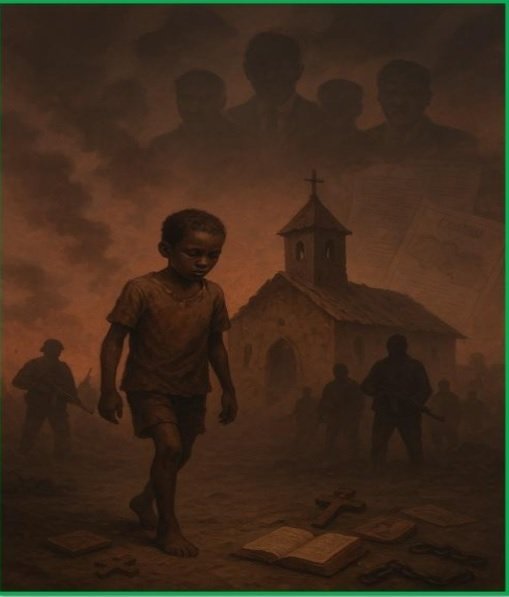
Between 2016 and 2025, members of the Ethiopian Orthodox Tewahedo Church (EOTC) residing in Oromia have faced repeated and targeted acts of violence. These include killings, forced displacement, destruction of churches, and obstruction of religious worship. Analyzing church archives, eyewitness accounts, and international media reports reveals that these attacks were not isolated incidents but part of a systematically orchestrated campaign. Factors such as political decentralization and the empowerment of local militias—most notably OLF-Shane (Oneg Shene)—facilitated the execution of these attacks. Evidence suggests the Oromo-led Prosperity Party played a significant role, either actively enabling or passively condoning these acts through policy decisions, administrative inaction, and collaboration with militia actors. High-level regional and federal officials—including Abiy Ahmed, Shemel Abdisam, Berhanu Julam, and Demelesh Gebre-Michael—are implicated in either mobilizing, sanctioning, or failing to prevent such atrocities. The human cost is starkly illustrated in the case of a child survivor who required amputation following a coordinated assault. This study documents systematic patterns of religious persecution in Oromia, highlighting the urgent need for accountability, protection, and historical record preservation.
Keywords: Ethiopian Orthodox Tewahedo Church, Oromia, religious persecution, Prosperity Party, OLF-Shane, militia violence, Abiy Ahmed, genocide indicators
Introduction
The Ethiopian Orthodox Tewahedo Church, with over 1,600 years of uninterrupted religious tradition, is a cornerstone of Ethiopia’s spiritual and cultural heritage. Yet, Orthodox Christians living in Oromia have endured sustained, targeted violence since 2016, ranging from mass killings and forced displacement to systematic destruction of churches (EOTC Holy Synod, 2018). Despite Ethiopia’s secular constitution, the combination of political decentralization and rising ethno-nationalist mobilization has left Orthodox communities particularly vulnerable to attack (International Crisis Group, 2020).
Emerging evidence indicates that the Oromo-led Prosperity Party played a significant facilitative role. Local militias such as OLF-Shane, alongside other clandestine actors, were granted operational autonomy, enabling them to carry out attacks against Orthodox Christians under the guise of ethnic or political motivations. These actions were often coordinated or tacitly approved by both regional and federal authorities (Anonymous eyewitness testimony, 2025; Human Rights Watch, 2025).
Political Decentralization and Militia Empowerment
The rise of Abiy Ahmed to the Ethiopian premiership in 2018 marked a period of rapid decentralization. While intended as reform, these policies inadvertently allowed local militias—including OLF-Shane—to operate with significant autonomy. In many cases, these groups coordinated with regional Prosperity Party structures to execute targeted campaigns (International Crisis Group, 2020).
Orthodox Christians in Oromia, frequently labeled as “outsiders” despite longstanding settlement in the region, became explicit targets. Eyewitness accounts and church records indicate that these attacks were systematically planned, exploiting local administrative structures to identify, isolate, and assault Orthodox communities (Eastern Arsi Diocese Administrative Office, 2018; EOTC PR Department, 2019).
Evidence implicates prominent regional and federal leaders—including Shemel Abdisam, Abiy Ahmed, Berhanu Julam, and Demelesh Gebre-Michael—in facilitating this violence, whether through inaction, policy guidance, or direct coordination with militia forces. The pattern of violence strongly suggests systemic orchestration rather than sporadic ethnic conflict (Anonymous eyewitness testimony, 2025).
Documented Evidence of Systematic Attacks
Case Study: Eastern Arsi Zone (2016–2017)
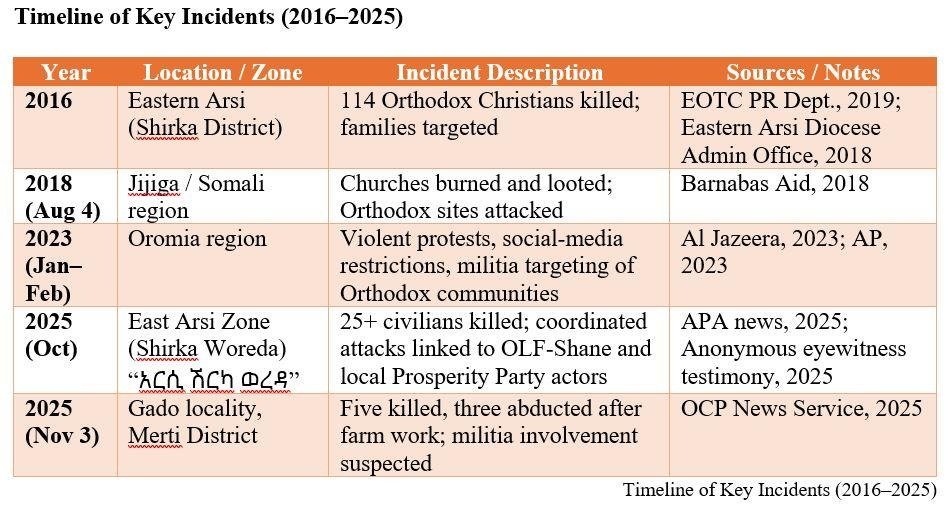
Church records from the Diocese of Eastern Arsi indicate that 114 Orthodox Christians were killed in Shirka District between September 2016 and November 2017, including infants as young as 70 days and elders up to 81 years old (EOTC PR Department, 2019). Among the victims:
- 45% were killed alongside their families.
- Children aged 2–11 were deliberately targeted.
- Attacks were motivated explicitly by victims’ Orthodox faith.
Analytical cross-referencing points to the involvement of OLF-Shane operatives in coordination with local Prosperity Party officials. Church correspondence and eyewitness testimony indicate that these attacks were methodically executed under guidance from political structures at the local level (Eastern Arsi Diocese Administrative Office, 2018).
Case Study: The Child Survivor (October 2025)
In a coordinated attack in RC (Arsi), a child sustained catastrophic injuries requiring amputation of the right leg. Clergy attempting to protect families were also targeted. This incident exemplifies the intergenerational impacts of violence, including physical disability, psychological trauma, and forced displacement. Documentation from the Diocese of Eastern Arsi confirms the involvement of OLF-Shane-affiliated militias and notes apparent indifference or tacit approval from regional authorities (Eastern Arsi Diocese Administrative Office, 2018; Anonymous eyewitness testimony, 2025).
Eyewitness narratives describe the attack in harrowing detail: gunmen abducted family members, shot an 8-year-old girl in the shoulder and side, and left her amidst the corpses of her slain family. Despite grave injuries and the traumatic loss of her mother and siblings, the child survived. The father, witnessing the aftermath, experienced profound psychological trauma. These accounts highlight both the human cost and the deliberate targeting of Orthodox families (Anonymous eyewitness testimony, 2025).
Eyewitness Account: The Night of the Massacre
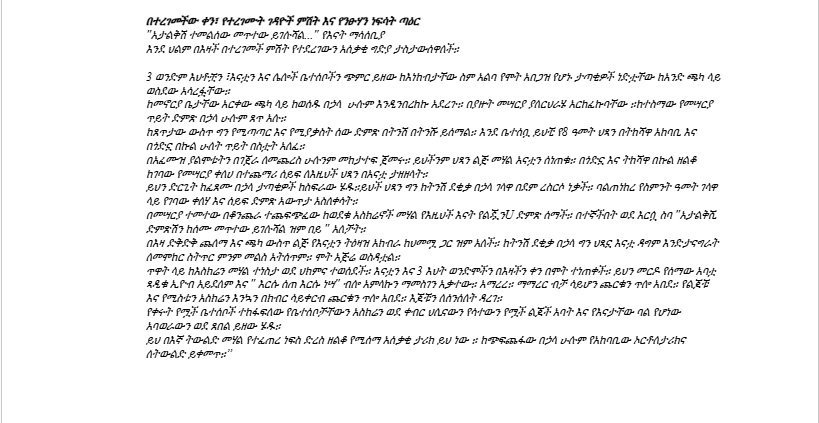
On that fateful night, described by survivors as “the day of the cursed,” armed assailants carried out a deliberate attack on an Orthodox Christian family in Oromia. Eyewitness testimony recounts that three brothers, sisters, their mother, and other family members were forcibly removed from the forest by unidentified gunmen. Upon being expelled from the woods, the victims fell to their knees, pleading for mercy.
During the attack, an 8-year-old girl sustained multiple gunshot wounds to her shoulder and torso. The assailants continued their assault, using their weapons to inflict additional injuries. Despite her severe wounds, the child survived; after the perpetrators departed, she was discovered amidst the corpses of her mother and siblings, crying and in shock. Medical records later confirmed that she required urgent hospital treatment for blood loss and trauma, and eventually underwent an amputation of her right leg.
The father of the deceased recounted the profound psychological impact of the massacre. Witnessing the deaths of his wife and children, he experienced a severe emotional breakdown, leaving the bodies unattended while he struggled with grief and shock. Community members eventually intervened, recovering the bodies and preparing them for funeral rites.
This account illustrates the extreme brutality inflicted upon civilians, including children, and highlights the systematic targeting of Orthodox Christian families. The massacre left lasting physical, psychological, and social scars, demonstrating the intergenerational consequences of the violence. Eyewitness testimony and church records emphasize the need for historical documentation and accountability to preserve the memory of the victims and prevent future atrocities.
Eyewitness Accounts: Patterns of Orchestration
Survivors and observers consistently report:
- Militia operations conducted with freedom under Prosperity Party oversight.
- Targeted killings and displacement of Orthodox Christians and Amhara communities.
- Systematic use of local registries to identify victims.
- Suppression of media and independent documentation of atrocities.
Accounts suggest complicity at both regional and federal levels, with authorities either failing to intervene or actively coordinating with militias (Anonymous eyewitness testimony, 2025; Human Rights Watch, 2025).
Corroborating Evidence from International Media
- NetBlocks / Al Jazeera (2023): Social-media restrictions coinciding with militia-led violence.
- APA news (2025): Over 25 civilians killed in East Arsi in October 2025; attacks linked to militia activity.
- The Guardian (2025): Hundreds of clergy and worshippers killed at Maryam Dengelat festival; militia groups implicated.
Humanitarian and Ecclesiastical Response
The Permanent Holy Synod condemned the violence, dispatched delegations, and coordinated relief efforts (Holy Synod, 2018). International faith-based organizations also emphasized the urgent need for protection and accountability (ACI Africa, 2025).
Legal and Ethical Considerations
- Non-incitement: Document evidence without endorsing retaliation.
- Witness protection: Maintain confidentiality to prevent further harm.
- Independent investigation: Access for UN/OHCHR and NGOs is essential.
- Verification: Cross-check medical records, satellite imagery, victim registries, and church archives.
Analysis: Systematic Orchestration and Leadership Accountability
Patterns strongly indicate that the Oromo-led Prosperity Party facilitated militia operations through decentralization policies, tacit approval, and coordination with actors like OLF-Shane. Key regional and federal figures—including Abiy Ahmed, Shemel Abdisam, Berhanu Julam, and Demelesh Gebre Michael—appear implicated in either directly enabling or indirectly permitting these atrocities.
The human toll demonstrates not only ethnic-religious targeting but also the consequences of governance failure: systematic impunity, media censorship, and disruption of religious and communal life.
Conclusion
From 2016 to 2025, Ethiopian Orthodox Christians in Oromia endured orchestrated, systematic violence at the hands of local militias and political actors. Evidence implicates the Prosperity Party and regional/federal leadership in facilitating these attacks. Victims suffered deaths, displacement, and loss of religious heritage. Scholarly documentation underscores the urgent need for independent verification, accountability, and preservation of evidence to prevent the recurrence of such atrocities.
References
ACI Africa. (2025). Ethiopia: Catholic bishops condemn deadly attack on parish; call for government protection. https://www.aciafrica.org/news/18449/ethiopias-catholic-bishops-condemn-deadly-attack-on-parish-call-for-government-protection
Al Jazeera. (2023, February 16). Ethiopia restricts social media amid unrest in Oromia. https://www.aljazeera.com
Anonymous eyewitness testimony. (2025). Oromia’s silent sorrow: An eyewitness account and call for urgent investigation [Edited for clarity].
APAnews. (2025, October 29). Eastern Arsi civilians killed in targeted attacks. https://www.apanews.net
Barnabas Aid. (2018, August 4). Churches attacked in Somali region. https://www.barnabasfund.org
Eastern Arsi Diocese Administrative Office. (2018). Letter concerning coordinated attacks against Orthodox communities [Unpublished].
Ethiopian Orthodox Tewahedo Church Department of Public Relations. (2019). List of Orthodox believers killed in Shirka district [Unpublished].
Ethiopian Orthodox Tewahedo Church, Holy Synod. (2018, October 29). Statement on violence against Orthodox Christians in Eastern Arsi [Press release].
Human Rights Watch. (2025). World report 2025: Ethiopia. https://www.hrw.org
International Crisis Group. (2020). Ethiopia’s transition and the Oromo conflict. International Affairs Review.
OCP News Service. (2025, November 5). Eastern Arsi killings: 5 dead, 3 abducted. https://www.ocpnews.com
The Guardian. (2025, January 6). Massacres at Maryam Dengelat festival: Hundreds killed. https://www.theguardian.com
Editor’s Note : Views in the article do not necessarily reflect the views of borkena.com
__
Support Borkena : https://borkena.com/subscribe-borkena/
Join our Telegram Channel : t.me/borkena
Like borkena on Facebook
Borkena Ethiopian News Youtube Channel
To submit Press Release, send submission to info@borkena.com
Add your business to Ethiopian Business Listing / Ethiopian Business Directory
Join the conversation. Follow us on X (Formerly Twitter) @zborkena to get the latest Ethiopian News updates regularly.