
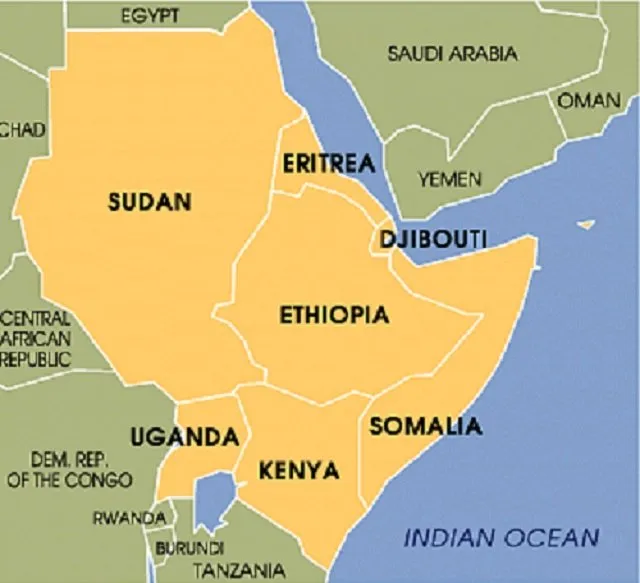
As millions of Somalis around the world await the expected results of the Turkish Petroleum’s deep sea drilling off of Galmudug’s coast, which is set to be completed in December 2026, one thing is beyond doubt: Somalia has entered a new, uncharted phase in its history. If managed well, the anticipated offshore oil revenue from the Curad-1 well will rejuvenate the Somali state itself, forge a strong foundation for a new national political compact between the Federal Government of President Hassan Sheikh Mahmoud and opposition politicians in Mogadishu, as well as ensure foundational prosperity for generations of Somali citizens.
Parallel to the high hopes surrounding the offshore oil deposits in the Curad-1 well is the equally unprecedented geo-political reality emerging in the Middle East and its immediate and long-term impacts on Somalia and the global energy sector.
After 7 months of intense US-Israel war on the expansionist Iranian regime, it is now clear beyond dispute that the Iranian regime and its main proxy, the Houthi movement in Yemen, have now taken full or partial control over two strategic global energy corridors vital to world trade: The Hormuz Strait and the Bab al Mandeb Strait.
Russia and China are supportive of Iranian control of Hormuz and Bab al Mandeb Straits since it deprives the United States of one of its key hegemonic pillars: the control over Middle Eastern energy.
The United States under President Donald J. Trump has suffered a self-inflicted catastrophic strategic defeat in the Middle East and the post- Iran war scenario is now seen by its main rivals, Russia and China, as the beginning of the post-America multipolar world.
Of course, Iranian and Houthi hegemony in the Arabian Gulf and Red Sea is not guaranteed and will be militarily contested by the United States, European Union and Israel.
However, as an immediate consequence of the ongoing failed Iran war, the Gulf Arab states, chiefly Saudi Arabia, the United Arab Emirates, Qatar and Kuwait have been exposed to unheard of political, economic and military destabilization and destruction of key infrastructure. In particular, Saudi Arabia and the UAE are now engaged in survival mode, fearing a permanent Iranian hegemony in the region.
The United States and Israel are unable or unwilling to provide long-term adequate protection for Arab Gulf states to prevent this new geo-political status quo from becoming a permanent Iranian-Houthi regional hegemony.
In fact, the United States and Israel now hope the best outcome in the Iran war would be to contain, disrupt and negotiate with an emboldened Iranian regime and its Houthi proxy to ensure free movement of Gulf Arab energy exports.
Today, no one, not even rational Trump administration officials or the Israeli govenment, are seriously hoping for an agreement on Iranian nuclear weapons. Rather, all diplomatic efforts are focused exclusively on finding a way to prevent full and uncontested Iranian hegemony over the Hormuz and Bab al Mandeb straits.
As the former Russian President and current Deputy Chairman of the Security Council of the Russian Federation, Dmitry Medvedev observed: The Strait of Hormuz has increasingly functioned as Iran’s primary strategic “golden weapon” and non-nuclear deterrent, superseding its formal nuclear program in immediate geopolitical leverage
The new geo-political reality in the Middle East is a catastrophic outcome for the Arab Gulf nations, something which was highlighted by the influential Emirati Presidential Advisor Anwar Gargash, who stated as recent as 7 September 2026 at the Hili Forum in Abu Dhabi:
“”Our energy exports will not be held hostage, nor will our trade and economic activity,” Gargash told the Hili Forum in Abu Dhabi.
Why Somalia Will Benefit from the New Geo-Political Reality in the Middle East
But for neutral Somalia, this new geopolitical reality offers unprecedented opportunities, despite the risks to the global economy.
Through the close strategic partnership and coordination with the Republic of Turkiye, the Federal Republic of Somalia is poised to develop and export huge volumes of offshore energy to India, China, Japan and South Korea.
Somalia is envisioned as a rival to Middle Eastern energy as a new energy corridor away from the unreliable Hormuz and Bab al Mandeb straits. Consequently, Somalia is now gaining a profound geo-political importance for India, China and Russia.
Turkiye has already begun preparations on shipping Somalia’s offshore oil and gas directly to Indian and Chinese refineries via the new Western Indian Ocean corridor.
Turkiye has also ensured that the Federal Government of Somalia under President Hassan Sheikh avoids any political or military entanglement with the ongoing US and Israeli war on Iran and its Houthi proxy for control of the Arabian Gulf and Red Sea- a simultaneous regional and global conflict which will only get a lot more bloodier and worse in the coming months and years for the Arab Gulf and Red Sea states.
As one Somali recently observed, Somalia can only move upward after three decades of anarchy and statelessness with Turkiye’s assistance while many Arab Gulf countries and the United States are now moving downward toward statelessness and hegemonic collapse.
As always, Somalia remains full of surprises!
The writer can be reached at : wadijir@hotmail.com
Editor’s Note: Views in the article do not necessarily reflect the views of borkena.com
__
Join our Telegram Channel: t.me/borkena
Like borkena on Facebook
To submit a press release, send the submission to info@borkena.com
Add your business to Ethiopian Business Listing / Ethiopian Business Directory
Join the conversation. Follow us on X (formerly Twitter) @zborkena to get the latest Ethiopian news updates regularly.