
II International Symposium
Press Release
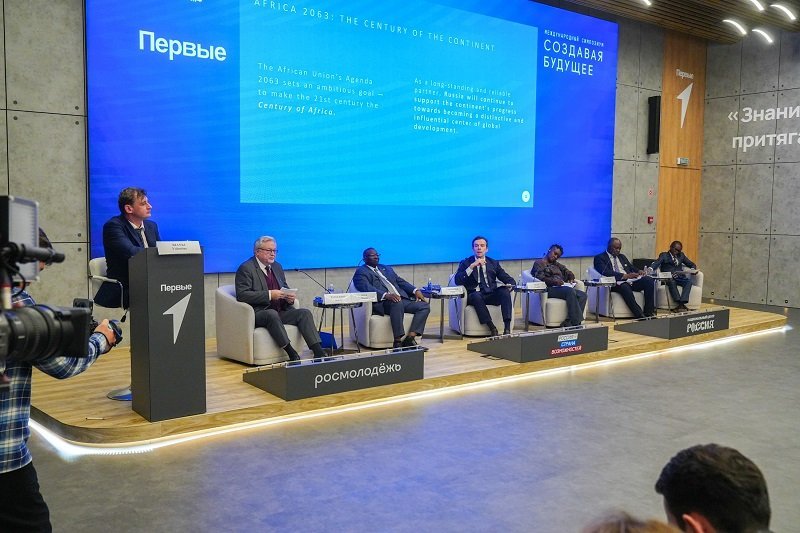
At the II International Symposium “Inventing the Future” held at the National Centre Russia, leading experts, policymakers, and business leaders from more than ten countries discussed how joint megaprojects could shape a new architecture of global cooperation — and what Russia–Africa partnership might look like by 2063.
Two flagship sessions — “Russia and Africa in 2063” and “Russia and the Global South: Megaprojects as the Architecture of the Future” — brought together representatives of the African Union Commission, the UN Economic Commission for Africa (UNECA), the Asia Cooperation Dialogue, and government officials, entrepreneurs, and academics from Ethiopia, Ghana, Mali, the Philippines, Tanzania, Zimbabwe, and Russia.
The discussions focused on cooperation in energy, transport, agriculture, digital transformation, and education — fields seen as the backbone of a shared development agenda across the Global South.
Valentine Bianki, Leading Expert of the Centre for African Studies (HSE University) and Managing Partner of Bianki & Partners, who moderated the Russia–Africa session, emphasized that long-term planning requires moving from forecasts to concrete scenarios:
“We are not just forecasting — we are designing scenarios. Africa is young, digital, and forward-looking; Russia is technological and resource-rich. Together, they can form a new pillar of global balance,” he noted.
Despite global changes, it’s vital to discuss and shape the future today. Our horizon is 2063 — in line with the African Union’s Agenda 2063, adopted in 2013.”
From the Russian side, Andrey Panyukhov, Deputy Director of the Department for Partnership with Africa, Ministry of Foreign Affairs of the Russian Federation, noted that Africa’s growing global role opens new horizons for collaboration in education, mobility, and digital integration.
Pavel Kalmychek, Director of the Department for Bilateral Cooperation, Ministry of Economic Development of the Russian Federation, added that trade between Russia and Africa — already exceeding $27 billion — is set to expand across all regions, supported by new investment and legal frameworks.
“Our partnership with Africa goes far beyond commodities. In the coming decades, we expect to see new joint projects in the spheres of industry, energy, agriculture and logistics based on technology exchange and sustainable growth.”
Dr. Mactar Seck, Chief of Frontier and Emerging Technology, Innovation and Digital Transformation at UNECA, highlighted digital sovereignty as a cornerstone of the continent’s development:
“By 2050, one in three young professionals worldwide will be African, and how this generation is integrated into global innovation networks will determine the digital economy’s structure. Russia could become a strategic partner in areas such as AI and innovation, cybersecurity and data sovereignty, e-government services, development of digital skills, and digital identity. Additionally, cooperation could extend to digital infrastructure like data centers and energy sectors, particularly civil nuclear energy.”
He added that Africa is moving from being a technology market to a technology ‘architect’: “Today the continent counts nine tech ‘unicorns’—less than 1% of the global total—but by 2050 we expect that this share could reach 10%. Joint Russia–Africa IT initiatives could generate dozens of new startups and unicorns within the next 10–15 years.”
The educational and humanitarian dimensions were also at the forefront. Dr. Elvira Dovletyarova, Director of the Agrarian and Technological Institute at RUDN University, stressed that every breakthrough begins with education, while Dr. Vicensia Shule, Senior Culture Officer at the African Union Commission, underlined the importance of integrating creativity and local languages into economic growth.
“Creativity should not exist apart from everyday life—it must be integrated into production, technology, and communities. If we bring agriculture and art together, making farming part of popular culture, it will breathe new life into entire industries.”
Amarquaye Armar, Board Chairman of First Atlantic Bank (Ghana), presented a vision for a 50 GW pan-African energy network involving Russian partners — an example of how megaprojects could catalyze systemic change.
Amb. Nasser Riden Thamer Al-Motairi, Secretary General of the Asia Cooperation Dialogue (ACD), underlined the importance of interregional solidarity in addressing global challenges:
“Digital, infrastructure, and educational gaps remain between regions. No country can solve them alone — what we need is coordinated exchange of knowledge, technologies, and resources. Partnership across the Global South is no longer optional; it is essential for collective resilience.”
Samuel Rahimeto Kebede, Director of the Interpretable AI and NLP Research Division at the Ethiopian Artificial Intelligence Institute, and Maksim Kuznetsov, Director of Strategic Development and Partnerships at AIRI Institute (Russia), discussed how collaboration in artificial intelligence can enhance language technologies, knowledge transfer, and human-capital development — building a generation of professionals able to work on global-scale innovation projects.
Ernest Denhere, Deputy Chief Investment Officer at the Mutapa Investment Fund (Zimbabwe), and Aliou Tunkara, Member of the National Assembly of Mali and Chairman of the Mali–Russia Parliamentary Friendship Group, emphasized the importance of sustainable investment and clear legal frameworks as foundations for long-term partnerships.
Summing up the debates, Vladimir Ilyanin, Managing Director for Sub-Saharan Africa of Sber, noted:
“Megaprojects go far beyond just constructions and investments. They are the architecture of cooperation, integrating transport, energy, and digital systems into a single framework for development. It is through their synergy that transformation occurs.”
Participants agreed that no single country can implement such initiatives alone and collaboration on megaprojects is not an option, but a necessity. The future of megaprojects lies in shared responsibility, co-financing, and human-centered innovation.
By 2063, participants envisioned, the Russia–Africa partnership could evolve into a strategic bridge linking energy, digital technologies, logistics, and education—a coherent ecosystem built on trust, innovation, and mutual benefit.
__
Disclaimer: Content in the Press Release category is provided by third parties and published as received, without editorial modifications. Borkena.com, one of the leading Ethiopian news portals based in Toronto, assumes no responsibility for the accuracy of the information. The views and opinions expressed do not necessarily reflect those of Borkena.com
Support : https://borkena.com/subscribe-borkena/
Borkena Ethiopian News Youtube Channel
Join our Telegram Channel : t.me/borkena
Like borkena on Facebook
To submit Press Release, send submission to info@borkena.com
Add your business to Ethiopian Business Listing / Ethiopian Business Directory
Join the conversation. Follow us on X (Formerly Twitter) @zborkena to get the latest Ethiopian News updates regularly.