
By Dr. Tadewos Taye
During the Christmas season, those who celebrate it exchange gifts with one another, reflecting the greatest gift humanity received from Heaven above—Jesus Christ, born in a manger in Bethlehem of Judea in Israel, now Bethlehem in Palestine. During this time, many families gather to discuss a wide range of topics, engaging in conversations that can be intense at times and, at other times, passionate and caring. In this context, at a dinner table, a friend—who seems to have a soft spot for Abiy Ahmed Ali—blamed Egypt as the scapegoat for every problem in the country. Then another person remarked, “Right now, in Ethiopia, Abiy Ahmed Ali is the best gift of Egypt.” This is a loaded statement that deserves to be unpacked as we celebrate the season.
What Does Egypt Want in Ethiopia?
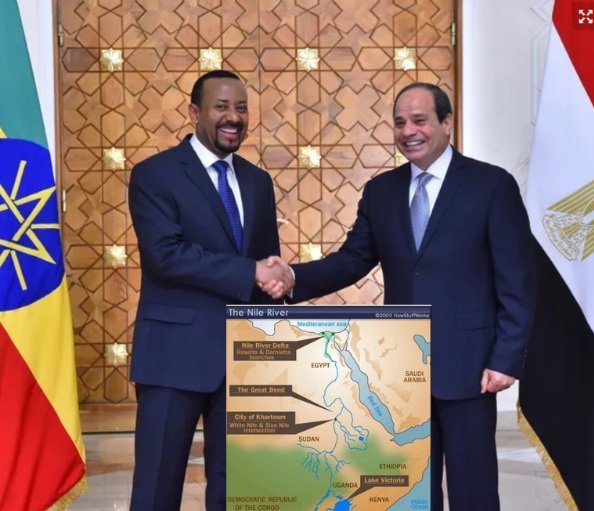
Let’s state the obvious: Egypt depends on the Nile for over 90% of its freshwater—a lifeline for agriculture, industry, and millions of people. Without the Nile, Egyptian civilization as we know it would not exist. That’s why the saying goes, “Egypt is the gift of the Nile.” But today, this 5,000-year-old civilization faces a serious threat. Who is challenging its very foundation by reshaping the Nile Basin? Ethiopia—through ambitious projects like the Grand Ethiopian Renaissance Dam (GERD). This is not just a dam; it’s a geopolitical game-changer that could redefine the balance of power and survival in the region.
So, what does Egypt want? It wants its dominance over the Nile waters—untouched, unchallenged, unshared, and non-negotiable—with absolute control. For decades, Egypt maintained this position through colonial-era agreements and, before that, through its own power and strategic wisdom. However, in today’s global order, such dominance is no longer guaranteed. The GERD stands as clear evidence of this shifting reality—a symbol of Ethiopia’s challenge to the status quo. Hence, a strong Ethiopia is a number one national threat for Egypt. And Egypt wants a weakened, divided and messed up Ethiopia. Exactly where the country is found now under the leadership of Colonel Abiy Ahmed Ali. Under Colonel Abiy Ahmed Ali’s leadership, Ethiopia finds itself at a critical crossroads. Once a nation celebrated for its unity and resilience, it is now deeply divided, weakened, and teetering on the brink of disintegration. Ethnic tensions have escalated, political institutions have eroded, and trust in governance has plummeted. Instead of fostering national cohesion, Abiy’s policies and power struggles have fueled fragmentation, leaving Ethiopia vulnerable to internal collapse and external manipulation. If this trajectory continues unchecked, the consequences could be catastrophic—not only for Ethiopia but for the entire Horn of Africa. So why blame everything on Egypt when the man in power is doing exactly what Egypt wants?
How Abiy became the best Gift of Egypt
Abiy Ahmed Ali’s propaganda machine would treat the claim that he is “Egypt’s best gift right now” as blasphemy, insisting instead that it is Abiy who saved the nearly failed GERD project. Yes, it is true—Abiy played a role in bringing the GERD project to some form of completion. But was it completed at the capacity originally intended? Not exactly. There were compromises and behind-the-scenes deals. This fact is well known to the real heroes of the GERD project—the many Ethiopian hydropower engineers, including figures like Ambassador Dr. Ing. Sileshi. Abiy became Egypt’s ‘gift’ partly by compromising GERD. Many have reflected on this reality. Of course, some credit Abiy for finishing the project, even though he claimed almost all the glory for himself—stealing it from the visionaries who laid the foundation, such as the late Meles Zenawi and Engineer Simegnew, the project manager of GERD, both now deceased, as well as millions of Ethiopians who supported it. In short, the way Abiy finished the GERD project is somehow a relief for Egypt, given the ambitious plan and the original vision of the project. Thanks to colonel Abiy Ahmed Ali!
However, the main reason Abiy Ahmed Ali is considered a gift for Egypt is not just because he weakened the GERD project—it is because he has weakened Ethiopia itself. Today, Ethiopia is at an all-time low in terms of internal coherence and cohesion. The country is deeply divided along ethnic lines. Although this fragmentation began under the TPLF, the central government is now at its weakest point in asserting authority and governance. Tigray is no longer under Abiy’s leadership; 80% of the Amhara region is beyond his control; Oromia is plagued by lawlessness and disorder; Gambela is in chaos; Benishangul faces ongoing conflict; tensions are brewing between the Somali region and neighboring Oromia; and Afar is embroiled in disputes along its borders with both the Somali region and Tigray.
What is left? Addis Ababa—the stage for Abiy’s drama and showcase of development. Yes, Addis Ababa has changed forever. It has developed, but at the cost of hundreds of thousands of people. It is the city where Abiy’s propaganda machine operates, portraying an image of progress and stability while masking the country’s deep turmoil. Beneath the surface, something is brewing. When it erupts, may God protect that city and its people. For now, Addis Ababa is Abiy Ahmed Ali’s Ethiopia. This is how he has reduced the country’s existence to a single city. Does that not make him a gift for Egypt? Do not start giving excuses—it is not because of this or that. In Africa, leadership is everything.
Another major reason Abiy Ahmed Ali has become Egypt’s greatest gift is his catastrophic failure on the diplomatic front. Under his leadership, Ethiopia has fallen to its weakest point in modern history—isolated, fragmented, and stripped of regional influence. Diplomacy, once Ethiopia’s shield and sword, has been reduced to empty slogans and photo ops. While Abiy parades around Addis Ababa showcasing vanity projects, Egypt is quietly rewriting the geopolitical map of the Horn of Africa. Look at the facts: Egypt now enjoys a strong foothold in Eritrea, Somalia, and Djibouti—countries that once looked to Ethiopia as a stabilizing force. Cairo has forged strategic partnerships with Uganda and South Sudan, and its influence in Sudan’s ongoing turmoil is undeniable. This is not coincidence; it is the direct result of Ethiopia’s diplomatic vacuum under Abiy’s watch. Where Ethiopia should have been building alliances and defending its interests, Abiy has been dismantling the very foundations of foreign policy, leaving the door wide open for Egypt to walk in and dominate. This is the essence of the argument: Abiy Ahmed Ali has not only weakened Ethiopia internally—he has surrendered its external leverage. In the Horn of Africa, leadership is everything. When a leader fails, the nation pays the price. Ethiopia is paying that price now, and Egypt is collecting the dividends. Does this not make Abiy Ahmed Ali the best gift Egypt could ever hope for?
There are countless reasons why Abiy Ahmed Ali has become such a gift to Egypt at this point in history, and one article cannot cover them all. At the root of the problem lies a leader with dangerously low competence. Despite his relentless investment in self-image—manipulating power and resources to craft a façade—the truth cannot be hidden forever. No matter how much wax you apply, under intense heat, the real shape emerges. If you are influenced by Abiy Ahmed Ali’s propaganda machine, you will only see his supposed strength. In today’s algorithm-driven social media age, falling into that spiral of propaganda is easy. Once inside, you are led down a path where you end up putting all the blame on Egypt and granting the benefit of doubt to an incompetent, self-worshiping leader, as the friend on the dinner table did.
Editor’s Note : Views in the article do not necessarily reflect the views of borkena.com
__
Support Borkena : https://borkena.com/subscribe-borkena/
Join our Telegram Channel : t.me/borkena
Like borkena on Facebook
Borkena Ethiopian News Youtube Channel
To submit Press Release, send submission to info@borkena.com
Add your business to Ethiopian Business Listing / Ethiopian Business Directory
Join the conversation. Follow us on X (Formerly Twitter) @zborkena to get the latest Ethiopian News updates regularly.