
Editor’s Note : Published with Permission from the Defense & Foreign Affairs Special Analysis Journal.
Analysis. From GIS/Defense & Foreign Affairs Special Analysis correspondents in Addis Ababa
Editor: Gregory Copley
Current concerns about the security of maritime traffic through the Strait of Hormuz — connecting the Indian Ocean/Gulf of Oman with the Persian Gulf — have overshadowed the fact that the related issue of Red Sea security is far from resolved, and is, in fact, becoming more dynamic.
The Red Sea-Suez link between the Mediterranean and the Indian Ocean is of equal strategic importance to global trade as the Hormuz chokepoint, and is, through geography and common players, intrinsically linked with the Persian Gulf conflict.
But it is Ethiopia’s civil war, brewing up with different factions and with varying intensity since the coup against Emperor Haile Selassie I in 1974, which is again moving in ways which could prove decisive. Always, in the background, is the reality that Ethiopia could revive its historical influence over the Red Sea-Suez sea line of communication (SLOC).
Inside Ethiopia, the conflicts which have been raging since 1974 between different governments and different factions are at a new level.
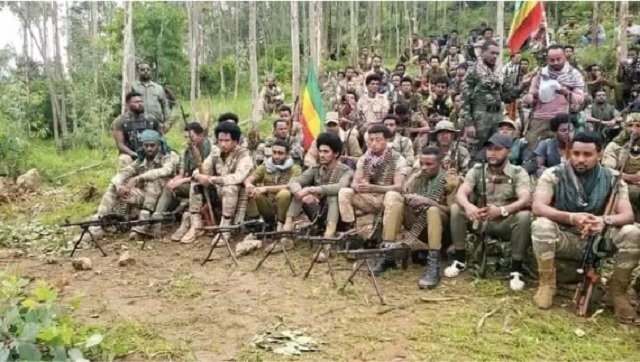
The four different Fano opposition militia groups, representing different areas of the Amhara heartland, have been fighting against the central government of Prime Minister Abiy Ahmed Ali for several years, and, in early 2026, came together with a united manifesto of their intentions. This has revived the momentum of the threat to Prosperity Party Government of Dr Abiy.
A statement issued by a united Fano on January 17, 2026 (Tir 9, 2018, in the Ethiopian Calendar) noted:
“So that the Amhara struggle may become one, the leaders of the Amhara Fano National Force and the Amhara Fano People’s Organization, through a historic decision that demanded courage, open-heartedness, decisiveness, and trust in the people, have been able to make Fano unity a reality. … We have designated one leader, one organization.”
Significantly, the leadership of the united Fano all signed themselves as “Arbegna”, a nod to the Arbegnoch, the Patriots, who, under the banner of Emperor Haile Selassie I, fought against the Italian invaders of Ethiopia from 1935 to 1941. This led to the ouster of the Italians at the Battle of Gondar, in late November 1941, the first major Allied victory of World War II, in the ouster of an Axis power (Italy) from territory it had seized.
Today, the result of the four separate Amhara Fano groups fighting against the Abiy Government over the past several years was the creation — finally — of the Amhara Fano National Movement (AFNM) as an umbrella for all civil and military operations. AFNM, however, described itself as working on behalf of all Ethiopians desirous of the restoration of the multi-ethnic empire [Ethiopia is home to some 80 ethnic and linguistic groups].
Prime Minister Abiy, half-Amhara and half-Oromo, has consistently identified with Oromo causes, and first fought against a Tigrean-dominated Government of Ethiopia, and then against the Tigrean Popular Liberation Front (TPLF) militia, which was forced into a ceasefire — essentially a military surrender by the TPLF — in November 2022.
Prime Minister Abiy’s Prosperity Party Government has increasingly been rejected by his original Oromo militant supporters who regard him as “insufficiently Oromo” in outlook, and the Government’s writ — or its area of focus — now rarely extends beyond the capital, Addis Ababa. The exception for Abiy’s travels is to some major projects such as the Grand Ethiopian Renaissance Dam (GERD) in the Benishangul-Gumuz Region of western Ethiopia. GERD has been the subject of some hostility from Egypt, which sees the dam’s existence as infringing on Egypt’s “right” to control the waters of the Blue Nile, even though they originate in Lake Tana in the Amhara Highlands of Ethiopia, outside Egypt’s territories.
The AFNM designated its initial leadership as follows:
Chairman of the Amhara Fano National Movement: Arbegna Zemene Kasse
First Deputy Chairman: Arbegna Meketaw Mamo
Deputy Chairman for Military Affairs: Arbegna Habte Wolde
Deputy Chairman for Political Affairs: Arbegna Henok Adise
In addition, the Amhara Fano National Movement assigned leaders to the following directorates:
Military Commander: Brigadier General Tefera Mamo
Deputy Military Commander: Arbegna Mire Wedajo
Deputy Commander for Military Administration: Arbegna Zinabu Lingeraw
Military Training Directorate: Arbegna Samuel Bale’idl
Special Military Campaign: Arbegna Dirsan Birhane
Military Campaign Directorate: Arbegna Bayu Alebachew
Political Directorate: Arbegna Geta Asrada
Organization Directorate: Arbegna Mintesnot Wondafe-rahu
Organization Office: Arbegna Aschalew Belete
Public Relations: Arbegna Asres Mare Damte
Public Administration Directorate: Arbegna Zemene Mihret
Finance & Procurement Administration: Arbegna Ashagre Baye
Policy & Strategy Directorate: Arbegna Eskinder Nega (subsequently resigned)
Partnership & Cooperation Directorate: Arbegna Abebe Fentaw
Foreign Affairs Directorate: Arbegna Biruk Sileshi
Meanwhile, the Government of Prime Minister Abiy has become increasingly dependent on support from the governments of the United Arab Emirates, Saudi Arabia, and, to an extent, Türkiye and the PRC, each of which has a strong interest in dominating the Red Sea-Suez SLOC. To a key extent, Prime Minister Abiy has focused on modernizing the capital, Addis Ababa — which now resembles a Dubai skyline — but has less control over the broader hinterland of Ethiopia.
At the same time, the Government of Egypt is working to support various Ethiopian regional independence groups to destabilize Ethiopian control of the Blue Nile waters, which Egypt claims is critical to its national security and economic wellbeing. Egypt has maintained an on-and-off war approach to Ethiopia since the late 19th Century and lost several major military confrontations with Ethiopia during the late 19th Century. All of the supporting nations as far as Prime Minister Abiy is concerned also have interests which are inimical to Ethiopia’s revival of Red Sea influence.
It is important to note that Prime Minister Abiy has consistently ensured that there is very little foreign news reporting from Ethiopia, which has had the positive benefit for the Government that the civil wars, and the massive loss of life, have not been known widely around the world. On the other hand, it has also prevented international investors and tourism interests in the country.
Now, Türkiye, in particular, is vying for control of the region, and actively now controls the Somalian Government, and uses Somalian coastal territory for its military testing of ballistic missiles, among other things. It was particularly hostile to Israel’s diplomatic recognition of independent Somaliland, on the Red Sea coastline, in late December 2025.
Internally, in Ethiopia, the AFNM has been speaking — in its initial unity document — about representing the interests of all Ethiopian ethnicities and regions, not just the Amhara people and regions. It has been gathering significant military momentum, with additions to its ranks coming from defecting government forces. It did not, however, mention the restoration of Ethiopia’s last constitution from the pre-coup era, given that this was the last democratic reference point for the country.
All subsequent “constitutions” have been designed in the divide-and-conquer mode to keep ethnic groups separate and competitive, keeping various Ethiopian peoples as second class citizens.
But what the AFNM has failed to do is to address meaningful international support, nor to define the future shape of Ethiopia if it were to attain power. There has been no public discussion of its proposed economic or strategic policies. Only the adoption of the name of the Patriots — the Arbegnoch — gives any indication of its reflection of traditional Ethiopian values or historical Ethiopian geopolitical aspirations, which would include a reunification with Eritrea and the reacquisition of Ethiopia’s traditional Red Sea coastline.
It is significant, however, that Eritrea has been supporting the AFNM groups with arms and other support, and some Tigrean elements from the now-split TPLF have also supported Fano groups.
The AFNM operates freely in Amhara areas close to Addis Ababa and could certainly challenge Dr Abiy’s forces in the capital. The other factor is the reporting that Dr Abiy himself may be closer to the end of his leadership than the start of it. Change may not be imminent, but Dr Abiy is becoming somewhat embattled.
__
Support Borkena : https://borkena.com/subscribe-borkena/
Join our Telegram Channel : t.me/borkena
Like borkena on Facebook
Add your business to Ethiopian Business Listing / Ethiopian Business Directory Business Listing Toronto
Join the conversation. Follow us on X (Formerly Twitter) @zborkena to get the latest Ethiopian News updates regularly. Subscribe to YouTube channel To share information or for submission, send e-mail to info@borkena.com
An analysis of Ethiopia’s complex historical narrative frequently points to the emergence of various armed movements. However, the rise of the Fano movement within this context presents a notably distinct and significant development. Fano has rapidly cultivated substantial popular support, indicative of a deep-seated and widespread acceptance that appears to be grassroots-driven and has materialized with considerable speed. The pace at which this backing has coalesced is a striking characteristic of its formation. Concurrently, there has been a demonstrable and swift advancement in the Fano movement’s operational capabilities and tactical approaches. Their engagements with governmental forces, led by Prime Minister Abiy Ahmed, have reportedly included repeated successes, often resulting in the appropriation of military resources. These actions have not only served to strengthen the movement’s own capacity but have also significantly reshaped the nature and dynamics of the ongoing conflict. The confluence of extensive public engagement and proven military effectiveness displayed by AFNM is widely regarded as a unique and perhaps unparalleled phenomenon in Ethiopia’s recent history.
Yes, the Red Sea issue is surging now on the news that the goons in Yemen have started lobbing missiles at Israel. They will definitely get a forceful response from Israel and its allies. Then they will start firing missiles and drones at places where they think their enemies have bases. Djibouti, Somaliland and Ethiopia will be potential targets and all these countries are just a stone throw away from their rabbit holes. I am not confident that these countries have a strong air defense system to shoot down so many drones and missiles coming at them the same time. Addis/Finfinne, Dire Dawa, Berbera, Jigjige and other cities could end up being fair game. That will be a pretty sight to watch for el-Sisi’s beast of burden Al-Toweel Isu and his running dogs who have been scavenging on websites among our Diaspora. Al-Toweel Isu goes ‘I told you so a million times that it has to do with my proven theory in geopolitics ‘Uni-Polar and Multi-Polar’.