
By Ewunetu Teshale
When Truth Meets Power
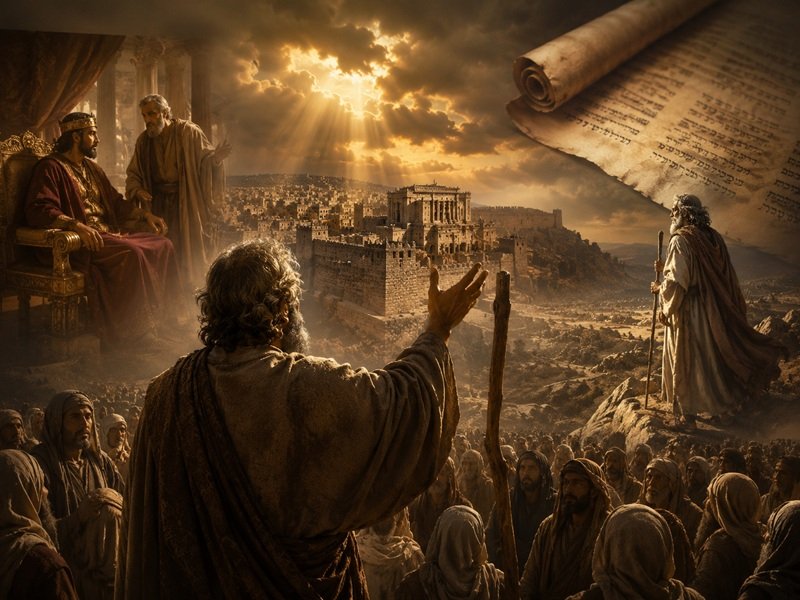
Throughout Scripture, prophets often stood where heaven and earth met, where divine truth confronted human power. They spoke in royal courts, confronted kings, challenged national policies, and called entire nations to repentance. From Moses before Pharaoh to Nathan before David, from Elijah confronting Ahab to John the Baptist rebuking Herod, the prophetic voice has always occupied a unique and often uncomfortable place in public life.
The Bible presents prophets as God’s messengers, not political strategists. Their primary responsibility was not to advance political agendas but to communicate God’s perspective into the affairs of nations. They reminded rulers that all human authority is accountable to divine authority and that no kingdom can flourish indefinitely apart from righteousness, justice, and obedience to God.
Yet whenever prophecy and politics intersect, a profound tension emerges. Political leaders naturally seek affirmation, legitimacy, and support. Prophets, however, are called to speak truth, even when that truth is inconvenient, unpopular, or costly. As a result, Scripture reveals three recurring types of prophetic voices: those who echo power, those who fear power, and those who confront power with the truth of God.
When Prophecy Echoes Power
One of the most sobering scenes in the Bible unfolds in 1 Kings 22. King Ahab gathered four hundred prophets before launching a military campaign. Their message was unanimous:
“Go and attack Ramoth Gilead and be victorious, for the Lord will give it into the king’s hand” (1 Kings 22:6, NIV).
At first glance, their words appeared encouraging and faith-filled. Yet these prophets were not speaking from the counsel of God. They had become interpreters of the king’s desires rather than messengers of God’s will.
They understood Ahab’s ambitions. They sensed the mood of the royal court. They knew what the king wanted to hear and gave him precisely that.
The prophet Ezekiel later condemned such voices:
“Prophesy against the prophets of Israel who are now prophesying out of their own imagination” (Ezekiel 13:2, NIV).
Likewise, Jeremiah warned against those who spoke “visions from their own minds, not from the mouth of the Lord” (Jeremiah 23:16, NIV).
These prophets functioned more as mirrors than messengers. They reflected the emotions, expectations, and ambitions of leaders rather than revealing the heart of God.
Their story remains a warning to every generation. Religious language, popularity, and unanimous agreement are not substitutes for divine truth. When prophecy becomes captive to political ambition, it ceases to be prophetic and becomes merely another instrument of power.
When Fear Silences the Truth
Not every prophetic failure originates in deception. Some originate in fear.
Throughout history there have been men and women who recognized the truth, understood the dangers facing their communities, and discerned God’s concerns, yet hesitated to speak openly. Their problem was not ignorance but courage.
Political power has always exerted enormous influence. Leaders can grant access, recognition, and opportunity. They can also marginalize critics and silence opposing voices. Consequently, many who know the truth become tempted to soften it.
They see the compromise.
They recognize the corruption.
They understand the consequences.
Yet they remain silent.
Jeremiah confronted this reality when he declared:
“The prophets are prophesying lies in my name. I have not sent them or appointed them or spoken to them” (Jeremiah 14:14, NIV).
Not every compromised prophet deliberately becomes false. Some simply allow fear to shape their message. They choose caution over conviction and safety over faithfulness.
History suggests that societies rarely collapse because truth is unavailable. More often, they decline because those entrusted with the truth become afraid to proclaim it.
When prophetic voices fall silent, power operates without accountability. When truth is muted, deception flourishes.
The challenge for every generation is not merely to discern God’s voice but to speak it when doing so becomes costly.
When Truth Costs Everything
Against the backdrop of four hundred compliant prophets stood one solitary figure: Micaiah son of Imlah.
Before appearing before King Ahab, he received practical advice:
“Let your word agree with theirs, and speak favorably” (1 Kings 22:13, NIV).
In modern terms, he was being told:
“Don’t make trouble.”
“Don’t challenge the consensus.”
“Don’t risk your future.”
Everything around him encouraged conformity.
Yet Micaiah responded:
“As surely as the Lord lives, I can tell him only what the Lord tells me” (1 Kings 22:14, NIV).
Those words capture the essence of authentic prophetic ministry.
Micaiah knew his message would be unpopular. He knew the king would reject it. He understood that imprisonment might follow. Yet he spoke because his loyalty belonged to God rather than to political power.
The king ignored the warning. Micaiah was imprisoned. The battle proceeded.
And Ahab died exactly as the prophet had foretold.
Truth did not become false because it was rejected.
Throughout biblical history, faithful prophets frequently paid a price for obedience. Noah was mocked. Jeremiah was imprisoned. John the Baptist was executed. Yet their faithfulness endured long after their opponents’ power had disappeared.
The authority of a prophet has never been determined by proximity to power but by fidelity to God’s word.
A Word to the Church Today
The Church today faces many of the same challenges faced by believers in ancient Israel. Political polarization, ideological conflict, and competing claims to truth create immense pressure on Christian leaders and communities.
In such an environment, discernment is essential.
Political enthusiasm must never be confused with prophetic truth.
Access to power must never be mistaken for spiritual authority.
Popularity must never become a substitute for faithfulness.
The Church is called to be more than a commentator on public affairs. It is called to be a moral and spiritual witness to society, proclaiming God’s righteousness, justice, mercy, and truth regardless of political consequences.
Whenever the Church becomes an echo chamber for political interests, it loses its prophetic distinctiveness. But when it remains anchored in Scripture and guided by the Holy Spirit, it becomes a voice of hope, accountability, and truth.
Heaven Honors the Faithful
The Bible presents three prophetic voices.
One echoes power.
One fears power.
One speaks truth to power.
History often celebrates the first.
History frequently overlooks the second.
But heaven honors the third.
In every generation, God continues to seek men and women whose loyalty to Him exceeds their desire for influence, approval, or security.
Like Micaiah, they understand that the prophet’s calling is not to tell rulers what they want to hear but to faithfully communicate what God has said.
Their conviction remains timeless:
“As surely as the Lord lives, I can tell him only what the Lord tells me” (1 Kings 22:14, NIV).
May God raise such voices again in our churches, our communities, and our nations.
Editor’s Note : Views in the article do not necessarily reflect the views of borkena.com
__
Join our Telegram Channel : t.me/borkena
Like borkena on Facebook
To submit Press Release, send submission to info@borkena.com
Add your business to Ethiopian Business Listing / Ethiopian Business Directory
Join the conversation. Follow us on X (Formerly Twitter) @zborkenato get the latest Ethiopian News updates regularly.
To Support Borkena : https://borkena.com/subscribe-borkena/ – one time support or small monthly options available. Inquire information about it : info@borkena.com