 and an Assessment of Yihenew Ewnetu’s Political Analysis. Read.)
A Critical Response to Sisay Mulu (Amoraw) and an Assessment of Yihenew Ewnetu’s Political Analysis
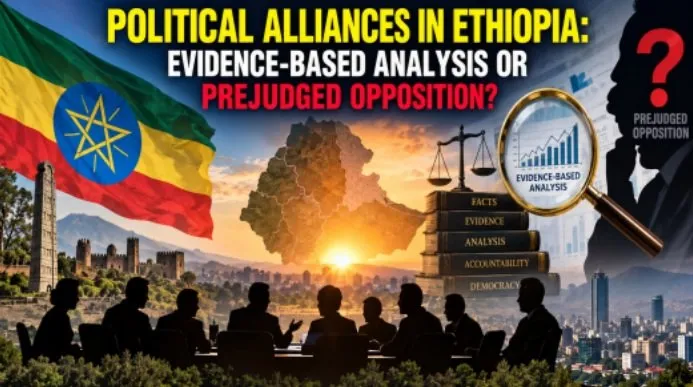
By Solomon Tesfaye
Abstract
The formation of a political alliance among historically competing Ethiopian movements raises important questions about national survival, political legitimacy, accountability and democratic transition. This article critically examines two contrasting interpretations: Yihenew Ewnetu’s Propaganda or Evidence-Based Criticism? (2026) and Sisay Mulu’s The Alliance for Survival Failed (2026).
It also places that debate within the record of the government of Prime Minister Abiy Ahmed Ali: power centralised since the 2019 creation of the Prosperity Party, a narrowed political space, stalled accountability, contested allegations of corruption and renewed war in Tigray. Documented findings are kept distinct from allegations and from the government’s own position (Freedom House, 2026; Human Rights Watch, 2026).
My position is that political alliances should be evaluated through verifiable evidence, established political science theories, strategic objectives and long-term democratic outcomes, rather than assumptions, historical hostility or premature conclusions. I support the principle of cross-regional political cooperation as a potential foundation for peaceful dialogue, constitutional reform, justice and accountable governance. However, support for an alliance must not mean abandoning independent scrutiny of its leadership, agreements or conduct.
1. Background: The Government of Prime Minister Abiy Ahmed Ali
The alliance debate cannot be separated from the record of the government it opposes. This section summarises that record under the evidential standard applied throughout this article. It separates findings documented by the United Nations, rights monitors and the United States Government from matters that are reported or alleged but not independently established, and from the government’s own position. It assesses institutional conduct and is not a finding of individual criminal liability.
1.1 Documented Findings
Centralised power and political space. Prime Minister Abiy Ahmed Ali’s Prosperity Party was formed from the ruling EPRDF coalition in late 2019; the TPLF refused to join and called the merger unlawful (Africanews, 2019). In the June 2026 election the party won 438 of 501 contested seats after most opponents were prevented from taking part, and 143 polling stations in Oromia and Amhara did not open (Associated Press, 2026). Freedom House (2026) rates Ethiopia 18 out of 100, “Not Free”. The US State Department reported that seven Oromo Liberation Front leaders were held for more than four years without charge despite court orders (US Department of State, 2025).
Media and information. Human Rights Watch (2026) recorded the arbitrary arrest of at least six journalists in August and September 2025, and an April 2025 amendment allowing the head of the media regulator, appointed by the prime minister, to suspend licences. The US State Department reported that the government used nationwide and regional internet shutdowns to control the online space (US Department of State, 2025).
Conflict and accountability. Human Rights Watch (2026) estimated that 3.3 million people were displaced by mid 2025, found transitional justice stalled and impunity the norm, and reported waves of forced evictions under the corridor development programme. The UN human rights office attributed 248 civilian deaths to government drone strikes in late 2023, which also destroyed schools, hospitals and water infrastructure, and recorded 4,879 detentions under the Amhara state of emergency (Office of the UN High Commissioner for Human Rights, 2024; US Department of State, 2025).
1.2 Reported or Alleged, Not Independently Established
An audit presented to parliament reportedly found about 98 billion birr, roughly 5 percent of the budget, misappropriated in nine months, but the available account is second-hand (Borkena, 2026). The planned Chaka palace complex was put at 49 billion birr by one outlet and at US$10 to 15 billion by others, estimates the government disputes (The Reporter, 2022; The Globe and Mail, n.d.). In 2023 USAID and the World Food Programme suspended food aid over mass diversion that USAID believed benefited military units (Voice of America, 2023). Claims that relief money financed combat drones could not be corroborated and are excluded.
1.3 The Government’s Position
The government and its defenders present their measures as necessary to protect national unity and security. Abiy called the June election proof of the “growing maturity of Ethiopia’s democratic culture” (Dawan Africa, 2026), and his press secretary says the palace project creates jobs and follows compensation law (The Globe and Mail, n.d.). These positions belong on the record, but the independent findings summarised above point the other way on political space and accountability.
1.4 The Tigray-Eritrea Front
The 2022 Pretoria agreement ended a war that killed at least 600,000 people by African Union estimates, but its core disputes were never settled (Agence France-Presse, 2026). The agreement then eroded. The election board revoked the TPLF’s legal status in May 2025 (AllAfrica, 2025). A TPLF-led alliance launched an offensive on 23 September 2026, after which Addis Ababa cut ties with Eritrea and accused it, Sudan and Egypt of backing the TPLF, which all three deny (TRT World, 2026). Federal and allied forces retook Mekelle on 3 to 5 October while the TPLF vowed to keep fighting (Al Jazeera, 2026), and the Prime Minister then announced a new Tigray administration and said he wants elections within six months (Reuters, 2026d). Analysts describe this as the worst escalation since 2020 to 2022 and warn that it could widen regionally (Reuters, 2026b), alongside Ethiopia’s Red Sea push (The East African, 2026) and reported troop movements at the Eritrean border (Reuters, 2026c).
Concerns about centralisation, accountability and renewed war explain why many Ethiopians look for alternatives to the incumbent government. They do not exempt any alternative from scrutiny. The same evidential standard applies to the alliance, to its critics and to the government, and it is the principle on which the rest of this article rests.
2. Introduction: Understanding Political Alliances
On 21 September 2026, Reuters reported the formation of an alliance involving seven Ethiopian armed movements, including the Amhara Fano National Movement (AFNM), the Tigray People’s Liberation Front (TPLF) and other regional organisations. The publicly reported name was the Ethiopian Peoples’ Forces Alliance for Survival. The name Ethiopian People’s Forces Alliances for Resistance (EPFAR) is used here in accordance with the terminology adopted in my research correspondence. The two names should not be treated as independently verified official equivalents without confirmation (Reuters, 2026a).
In my earlier analysis, Freedom Fighters’ Coalition: Unity of Purpose Without Uniformity of Ideology, I argued that cooperation between historically competing movements can be evaluated through shared objectives, transparent decision-making, civilian protection and a legitimate transitional framework (Tesfaye, 2026).
This principle is supported by Fotini Christia’s research on civil-war alliances. Christia (2012) demonstrates that alliances frequently emerge from changing political and strategic interests rather than common identities or permanent ideological agreement. Her research also identifies the risk of fragmentation when power relationships change. Alliance formation is therefore neither proof of success nor evidence of inevitable failure.
3. Three Perspectives on the Ethiopian Alliance
3.1 Supporters of Political Cooperation and Democratic Transition
The first perspective supports coalition-building as a potential means of overcoming political fragmentation. From this viewpoint, a credible alliance could create opportunities for:
Constructive dialogue between historically competing political movements.
Negotiated solutions to constitutional and territorial disagreements.
Protection of civilians and fundamental human rights.
Institutional accountability and transitional justice.
Inclusive democratic governance and peaceful political competition.
These are potential benefits, not established achievements. The strongest argument for an alliance is not that its leaders are beyond criticism. It is that structured political cooperation may offer opportunities for dialogue that prolonged confrontation has failed to deliver. Its durability depends on changing interests, commitments and institutional arrangements (Christia, 2012).
3.2 Opponents of the Alliance and Unsupported Conclusions
The second perspective opposes the existing alliance or questions its leadership. Some criticism may be politically motivated or influenced by propaganda. However, opposition to the alliance alone is not evidence that someone supports Prime Minister Abiy Ahmed or the Prosperity Party. That distinction is essential to evidence-based analysis.
Sisay Mulu’s The Alliance for Survival argues that the alliance has suffered a serious strategic setback, that its leadership misjudged political risks and that Amhara political priorities require stronger internal organisation (Mulu, 2026). His central argument links the alliance’s declining prospects to the TPLF’s loss of Mekelle and the resulting political uncertainty.
My principal disagreement concerns the strength of the conclusions drawn from the available evidence. Recent reporting described federal-aligned forces regaining Mekelle and the announcement of a caretaker administration. Those developments do not independently establish that the entire alliance has dissolved or that all political cooperation among its members has become unviable (Reuters, 2026b, 2026d).
First, an observed setback is not sufficient proof of inevitable organisational collapse. Such a conclusion requires evidence concerning political agreements, leadership cohesion, institutional arrangements and continuing cooperation.
Second, claims about widespread public rejection require representative evidence. Historical grievances and security fears are real considerations, but they cannot establish the opinions of an entire population without credible supporting research.
Third, criticism of leadership must distinguish demonstrated failures from predictions. Leaders should explain decisions and accept scrutiny, but an adverse event does not automatically prove the original decision lacked all strategic justification.
Yihenew Ewnetu (2026) identifies similar weaknesses, particularly premature conclusions and the use of territorial developments as decisive evidence of overall alliance failure. Nevertheless, Mulu raises legitimate questions about public consultation, leadership accountability, representation and safeguards for Amhara communities. His article calls for independent assessment and periodic review of partnerships. Those arguments deserve consideration even where his broader conclusions are disputed (Mulu, 2026).
I disagree with dismissing the alliance as conclusively failed, but I would not dismiss every concern raised by its critics.
3.3 Independent, Undecided and Non-Aligned Perspectives
The third perspective consists of individuals who neither endorse the alliance nor support the incumbent government’s political position. Their concerns may include uncertainty about internal agreements; historical grievances and territorial disputes; representation; renewed violence; and doubts about a successor administration’s democratic commitments.
These individuals should not be automatically classified as political opponents. A genuinely inclusive political process must accommodate independent judgement, peaceful dissent and constructive criticism. Political disagreement is not disloyalty. Democratic legitimacy requires the freedom to question every political organisation.
4. Ethiopia’s Conflict, Civilian Atrocities and Geopolitical Risks
The debate about alliances must be considered against Ethiopia’s documented humanitarian crisis. Human Rights Watch’s World Report 2026 records continuing armed conflict in Amhara and parts of Oromia, instability affecting Tigray, restrictions on civic freedoms and serious abuses involving government forces and armed groups. It reports civilian casualties, displacement and inadequate accountability (Human Rights Watch, 2026).
No government, opposition movement or armed organisation should receive unconditional political immunity from scrutiny concerning alleged violations of international humanitarian law.
Ethiopia’s geopolitical environment further complicates the crisis. Its strategic position connects the Horn of Africa, the Red Sea, the Nile Basin and regional trade corridors. Relationships with Eritrea, Sudan, Somalia, Djibouti and international partners affect regional stability. Reuters reported renewed Ethiopia-Eritrea border tensions in October 2026, reinforcing the importance of diplomacy, peaceful conflict resolution and regional cooperation (Reuters, 2026c).
Consequently, the political value of any alliance should be measured partly by whether it can help create conditions for de-escalation, humanitarian access and inclusive negotiations. An alliance that merely reproduces authoritarian practices would not constitute meaningful democratic progress.
5. Assessing Yihenew Ewnetu’s Analysis
I broadly agree with Yihenew Ewnetu’s central methodological argument: political commentary should distinguish evidence-based criticism from speculation, rhetorical exaggeration and premature conclusions. His application of civil war alliance theory explains why historically antagonistic organisations may cooperate without abandoning separate political identities (Ewnetu, 2026; Christia, 2012).
However, academic rigour requires the same evidential standards on both sides. Ewnetu’s claims about military effectiveness, public support and diplomatic achievements require independent verification. His characterisation of Mulu’s article as approximately “85% propaganda” is not accompanied by a reproducible scoring methodology in the supplied document. I therefore support Ewnetu’s analytical direction without treating every conclusion as independently established fact.
The credibility of an argument depends on its evidence and reasoning, not simply on whether it supports the political position we favour.
6. Conclusion: From Political Alliance to Democratic Accountability
The debate surrounding EPFAR should move beyond personal accusations and political polarisation. My support for coalition-building rests on its potential to encourage dialogue, reduce fragmentation and establish a framework for democratic transition. Yet a successful alliance requires more than agreement against a common political opponent. It must demonstrate commitments to civilian protection, constitutionalism, equal citizenship, institutional independence, transitional justice, peaceful dispute resolution and credible elections.
Sisay Mulu’s conclusion that the alliance has failed is, in my assessment, stronger than the available evidence currently supports. At the same time, his concerns about leadership accountability and public consultation should not be disregarded. Similarly, allegations that alliance critics are government propagandists must be supported by verifiable evidence rather than inferred from their opinions.
Political alliances should be judged by their objectives, evidence, governance arrangements, accountability and measurable contributions to peace. Supporting an alliance does not require unconditional loyalty. Opposing an alliance does not automatically establish political collaboration with the incumbent government. Ethiopia’s long-term interests require political maturity, civilian protection, peaceful dialogue, justice and democratic institutions capable of resolving disagreement without violence.
References
1. Africanews. (21 November 2019). Tigray bloc rejects ‘unlawful’ merger of Ethiopia ruling coalition. [Source] 2. Agence France-Presse. (29 January 2026). Flights to Ethiopia’s Tigray region suspended as clashes erupt. Ahram Online. [Source]
3. Al Jazeera. (5 October 2026). Ethiopia’s forces retake Mekelle amid renewed Tigray fighting. [Source]
4. AllAfrica. (15 May 2025). Ethiopia’s election board revokes TPLF’s legal status. [Source]
5. Associated Press. (21 June 2026). Ethiopia’s ruling party retains parliamentary majority in election marred by crackdown on dissent. The Washington Times. [Source]
6. Borkena. (4 May 2026). Ethiopia audit uncovers 98 billion birr grand corruption scandal. Second-hand report. [Source] 7. Christia, F. (2012). Alliance Formation in Civil Wars. Cambridge University Press. [Source]
8. Dawan Africa. (5 October 2026). Ethiopia’s Abiy sworn in for second term, vows to protect national interests. [Source] 9. The East African. (October 2026). Abiy starts new term, pushes Red Sea tensions. [Source]
10. Ewnetu, Y. (17 October 2026). Propaganda or Evidence-Based Criticism? A Short Evaluation of the Anti-Alliance Critique. Borkena. Supplied article, 12 pages.
11. Freedom House. (2026). Freedom in the World 2026: Ethiopia. [Source]
12. The Globe and Mail. (n.d.). New palace for Ethiopian PM brings evictions and dissent. [Source]
13. Human Rights Watch. (2026). World Report 2026: Ethiopia. [Source]
14. Mulu, S. (2026). The Alliance for Survival. Supplied political commentary, 5 pages.
15. Office of the United Nations High Commissioner for Human Rights. (2024). Update on the human rights situation in Ethiopia in 2023. [Source]
16. The Reporter. (21 May 2022). Government inches to build palace for over 49 billion birr. [Source] 17. Reuters. (2026a, 21 September). Seven Ethiopian armed groups announce anti-government alliance. [Source] 18. Reuters. (2026b, 4 October). Ethiopian government forces and allied militias regain control of Tigray capital. The Jerusalem Post. [Source]
19. Reuters. (2026c, 13 October). Ethiopian troops enter town on border with Eritrea, stoking war fears. [Source] 20. Reuters. (2026d, 16 October). Ethiopia’s Abiy names new Tigray government, wants polls in six months. [Source] 21. Tesfaye, S. (2026). Freedom Fighters’ Coalition: Unity of Purpose Without Uniformity of Ideology. Previously prepared political analysis, 3 pages.
22. TRT World. (4 October 2026). Ethiopian forces take control of Mekelle from TPLF-led alliance. [Source] 23. US Department of State. (12 August 2025). 2024 Country Reports on Human Rights Practices: Ethiopia. ecoi.net. [Source] 24. Voice of America. (9 June 2023). WFP joins US in suspending Ethiopia food aid. [Source]
Editor’s Note: Views in the article do not necessarily reflect the views of borkena.com
__
Join our Telegram Channel: t.me/borkena
Like borkena on Facebook
To submit a press release, send the submission to info@borkena.com
Add your business to Ethiopian Business Listing / Ethiopian Business Directory
Join the conversation. Follow us on X (formerly Twitter) @zborkena to get the latest Ethiopian news updates regularly.