
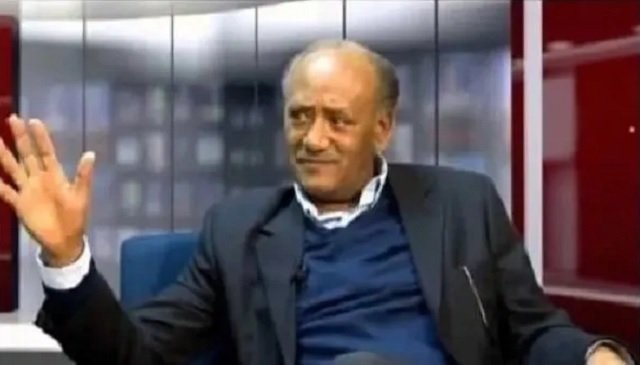
Aklog Birara (Dr)
Part III of V
In Part II of this series I identified and discussed three policy themes: education and the future, justice and the rule of law and freeing Ethiopia’s weak domestic private sector from state and party control. All three are critical in the pursuit of sustainable and equitable social, economic, and political transformation and a transition towards a citizenship based, all-inclusive, just, and social democratic society in this ancient and important African country.
Let us face it. Ethiopia may be the only country in the world where its Prime Minister sits in his palace built by Pan-Ethiopianists and Pan-Africanists who is determined to gut its history and convert the country he leads into a garrison of Oromo-elite fanatics and tribalists. This is insane.
It saddens me that Abiy Ahmed’s submissive and obedient cabinet, parliament, self-serving bureaucratic and party network, military and intelligence, media as well as the intellectuals applaud and give consent; but never dare to critique or challenge him when he is in fact endangering Ethiopia—symbol of African independence.
On the other hand, blaming Abiy Ahmed alone is not credible or intellectually honest. Ethiopian society is the only one I know where the majority of the population, the second largest in Africa, is eerily silent, dumbfounded, confused, disoriented, fractured, dispirited, morally challenged, in effect complicit, and incapacitated when assessed against a suffocating environment in which innocent civilians are slaughtered like sheep, tens of thousands suffer in dungeons, scores of Ethiopian Orthodox Tewahedo Christians killed in Oromia, millions of children unable to attend school, millions displaced and seventy percent suffer from multidimensional poverty. When do people say, “NO MORE?”
I find it disheartening that no public official at any level admits the fact more than seventy-one million Ethiopians lack access to electricity. Those directly affected are rural and live in darkness in a country whose people financed the GERD. Two hundred and twelve million Ethiopians lack basic sanitation. Sixty million Ethiopians lack safe drinking water. “A June 2024 systematic review and meta-analysis of studies from 2013-2023 estimated the pooled prevalence of stunting of children under the age of 5 at 43 percent,” one of the highest in the world.
On the positive side of the equation, there is substantial improvement in maternal health in Ethiopia. The National Institutes of Health (NIH) reports “Ethiopia has accomplished notable reductions in neonatal and maternal mortality, establishing the nation as an Exemplar. However, additional progress is needed to reach the Sustainable Development Goal (SDG) target of 140 maternal deaths per 100,000 live births and 12 neonatal deaths per 1,000 live births by 2030. In 2020, the maternal mortality ratio (MMR) was 267 maternal deaths per 100,000 live births, a significant improvement from earlier years.”
In its “Grain and Feed Annual Country Report Ethiopia,” May 2025, USDA “forecasts Ethiopia’s wheat production to reach 6.5 million metric tons (MT) in MY 2025/26, driven by improved yields and expanded irrigated farmland. In the same period, wheat imports are projected to decline by 24 percent to 1.3 million MT. Although domestic demand remains strong, commercial wheat imports are expected to fall gradually as local production improves. Recent macroeconomic and trade policy reforms including the shift to a market-based foreign exchange system, removal of the FrancoValuta duty free import scheme, and the introduction of new tariffs on flour imports are also reshaping Ethiopia’s import dynamics.”
This is good news. It shows Ethiopia can achieve food self-sufficiency and security if it deals squarely with its domestic political crisis. I am thinking of enabling and supporting stallholder farmers throughout the country. I am thinking of security and mobility.
The biggest challenge Ethiopia faces is internal conflict, human insecurity, political instability, and lawlessness. This stems from federal government-initiated and led repression, human rights violations, corruption, nepotism, and sheer incompetence. Systemic in nature, divisive and corrosive political culture oozes from Apartheid-like ethnic federalism that pits one ethnic group against another. Grievances and unfulfilled promises like lack of a level playing field and commitment to the rule of law drive regional insurgencies like the Fano uprising in the Amhara region. The issue is no longer confined to Ethiopia. It affects the entire Horn and Eastern Africa directly. This is costly.
Compounding and inflaming this volatile situation are Ethiopia’s Oromo elite one-party state that Abiy Ahmed bolstered. The system continues to degrade commonalities among Ethiopians. It debases freedom, human rights, and the rule of law. It deconstructs major cities and towns through demographic changes and wealth transfers. This is especially true for the city of Addis Ababa whose population represents peaceful coexistence.
The Oromo-elite ethnic group commandeered the state believes in exclusionary policies and programs. It does not advance universal and quality education. It does not respect human rights and the rule of law. Its political, economic, and monetary policies and programs are major barriers in promoting and unleashing the country’s domestic private sector. International organizations like UNESCO, WFP, the World Bank, the UN Human Rights Council, Amnesty International, Transparency and the like offer credible data that show Ethiopian society faces crisis after crisis.
It is hard for the world community to imagine that Ethiopia suffers from a government leadership that abandoned its commitment to represent the interests of its 134 million people. You do not have to take my word. On November 5, 2021, Eliza Mackintosh of CNN wrote a blistering critique of Abiy Ahmed penchant for war. In her “From Nobel laureate to global pariah: How the world got Abiy Ahmed and Ethiopia so wrong” she writes “ Excitement was surging into an almost religious fervor around the young politician, who promised to bring peace, prosperity, and reconciliation to a troubled corner of Africa and a nation on the brink of crisis.”
We all joined the euphoria because Abiy promised us the promised land. He “kickstarted a flurry of ambitious reforms – freeing thousands of political prisoners, lifting restrictions on the press, welcoming back exiles and banned opposition parties, appointing women to positions in his cabinet, opening the country’s tightly-controlled economy to new investment and negotiating peace with neighboring Eritrea.”
There were skeptics though, including people I know who had read his writings and knew his connections with the TPLF, the OLF and the CIA, including diplomat Berhane Kidanemariam, Tigrayan Ethiopian. “The Ethiopian diplomat has known the prime minister for almost 20 years, forging a friendship when he worked for the governing coalition’s communications team and, later, as CEO of two state-run news organizations, while Abiy was in military intelligence and then heading Ethiopia’s cybersecurity agency, INSA. Before working for Ethiopia’s Ministry of Foreign Affairs, Kidanemariam ran the country’s national broadcaster, the EBC, and he said Abiy sat on its board of directors” and served as Counsel in Los Angeles.
It is the diplomat’s keen understanding of Abiy Ahmed’s conning mindset I wish to underscore. The diplomat had a tough time defining the real Abiy Ahmed behind the mask who “he described as power-hungry intelligence officer obsessed by fame and fortune – with the portrait emerging of a visionary peacemaker from humble beginnings.”
To his credit, Kidanemariam said to CNN “he believed Abiy’s focus had never been about “reform or democracy or human rights or freedom of the press. It is simply consolidating power for himself, and getting money out of it … We may call it authoritarianism or dictatorship, but he is really getting to be a king.” I would ask “Consolidation of power” to what end? The end goal in Abiy’s mind is total hegemony over Ethiopia, its institutions, natural resources, its culture, and people. Ethnic elite Hegemony is a form of fascism and undermines peace, stability, and national unity.
The diplomat is telling CNN that Abiy is a con artist. His repeated out of bound statements confirm this. I recall he said he will “die for the United States (ለአሜሪካ እቀላለሁ).” Do you know any worthy leader of any country who would say this and get away with it? During the catastrophic war he no doubt initiated, he said the TPLF army scattered like shredded grain (ዱቂት). Following the slaughter of scores of Amhara civilians in Welega, Oromia, he claimed planting trees would protect their souls. Really?
I never in my interactions with borrower country officials in Africa, Asia, and Latin America come across anyone who admired the IMF and the World Bank as Abiy did; claiming these insitutions are “like a mother that grants milk.” Burdening nations with struactual adjustment loans is hardly altruistic, except in the mind of Abiy Ahmed. I wish he would read books by Dambissa Moyo on trade rather than aid; Joseph Stiglitz’s on globalalization and discontent, and especially a pioneering book by well known Econmost “The Darker Nations.
If a government does not anchor development on the improvement of the lives of people as a core principle, sustainable and equitable development is untenable. To make it central, a government must also commit itself to human rights and the rule of law. This is the heart of the problem in Ethiopia under the OPP. It is heartless and soulless.
Abiy Ahmed dismisses as nonsense that his military kills innocent civilians. He rejects the fact on the ground that his regime denies education to millions of children. He disputes staggering education poverty and the hunger of millions under his watch. It is not in his soul or heart to tell the truth and to empathize. The diplomat put it correctly, “The problem is not for Tigrayans only. It is for all Ethiopians. Everybody is suffering everywhere.”
In Norway, Abiy Ahmed spoke “War is the epitome of hell.” If he believes in this truth, “Why has his regime become the source, creator, and propagator of hell on earth this century?
CNN concludes, “In less than two years, Abiy has gone from darling of the international community to pariah, condemned for his role in presiding over a protracted civil war that, by many accounts, bears the hallmarks of genocide and has the potential to destabilize the wider Horn of Africa region.”
Abiy continues war crimes, crimes against humanity, crimes of genocide and ethnic cleansing and crimes of corruption, massive displacement, in huge part, because a) the international community keeps silent b) Ethiopian society is dumfounded, disoriented and is afraid to challenge his tyrannical rule and c) Ethiopian intellectuals are scared to defend the truth.
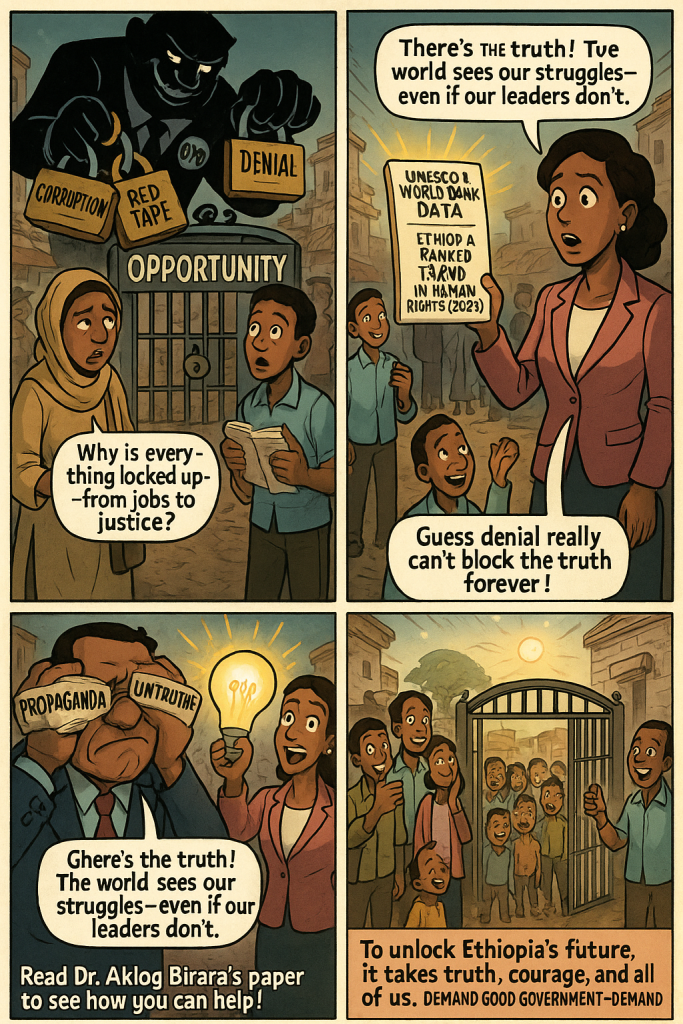
I want to buffet my arguments through graphic illustration by accessing Linkin’s A-I platform that prepared and sent me the illustrations next page.
I urge Ethiopian intellectuals and the international community to recognize ordinary Ethiopians suffer from a locked-up system, Red Tape, bribery, and corruption.
Citizens cry loudly for justice and good government services; but no official listens to them. Youths grow up affected by untruths.
Students go to school but end up unemployed and hopeless. They flee their homeland in search of opportunities elsewhere in the world.
Consider the hundreds of thousands of Ethiopian youths who live and work in the Arab world earning low wages and being treated like slaves. Just think of this alone!!
The graphic depicts “propaganda and untruth” and the calls “The World sees our struggles-even if our leaders do not. To unlock Ethiopia’s future, it takes truth, courage, and all of us. Demand Good Government! Demand” tell you what ails the Ethiopian people.
There is no doubt in my mind the world sees the abysmal conditions of life in Ethiopia under Abiy Ahmed’s OPP. The question is Why is there silence in challenging state brutality?
It is true the donor community shows deep concern but shies away from pinpointing the real governance and leadership crisis Ethiopian society faces under Abiy Ahmed.
On September 18, 2025, the IMF and the World Bank “Warn of Reform Fatigue as Ethiopia’s Debt Service Reaches 36.6% of Exports. declaring the country’s public debt unsustainable and warning that “reform fatigue” could derail efforts to restore stability.”
More specifically, the Joint statement tries to caution the hurdle this way. “Reform fatigue due to political and social pressures could lead to delay in or reversal of policy measures. the document cautioned. Public frustration over rising living costs and shortages has already surfaced, with inflation still hovering above 13 percent. Although growth remains comparatively strong, 8.1 percent last year and 7.2 percent projected for this year—slower momentum compared to the pre-2019 average, combined with recurring security challenges, risks undermining investor confidence.”
You may wish to ask “What is reform fatigue? For whose benefit? Is it for Ethiopia and all Ethiopians?”
It is not hard to find the answer. In my view, we need to consider Abiy Ahmed’s singular and energetic political and ideological commitment to remake Ethiopia in his own or his group’s image. His party’s capture of state, government and institutions in all sectors is far-reaching and consequential. He does speak plainly when he says, “There are Oromo haters in Addis Ababa.” This is a powerful signal of things to come.
I would add to this a comment made by Field Marshall Berhanu Jula who spoke passionately that “There is nothing wrong with Oromo-elite following the footsteps of TPLF and accessing power and wealth (ተተኪነት ምን ችግር አለው).” My turn to eat is a zero-sum game.
Whether Abiy Ahmed, Berhanu Jula, Shimelis Abdissa or Jawar Mohammed, the end goal is identical. It is reinless pursuit in advancing and securing the greater and common good for the Oromo population at any cost and by any means. This is done mostly with the exclusion of Ethiopia’s “others.” These others are treated as disposable non-persons.
On the other hand, Amhara Fano rejects tribalism and ethno-nationalism and embraces political pluralism, democracy, inclusivity, and diversity as core democratic values. The fact that Amhara Fano organized its self-defense as Amhara is legitimate.
This is because Amhara faces an existential threat. The allegation that Amhara Fano is fighting to restore Amhara power (if there was ever such a thing) is patently false.
The Amhara Fano struggle is a) to defend Amhara survival; and b) establish a democratic system of government based on citizenship rather than ethnic or tribal differentiation. It plans to do this in partnership with other stakeholders.
It is high time that we contrast two visions that will shape Ethiopian’s destiny: one of inclusion and diversity and the other single ethnic hegemony.
The vision and strategic agenda Abiy Ahmed and team espouse is discussed in a penetrating assessment of the current meaning of reform in Ethiopia by Political and Social Commentator Jawar Mohammed under the tile “ያለንበት ሁኔታና ቀጣይ የትግል ምዕራፍ፤ መጋቢት 2023,” a subject matter I shall diagnos in Part IV.
Editor’s Note : Views in the article do not necessarily reflect the views of borkena.com
__
Support Borkena : https://borkena.com/subscribe-borkena/
Join our Telegram Channel : t.me/borkena
Like borkena on Facebook
Borkena Ethiopian News Youtube Channel
To submit Press Release, send submission to info@borkena.com
Add your business to Ethiopian Business Listing / Ethiopian Business Directory Join the conversation. Follow us on X (Formerly Twitter) @zborkena to get the latest Ethiopian News updates regularly.