
Pan-Africanism: The Vision of Our Forefathers
By Dawit W Giorgis
Introduction

I was a young Ethiopian man when, in March 1957, the world’s attention was fixed on Ghana and its charismatic nationalist leader, Kwame Nkrumah, as he led the first colonial territory in sub-Saharan Africa to independence. Standing atop a high wooden platform, Nkrumah wept and spoke of a vision for a continent long recognized as the cradle of humanity, yet dismissed as the “Dark Continent” by nineteenth-century Europeans. “Our independence is meaningless unless it is linked up with the total liberation of Africa,” he declared. Total liberation meant not only freeing the remaining colonies but eradicating the poverty, hunger, disease, and ignorance of the colonial era. Political independence, he insisted, was hollow without economic emancipation: “It is far better to be free to govern, or misgovern yourself, than to be governed by anybody else.”
Seventy years after the flags of independence were raised, Africa has slipped into a modernized phase of neocolonialism, in which its sovereign soil serves as a global military chessboard. Today, between 13 and 16 non-African nations—spanning superpowers such as the United States, China, Russia, and France, alongside middle powers such as Turkey, India, and the United Arab Emirates—operate roughly 65 to 85 military bases, drone launchpads, signals-intelligence posts, coastal radar stations, and dual-use observatories across African territory. From the crowded garrisons of Djibouti astride the Red Sea to clandestine drone runways in the Sahel and satellite-tracking stations farther south, foreign militaries use African land to police shipping lanes, monitor rivals, and test systems far from their own borders. Rather than the unified, self-reliant space envisioned by early Pan-Africanists, the continent has been carved into strategic outposts from which external powers project influence at the direct expense of African sovereignty.
Where formal flags and permanent garrisons provoke resistance, a shadow architecture of proxy warfare and private military contractors ensures that the extraction of Africa’s wealth continues. Across major active conflicts—from Sudan and Libya to the Sahel and eastern Congo—foreign sponsors arm rival factions and sustain compliant regimes to secure ports, minerals, and political allegiance. Operating alongside these wars are numerous foreign private military networks and thousands of contractors, ranging from Russian-linked fighters who trade combat support for resource concessions to Chinese, Turkish, and Western firms guarding oil fields, cobalt belts, and lithium deposits. Seventy years after decolonization, this fusion of hired force and proxy conflict has perfected a system in which African blood is spilled in foreign-backed wars while the continent’s richest resources continue to build prosperity elsewhere.
It Was Not Supposed to Be Like This
Our forefathers held a different vision of where Africa was heading as colonialism drew to a close.
As a junior officer fresh from a three-year military academy and para-commando training, I was first exposed to the wider continental struggle through a covert project in Wukro, Tigray, where we trained members of the South Sudanese Anya-Nya movement. During the same period, other Ethiopian officers trained fighters and future civil servants from the South African ANC, Mozambican FRELIMO, Zimbabwean (ZANU-ZAPU), and Namibian SWAPO elsewhere in the country. After completing an advanced infantry course at Fort Benning and being promoted to captain, I became directly involved in this training. Later, as my career shifted to diplomacy, I was assigned to serve as a counterpart to the anti-apartheid struggle and the continental liberation movements. I stood at the intersection of the armed and political struggles of decolonization and the diplomatic process that led to Djibouti’s independence, overseeing civilian and military training for these movements.
My direct relationships with leaders such as Robert Mugabe, Joshua Nkomo, Sam Nujoma, Oliver Tambo, Alfred Nzo, Samora Machel, and Angolan foreign minister Paulo Jorge, together with my presence as an observer at the Lancaster House negotiations, my regular participation in the Dar es Salaam conferences—the political epicenter of the liberation struggle—and in the UN Third Committee debates, and my witnessing the birth of the Organization of African Unity, meant that I lived the vibrant spirit of Pan-Africanism rather than observing it from afar. It was a distinguished honor to serve these nations not only during their struggles for freedom but also, after independence, as a UN Senior Adviser.
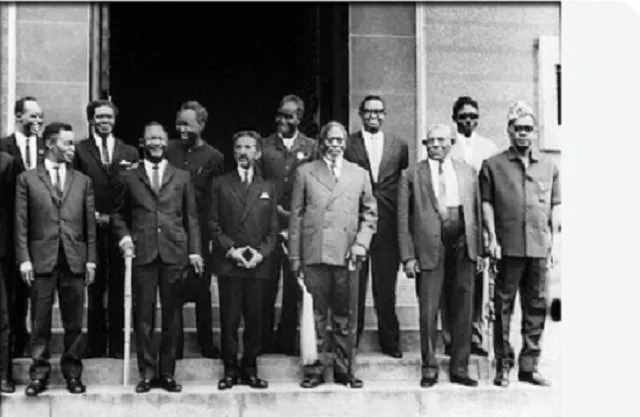
Nkrumah’s outlook was shared by his peers. Sékou Touré of Guinea preferred “poverty and liberty” to “riches and slavery.” Léopold Senghor of Senegal articulated Négritude as a humanist affirmation of African cultural values capable of engaging with and enriching broader human civilization. In 1958 in Accra, Emperor Haile Selassie spoke of free men laboring unceasingly for peace, independence, and prosperity. Five years later in Addis Ababa, at the founding of the OAU, he looked toward “an Africa not merely free, but united,” reminding the assembled leaders that “history teaches us that unity is strength.” The founding generation envisioned mobilizing the continent’s human and natural resources for science, technology, industry, and shared prosperity. They knew the obstacles—artificial borders, weak infrastructure, and the sheer number of new states—were formidable, yet they believed a common destiny made the project imperative.
In the 1960s and 1970s, many of my generation regarded Pan-Africanism as a living hope rather than a historical subject. My close friend Abdul Mohammed, whom I met at Columbia University, New York, has been a passionate advocate of Pan-Africanism since those early years and has become a leading African figure in peacebuilding, negotiation, and recovery. In his writing on the subject in Amani journal, he observed:
“Pan-Africanism, at its core, is not a cultural aspiration or a sentimental slogan—it is a political project. It was born of struggle, forged in the furnace of slavery, colonialism, and racial domination, and matured through the anti-colonial liberation movements of the 20th century. Its essence is the sovereign determination of African peoples to shape their own destiny—to liberate themselves from all forms of external servitude, whether colonial, neocolonial, or neoliberal. Pan-Africanism’s central purpose was never merely to unite for unity’s sake. It was a response to fragmentation—the deliberate fracturing of Africa by slavery and colonial borders. That fragmentation persists today in new and more insidious forms: economic dependency, ideological subservience, the weaponization of identity, and the erosion of common purpose. The Pan-African project, therefore, remains unfinished.”1
In spirit, almost all countries supported Pan-African ideology. Initially, it split into two camps. The Monrovia Group, led by Nigeria, opposed a rushed union of all African states under a single central government, fearing chaos—a concern that proved correct in hindsight. The Casablanca Group, formed by a progressive elite that included Algeria and Ghana, believed Africa should move quickly toward political unity. Nkrumah was among its most prolific supporters. The vision of a United States of Africa was never universally accepted; a continental union would have required the surrender of sovereignty. The OAU that emerged was a diluted version of these ideas, driven more by emotion and idealism than by pragmatism. Eventually, as a compromise, the OAU was accepted by all. The idea of transforming it into an African Union was revived in the late 1990s by Muammar Gaddafi. The Sirte Declaration (Sirte is in Libya) of 1999 called for the establishment of the African Union (AU). In 2001, the then-chair of the OAU, Thabo Mbeki, dissolved the OAU; the African Union was launched in Durban in 2002. Built to address globalization, regional governance, and modern challenges, the AU is widely seen as an elitist body that has done little to transform Africa. It has been unable to stem successive coups, instability, and insecurity; it has weak mediation capacity; and it remains heavily dependent on external finance. Studies indicate that only a small fraction of its decisions have been implemented.
Where Are We Now?
The ideal remains distant. While life expectancy has risen into the mid-60s and literacy has improved, Sub-Saharan Africa remains the world’s poorest region by most measures. GDP per capita hovers around $1,600–$1,700, and extreme poverty—defined as living on under $3 a day in 2021 purchasing-power-parity terms—still affects roughly 45 percent of the population. Hundreds of millions live under these conditions, accounting for the vast majority of the global extreme poor.
Progress has stalled. Despite vast arable land, Africa remains a net food importer, carrying an annual food and agricultural import bill of $90–$110 billion in recent years. Under-five mortality remains the highest in the world. These outcomes reflect a sobering reality: political independence was achieved while economic, technological, and security dependencies were preserved or merely reconfigured.
Colonial administration was succeeded by subtler forms of neocolonialism—monetary, commercial, security, and technological arrangements that allow external actors to maintain influence, often with the collaboration of local elites. Africa’s mineral and hydrocarbon wealth continues to generate far greater benefit for external consumers and domestic political-business networks than for broad-based industrialization. Raw materials leave; finished goods and food return.
The continent has become a major market for Chinese and European manufactures while remaining, through policy and power imbalances, dependent on imported food. Structural factors—underinvestment in agriculture, colonial monoculture legacies, weak infrastructure, land-tenure disputes, and heavy agricultural subsidies in wealthier nations—lock in this dependence.
Conflicts are often managed rather than resolved, kept at levels that permit continued resource extraction. Eastern Democratic Republic of the Congo is the clearest long-running example. MONUSCO remains one of the world’s largest UN peacekeeping operations—authorized at nearly 11,500 military personnel, with its mandate repeatedly extended into 2026—yet while it has protected some civilians, it has failed to end the violence. Dozens of armed groups operate in the region, and the M23 rebellion, backed by documented Rwandan support, persists. The overarching pattern is one of protracted, limited warfare coexisting with continuous mineral extraction. Africa remains subject to global monetary rules, credit-rating agencies, trade regimes, and technology standards it had little hand in designing. The digital platforms and algorithms shaping information, credit, and markets are largely imported and controlled from abroad.
In West Africa, the geopolitical landscape has shifted. Coups in Mali, Burkina Faso, and Niger between 2020 and 2023 expelled French forces; Chad, Senegal, and others later ended permanent foreign basing. France has largely withdrawn its large permanent footprint, shifting toward more limited engagement, yet the CFA franc remains a potent symbol of monetary linkage despite recent reforms. External powers continue to apply pressure through sanctions, selective diplomatic recognition, and media campaigns whenever governments they disfavor emerge. Russia and other actors have stepped into parts of the security vacuum. The tools have changed, but the appetite for external influence has not.
Chinese engagement has delivered infrastructure and investment on a scale many Western partners did not match. It has also saddled several nations with heavy debt burdens and new dependencies. The relationship is interest-driven, and African governments have demonstrated varying levels of leverage and competence in negotiating it.
Democracy has failed to advance steadily. Freedom House recorded a twentieth consecutive year of global decline in freedom in 2025, with notable deterioration in Africa tied to coups, state repression, and constitutional manipulation. While a preference for democracy remains the majority view in public surveys, citizen satisfaction is low, and support for military rule has risen in several regions. Coups and authoritarian consolidation have become more frequent since 2020.
Artificial Borders, Spillover, and Expanding Extremism
Practically every African state was shaped by colonial borders drawn with little regard for existing ethnic, linguistic, or economic realities. These artificial boundaries routinely split cohesive peoples across multiple jurisdictions. Consequently, a conflict, insurgency, or state collapse in one territory almost inevitably spills over into neighboring states. Contagion is structural, not accidental. This dynamic is evident across several active theaters. Nigeria’s long-running Boko Haram insurgency and its successor, the Islamic State West Africa Province (ISWAP), have operated across the Lake Chad basin for years, destabilizing Cameroon, Niger, Chad, and northern Nigeria. Across the broader Sahel, jihadist coalitions linked to al-Qaeda and the Islamic State have expanded despite—and sometimes because of—successive military interventions and coups. In Somalia, Al-Shabaab continues to hold territory, tax local populations, and project violence into Kenya and beyond. Sudan’s destructive civil war and Ethiopia’s successive wars in Tigray, Amhara, Oromia, and the southern part of the country have caused massive death and displacement, with severe regional ripple effects. In northern Mozambique, an Islamic State-linked insurgency in Cabo Delgado has displaced hundreds of thousands. The Central African Republic remains chronically fragmented among rival armed groups with shifting external patrons. Libya’s post-2011 collapse has turned the country into both a perilous transit corridor for migrants and a theater of proxy competition.
Gulf and Middle Eastern actors have grown increasingly prominent. The United Arab Emirates, Saudi Arabia, Turkey, Qatar, and others have pursued strategic footholds through port concessions, military facilities, agricultural land acquisitions, real-estate developments, and political alignments across the Horn of Africa and the Red Sea littoral. Their motivations are both commercial and geopolitical. In several theaters, these actors have engaged with or tolerated armed factions as instruments of influence. As a result, Africa’s security landscape is increasingly entangled with Middle Eastern rivalries. The Horn of Africa and the Red Sea corridor—encompassing the vital Bab el-Mandeb chokepoint—have become among the world’s most complex security zones. Foreign bases, competing port projects, naval activity, and proxy alignments now overlay local grievances, making purely African solutions far harder to achieve.
National Trajectories That Illustrate the Pattern
Ethiopia was never colonized. It defeated Italian forces at Adwa in 1896, joined the League of Nations, and stood as one of only two African founding members of the United Nations. Emperor Haile Selassie was a global symbol of African sovereignty and resistance to fascist aggression. For decades, the nation was regarded as a beacon of ancient civilization and political independence. Yet in recent years, it has become the scene of massive crimes against humanity, displacement, and uncontrollable people’s uprisings. It is the most worrying country in Africa. With a population of 135 million, the second-largest in Africa, it will have massive spill-over effects in the region—driven by internal political competition, the contradictions of a weird form of ethnic federalism, elite power struggles, and external interference.
South Africa entered the post-apartheid era with the continent’s most advanced industrial base and sophisticated financial system and was widely expected to serve as a continental economic locomotive. Instead, it has grown markedly fragile. Persistent mass unemployment, extreme inequality, state-capture scandals, failing energy and logistics infrastructure, elevated crime, and political fragmentation have steadily eroded its early promise.
Zimbabwe was once celebrated as the breadbasket of southern Africa. Under Robert Mugabe, the fast-track land reforms of the early 2000s, paired with fiscal mismanagement, unchecked money-printing, and the dismantling of property rights and commercial agriculture, triggered historic hyperinflation and mass emigration. While Western sanctions and historical grievances played a role, the primary drivers of the breakdown were internal policy failures—a decline that Mugabe’s removal in 2017 has failed to reverse.
Sudan, an ancient Nile Basin country that shares a deep history with Egypt and confronted British colonialism to win its independence, has succumbed to internal conflict, proxy wars, and direct foreign interventions. Once a nation bonded by shared history and faith, it now faces a long road to restore the unity and integrity it possessed before this war. The destinies of these two ancient countries, Ethiopia and Sudan, are intertwined through the Nile River and shared borders and cultures. Now the two governments are in hostile positions, supported by adversary proxies.
Mass migration is both a symptom and a compounding cost of this breakdown. Tens of thousands of Africans attempt perilous journeys across the Sahara and the Mediterranean each year. Thousands perish or disappear, while countless others are stranded, trafficked, or trapped in legal limbo—driven by economic desperation, violent conflict, and the absence of credible prospects at home.
Since its establishment in 2002 to replace the OAU, the African Union has faced chronic financial reliance on external donors. External partners consistently fund 60 to 75 percent of the AU’s total annual budget, leaving African member states responsible for a minority share. While the AU is not technically bankrupt, its dependence on foreign partners—primarily the European Union—creates severe cash-flow constraints and limits its ability to execute programs or peace operations independently. Critics often describe the AU as a “paper tiger” because it lacks the financial autonomy and supranational enforcement power needed to compel its 55 member states to comply with its decisions. Viewed through the lens of global financial capture, this inability looks less like simple administrative failure and more like the predictable outcome of a system that keeps African nations fragmented and dependent. African leaders frequently manage states whose economic survival depends on external creditors, making true Pan-African solidarity financially and politically perilous.
Toward a Second Liberation
Pan-Africanism has largely been reduced to a historical relic, commemorated in ceremonial speeches even as daily life centers on mere survival. The founding vision of dignity, unity, and collective economic emancipation remains unrealized. In its place stand fragmented states, relentless resource extraction, managed conflicts spilling across artificial borders, technological and monetary dependence, expanding extremist networks, and political classes too often answerable to external patrons or domestic patronage networks rather than to their own citizens.
Africa’s challenges are severe. In a global order where might frequently supersedes law or compassion, the trajectory is clear if the continent remains a collection of weak, permeable states competing for external favor. Coordinated capacity—“might” in the practical sense of credible collective security, economic bargaining power, and the ability to regulate foreign involvement—can only be forged through a revived Pan-African front. This does not require a single continental super-state tomorrow. It requires functional mechanisms for joint action on border security, resource governance, counter-extremism, and industrial policy that individual states have failed to sustain on their own.
This decline is not destiny. Africa is not condemned to permanent instability or to serving as an arena for Middle Eastern and global rivalries. Yet continued reliance on raw-material exports, limited industrialization, elite rent-seeking, external security dependencies, and weak continental coordination will deepen marginalization.
Remedies cannot come primarily from abroad. They require African populations and a new generation of leadership to demand different priorities: domestic value addition, genuine policy autonomy, sustained investment in human capital and technology, the dismantling of incentives that fuel predatory conflict, and resilient institutions capable of negotiating from a position of strength.
The second liberation will not resemble the first. It will be less about lowering colonial flags and more about building productive capacity, defending sovereign decision-making space, and establishing political systems in which ordinary citizens can hold their leaders accountable—and in which neighboring states act in concert when crises cross borders drawn by others. The resources, the youthful population, and the historical memory all exist. What has been missing is the sustained political will and organizational capacity to convert them into power that serves African societies.
A Revolution of the Youth Mindset
Over 60 percent of Africa’s population is under the age of 25, forming the world’s largest cohort of digital-native, hyper-connected citizens. Breaking the cycle of exploitation and transitioning from a raw-resource base to a position of greater strength requires a radical shift in both the mindset of African youth and the continent’s external relations.
A “revolution of the mind” means addressing the domestic vulnerabilities that foreign powers routinely exploit. Historically, individual leaders championing radical independence have been isolated and suppressed; lasting transformation therefore depends on a collective, Pan-African movement rather than solitary figures who are easily targeted. Practicing unity means laying down arms and resolving interstate and intrastate conflicts internally, thereby depriving foreign powers of pretexts for military intervention. Too often, conflicts across Africa are either instigated by external forces or deliberately neglected so that external actors can profit from instability. Poverty and destabilization give those actors leverage; whenever strong national unity or an uncompromising system emerges, it is too often undermined from within and without. ( Refer to my previous article, The Crucible of Second Liberation)
AI and Africa: The Threat of Digital Colonization
Alongside its existing crises of conflict, extraction, and political fragmentation, Africa now faces an existential threat it cannot confront alone: unregulated artificial intelligence and the risk of becoming a digital colony. When a continent acts primarily as a net consumer of technology—lacking the domestic capacity to regulate, audit, or structurally understand the systems it relies upon—power shifts to external creators. Digital colonialism operates through a sophisticated architecture of extraction: data harvesting without representation, algorithmic systems shaped elsewhere, and the exploitation of digital labor.
Unlike the anti-colonial wars of the twentieth century, digital colonization is not an enemy that can be defeated on a traditional battlefield. As a net importer of technology with virtually no ownership over the algorithms shaping its economies, information flows, and national security, Africa must develop a new collective strategy to defend itself. Africa holds critical material resources, yet if individual states continue to bargain separately—precisely the fragmented approach external powers prefer—they will lose. Left uncoordinated, the continent risks becoming an unregulated testing ground where experimental AI systems are deployed directly or through proxy operators.
For these reasons, as argued in my earlier article “The Crucible of the Second Liberation of Africa,” the continent must return to the drawing board and build collective leverage through Pan-Africanism. Pan-African digital sovereignty means African states acting together to set the rules governing data, algorithms, and AI, rather than remaining passive importers of technologies designed and controlled elsewhere. No single African country has the market size, computing power, or bargaining leverage to achieve this alone. Currently, Africa holds well under one percent of global data-center and computing capacity. While continental frameworks exist in outline—such as the AfCFTA Digital Trade Protocol, African Union data strategies, and initiatives like Smart Africa’s interoperable identity pilots—they remain weak without enforcement and shared infrastructure.
Without coordinated regulatory standards, pooled computing capacity, and the strategic use of its mineral wealth as diplomatic leverage, Africa risks becoming a laboratory for technologies it neither owns nor controls. Digital dependence is simply the latest iteration of an old pattern: external control over the foundational tools that shape African economies and security. A revived, coordinated Pan-African front is the only realistic path to negotiating from a position of strength.
As Abdul Mohammed has warned:
“Pan-Africanism today stands at a crossroads. Either it becomes irrelevant, buried under bureaucratic inertia, or it is repoliticized—revived as a people’s movement guided by serious, principled leadership dedicated to advancing Africans’ freedom from want, fear, and external domination.”
Coming from a man with deep lived experience of the continent, the statement makes Africa’s future indeed troubling. The new generation must take up the task through collective economic statecraft and an unyielding willingness to endure the crucible of transformation. This is a call for generational sacrifice. The pain is certain, but it remains the only path to genuine, permanent liberation.
END
1 https://amaniafrica-et.org/pan-africanism-and-its-contemporary-challenges-reclaiming-africas- political-project/
2 https://www.eurasiareview.com/11092026-the-crucible-of-the-second-liberation-of-africa-why-the- african-youth-must-choose-generational-sacrifice-analysis/
Editor’s Note: Views in the article do not necessarily reflect the views of borkena.com
__
Join our Telegram Channel: t.me/borkena
Like Borkena on Facebook
To submit a press release, send the submission to info@borkena.com
Add your business to Ethiopian Business Listing / Ethiopian Business Directory
Join the conversation. Follow us on X (formerly Twitter) @zborkena to get the latest Ethiopian news updates regularly