
By Habte H.
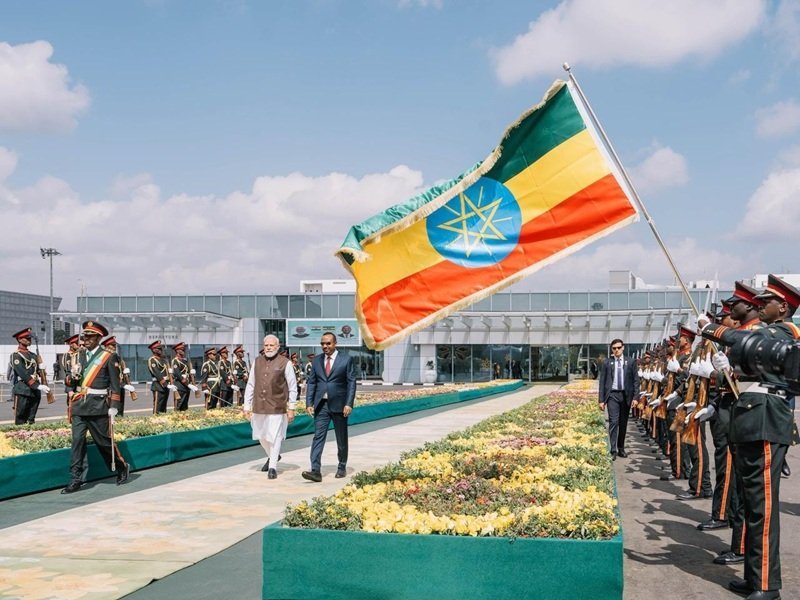
This week, Prime Minister Narendra Modi’s arrival in Addis Ababa was met with choreographed fanfare unseen in Ethiopia for years – meskel flower carpet, a ceremonial guard of honor, traditional dance, and grand parliamentary speeches. For Abiy Ahmed’s government, the occasion was a potent symbol: the promise of a “new chapter” in bilateral ties, cemented by the conferral of Ethiopia’s Great Honour Nishan and the elevation of relations to a strategic partnership.
For observers – particularly Ethiopians at home and in the diaspora – the elaborate reception begs two critical questions: What prompted Modi’s visit at this precise moment? And does it genuinely mark the end of Abiy Ahmed’s international isolation?
In essence, India’s calculus is rooted in its own regional and economic strategy. Abiy, in turn, has leveraged the visit as proof of diplomatic revival. But a single state visit, however grand, does not rewrite years of strained foreign relations or obscure the complex realities on the ground in Ethiopia.
Old friends, new calculations: Why India cares about Ethiopia
India and Ethiopia are not strangers. Educational exchanges, medical tourism, trade, and investment, and South – South rhetoric go back centuries. Modi’s speeches in Addis Ababa openly leaned on that shared history and on the language of “Global South solidarity” and “mutual respect.”
The timing reveals India’s strategic competition with China and the Gulf. As a strategic BRICS member, Ethiopia is a prize. Agreements span peacekeeping, tech, and debt. It is also vital for Indian investment and as a destination for Ethiopian students and patients. This was not charity for Abiy. It was New Delhi locking in its own interests, not an endorsement of his politics.
From empty chairs at GERD to a full house for Modi
To understand why this visit feels so politically charged inside Ethiopia, we have to rewind a few months. When Abiy inaugurated the Grand Ethiopian Renaissance Dam (GERD) – the project he tried to frame as both a continental and global symbol – his government reportedly sent invitations far and wide. But the list of attendees was modest: mainly neighbouring leaders from Djibouti, South Sudan, Somalia, Kenya, and a few others. Many of the heavyweight leaders Abiy courted never showed up. The ceremony did not deliver the international validation he wanted; the images were celebratory, but the absences were loud.
This moment is not isolated. For years, Abiy’s government has faced serious, documented allegations of atrocities in conflicts from Tigray to Oromia and Amhara. Concurrently, his diplomatic tours, such as the awkward, scrutinized 2025 visit to Europe, have often been marked by pressure and criticism, not genuine warmth. This pattern reveals a profound disconnect between international engagement and domestic conduct.
The message from many Western capitals has been cautious at best: cooperation on security and migration where necessary, but no full rehabilitation of Abiy’s image while the domestic situation remains so troubled.
Against that background, Modi’s enthusiastic two-day stop in Addis looks like an exception, a rare moment when Abiy can point to a global heavyweight standing next to him on the red carpet.
Abiy’s desperate search for photo-ops
Ethiopians recognize a pattern. When domestic crises hit, Abiy swiftly shifts to external optics: touting BRICS membership, lobbying for a G20 seat, and flooding media with images of Abiy shaking hands with world leaders – distracting from unresolved wars at home. Thus, Modi’s visit is political gold. Abiy can claim: “A global power calls us partner. We are not isolated.” For many, the takeaway will only be the curated photo: two leaders smiling before the flags.
Did Modi come because Abiy’s diplomacy is succeeding?
This is where we have to separate cause from spin. Abiy’s narrative:
“Modi came because Ethiopia is respected, my diplomacy is working, and the world recognises our reforms.”
A more honest reading is this:
- India came to protect its own strategic interests in an increasingly crowded African geopolitical space. Ethiopia’s BRICS membership, large market, and location in the Red Sea corridor make it too important for India to ignore.
- Abiy has spent years knocking on doors – in Russia, China, the Gulf, Europe – with mixed success. Some have welcomed investment and security talks; others have kept him at arm’s length. Ethiopia’s need for new credit lines, investment, and diplomatic cover is enormous.
- Modi’s acceptance of the invitation reflects India’s global strategy, not a moral judgement about Abiy’s governance. New Delhi does business with a wide range of regimes; it deals in interests, not in human rights scorecards.
So no, Modi’s visit does not automatically mean Abiy has “fixed” his international reputation. It means Ethiopia still matters – and other powers are willing to engage, even while domestic repression and unresolved conflicts continue.
The limit of foreign endorsements
There is another uncomfortable truth Abiy’s propaganda machine avoids: You cannot bomb, jail, and silence your own citizens into submission – and then try to buy legitimacy with foreign ceremonies and medals.
Ethiopians, including many of those cheering the strengthening of ties with India, also know:
- Entire regions remain militarised, with recurring reports of massacres, arbitrary detentions, and internet shutdowns.
- Political space is suffocated, opposition figures, journalists and activists face harassment, exile, or prison.
- Relations with neighbours are fragile, with border tensions, refugees and mutual suspicions undermining any “regional leadership” narrative.
Modi can come today, give a powerful speech, sign a strategic partnership, and fly back to Delhi. But he does not have to live with the consequences of Abiy’s domestic choices. Ethiopians do.
What this visit really tells us
- Ethiopia still has leverage. Our geography, population, markets, and diplomatic weight mean big powers like India will keep knocking. That is a national asset, not a personal achievement of Abiy.
- The global order is shifting. As Western relationships cool, countries like India, the Gulf states, China, and Russia see openings. That can be used smartly – or irresponsibly.
- One shining visit cannot wash away blood and broken promises. No matter how many flags are waved at Bole Airport, Ethiopia’s real legitimacy will be decided inside the country, not in foreign press releases.
If Abiy truly desires a genuinely proud and respected Ethiopia, he has only one viable path: end internal wars, open political space, respect fundamental rights, and build a state that does not depend on the borrowed smiles of visiting leaders. His record offers little hope he will choose it, but that decision, far more than Modi’s handshake, will define the nation’s future.
Editor’s Note : Views in the article do not necessarily reflect the views of borkena.com
__
Support Borkena : https://borkena.com/subscribe-borkena/
Join our Telegram Channel : t.me/borkena
Like borkena on Facebook
Borkena Ethiopian News Youtube Channel
To submit Press Release, send submission to info@borkena.com
Add your business to Ethiopian Business Listing / Ethiopian Business Directory
Join the conversation. Follow us on X (Formerly Twitter) @zborkena to get the latest Ethiopian News updates regularly.
Sir/Madam writer,
I highly suggest to you that you should concentrate in the affairs of your own country. You have your own an internationally recognized country. Don’t you? Stay preoccupied where you belong and leave the affairs of Ethiopia to be sorted out by its own sons and daughters. Get the steppin’!!!!