
Editor’s Note : Views in the article do not necessarily reflect the views of borkena.com
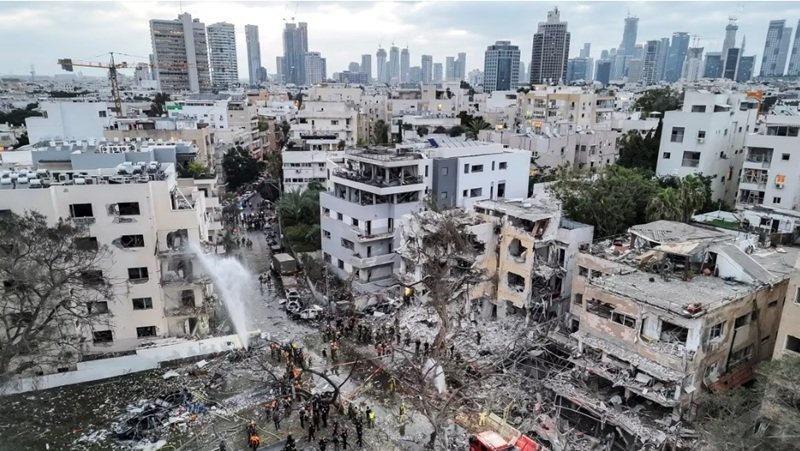
The Middle East is burning again. But now the flames have another chance of spreading far beyond its borders to Africa, to Asia, into the middle of a global economy already balanced on the edge. The situation has reached a point that the escalating brinkmanship between Iran and Israel has now also involved the United States of America, and their participation under what is cast as Trump-era short-sightedness in policy— and Zionist pressure, endangering not just regional peace but possibly peace worldwide.
Recent developments mark a critical turning point. The U.S. military, under the guise of defending its allies, has launched direct airstrikes on three key Iranian nuclear enrichment facilities, a move that effectively drags the world’s largest military into a dangerous, expanding war. The consequences will be profound—not just for Tehran and Tel Aviv—but for all nations, particularly African countries, whose silence and neutrality are being tested by coercive diplomatic maneuvers and economic pressures.
Ideological Extremism Meets Strategic Error
This war was not inevitable. It was manufactured.
The roots of the situation today began taking hold during the first term of Donald J. Trumps as Zionist motivated foreign policy outweighed reason and diplomacy , and this continues to be the case as planned. His unilateral withdrawal from the Joint Comprehensive Plan of Action (JCPOA)—a multilateral nuclear accord with Iran endorsed by the international community—was not only a violation of trust, but a coldblooded policy influenced by the hardline interests of Israel, and its evangelical partners in the United States. This irresponsible action torn years of diplomacy asunder and threw open the door to regional conflict.
But the damage from Trump didn’t stop there.
Donald Trump made a dangerously erroneous and incendiary statement about Ethiopia’s “Grand Ethiopian Renaissance Dam (GERD)” in a recent statement. He said that “America funded the GERD” and that it “has greatly reduced Egypt water consumption” a remark that is also factually baseless and obviously intended to sow discord in the Nile Basin. These are not just irresponsible statements , they are a deliberate effort to use regional resentments as leverage to gain Egyptian approval in the U.S.-Israel-Iran dispute.
Let’s be clear-eyed: Trump is playing the GERD like it’s a political casino chip and hinting to Egypt that if it just stands with Israel against Iran in this case, the U.S. will back Egypt’s claims on the Nile — and then “an arm-twisted Ethiopia” after that. This is a colonial- age strategy with modern diplomacy cloaks but the formula is the same — divide and dominate.
Africa: Beware the Trap of Proxy Alignment
Africa: Beware the Pandora’s Box of Proxy Alignment
African countries — with the Horn of Africa and North Africa being particularly sensitive zones — need to tread carefully.
This is not Africa’s war. But if African leaders are drawn into it — whether by economic inducements, political arm twisting or ignorance — the continent will suffer the consequences of a self-inflicted crisis. It would be a catastrophic misreading of the geopolitical situation to align with the Western-Israeli alliance against Iran in the name of “combating terrorism” or “strategic partnership.”
African countries must remember: whenever major powers clash, Africa pays the price. From food inflation and fuel shortages to diplomatic marginalization, the continent has historically suffered from external wars it did not start. In this case, the risks are even greater:
• The price of oil already has begun to climb, affecting transport and energy across African markets.
• The risks to investments are growing, especially in vulnerable states such as Sudan, South Sudan and Somalia, Eritrea And also even Ethiopia, kenya , Djibouti and Egypt.
• Food security might deteriorate if supply lines through the Middle East and Suez are severed.
• The world’s competition for influence will grow more intense because the West and its rivals among the rising powers, the chapter suggests, will want to make alliances with Africa, too — both China and Russia, for their anti-Western politics, and India and even Iran, for their economic opportunities.
African leaders should never be pawns in this war. Africa needs to find its voice, press for peaceful multilateralism, and not be coerced into a bloc-driven world order.
Ethiopia: A Nation That Must Speak with One Voice
As an Ethiopian writer, I feel compelled to speak directly to my own people.
Ethiopia’s role in global geopolitics is rapidly evolving. The Grand Ethiopian Renaissance Dam (GERD) stands not only as a beacon of energy hope for millions but also as a powerful symbol of African self-reliance and development. As the largest hydropower project on the continent, GERD has become a focal point for both regional pride and external pressure, targeted by those who perceive independent African advancement as a threat to entrenched global influence.
Beyond its developmental achievements, Ethiopia plays a critical role in regional and continental security. As an anchor state in the Horn of Africa, Ethiopia has long been central to counterterrorism efforts, peacekeeping missions, and conflict mediation across East Africa and beyond. Its strategic location, demographic weight, and military capabilities make it a geopolitical linchpin, particularly in efforts to combat extremist threats in Somalia and the wider Red Sea corridor.
In this context, attempts to weaken Ethiopia—whether through disinformation, diplomatic coercion, or economic pressure, should be seen not only as threats to national sovereignty, but also as destabilizing moves against broader African and international security architecture.
Trump’s false statements about GERD are not an accident. They are part of a broader strategy to isolate and intimidate Ethiopia and to blackmail Egypt into supporting Israel in the war with Iran. We must understand that if we are divided politically, religiously, or ethnically, we open the door to foreign agendas that care nothing for our sovereignty.
This is a moment for Ethiopian elites across all political ideologies, religions, and affiliations—to unite. The issue of GERD is national. The issue of regional stability is national. And the manipulation of Ethiopia in global conflicts must be met with one voice, one stand, and one diplomatic strategy.
Trump’s Warrior Mindset: A Threat to Global Peace
Donald Trump’s worldview is rooted not in diplomacy, but domination. His record shows a consistent disregard for facts, for peace, and for African agency. His statements on the Middle East and the Nile reflect a dangerous logic: create division, escalate tension, then appear as a “savior” by offering conditional support.
But this time, his tactics are risking a global war, not just political headlines. His so-called “America First” strategy is in truth Zionism First, pushing the U.S. into wars of ideology and occupation that serve narrow interests—not the American people, and certainly not the world.
His obsession with war diplomacy is now endangering even African and worldwide nations sovereignty and democracy
THE CASE FOR NEGOTIATED PEACE, NOT MANUFACTURED VICTORY
The reality is nobody is going to win this war. Israel can claim tactical victories. Iran could respond with force. Airspace the U.S. might dominate. But ultimately, every side will lose:
• Civilians will die.
• Economies will crash.
• Diplomacy will collapse.
The only reasonable result is negotiation — a peaceful, mediated process animated by mutual concern, circumscribing nuclear escalation, and slipping back to the fundamentals of international law.
The African Union, the Non-Aligned Movement and rising regional powers also must insist on a cease-fire. Africa should volunteer to hold peace talks, not choose sides. This is how Africa should lead — not with guns, but by principles.
Final Reflections
This war is not just between Iran and Israel. It is a test of how the world responds to manipulation, propaganda, and polarized foreign policy. It is a test of whether the Global South, especially Africa, can assert an independent path rooted in peace, diplomacy, and sovereignty.
And for Ethiopia, this is a wake-up call. We must recognize the traps laid before us—disguised as aid, diplomacy, or security promises and reject any effort to make us part of a war that is not ours.
Let us rise as a people who seek peace not as instruments of someone else’s empire.
Abdirezak Sahane Elmi – Former Government Official, Political Analyst & Federalism Advocate in Ethiopia.
Editor’s Note : Views in the article do not necessarily reflect the views of borkena.com
__
Subscribe : https://borkena.com/subscribe-borkena/
Join our Telegram Channel : t.me/borkena
Like borkena on Facebook
Add your business to Ethiopian Business Listing / Ethiopian Business Directory Business Listing Toronto
Join the conversation. Follow us on X (Formerly Twitter) @zborkena to get the latest Ethiopian News updates regularly. Subscribe to YouTube channel To share information or for submission, send e-mail to info@borkena.com
Your suggestion that “ America First means Zionism First “ is shortsighted . America first proponents are far right hard core nationalist critical about state of Israel parasitic political nature they are advancing.