
Landlocked Ethiopia, Unstable Red Sea, and Strategic battle in the Horn
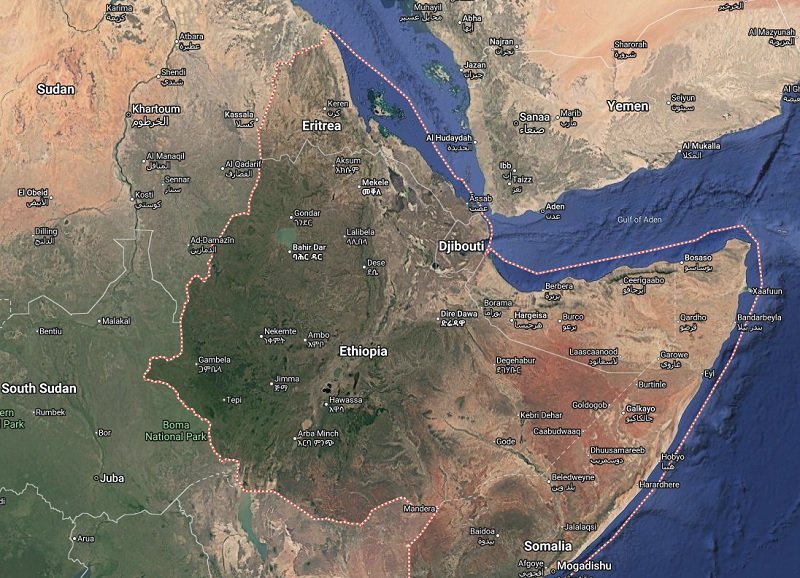
By Metta-Alem Sinishaw
Washington, DC
Executive Summary
Ethiopia currently faces multi-front insurgencies, severe economic distress, and a legitimacy deficit which collectively poses a serious threat to national survival. The insurgencies are manifestations of a much deeper strategic crisis that needs political reconfiguration. Ethiopia’s internal political crisis, its quest for access to the Sea, and the dispute over Nile water resources are increasingly intertwined.
Ethiopia’s quest for access to the Sea is a legitimate and pragmatic effort aimed at building regional integration. Dependence of a country with over 130 million people, expanding economy, and asymmetrical military prowess on a single port increases vulnerability and undermines Ethiopia’s industrial aspiration. Although a commercially leased port is required, it represents only a partial solution to meeting the expanding operational needs. As the security of the Red Sea affects Ethiopia much more acutely than any of its neighbors combined, the fundamental geopolitical question Ethiopia seeks to answer is: “why would neighbors resist to offer Ethiopia a naval base while accommodating similar needs of other countries?”
As the geographic and demographic center, Ethiopian stability has significant repercussions on its neighbors. Ethiopia’s sudden rhetoric on access to the Sea and rapprochement with sub-state actors has distorted its otherwise valid security demand and angered its neighbors. Egypt capitalized on the tension and forged a tripartite agreement with Eritrea and Somalia to contain Ethiopia. Its continued encirclement will only exacerbate regional insecurity. Ethiopia’s untactful rhetoric brought strategic costs: the US and EU firmly backed Somalia’s territorial integrity while maintaining Ethiopia in its counter-terrorism commitments. While Russia quietly monitors shifting alignments, China views Ethiopian ambition with skepticism to protect its extensive Belt and Road Initiative and avoid a precedent for Taiwan. Amid this friction, Türkiye brokered the Ankara Declaration, in which Somalia recognizes Ethiopia’s right to access the sea in exchange for a firm commitment to Somalian unity.
Ethiopia’s domestic stability, infrastructure ambitions, and military capabilities remain deeply tied to Gulf backing. Rivalry between Gulf Royals is splitting the region into two informal and fluid “blocs” that function without legal or institutional mechanisms. On one hand, the UAE Bloc comprises Israel and aligns with Ethiopia, Somaliland, RSF (Sudan) and desires to project forward commercial and maritime power in the Red Sea. Conversely, the Saudi bloc includes Egypt, Türkiye, Qatar, Somalia, SAF, and Eritrea and desires to restrict Red Sea governance exclusively to littoral states and deprive other middle powers from gaining a foothold in the region.
Ethiopia’s relations with Eritrea deteriorated following the 2022 Pretoria Agreement. In response to Ethiopian sudden shift in rhetoric on sea outlets, Eritrea forges partnership with the Tigray People’s Liberation Front (TPLF) old guards that considered the Pretoria deal as complete surrender. In the face of narrowing political space and shared threat from the federal government, seven Ethiopian political and armed opposition groups, including the TPLF, Amhara Fano, and the Oromo Liberation Army (OLA) forged the Ethiopian People’s Forces Alliance for Survival. The alliance seeks to overthrow the government and establish an inclusive transitional administration.
Despite contradictory ideology and various national orientations, the alliance marks a paradigm shift in the Ethiopian fragmented political landscape. Rebels are suppressing their self-contradictions to avoid horizontal conflicts and pave the way for convergence. With fluid institution and organization, the cohesion and success of the alliance would only be tested through time, especially until after it offers a credible alternative and inclusive political architecture, beyond coordinated military operations.
Rivalry of Gulf Royals increases asymmetric backing and strategic vulnerabilities. Collaboration with the UAE enabled Ethiopia to render Egyptian-led encirclement ineffective. Yet intensified insurgencies prompted the withdrawal of Ethiopian peacekeeping forces from Somalia.
Political survival forces rebel to become conduit for external geopolitical rivalries. Disrupting rebels’ access to foreign lifeline is the only mechanism to force them towards a compromise. If the war on Iran prolongs, declining Gulf attention will force cash-starved Horn economies to shift their alignment.
The ongoing crisis is not a conventional civil war fought to control the capital but more of a critical existential dispute over what kind of state Ethiopia must become. While external powers can offer financial, technological, and military aid, they cannot settle deep-seated domestic political fractures.
Winning the internal war will enhance Ethiopian regional posture and attractiveness to powers. Yet there is no military solution to domestic political demands. The federal government may possess the operational reach to suppress specific fronts, but it cannot win the broader political war without genuine institutional reform. Even if the federal government successfully suppresses insurgencies, it may still lose the political war. Conversely, while capable of degrading federal military capacity and capturing strategic hubs, the alliance lacks a cohesive political program to govern. Thus, a negotiated political settlement is needed to restore lasting stability. Ethiopia’s regional posture will be significantly enhanced through internal healing and reconciliation.
While a political solution must come from within, heavy reliance of Ethiopian political actors on external support only delays dialogue, in the absence of which the International Community (IC) has a moral responsibility to pressure the fragmented domestic actors into a negotiated compromise. In collaboration with the IC, the US and EU should condition debt-restructuring agreements on verified, inclusive, and genuine political dialogue. The US should encourage Egypt and Ethiopia towards a comprehensive “two waters” framework to deescalate regional crises. Under this framework, Ethiopia would appease Egyptian concern over the Nile and GERD in exchange for a reliably negotiated maritime access to the Red Sea. The US should urgently persuade its key regional allies (Saudi and UAE) to cease fueling regional conflicts and restraint from transactional engagement with non-state and sub-state actors.
BRICS should complement international diplomatic efforts. Its New Development Bank could foster South-South cooperation by financing a tripartite Nile Water, Energy, and Food Security Nexus to pacify rivalry between its members, Egypt and Ethiopia. The AU, in cooperation with the UN, should challenge the Saudi-led Red Sea Council to revise its exclusionary “littoral states first” governance model and become inclusive to accommodate the needs of vital non-littoral anchor states.
The AU, UN, and IGAD should jointly pressurize Ethiopian political actors to agree on comprehensive Security Sector Reform (SSR) and negotiate a Disarmament, Demobilization, and Reintegration (DDR) transitional compact to integrate and stabilize the state and preemptively mitigate the zero-sum “winner’s dilemma” that threatens Ethiopian and reginal security.
1. Introduction
Ethiopia continues fighting multiple insurgencies and the current political architecture could not restore political stability and remain a fundamental structural fault line. Lingering armed confrontations consumes Ethiopian meager economy and poses a severe foreign exchange crisis that led to painful currency devaluation. Unresolved debt restructuring negotiations continue aggravating the security crisis. High youth unemployment and civil unrest directly feed into active insurgencies. The humanitarian crisis remains unabated; millions are internally displaced and millions of others are in urgent need of emergency food. While acute malnutrition surpassed the critical threshold, nine million children are out of school.
The government’s increased reliance on military response and dwindling political space further exacerbates grievance and erodes state legitimacy. The 2026 election was conducted amidst active conflicts and omitted key jurisdictions. The National Dialogue Commission excluded dominant political and armed groups. Seven political and rebel groups forged the Ethiopian Peoples’ Forces Coalition for Survival or “alliance for survival” that vowed to topple the incumbent government. Recent explosions around the capital and critical military infrastructures raised questions about the governments’ established supremacy in military technology.
Ethiopian sudden quest for a Sea outlet added a new height of tensions with neighbors, unsettled Egypt, and entangled internal actors with external adversarial states. The rivalry between Egypt and Ethiopia over the Nile, GERD and the Red Sea creates geopolitical standoffs. The Horn remains in political turmoil and competition for influence along the Red Sea continues proliferating conflicts. Sudanese civil war, intra-Somali political tensions, and Ethiopia’s insurgencies are interconnected with external proxies. Rival middle powers are using transactional deals to pull Horn of Africa nations into proxy alliances, including alliance with non-state actors to contain their adversaries from within. The deal offers internal dissidents access to adversarial states and critical support.
Efforts to resolve Ethiopia’s internal political crisis should not exclusively rely on domestic discontents, changing regional dynamics should be accounted for. This paper attempts to map out Ethiopia’s dominant political fractures and their interplay with neighboring states. It evaluates the impact of global power competition, transactional deals by regional rivals, and the efforts of Ethiopian opposition groups to rescue the country, before outlining a modest strategic way-out.
2. Existential Threat: The New Strategy for Political Dominance
The term “existential threat” has become a dominant political buzzword in the Red Sea Region. Egypt considers Ethiopian development efforts on the Nile River as a threat to its existence. Ethiopia believes that the lack of access to the Sea threatens Ethiopian national survival. Djibouti views Ethiopian port diversification policy as a threat against its existence. The Sudanese warring factions accuse each other of threatening Sudan’s survival as polity. Somali views Ethiopian Memorandum of Understanding (MoU) with Somaliland as unprovoked aggression against its sovereignty and territorial integrity. Eritrea considers Ethiopia’s rhetoric on access to the Sea as a direct threat against its sovereignty. The utilization of existential threat across the region demonstrates the lack of shared regional agenda, shifting alignment, and entanglement with rival foreign states in which one country’s gain is tantamount to another country’s loss.
The use and misuse of “existential threat” in the Ethiopian political landscape is even much more nuanced. Political elites’ selective narrative about historical grievance, real or imagined, has transformed political competition into existential threat. Since the politicization of ethnicity as modus operandi, rival political elites portray themselves as defensive while being perceived as offensive by others, making conflict resolutions nearly impossible. Every ethnic group appears to have contradictory memories with varying historical pasts, making it impossible to have a shared collective national memory. Ethnic entrepreneurs perceive losing political control in each group’s territory as equivalent to losing one’s homeland.
The fundamental feature that differentiates a genuine existential threat from that of political threat is the evidence based upon which the respective narratives are built. The 1991 victor prescribed ethnocentric arrangement has empowered ethnic groups, promoted vernacular languages, developed local cultures and traditions. However, despite claiming to have redressed historical grievances, the political architecture only shifted and institutionalized inequality and domination. Assigning federating units to a dominant ethnic group intensified victimhood narratives and exacerbated the claim over existential danger when competing for political power.
The Ethiopian state currently faces a profound national security dilemma, while the federal government argues that “armed resistance groups threaten national survival,” regional governments counterclaim that “centralization threatens regional autonomy and therefore we must resist.” However, not all existential threat claims are unfounded. For example, persistent atrocities against Amhara and the recent Tigray war made existential politics much more credible. Human Rights Watch documented serious abuse by multiple parties to the conflict which created powerful lessons for every Ethiopian political actor: “If we lose political power, we may eventually lose our physical security” making political compromise harder.
If applied, critical analysis could have helped to distinguish between community security, political autonomy, and elite political power competition to identify the scope, extent, and intent of the threat that political elites often present as one and indivisible. Ethnic entrepreneurs view another governance model simply as an existential threat to their own model. Under current arrangement, political programs and policy preferences are not criteria for affinity with political parties and political loyalty remains exclusively dependent on ethnic identity.
When each actor is organized politically and militarily to defend itself against the other, the combined effect creates a national security dilemma that forces even groups with contradictory ideology to forge tactical alliances despite lacking a shared national political program. The emergence of “Tsimdo” and alliance for survival follows this pattern. Such alliances remain purely tactical and operational and rarely get strategic height. Therefore, a serious attempt to chart a new political dispensation in Ethiopia must reimagine how the unfolding tactical alliance could be transformed into a veritable national political and security program in which no community feels excluded.
3. Internal Faultlines and vulnerabilities of Contemporary Ethiopia
The 2026 National Dialogue Commission deliberation recognized that variation in historical narratives, state building, heritage, institutional design (ethnic vs Unitary), forms of government (religious vs secularism), and loyalties (class vs ethnic) are the fundamental faultlines. The violent insurgencies Ethiopia continues facing today are only manifestations of a much deeper strategic crisis that demand political reimagination and overhaul over state architectures. In the absence of middle ground and compromise, reconfiguration of fundamental state structure remains only desirable. Continued internal disharmony exasperates fragmentation and makes Ethiopia a geopolitical battle ground. Despite the urgency, however, Ethiopian political actors seem to favor zero-sum games.
With a growing population of more than 130 million, expanding economy, and asymmetrical military power balance, dependence on a single port increases Ethiopian vulnerability and severely undermines its industrial aspiration. It stresses that denying access to the sea while reaping massive economic benefit by small sized littoral states is inherently unsustainable and unjust. Ethiopia’s sudden and aggressive rhetoric and its controversial dealings with sub-state actors have deeply alienated its neighbors and overshadowed its otherwise valid national interests.
Recent Ethiopia’s demand for maritime access is a legitimate and pragmatic path toward regional stability. Lack of favorable response to Ethiopian longstanding predicament will only aggravate regional insecurity. Because Red Sea instability harms Ethiopia more than any of its neighbors combined, temporary commercial leases are simply insufficient. Ethiopia realizes the distinction between commercial and sovereign access and its geopolitical cascading effect. However, it questions why neighboring states failed to offer Ethiopia with a naval base while allowing several other countries.
Despite recent calls for peaceful negotiation and dialogue for mutual economic dividend, Ethiopian request remains misconceived and contentious. Immediate neighbors continue viewing Ethiopian positions as an existential threat and establish alliances with the adversaries of Ethiopia and UAE, Ethiopian dominant external enabler. Ethiopia currently stands at a historical crossroad juncture, and its future would be redefined by the following three inextricably linked domestic and regional geopolitical drivers. These dynamics critically determine Ethiopian relations with its neighbors that align with a web of adversarial actors seeking to project influence in the Red Sea region.
1. Accelerating domestic fragmentation
isolated and coordinated insurgencies are severely overstretching federal forces, as witnessed by the recent withdrawal announcement of Ethiopian peacekeeping mission from Somalia. Continued failure of the Ethiopian government to harmonize domestic forces will unavoidably exacerbate Ethiopia’s vulnerability and offer regional adversaries with opportunity for aggressive proxy meddling.
2. The Red Sea stalemate
Ethiopia’s rhetoric on the Red Sea and framing of permanent, sovereign sea access as a non-negotiable strategic imperative has triggered acute security anxieties among Somalia, Eritrea, and Djibouti and led to shifting regional alignments. Egypt and Saudi are cooperating with other coastal states that view the Red Sea exclusively as littoral states affairs and seek to contain non-coastal states, and
3. The hydrological faultline
The completion of GERD and Ethiopia’s continued desire to build three more dams on the Nile River remains an unyielding existential flashpoint for Egypt, and its aggressive move to construct a military and political encirclement of Ethiopia via treaties with Eritrea and Somalia and recently with Sudan.
As a credible internal political settlement significantly enhances Ethiopian regional posture, its fragmentation opens doors for meddling. Without a genuine political settlement, Ethiopia will remain in perpetual conflict in which River Nile and the quest for access to the Red Sea serve as catalysts. Only if Ethiopia establishes a legitimate new political architecture and resolves conflicts, it can achieve national cohesion, improved security, promote economic growth, and reestablish its lost regional anchor state status.
4. Shifting Alliances and Changing Geopolitical Relations with Neighbors
Ethiopia’s current foreign policy focuses on nationalist assertiveness, an existential drive for sea outlet, and sovereign power projection. As the region’s largest landlocked country, its rhetoric for maritime access has altered its relations with neighbors and affected regional security landscape. Following is the summary of Ethiopia’s relations with the region.
Sudan
Despite fractured and volatile relations with Sudan, Ethiopia remains opportunistic and cautious to balance its interest in Blue Nile water rights and disputes over border territory. The strained relations over the disputed Al-Fashaga border became even more polarized during the Sudanese Civil War. Since then, fighting near the border over the disputed farmland has been triggering military incidents. Ethiopia actively navigates the fallout from Sudan’s civil war while collaborating with UAE to support the Rapid Support Forces (RSF) that pushed the Sudanese Armed Forces (SAF) closer to Egypt and join the anti-Ethiopia regional networks. SAF accused Ethiopia of sheltering and permitting paramilitary RSF to transfer supply and armaments. Despite fluctuating internal dynamics, SAF offers Ethiopian rebel fighters’ sanctuary, medical assistance, and cross-border supply routes to counter Ethiopian increasing alignment with RSF.
Somalia
Ethiopia considers the Somalian federal government as a fragile state that cannot maintain regional security and circumvent via sub-state actors to secure its sovereign maritime footprint in the Red Sea. The 2025 MoU with the self-declared Somaliland to lease commercial and naval space in exchange for formal recognition of Somaliland’s independence shattered its otherwise amicable relations. Somalia viewed the MoU as a direct violation of its national sovereignty and territorial integrity. Egypt, Ethiopian main regional rival, capitalized on the deteriorating relations and quickly signed a defense pact with Somalia. Growing internal insurgency has forced Ethiopia to announce its desire to pull Ethiopian peacekeeping forces from Somalia. If implemented, it demonstrates Ethiopian declining regional posture and embolden its adversary’s encirclement policy during a time when it is seeking to gain a foothold on the Red Sea.
Eritrea
The 2018 rapprochement and the close collaboration between Ethiopia and Eritrea in 2020 against TPLF during the Tigray war collapsed in 2022 following the Pretoria Peace Agreement. Ethiopia views Eritrea with deep suspicion and considers its president as detriment to Ethiopian regional ambition. Conversely, Eritrea considers Ethiopian historical claim and quest for access to the Red Sea as a prelude to coercive pressure which collectively result in a deteriorated bilateral relation.
Eritrea perceives Ethiopian ambition as an existential security threat and prompted troop buildup along the border. On one hand, Eritrea joined Somalia and Egypt and forged a tripartite security axis aimed at encircling Ethiopia. On the other hand, Eritrea subtly aligned with TPLF hardliners and other Ethiopian groups to counter the federal government from within. Eritrea provides safe haven, training, weapons, and logistics to challenge the Ethiopian Defense Forces and prevent a potential Ethiopian aggression. Relations sharply deteriorated after the emergence of “Tsimdo” and its collaboration with the alliance for survival. Both countries continue supporting each other’s opposition groups. Following the recent explosions in Addis, Eritrea and Ethiopia severed diplomatic ties and are at the brink of war.
Djibouti
Except for transitional tension, Ethiopian relations with Djibouti remain pragmatic with deep bilateral economic integration, handling over 90% of Ethiopian maritime imports. Nevertheless, Ethiopian port diversification policy aimed at eliminating dependence on a single port aggravates Djibouti’s insecurity of losing billions in transit fees. While economic cooperation remains active, Djibouti’s relations with Ethiopia are transactional and distrustful due to the possibility of losing its lucrative monopoly if Ethiopia gains access to the sea elsewhere (Somaliland or Kenya). Djibouti played a key role to de-escalate regional tensions but remained focused on shielding its commercial interest. During the 2024 Arab League session in Bahrain, Djibouti called for respect of Arab state sovereignty amid the Ethiopia Somalia rivalries, supporting Somalian position against Ethiopia.
Kenya
is the only stable and predictable neighbor that entertains pragmatic relations with Ethiopia. They have strong security ties to collaborate on joint anti-terrorism and a commercial deal through cross-border infrastructure initiatives in the Lamu Port-South Sudan-Ethiopia Transport Corridor (LAPSSET.) Ethiopia collaborates with Kenya and South Sudan in strategic regional integration to increase interdependence, predictability, and stability. Kenya maintains neutrality and plays a mediatory role between Ethiopia and its hostile neighbors. It serves as the primary economic balancer in the region through cross-border infrastructure initiatives and green electricity exports. However, Kenya remains concerned over escalating regional rivalries.
South Sudan
Ethiopia’s relations with South Sudan are cordial. They have shared concerns over ethnic conflicts and maintain strong mutual security cooperation along the border. Although internal political fragility constrains its desire to engage boldly in regional disputes, South Sudan remains aligned on infrastructure expansion and trade and is largely dependent on Ethiopian political mediation and security cooperation.
5. Under Pressure: How Powers Competition is Forcing Ethiopian Hands
Ethiopia’s attractiveness to powers depends on its commitment to internal harmony and pursuing coherent foreign policy that fits into the geopolitical demand of the day and its potential contributions for regional security and stability.
If Ethiopia integrates water, hydropower, cheap electricity, industrialization, exports, rail corridors, and ports with the Red Sea security and Gulf and Indian Ocean markets, it could fundamentally transform its geopolitical and geostrategic significance. Ethiopia should leverage its strategic location, key water resources, and agricultural capital and seek to diversify trade corridors and reduce dependency on single ports. Ethiopia should present Nile water and access to the Red Sea as a single and comprehensive framework that links water to food, trade corridors, maritime access, and regional security.
Conversely, without a predictable government and internal turmoil, powers and regional actors alike could exploit its vulnerability. In addition, Ethiopia should avoid the temptation to pursue unilateral territorial recognition and use of coercive strategy that threatens its neighbor’s sovereignty.
5.1. Great powers competitions: the US/EU, China, and Russia
Great powers evaluate Ethiopian quest for access to the Sea mainly through maritime security prism to balance strategic regional stability. As powers remain preoccupied by the war in Iran and Ukraine, the Ethiopian internal crisis is unlikely to become a priority. The US and EU consistently reaffirmed Somalia’s territorial integrity to prevent fragmentation, while keeping Ethiopia aligned on counter-terrorism initiatives to secure the Red Sea shipping corridors. As Ethiopia plans to build Africa’s largest airport, its relationship with the US is expanding from security into economic and investment.
As the largest bilateral lender, China’s relations with Ethiopia are predominantly economic. China favors current regional security arrangements to shield its Belt and Road Initiative and would minimally be interested in addressing Ethiopian internal fractures. When the International Monetary Fund (IMF) viewed Ethiopian debt as unsustainable, China serviced Ethiopian debt to appease fiscal constraints. As the largest creditor of the Djibouti port, China views Ethiopian port diversification policy with skepticism and discourages Ethiopian unilateral efforts to recognize Somaliland to prevent a precedent for Taiwan.
Russia has long-term strategic relations focused on military hardware that is expanding into nuclear energy. In recent years, Ethiopian attraction to Russia gravitates towards diversifying alternate partners in the emerging “multi-polar” order and joining BRICS. Russian engagement remains focused at strengthening Ethiopian federal government’s coercive hard-power capabilities and investing minimally, if any, to reconcile its internal contradictions.
5.2 BRICS and the multipolar shift: Strategic Opportunities for Ethiopia
As the rule based global order evolves, BRICS would have a role to play. Expanding BRICS signals growing multipolarity and increased strategic importance of the Horn of Africa. Despite connecting the Red Sea with the Gulf and Indian Oceans, however, it could not necessarily guarantee its stability due to rivalry among its member states: Ethiopia vs Egypt, UAE vs Iran, China vs India. BRICS offers rivals (Egypt and Ethiopia) proximity to eastern powers and additional diplomatic channels for dialogue to address their disputes over the Nile, GERD, and Red Sea. Both Egypt and Ethiopia are exploiting the diplomatic platform to promote their national interests.
Although BRICS does not replace the US and EU, the dilemma of whether it would resolve the growing tension among its members such as Ethiopia vs Egypt over GERD, Nile, and Red Sea remains to be seen. China is likely to emerge as a major beneficiary in the Horn due to its heavy economic weight and established bilateral relations which would compel regional states to align with its demand. As China converges with Egypt to protect its investment in the Red Sea Suez Canal, Ethiopia would expand its growing partnership with India to diminish dependency on single power. The 2026 BRICS Declaration endorsed Ethiopia’s quest for WTO accession, ICAO Council candidacy, and hosting of COP32. It provides a powerful platform to enhance international legitimacy and market integration. To maximize this opportunity, Ethiopia must expand the initial gain and transform its natural assets into regional bargaining chips.
6. Clash of Middle Powers: Rivalry beyond superpowers in the Horn of Africa
The Red Sea has integrated the Horn of Africa with the Arabian Peninsula and transformed the region into a unified geopolitical and security landscape. Gulf and other middle powers are competing for influence in the Red Sea corridor and are forcing resource-constrained Horn of African states to shift their alignment through transactional bilateral relations.
In recent years, Saudi and Emiratis are converging with other state and non-state actors to forge broad, fluid, and porous rivalry “blocs” that are driven by national interests and geopolitical competition. Both blocs function informally without legal, institutional, or organizational mechanisms and collaborate with states that aspire to gain foothold in the Red Sea region, projecting influence, countering adversaries, protecting sovereignty, and transactional economic benefits.
The rivalry of Emiratis vs Saudi, both of whom are key US allies, is proliferating horizontal conflicts in Sudan and Yemen, intensifying tension between Eritrea and Ethiopia, aligning with contradictory actors in Sudan and Somalia. Türkiye has proven that defense ties with Somalia and economic investments in Ethiopia are not mutually exclusive and emerged as an indispensable mediator.
Middle powers’ competition for influence particularly creates a volatile dual reality for Ethiopia. On one side, convergence between UAE and Israel, both of whom are signatories to the Abrham accord, offers Ethiopia critical financial, technological, and military lifeline and successfully weakened Egypt’s containment strategies. On the other hand, proximity to the Emirates entangles Ethiopia within the broader Saudi Emirati contest. Saudi Arabia actively champions Somalian territorial integrity that undermines Ethiopian Red Sea ambition. Entanglement further increases Ethiopian vulnerability and enables rebels to gain financial, armament, and diplomatic support from adversaries.
6.1. The United Arab Emirates (UAE)
UAE converges with Israel to counter Saudi’s hegemony on the Red Sea and aligns with other progressive states and non-state actors in the region. Emiratis is considered as a revisionist power broker that engages transactionally. It pursues a “string of ports” to control logistics and maritime choke points along the Gulf of Aden and Bab-el-Mandeb Strait. UAE favors pragmatism and openly funds regional administrations and secessionist entities. It partners with autonomous enclaves and non-littoral regional states to build trade routes independent of hostile host governments.
Israel and UAE have dynamic objectives in Ethiopia and Somalia to reinforce each other’s regional ambition. Ethiopian relations with UAE started in 2018 and continues steadily deepening with shared regional economic and security interests along the Red Sea shipping lanes. Ethiopia views the UAE as its most indispensable foreign ally that provides a crucial financial lifeline, military hardware, and infrastructure investment. In the face of mounting economic distress, currency crisis, and stalled debt restructuring, UAE offers Ethiopia an indispensable breathing room.
UAE encourages Ethiopia to seek sovereign access to the Sea to gain a strategic foothold on the Red Sea for shared benefits. It has been backing Ethiopian port diversification ambition and injected billions. It is also a dominant ally of the Sudanese paramilitary Rapid Support Forces (RSF) and leading partner for local Somali regional governments pursuing greater autonomy. It closely collaborates with Somaliland and grants financial and military resources in support of Ethiopian regional postures.
However, the strong relationship hinges on the leaders of both countries and lacks institutional arrangements. The bilateral relations remain asymmetry due to structural imbalance between Ethiopian temporary financial relief and Emiratis aspiration on gaining ports, Red Sea ports, food security, and military cooperation. As a key partner, UAE has done little, if any, to address the Ethiopian governance crisis and continues exploiting Ethiopian core vulnerabilities. Its military support carries significant risks and has been straining Ethiopian relations with Sudan and Egypt due to UAE’s support to Sudan’s civil war. UAE’s prolonged engagement in the Sudan, Libya, and Somalia conflicts is likely to attract proxy support for Ethiopian rebels from UAE’s adversaries.
6.2. The Kingdom of Saudi Arabia (KSA)
Saudi Arabia views the Red Sea as its vital economic and security hegemony and aims to maintain the status quo. It believes that the Red Sea governance should be dictated exclusively by coastal nations and favors a “littoral states first” strategic approach. In 2020, in collaboration with Egypt, Saudi spearheaded the establishment of the Council of Arab and African Coastal States of the Red Sea and the Gulf of Aden (CAASRSGA) to safeguard the security of the Red Sea and improve regional coordination. The Council aims at countering strategic interference from non-littoral states.
While Iran and Türkiye were the primary targets, the Council progressively targeted Emirates and Israel. In response to UAE’s increasing penetration in Yemen, Somalia, and Sudan, Saudi shifted from cautious investment to a more assertive engagement by reengineering its Red Sea strategy. Saudi Arabia persuaded Jordan, Yemen, Eritrea, Somalia, and Djibouti to join the Council and deprive a foothold to the UAE along the Red Sea. Ethiopia’s exclusion was partly by the desire to appease Egypt’s dispute over GERD and partly to discourage UAE’s indirect penetration into the Red Sea.
Based on shared geopolitical interest, Saudi, Egypt, Türkiye, and Qatar, Eritrea, Djibouti, and Somalia created a dynamic alliance to counter the growing penetration of the UAE-Israel-Ethiopia axis into the Red Sea. Following the Iran war, Saudi led multi-nations Red Sea security partnerships alongside Egypt, Somalia, and Djibouti. Recently, it signed and activated the Mecca Joint Defense Agreement with Türkiye and Pakistan. It seeks to establish structured, state-to-state maritime security to counter-balance unilateral moves in the region. Saudi Arabia especially aims at disrupting Emirati arms and logistics flows to the RSF and supports SAF in Sudan to push back the UAE. Saudi Arabia deprived UAE of military overflight permission and closed a major RSF supply node in Libya. It committed $1.5 billion weapons supply to SAF which unavoidably spills over into Ethiopia and exacerbates domestic instability.
Saudi Arabia favors traditional institutional state to state relations and maintains sound bilateral diplomatic and strong labor and economic relations with Ethiopia. However, it prioritizes security along the Red Sea coastline and remains wary of Ethiopia’s unilateral maritime ambition. Saud views the Ethiopian unilateral MoU with Somaliland as a regional destabilization effort that creates vacuums in which its adversaries (UAE and Israel) could exploit. It aligns with Egypt, Somalia, and Djibouti and strongly advocates for Somalian sovereignty and territorial integrity.
As the Iran war makes the Red Sea corridor even more invaluable, Saudi strengthens its ties with Türkiye and Pakistan to protect its dominion on the Red Sea. Egypt and Saudi are entangled with Sudanese civil war and their rapprochement with Eritrea could be motivated, at least partly, to gain access to Ethiopian insurgent groups through Eritrea.
Despite the escalation risk Saudi’s alignment with Egypt and Eritrea poses, Saudi carefully balances its alliance with Egypt while keeping Ethiopia stabilized. It mediates Ethiopia and Eritrea to prevent military confrontation. However, Ethiopia remains vigilant of Saudi’s strategic regional alignment. Saudi’s increasingly dominant role in the Red Sea combined with Egypt’s hostility could bring a much more sophisticated, coordinated, and financed regional opposition bloc to Ethiopia. This pushes Ethiopia to be even more close to UAE and RSF to deter adversarial support to the Ethiopian rebels. Ethiopia worries Saudi’s growing reliance on Egypt and Eritrea and rivalry with UAE could encourage support for the alliance for survival, which aggravates its predicament.
6.3. The State of Israel
Ethiopia and Israel have deeply rooted historical and multidimensional relations. Israel’s periphery doctrine to build alliances with non-Arab states and counterbalancing threats in the Red Sea and Nile Basin are the pillar principles for convergence. They have a defense agreement on Intelligence, Surveillance, and Reconnaissance (ISR) to counter regional threats. The emerging Tri-Axis (Ethiopia, India, and Israel) combines Israeli ISR and Indian economic and infrastructural statecraft with maritime domain which places Ethiopia as a regional anchor. The socio-cultural and diaspora relations in which the Beta Israel (Ethiopian Jewish) community forms a cultural bridge between the two countries.
Ethiopian partnership with Israel has significant and broad geopolitical implications for the Horn of Africa. Ethiopia’s core existential priority, securing sovereign access to the Red Sea port directly aligns with Israel’s expanding security presence around the Gulf of Aden and Bab-el-Mandeb. Recognizing Somaliland and advocating for Ethiopian ambition for a Sea outlet will allow Israel to counter Iranian backed Houthis, other regional hostile actors, and create a buffer in the Red Sea maritime routes.
Israel’s strong bilateral partnership with Ethiopia further aligns with that of UAE’s close security and economic cooperation. The triangular (Ethiopia, Israel, and UAE) axis directly rivals the Saudi led group that aims at restricting access to the Red Sea. Ethiopia’s strategic alignment with Israel’s Red Sea strategy forces Egypt, Türkiye, and Iran to recalibrate their regional postures and adopt distinctive geopolitical countermeasures.
Egypt views Ethiopia’s security partnership with Israel as an existential threat to its regional dominance and pursues an aggressive strategic encirclement against Ethiopia. Egypt is fearful that close ties with Israel will enable Ethiopia to project influence over the Nile River and Red Sea. It is anxious that access to Israeli military technology would enable Ethiopia to effectively challenge its interests in the region. Using Israel as leverage, Ethiopia would successfully circumvent Egypt’s strategic encirclement and containment. Thus, Egypt engages with counter-alliance through a security pact with Eritrea and Somalia. Egypt is committed to protect its hegemony over the Red Sea and recently deployed more military assets to Somalia to challenge Israeli’s presence in Somaliland and stretched Ethiopian military along its eastern border.
Türkiye avoids direct confrontation and pursues a pragmatic balancing and economic hedging with equidistance. It recognizes the growing Israeli influence in Somaliland and Ethiopia as competitive expansion into its strong sphere of deep military and economic interests. It counters Israeli’s expansion through commercial and defense agreements (mainly drone technology) with Ethiopia while maintaining massive naval footprint in Somalia. Using its ties with Ethiopia and Somalia, it acts as diplomatic buffer and mediated the Ankara Declaration to prevent a potential war between Ethiopia and Somalia.
Iran views Israel’s partnership with Ethiopia and Somaliland as a threat to its proxy operations across the Red Sea and Bab-el-Mandeb. It fears that presence in the Horn provides Israel with forward operating sites to monitor Houthi activity and track Iranian movement. Iran pursues a pragmatic diplomatic channel and engages with Ethiopia to build a buffer against Israeli’s encirclement. It succeeded in keeping Ethiopia at bay by offering drones during the 2021Tigray war and aspires to prevent Ethiopia from falling exclusively into the Israeli Emirati side. Iran leverages the Houthis as an asymmetric counterweight to the Israeli and Ethiopian presence in Somaliland.
6.4. The Republic of Türkiye
Türkiye favors geopolitical pragmatism and recognizes that isolating Ethiopia, African diplomatic capital with the largest demographic force, is counterproductive. It projects hard power in Somalia and is a primary investor in the Ethiopian manufacturing sector. It has successfully established a multi-vector regional policy, serving as a key defense partner to Somalia while keeping deep economic and military ties with Ethiopia.
In response to Ethiopia’s Somaliland MoU, Türkiye signed a defense agreement with Somalia under which Türkiye helped rebuild, equip, and train the Somali Navy while assisting in maritime patrol to deter piracy, illegal fishing, and foreign incursions. In return, the pact offers Türkiye offshore hydrocarbon exploration and extraction rights. Türkiye operates its largest overseas military base in Somalia and serves as the primary institutional backbone for the Somali National Army. It remains the single most country of Türkiye’s power projection in Africa where its relations are anchored on security, naval protection, and state building.
Despite a strong defense pact with Somalia, Türkiye maintains excellent relations and considers Ethiopia as a key continental economic engine. Türkiye is the second-largest foreign investor (FDI & Industrial) in Ethiopia. It has supplied Ethiopia with military hardware & drone technology that were instrumental in repelling the 2021 rebel advances and earned immense political credit. This unique dual trust from both Ethiopia and Somalia allowed Türkiye to emerge as a successful mediator and balancer to restore diplomatic dialogue. The agreement preserved Somalian sovereignty and discouraged unilateral state recognition of Somaliland while facilitating a reliable commercial access to the sea for Ethiopia.
Türkiye’s success in mediation served to counter its rivals indirectly. Reconciling Ethiopia with Somalia undermined Egypt’s strategy of using Somalia as a springboard to build a hostile encirclement against Ethiopia. Türkiye’s defense assistance further diminished Somalian dependence on Egyptian military support. It countered UAE’s autonomous enclave in Somaliland by offering military training, state-building assistance, and strengthening the Somalian federal government while keeping the doors open for Ethiopia.
6.5. The Islamic Republic of Iran
Iran is known more by its asymmetric influence and security disruption along the Red Sea than economic investment. Iran maintains a tactical security alliance with the Sudanese Armed Forces (SAF) which is backed by Saudi, Egypt, Türkiye, and Qatar. In the past, Saudi Arabia persuaded Djibouti, Eritrea, Ethiopia, Somalia, and Sudan to sever ties with Iran in return for military and economic incentives. Iran leans towards Eritrea than Ethiopia due to the direct access to the Red Sea Eritrea could offer. Eritrea’s critical view of Israel as an Ethiopian enabler has been an additional advantage that Iran exploits in Eritrea. Iran could use Eritrea as a staging ground (directly or via the Houthis) to open a second maritime front in the Red Sea shipping lanes, a major strategic risk that dominant powers are monitoring closely.
Strategically, Iran projects influence through proxies mainly via the Houthis to target the Red Sea shipping lanes. Despite reduced posture since its war with US/Israel, Iran mainly engages via the Gulf and other Red Sea states without bilateral ties with Horn countries.
Iran’s broader strategy of countering the Gulf and westerns along the Red Sea shipping lanes creates direct harm for landlocked Ethiopia. Iran maintains low-profile pragmatic ties with Ethiopia and supplied the Mohajer-6 drones during the 2021 Tigray war. Although Iran isn’t a critical player in the Ethiopian internal conflict directly, its relationship with Eritrea could offer proximity to Ethiopian insurgents to counter the UAE. As it remains in war, it is unlikely to offer direct support to Ethiopian rebels, at least in the short term. However, Iran’s proximity to Eritrea and Sudan could extend to the alliance for survival to discourage Ethiopian growing convergence with Israel and UAE and to prevent Ethiopia from falling exclusively under UAE and Israeli influence.
However, focus on the Iran war has shifted Gulf countries priority and if prolonged, will diminish external patronage over Horn countries. This may encourage local rivalries, especially between Egypt and Ethiopia. Nevertheless, Türkiye is capitalizing on Gulf’s distraction and expanding its own influence by encouraging Ethiopia-Eritrea to restrain.
6.6. The State of QATR
Qatar stands against the Ethiopia-UAE-Israel axis, aligns with the Saudi led bloc, opposes Israel’s recognition of Somaliland, and plays a significant role in Somalia especially after the fallout between Somalia and UAE. Qatar alignment with Somalia on sovereignty served as an instrument to replace the UAE and become Somalian key security partner. In addition to UAE’s facilitation of Israel’s recognition of Somaliland, Qatar deeply resents UAE’s sponsored entry of a Yemeni separatist leader in Somaliland. Qatar adheres to the “One Somalia” doctrine in support of Somalian territorial integrity which positions it against Ethiopia. Its proximity to SAF in Sudan and Eritrea may offer proximity to Ethiopian rebels and may pressurize the Ethiopian government to officially renounce its Mou with Somaliland.
Qatar mainly focuses on diplomatic mediation, humanitarian aid, and targeted investments, and avoids military alignment with any single Horn actor. Along with Egypt and Iran, Qatar offers finances to SAF in Sudan, humanitarian support in Somaliland, and aspires to become a regional mediator. However, Qatar’s closer ties with Eritrea in the past had constrained its relations with Ethiopia. When its relations improved through pragmatic engagement, Qatar explored diplomatic channels and investment opportunities in Ethiopia. Nevertheless, Qatar remains sympathetic to Eritrea suggesting a potential hostility towards Ethiopian Red Sea ambition. Qatar maintains minimal footprint in Ethiopian internal conflict and remains invested in Somalia and Sudan.
7. Middle Powers Rivalry and the Evolving Threats Against Internal Stability
7.1 The Saudi-Emirates Rivalry and the implication for Ethio-Eritrea Relations
Gulf’s transactional engagement with Horn states have fragmented domestic politics, weakened governance mechanisms, militarize strategic maritime routes, and embolden authoritarian actors. Gulf rivalry encourages state and non-state actors in the region to become client partners. In Somalia, Gulf-backed alignments emboldened breakaway federal states against the central government. In Sudan, UAE and Saudis alignment along the belligerent RSF and SAF Generals, respectively, engulfed Sudan in a quagmire that is spilling over into Ethiopia. Partnering with UAE ties Ethiopia to align with RSF in Sudan which in turn could strengthen domestic insurgencies through support from Emirates’s adversaries.
The Saudi and Emirates led blocs would approach the Ethiopian alliance for survival from opposite positions. UAE executes its Horn of Africa strategy by aligning with the Ethiopian federal government and thus positions structurally against the alliance. While the UAE will stand along Ethiopia to protect its investment and counter Saudi’s dominance in the region, strong ties with Egypt would push Saudi to align with Eritrea in support of the new alliance indirectly. Although Saudi is mediating Ethiopia and Eritrea, it is likely to support the position of Eritrea against Ethiopia to curb Emiratis penetration into the region. The tripartite security pact among Egypt, Eritrea, and Somalia directly reinforces the emerging anti-Ethiopian government alliance.
The rivalry of Gulf states is a double edge sword. On one hand, if Gulf attention shifts to Iran and/or Yemen, Egypt, Sudan, and Eritrea may not be economically strong to support Ethiopian rebels directly and this will allow the Ethiopian military to redirect its full capability towards internal rebels. On the other hand, if Gulf rivalry fractures the GCC, it encourages proxy conflicts, exacerbates Ethiopian internal conflicts, and entangles Horn states into the Saudi-UAE contest. The Saudi bloc’s support to Egypt, Eritrea, and Sudan could indirectly reach Ethiopian rebel alliance to curb Ethiopian growing ambition in the Red Sea
7.2. Rivalry among Israel, Türkiye and UAE and Ethiopian Internal Stability
As signatory to the Abrham’s accord, Israel leans towards the UAE-led axis. UAE reportedly facilitated the Israeli’s recognition of Somaliland to counter Iranian-aligned networks in the Red Sea. Israel’s collaboration with UAE and Ethiopia directly feeds into Ethiopian domestic and regional tensions. Israel has opened a new economic office in Ethiopia and is persuaded to abstain from voting against Israel on the UN resolution concerning the Israeli Palestinian conflict. Such partnership entrenched the Egypt-Eritrea-Somalia-Sudan partnership to contain Ethiopia.
Alignment with Israel and UAE exacerbates Ethiopian vulnerability and offers Ethiopia’s internal insurgencies access to the adversaries of the UAE-Israel bloc. Entanglement in adversarial actors transforms Ethiopian insurgency into active extension of Middle Eastern rivalries and creates additional pressure points for the Ethiopian government from within. Israel’s alignment with Emirates and Ethiopia and recognition of Somaliland stirred the Egypt, Eritrea, Saudi, and Türkiye alliance to counterbalance. Türkiye responds well to the Ethiopian policy of port diversification and desires closer partnership with Ethiopia, but not at the expense of Somalian sovereignty. Türkiye condemned Israel’s recognition of Somaliland and stood against the UAE-Israel partnership. It deployed F-16 fighter jets in Somalia to deter Israeli’s growing influence and warning Ethiopia and others from further unilateral recognition.
Competition between Türkiye and UAE in Somalia added another layer of complexity to the Horn’s security. Türkiye most likely will not support Ethiopian rebellion groups unless Ethiopia desires to activate the 2025 MoU with Somaliland. By restraining Ethiopia, Türkiye stabilizes the region which otherwise would have irritated the Egypt-Eritrea-Somalia axis to directly support the Eritrean coordinated “Tsimdo” and the alliance for survival. While fighting its domestic rebels, Ethiopia must satisfy Türkiye’s demand of not undermining Somalian sovereignty, the failure of which would push Türkiye to activate its partnership with Egypt and Sudan to channel resources to Ethiopian rebels, should Türkiye desire.
8. From Nile to the Red Sea: How Ethio-Egyptian Rivalry is shaping the Horn
8.1 Egypt’s Strategic Encirclement of Ethiopia
The completion of GERD has fundamentally altered the hydro-political landscape of the Nile Basin. In response, Egypt shifted its campaign for legally binding agreement into military encirclement. It engages in aggressive diplomatic offensives and institutional multilateralism by framing the Ethiopian MoU as an illegal aggression of Somalian sovereignty both within the Arab League and the African Union. It continues lobbing the UN to frame GERD and Nile water security as an international peace and security issue. Egypt continues pressurizing Ethiopia to get operational concessions and the release of more water during the dry seasons, which undermines Ethiopian sovereign rights.
Ethiopian sudden ambition to have sovereign access in the Red Sea directly contradicted Egyptian hegemony over the Red Sea. Egypt capitalized on the regional tension and partnered with Ethiopian neighbors to pressurize Ethiopia and resolve the lingering dispute over GERD. The tripartite defense pact serves Egypt, Somalia, and Eritrean alliance as bedrock and has been extended to Djibouti and SAF in Sudan. The pact adheres to the foundation of the Red Sea Council that Egypt helped to establish and asserts that Red Sea belongs exclusively to coastal nations and intentionally excludes Ethiopia out of maritime frameworks. The pact transformed Ethiopia’s Red Sea quest from a localized diplomatic dispute with Somalia into a multinational proxy standoff that eventually forced Ethiopia to shift away from unilateral recognition of Somaliland, at least for now.
The deployment of Egyptian troops and military assets in Somalia represents a consequential security shift in the Horn of Africa and seriously undermines Ethiopian regional posture. This direct military footprint affects the security landscape, power balances, and proxy dynamics across the Horn. For example, Egyptian military presence in Somalia stretches Ethiopian National Defense Forces, which indirectly strengthens Ethiopian domestic rebels and weakens the Ethiopian government from within. In a major escalation, Egypt, Eritrea, Somalia, and Sudan signed the Alamein Declaration by extending the tripartite alliance. The quadrilateral summit created an exclusive political and military bloc designed to coordinate intelligence, protect Nile water rights, and effectively isolate Ethiopia. Egypt would implement the pact by deploying 15,000 troops to Somalia and securing naval access in Eritrea.
If Ethiopia succeeded in gaining access to the Red Sea, it will most likely face Egyptian naval blockades under the guise of defending Somalian territorial integrity. The Egyptian military in Somalia aims at restraining Ethiopia from implementing its MoU with Somaliland and discouraging its quest for access to the Red Sea. Following the establishment of the alliance for survival, the Ethiopian federal government was forced to announce its desire to withdraw its peacekeeping military personnel from Somalia to suppress domestic insurgents.
Egypt capitalizes on regional frictions to build anti-Ethiopian regional alliances. It collaborates with the TPLF hardliner faction and other broader regional dissidents. It offers asymmetric support for Ethiopian insurgencies via regional proxies to keep Ethiopia stays busy on its internal security and diminish its capacity to project influence in the wider Horn of Africa. It channels clandestine intelligence and covert diplomatic support, including indirect material backing and logistics through allied regional proxies, especially Eritrea and SAF.
8.2 Ethiopia’s Counter-Encirclement Strategy and Regional Alliances
In response to Egyptian penetration in Somalia, Ethiopia sought to cultivate regional proxies by deepening its security leverage in autonomous Puntland and Somaliland. Ethiopian ties with local militias opposed to the federal government could force the Somalian government to restrain and discourage its growing partnership with Egypt.
UAE is leveraging its capital and drone technology to enable Ethiopia to remain a dominant and friendly anchor state that will allow UAE to project influence and implement its overarching geopolitical strategy in the Horn. UAE’s support for Ethiopia is motivated by its desire to secure maritime gateways and control trade, logistics, and naval choke points surrounding the Bab-el Mandeb Strait, the Gulf of Aden, and the Red Sea corridor. By isolating Egypt, UAE aims at curtailing Saudi’s increasing ambition to dictate Red Sea security singlehandedly. UAE views Egypt’s close ties with Saudi and aggressive regional posture unacceptable and offer Ethiopia with critical support, diplomatic shield, and serve as structural counterweight to Egyptian hydro hegemony on the Nile.
UAE and Ethiopia converged to counter the Egyptian led anti-Ethiopia encirclement through multi-tiered strategies. UAE funnels billions and finances the Berbera corridor including a highway to link to Ethiopia which serves as backbone for Red Sea access strategy. UAE encourages discreet international ties to prepare Somaliland for independence and neutralizes Somalian ability to completely deny Ethiopia maritime access. If Ethiopian quest for access to sea via Somaliland meets strong opposition, UAE would offer alternative transit logistics facilitation through its other port networks without succumbing to an Egyptian naval embargo.
UAE’s engagement in drone diplomacy and air superiority continues providing military hardware, maintenance, and surveillance capabilities to bolster Ethiopia. It shares critical maritime and logistics intelligence to keep Ethiopia abreast of Egyptian naval movements. As primary creditor to Egypt, UAE signals and discourages escalatory warfare in the Horn of Africa by imposing fiscal restraint on Egypt. UAE could exploit its financial leverage over Egypt to limit Egypt’s fiscal ability to sustain expensive long-term military deployments in Somalia, along the Ethiopian border.
8.3 Deepening China–Egypt Relations and the Implication for Ethiopia
Chinese interest in the region is primarily connectivity, trade, security and strategic access to the Red Sea and Suez Canal, which signals expanding interest in regional security. Ethiopia is anxious that Egypt’s deepening security relations with China could provide Egypt with additional diplomatic, economic, and strategic leverage that undermines Ethiopian interest on the Nile River and Red Sea.
Economically, Egypt is emerging as a Chinese strategic hub that connects Asia, Africa, and Europe through the Suez Canal route which unavoidably adds a security dimension in their bilateral relations. Ethiopia maintains “all-weather” strategic relations focusing mainly on economic partnership, which compels China to manage the Egypt-Ethiopian dispute over GERD neutrally rather than decisively aligning to either side. China is most likely to maintain strategically balanced relationships with both countries.
However, China would face its most structural dilemma on GERD. While Ethiopia considers GERD as a development tool for energy and national sovereignty, Egypt views GERD as a fundamental national-security issue. Chinese support to Ethiopian development could be perceived by Egypt as contradictory to its strategic interest. Alternatively, Chinese bold alignment with Egypt on GERD would undermine China’s extraordinary economic partnership with Ethiopia and diplomatic ties with sub-Sahara Africa. Thus, China would be more interested in promoting negotiation, stability and mutually acceptable arrangements than openly endorsing either side’s maximalist position.
In addition to GERD, the strategic position of China, Egypt, and Ethiopia on the Red Sea could complicate the geopolitical calculus. Heavy reliance on the Red Sea and Suez Canal for its economic interest is pushing China to advocate for a new regional security framework which signals its deep interest in a new Red Sea security architecture far beyond mere economic relations with regional states. This converges with Ethiopian quest for secured sovereign access in the Red Sea and Egypt’s desire to have a dominant role in the Red Sea security and Nile strategic water resources. However, despite overlapping interests, Egypt’s commitment to exclude non-littoral countries from the Red Sea security sharply opposes Ethiopian ambition. For this reason, some may be tempted to perceive the convergence between China and Egypt as an anti-Ethiopian partnership.
Ethiopia should consider expanding into the China–Ethiopia–Horn industrial corridor rather than the wanning China–Ethiopia economic partnership. The most strategic dilemma Ethiopia should navigate is “How could it fit itself into the emerging Chinese broader Red Sea–East Africa strategy.” Ethiopia must revisit its grand strategy to be linked to the Chinese production and logistics network and compel China to support Ethiopian economic integration into the Red Sea. Ethiopia must also learn from Egypt to redesign its alignment with China, US, EU, Gulf, Türkiye, and India to extract economic and strategic value from each relationship.
9. Restoring the State: Emerging Paradigm for National Salvation
The coming together of ethnonationalist military-political elites can be considered a paradigm shift. The convergence diminishes horizontal conflicts and facilitates negotiation with the incumbent administration. It should distinguish ideological alliance from strategic alignment and whether Ethiopian rebels could cooperate without agreeing on what Ethiopia should become.
Opposition groups with contradictory ideology could theoretically cooperate based on shared enemy or “The enemy of my enemy is my friend” logic. Shared opposition to the federal government could temporarily override deep disagreements among insurgent groups. An alliance doesn’t necessarily need to answer, “What political dispensation should they need to offer currently?” prior to resolving “What could have prevented the alliance from achieving any desirable political objective?” If so, the alliance could operate at two levels: (1) common short term objective that aims either to weaken or remove the incumbent government, and (2) separate long-term objectives to decide afterward what political order should replace the administration. However, such agreement remains purely tactical rather than coherent ideology for governance.
The dominant challenge for the federal government is not singularly defeating rebel groups but rather the most consequential transition from coercive maneuvering to a legitimate political settlement and mobilization of Ethiopia’s enormous national power. Without a compromise, even if the federal government could arguably defeat insurgencies, it may still lose politically. Similarly, using resources from UAE/Ethiopian rival states, rebel groups could weaken the federal militarily but not control and reconfigure the state. The current crisis is not a struggle for controlling the center but redefining what kind of state should Ethiopia become which calls for a genuinely negotiated political settlement to bring Ethiopia back into stability.
In September 2026, the alliance used advanced drones or technological warfare which signals access to external supply and entanglement with a more powerful proxy. It challenges the government’s established superiority in drone technology. However, military victory alone is unlikely to resolve the internal crisis. Only inclusive negotiation and painful concessions among all actors and redefining state political structures is needed to earn political legitimacy at home and reassert autonomy in today’s most delicate geopolitical Horn of Africa region.
9.1 The emergence of “Tsimdo” and its Continued Development
Ethiopian intensive rhetoric on the Assab port and desire to disarm the Amhara regional forces in 2023 has shattered deteriorating relations with Eritrea and Fano, respectively, both of which were key allies during the Tigray war. “Tsimdo” (a Tigrigna word for partnering) was conceived in March 2023 through a bilateral initiative between the Eritrean government and the TPLF hardliner old guards who saw the Pretoria Agreement as a complete surrender.
Ethiopia views “tsimdo” as a dangerous military alliance of “Axis of Destruction“ designed to overthrow the federal government. It believes “Tsimdo” is a covenant of Ethiopian “historical enemies” that aims at stripping Ethiopian regional influence. “Tsimdo” rejects Ethiopian accusation and defends itself as a peaceful, cross-border “people-to-people” framework committed to grassroot conflict resolution among borderline communities of Sudan, Eritrea, and northern Ethiopia, implying the regional convergence beyond Ethiopian border.
Irrespective of its effectiveness, “tsimdo” appears to be real and expanding under the coordination of Eritrea and TPLF. It serves as a platform between Ethiopian and foreign actors and funnels resources. Eritrean collaboration with hardcore TPLF leadership succeeded in convincing some elements from Fano and fractured OLA, both of whom were previously exiled in Eritrea, to join the evolving alliance. In October 2025, a loose military alignment involving Eritrea, Sudanese Armed Forces (SAF), TPLF, Fano, and OLA convened in Sudan and Kenya in May and August 2026, respectively, for consultative meetings.
In September 2026, a broader Ethiopian rebel group of seven Ethiopian opposition groups formed an alliance for survival with the announced objective of joint political, military, and diplomatic actions to challenge and replace the ruling Prosperity Party (PP). In the past, these rebels fought each other but forged a loose, tactical anti federal government alliance without deliberation. TPLF and Fano crossed a fundamental red line due to the irreconcilable positions over the same disputed territory which represented Fano’s founding grievance against TPLF. Similarly, Fano and OLA have fundamental ideological differences.
The alliance is a work-in-progress as mutual suspicion still exists not only among Ethiopian rebels but also between Eritrea and TPLF. A unified and fully functional anti- government alliance remains limited despite genuine signs of cooperation manifested through troop mobilization and intensive media campaigns. The alliance will remain fragile for the foreseeable future as it is a marriage of convenience and lack shared ideology.
Egypt tasked Eritrea to organize the Ethiopian opposition groups in collaboration with TPLF. Egyptian intelligence and security covertly channeled logistical support to Ethiopian domestic insurgents via Eritrea and Sudan. Evidence suggests a wider and complex web of tactical convergences among external actors exerting compounded security pressures to contain Ethiopia. In addition to drawing SAF, Egypt’s proximity to the Eritrean regime proves the regionalization of Ethiopian internal conflict with Egyptian clandestine operational and covert logistics, armaments, and diplomatic support.
9.2 United in Division: What forces Ethnonationalist groups to Converge?
If each rebel group perceives that they cannot defeat the incumbent government single handedly despite interconnected threats, they can converge to mount a more coordinated attack. They hope to force the vulnerable administration to stretch its military, intelligence, financial, and political resources across several fronts at the same time. If implemented coherently, the strategy will suffocate, divide, and pressurize ruling party officials and senior military officers for change. Groups with contradictory ideologies could converge if they have shared enemies and overlapping grievances.
Rebels have not yet designed a shared national political program with specific strategic objectives. However, they may have common short-term interest in weakening the center, ensuring its political survival, and pushing the conflict outward. Instead of agreeing on a maximum program, rebels seem to have converged towards a minimum program of changing the current political security structure without delving into political settlement. In 1991, for example, Ethiopian rebels’ groups with different ethnicities and political orientation cooperated because defeating the Derg regime came first, but only TPLF has succeeded to dominate the federal power structure.
Ideological differences and territorial disputes among members would become detrimental to a national political program. Despite convergence, each group may have calculated strategically that if the other two groups pressurized the administration, the federal government would be overstretched to fight three insurgencies and impose its will by force. For the alliance, tactical cooperation remains the most rational choice, even if the three groups do not trust each other.
The paradox is that weakening the government makes the alliance more attractive to the rebels. However, lack of shared political programs makes the alliance weaker once it achieves its minimum tactical objective, if at all it is feasible. If the alliance succeeded in weakening the federal government, the fundamental question emerges over who would control the center, underscoring military cooperation alone will never produce a granted political integration.
To be successful, the alliance must have, while postponing the most divisive constitutional questions, designed at least a minimum national program on how to establish a provisional and subsequently inclusive transitional government. Without a comprehensive national political framework, a tactical alliance could only defeat or seriously weaken a common adversary and produce a dangerous competition among former allies. Rebels could weaken their common enemy following which the alliance is most likely to collapse from internal contradictions.
It is likely that the alliance could coordinate rebels’ asymmetrical capabilities, institutionalize fragmented units, expand geographical presence, build local, regional, and international legitimacy and become formidable challengers to the government. However, defeating the government is much easier than replacing it successfully through political pluralism. Therefore, despite suspicion and deep mistrust. The fundamental issue is not whether rebels could temporarily cooperate, but rather “could they transform their tactical convergence into a credible and inclusive national political program.”
9.3. The New Alliance and its Pathway for Progress
Whether the alliance would emerge as a cohesive military machine remains to be seen. It is still fluid and its ability to overthrow the government is much less certain. The alliance is unlikely to become one unified army, but temporary convergence could transform Ethiopia’s conflict from multiple disconnected regional insurgencies into a coordinated national political crisis.
The biggest strategic pressure it could possibly exert is simultaneous political-military pressure from several directions, stretching government security apparatus, and making political control increasingly expensive. Ultimately, increased pressure could deteriorate political confidence that will be followed by elite defections and increased vulnerability of the regime. But the fundamental challenge facing the emerging alliance is how can they govern the state that their insurgency made ungovernable without an inclusive national political program?
In the absence of an alternative comprehensive political vision, the government would benefit by presenting itself as the only actor capable of preventing a national crisis. Controlling some territory is not equivalent to replacing the federal government. If the objective is to replace the government, the alliance could be more consequential if it transforms the tactical military alliance into a minimum national political program and offers credible alternative political order. This effectively renders the government’s monopoly unnecessary and/or unsustainable, including depriving constituencies of reason to align with the administration.
The alliance must elaborate its position on Ethiopian unity and the distribution of political power. They should propose a road map to guarantee unity without forced homogenization, autonomy without disintegration, and political inclusion and security guarantees through broader Security Sector Reform. Ultimately, the alliance does not need to agree on what Ethiopia should become but agree on the rules and mechanisms by which Ethiopians should peacefully decide about what kind of arrangement would Ethiopians decide about their future.
10. The Path to Lasting Concord
10.1. Would military confrontation resolve the Ethiopian predicament?
Due to a lack of a functional and trusted dialogue mechanism, the political discourse remains in a severe stalemate. In the absence of political negotiation, military victory would not resolve the seasoned state structural crisis. Even if the federal government successfully suppresses some of the insurgencies and installs negative peace, it cannot win the broader political legitimacy without political reform and institutional reconfiguration. Conversely, for the rebels, while capable of degrading federal military capacity and capturing strategic locations, they lack unified ideology, national program, and cohesion to bring stability and reinstitute new political dispensation.
The government does not necessarily need to defeat every opposition group to remain in power. The government must entertain alternate avenues to achieve peaceful political settlement among competing elites beyond administrative control. The fundamental crisis revolves around elite competition, and the government should work to de-escalate intensified conflicts through genuine and comprehensive negotiation beyond cessation of hostilities. Optimizing regime’s survival and state consolidation needs new political architecture in which federating units can compete without perceiving political defeat as collective annihilation. Conversely, the alliance for survival should explore seriously how to transform military confrontation into political settlement.
The central question is: “Could the incumbent administration end insurgency, ethnic polarization, state fragmentation, and become politically dominant to reclaim legitimacy? Despite holding on to a fragmented state with fast eroding legitimacy, the administration is unlikely to consolidate political power without serious political reform. Despite winning the 2026 election, the government has lost political legitimacy from dominant regions. The deliberation of the National Dialogue Commission showed acceptable procedures in isolating relevant national agenda, but it excluded key insurgent groups and other dissident voices which signals it is unlikely to address the countries’ glaring and immediate challenges in the face of regionalized conflicts.
The alliance draws strength from different geographic, social, and political constituencies which makes it almost impossible for the government to neutralize. If managed carefully, diversities in ethnicity and ideology could release multiple pressure points against the government and offer alternative discourse to the public. The dilemma is not whether the newly formed alliance would defeat the government. In the face of a common adversary, ideological contradictions could easily be suppressed to counter a shared enemy. The question remains how would the alliance convince Ethiopians that the next administration will be more inclusive, stable, and legitimate?
The alliance is intentionally postponing the political settlement until after removing the incumbent administration which carries forward the temptation to redefine state structure single handedly by a potential dominant group. If the alliance becomes militarily strong, the need for political architecture becomes even more important in which a dominant group may attempt to maneuver the political outcome and serve a narrow group interest.
If the alliance seeks domestic legitimacy and international recognition, it must confront the question of what comes next much earlier and demonstrate convincingly how it would manage contradictory ideologies. Without harmonization of the endgame, the diversity that gives the alliance strengths would eventually become a great vulnerability and an unfortunate mechanism for its collapse. The strategic cost of internal disagreements would even become more significant if the shared adversary collapses and opens the “common-enemy paradox” in which former allies would become bitter enemies to grab power following victory. Military victory without a negotiated political program will only lead to power vacuum that eventually could lead to protracted military confrontation among camaraderie, as was the case in Angola in 1975 or in Ethiopia in 1991.
Members of the alliance must confront ideological contradictions and forge a manageable pluralism through a political compromise that will serve as an instrument for institutional rule. One way of preventing future fragmentation is establishing the principles and rules of governance before victory rather than drafting an ideological manifesto. A military victory without a political program couldn’t guarantee the institutionalization of legitimate new order. The most pragmatic and strategic victory is not winning the military confrontation. It is harmonizing Ethiopian political actors and building a shared future for all stakeholders to allow citizens to live peacefully and realize their respective full potential.
10.2. How would the Alliance Overcome its Contradictions and Build Lasting Stability?
For the alliance to be successful, beyond intense media campaigns, it must identify and satisfy at least the following five conditions.
1. A minimum national political program
Given the massive security crisis and urgency for peace to prevail, the alliance shouldn’t be asked whether they stand for unitary Ethiopia, ethnic federalism, confederation or self-determination. The alliance should design a minimum national program to address the immediate political crisis and should not attempt to resolve lingering major constitutional questions. They must recognize their disagreement about the final political architecture and agree on the fundamental rules of how to resolve them. They should agree at least on the following three-phased transitional arrangement to reconcile ideological variation.
• Phase one of the transitions should focus on cessation of hostilities, release of political prisoners, reintroducing political freedoms, institutionalizing transitional order, security sector reform, and humanitarian rehabilitation.
• Phase two focuses on political settlement and comprises constitutional conference, mechanisms for territorial disputes, negotiating regional autonomy and building electoral institutions.
• Phase three will deal with legitimate competition by defining the rules of the game for competitive elections, constitutional referendum, and peaceful transfer of power. This will allow rebels and others to retain different visions and compete for power without making cooperation impossible.
2. The alliance must resolve the real or perceived “winner’s dilemma”
The alliance must assure the public about the breadth of intragroup relations based on democratic principles. As members of the alliance have differences in organizational strengths and leadership capabilities, they must decide on who would control the national defense forces, intelligence and security services, federal police, economic centers such as Banks, Airports, Telecommunication and state bureaucratic machines. Successful transition requires comprehensive pre-arranged agreement on the rule of power sharing far beyond coordinating military operation command and control. Ethiopian political groups in the past have exploited or misused public thrust and derail transitions for political expediency.
3. The alliance must offer reassurance to stakeholders
Transforming the insurgent alliance into a national political alliance requires inclusivity and public buy-in. Diverse stakeholders must be consulted for endorsement and legitimization. The alliance of the traditional trio dominant groups and elite tokenism will only lead to rejection and counter mobilization. The alliance must not be transferring power from one ethnic bloc to another but rather create a national political system. If the alliance wants to emerge politically powerful and earn public support, no segment could potentially monopolize or dominate the state.
Before forcing the rebels to reconcile its self-contradictions, the alliance could use the untapped Ethiopian diaspora to build consensus, design a comprehensive diplomatic and public relations eco-system to ensure the Ethiopian public and the international community. However, despite immense potential, diaspora mimics domestic faultline, exacerbating internal contradictions.
Diaspora, especially in the US, has substantial economic and diplomatic leverages and exerts disproportionally higher influence through political activism. It offers alternate media platforms, but most outlets entertain only a handful of disgruntled politicians, disconnected intellectuals, and radical activists. The fragmented diaspora is mistrustful of home institutions, clashes with domestic realities, and remains unable to mediate the current impasse between the rebels and government. Therefore, the alliance should be cautious when navigating the diaspora to take advantage of its immense capabilities.
4. Transforming from military to political program and civilian leadership Rebel groups could win over the military conflict and lose politically if the alliance doesn’t earn political legitimacy through a negotiated political transition. If the alliance remains only a collection of rebels, the incumbent administration will remain the sole representative of the Ethiopian state despite eroding legitimacy and increasing insecurity. Establishing parallel political legitimacy and credible civilian leadership composed of genuine representatives of constituencies beyond the armed groups is critical. Transitional security forces must be politically neutral and obey civilian leadership. The leadership should ensure that every community receives political guarantees during the transition and constitutional questions would be addressed through a genuine and inclusive dialogue.
5. Mechanism for resolving internal contradictions among member organizations
Members of the alliance have different propensity for a stronger Ethiopian national-state, regional autonomy, reformed ethnic-federal arrangement, or self-determination. Such fundamental differences in state structure pose serious challenges, may exacerbate the deep mutual mistrust and horizontal conflict, and render the alliance dysfunctional. Therefore, members of the alliance must adhere to no permanent monopoly of power, no forceful alteration of territorial settlement, and no collective punishment against any communities. Sustainable and effective alliance requires devising institutional mechanisms based on democratic values on how to resolve differences when or before they arise. The alliance should restrain from political maneuvering to consolidate power for a specific group.
10.3. Appeal to the International Community
Ethiopian political solutions must ultimately come from internal actors. However, amid the internal crisis, lack of neutral platform, and regional tension, political actors could not negotiate. Powers have the moral responsibility, notwithstanding sovereign rights, to pressurize internal actors for a compromise and negotiated settlement. The International Community should encourage a multi-layered engagement to respond to Ethiopia’s internal ills and its legitimate quest for access to the Red Sea. However, external powers could offer financial, technological, and diplomatic support but not settle domestic political fractures. Without internal reconciliation, foreign actors couldn’t implement Security Sector Reform (SSR) and negotiate Disarmament, Demobilization, and Reintegration (DDR) as has been seen in the Pretoria Agreement.
10.3.1. The United States (US) and European Union (EU)
The US and EU have demonstrated more interest and have more leverage than other powers to broker peace. The US has the 2021 accountability-focused executive order which offers legal power to target individuals responsible for prolonging conflict, blocking humanitarian access, or obstructing ceasefires. Leaving the Red Sea region for middle powers would only exacerbate the region’s predicament and aggravate maritime security along the Red Sea shipping lanes. If the US couldn’t intervene with strong measures, the proxy conflict would spill into the Red Sea region where US strategic interest of maritime security, counterterrorism, and containing hostile states will be compromised. They should discourage zero-sum transactional engagements by imposing meaningful and tangible constraints on those that are detrimental to regional peace and US strategic interests.
1. The US and EU should condition financing and direct foreign assistance to verifiable milestones within a restructured genuine and all-inclusive National Dialogue. They should mandate that the Ethiopian government must negotiate with politico-military groups to achieve national harmony.
2. The US and EU should collaborate with regional actors to facilitate a multi-lateral comprehensive two waters (Nile and Red Sea) regional framework. According to this framework, Ethiopia should appease Egyptian concern on Nile water, offer agricultural land, and supply electric power to the region in return for a granted and reliable access to the Red Sea corridor. They should support financing Ethiopian port diversification with neighboring coastal states. Ethiopia would formally renounce its unilateral de jure territorial recognition of Somaliland and maximize GERD’s potential for the management of waterflow and power production that ultimately creates interdependency and stability.
3. The US should encourage, especially Saudi and Egypt, to chart a more inclusive regional diplomatic architecture and join non-coastal countries into the Red Sea Council and Abraham Accord. The US should establish an institution that collaborates directly with the African Union, Türkiye, and Qatar that have legacies in resolving African conflicts. The US should persuade Saudis and Emiratis to curb their transactional engagement with non-state actors and warn against channeling indirect support to sub state and non-state actors.
10.3.2. How could BRICS help Resolve Regional Crisis and Build Stability
The 2026 BRICS summit underscored the great importance of Gulf–BRICS cooperation. BRICS member states have major interests in ports, food security, and Red Sea maritime commerce and security. It should encourage a Horn–Gulf focused strategic economic architecture rather than treating the Red Sea exclusively as a security issue. Membership in BRICS offers Egypt and Ethiopia unique diplomatic and institutional arrangements to transcend rivalry. BRICS should encourage the Horn region to transform from a geopolitical battleground to economic hub by taking advantage of Ethiopian strategic location, critical assets of water, and expanding demography to promote regional stability.
1. The Water-Energy-Food Nexus:
Ethiopia should propose a comprehensive BRICS-backed African Water SecurityInitiative. By linking cheap electricity exports and regulated flood control to Sudanese agriculture and Egyptian water-management predictability, Ethiopia should reposition the Nile as an engine of regional interdependence rather than conflict.
2. Port corridor Diversification:
The New Development Bank (NDB) of BRICS should support an integrated upstream-downstream investment fund and view the Nile as a cooperation platform rather than an exclusive hard-security lens. BRICS should bundle Ethiopian port diversification with GERD’s cheap hydroelectric output, agricultural expansion and predictable water-management.
10.3.3. Other Multilateral Agencies
1. The African Union (AU) and Inter-Governmental Agency for Development (IGAD) should collaborate with the Arab League under the auspices of the UN to encourage multi-layer cooperation on the Nile River and Red Sea. The cooperation should recognize Ethiopia’s sovereign right to develop its water resources and gain reliable access to the Red Sea. In return, Ethiopia should cooperate on hydropower, irrigation, drought management, electricity exports, food security, agricultural modernization, and climate adaptation.
2. The AU and IGAD, in cooperation with the UN, should engage the Red Sea Council to revisit its exclusionary “littoral states first” governance model. They should advocate for an expanded transregional Red Sea maritime integration that includes non-littoral states to defuse the isolation of landlocked economies.
3. The AU, IGAD, and other stakeholders should pressurize Ethiopian political actors, notwithstanding sovereign rights, to converge into a comprehensive Security Sector Reform (SSR) and an integral Disarmament, Demobilization, and Reintegration (DDR) with the support of the AU Peace and Security Council to mitigate the existential “winner’s dilemma.”
PDF version of the article available here
Editor’s Note: Views in the article do not necessarily reflect the views of borkena.com
__
Join our Telegram Channel: t.me/borkena
Like borkena on Facebook
To submit a press release, send the submission to info@borkena.com
Add your business to Ethiopian Business Listing / Ethiopian Business Directory
Join the conversation. Follow us on X (formerly Twitter) @zborkena to get the latest Ethiopian news updates regularly.