
A Critical Review
By Yehenew Ewnetu
Sweden
Introduction and Theoretical Framework: Authoritarian High Modernism
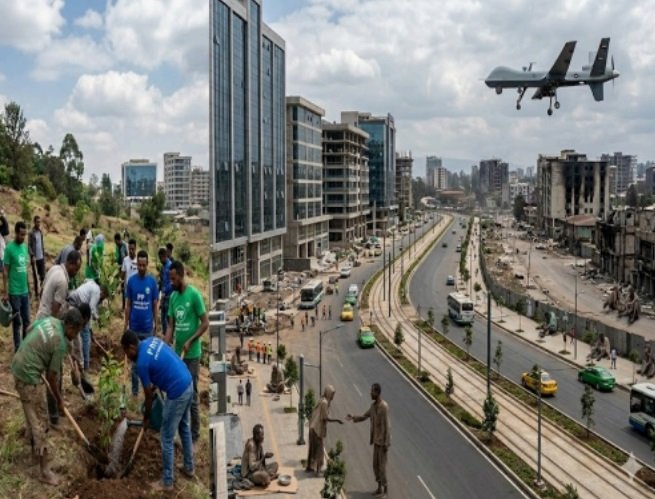
The assertion by Ethiopian Prime Minister Abiy Ahmed and the ruling Prosperity Party (PP) that the government has successfully planted over 48 billion trees since 2019—with a target of exceeding 56 billion by the end of 2026 and reaching 65 billion by 2027—represents one of the most ambitious and mathematically staggering environmental claims in modern history. Ostensibly designed to combat climate change, prevent soil erosion, and promote regional food security, the “Green Legacy Initiative” (GLI) requires intense academic, logistical, and political scrutiny.
To understand the nature and scale of these assertions, it is essential to apply the political theory of “authoritarian high modernism,” a concept established by political scientist James C. Scott in his seminal work, Seeing Like a State (1998). Scott defines authoritarian high modernism as a sweeping, top-down state ideology characterized by supreme self-confidence in centralized planning, to artificially order nature and society (Scott, 1998, p. 4). High-modernist regimes attempt to force complex, organic social and ecological systems to become administratively “legible” to the state. These governments frequently deploy coercive state power to impose grand, aesthetically pleasing, utopian mega-projects while completely disregarding local realities, physical constraints, and the limits of state capacity.
When a state lacks the genuine geopolitical stability, capital, and logistical infrastructure to actualize these high-modernist visions, it often resorts to statistical fabrication. The habit of asserting unachievable, grandiose developmental goals allows the regime to dominate the political narrative in the short term, presenting the leadership as omnipotent, forward-thinking, and globally relevant. However, it carries profound systemic risks. As the cognitive dissonance between the state’s extravagant claims and the population’s lived reality of civil war, displacement, and economic collapse widens, the regime risks a terminal collapse in both domestic and international credibility. This review aims to reveal the profound discrepancies between what is biologically, logistically, and demographically possible in Ethiopia and what is being exaggerated to fulfill the PP’s high-modernist political narrative.
Methodology and Methodological Limitations Methodology
This review employs a deductive quantitative estimation method to evaluate the state’s claims. By applying standard parameters of modern forestry, agricultural economics, and logistics—specifically seedling spacing requirements, heavy-duty truck freight capacities, nursery worker output, and cultivation costs—we project the minimum physical, financial, and human resources required to cultivate and plant 56 to 65 billion trees. These raw mathematical requirements are then cross-referenced against Ethiopia’s demographic realities (accounting for regions inaccessible due to war and proxy conflicts), geographic constraints (subtracting deserts and water bodies), and the country’s commercial logistical capacity.
Methodological Limitations
This methodology is constrained by the extreme fluidity of data in a severe conflict environment. Precise, real-time demographic data regarding internal displacement, mass evictions, and casualty figures are difficult to verify, and the exact number of citizens absorbed into various armed factions remains obscured by state secrecy. Furthermore, comprehensive spatial data precisely mapping areas devastated by ongoing conflicts is continuously evolving. Therefore, the calculations rely on generous baseline estimates that, if anything, vastly underestimate the difficulty of the government’s task.
The Official Narrative: The 2026 Claims and
Historical Precedents
According to official updates from the Office of the Prime Minister, the Ethiopian News Agency, and allied diplomatic missions, the mathematical claims behind the GLI are staggering. By the conclusion of the 2025 cycle, Ethiopia had purportedly planted over 48 billion seedlings. The 2026 phase operates under the banner of “Renewal Through Planting,” with a goal of adding 8 billion new seedlings during the brief 90-day rainy season, bringing the cumulative total to 56 billion trees. The state claims to be on track for an ultimate goal of 65 billion seedlings by 2027.
The government asserts that these 8 billion seedlings for 2026 are meticulously divided: roughly 52% are agroforestry trees (fruit-bearing species like avocado and mango for food security), 47% are forestry trees (to rehabilitate watersheds), and 1% are ornamental trees for urban greening. Consequently, the government claims national forest coverage has rapidly risen from 17.2% in 2019 to roughly 24% today.
To contextualize the sheer impossibility of these figures, one must look at historically audited, heavily funded global green ventures:
● The United States Civilian Conservation Corps (CCC): Over nine years (1933–1942), utilizing immense federal funding and a dedicated, paid workforce of 3 million men, the U.S. planted approximately 3 billion trees.
● Pakistan’s Billion Tree Tsunami (BTAP): It took the provincial and federal governments of Pakistan three full years of rigorous, internationally audited work—costing roughly $169 million USD—to cultivate and plant just 1 billion trees (Shafeeque et al., 2022, p. 3).
● China’s Three-North Shelter Forest Program: Projected to run from 1978 to 2050, it aims to plant roughly 100 billion trees over 70 years.
By contrast, the Ethiopian government claims an execution velocity that dwarfs the United States, China, and Pakistan combined, asserting an average of 8 billion trees cultivated and planted annually in a single 90-day rainy season by an unpaid, ostensibly volunteer workforce.
Critical and Academic Review of the Claims
A. Demographic Feasibility, Regional Conflicts, and Proxy Warfare
Ethiopia’s total population is estimated to be approximately 120 million, with roughly 50% (60 million) above the age of 18 (World Bank, n.d.). If the entire adult population were fully mobilized in a time of absolute peace and stability, planting the 8 billion seedlings targeted for the 2026 season alone would require every single adult to plant approximately 133 trees. Cumulatively, reaching 56 billion trees would require a lifetime contribution of over 930 trees per adult.
However, state-sponsored mass civilian mobilization is a physical and political impossibility in a nation fractured by widespread civil war, localized insurgencies, and geopolitical proxy conflicts. The demographic realities must be drastically adjusted downwards to account for regions entirely severed from federal administrative projects:
1. The Benishangul-Gumuz Conflict and UAE Proxy Dynamics: The Benishangul-Gumuz region has been plagued by severe ethnic violence, massacres, and localized insurgencies. This instability is deeply compounded by a clandestine proxy war, including operations surrounding United Arab Emirates (UAE)-sponsored camps in the region. The high-stakes security environment and Ethiopia’s military involvement in containing these borderland factions have completely paralyzed civilian administrative programs. Tree cultivation and logistics are entirely non-functional in these heavily militarized, volatile zones.
2. The Oromia Conflict (2018–Present): An ongoing war in the Oromia region has persisted since Prime Minister Abiy took power. This structural conflict has permanently disrupted agrarian safety, severed primary highway corridors, and made the safe movement of seedlings logistically impossible across massive swaths of the country’s largest region.
3. The Tigray and Amhara Wars (2020–Present): The devastating Tigray War (2020–2022) absorbed the vast majority of the federal military, regional special forces, and the country’s youth. The Amhara youth, in particular, were heavily mobilized for existential combat rather than environmental programs. Since 2023, the war in the Amhara region has further paralyzed daily life
across more than 80% of the territory. In a theater of active drone warfare and urban fighting, tree planting is completely absent from local priorities.
B. The Toll of Political Apathy and Economic Devastation
Beyond active combat zones, the psychological toll of the Prosperity Party’s (PP) domestic policies has generated unprecedented political apathy among the Ethiopian populace. This alienation makes the mobilization of an unpaid, volunteer workforce for a state-sponsored “cosmetic” project deeply unviable:
● Civilian Atrocities and Mass Evictions: Unabated civilian massacres, widespread kidnappings, and state-enforced mass evictions have broken the social contract. Furthermore, the government’s controversial and highly expensive “corridor development” projects in Addis Ababa have forcibly displaced thousands of low-income families, demolishing historic neighborhoods to serve a high-modernist aesthetic.
● Hyperinflation and Real Wage Collapse: Ethiopia is gripped by hyperinflation and a skyrocketing cost of living that surpasses growth in real wages several times over. As families struggle to afford basic dietary staples, the population’s focus is restricted to immediate survival.
When the state demands that impoverished, traumatized, and politically alienated citizens provide intense, unpaid physical labor for the Green Legacy Initiative, it is met with profound resistance and non-compliance. Adjusting for these factors leaves an available, cooperative adult labor pool of at most 15 million people. To plant 8 billion trees in a 90-day window, this reduced workforce would have to plant over 530 trees per person per three months, without payment and without a single day off.
C. Spatial, Financial, and Nursery Cultivation Constraints
The physical cultivation of billions of seedlings requires an industrial nursery infrastructure, immense capital, and a permanent workforce that does not exist within the Ethiopian state. Standard forestry practices dictate that high-density modern nurseries can cultivate approximately 100 seedlings per square meter.
● Nursery Footprint: To produce the 8 billion seedlings claimed for the 2026 season alone, the state would require a continuous, highly managed nursery canopy footprint of 80 square kilometers. When accounting for irrigation infrastructure, access roads, and staging areas, the physical footprint of these facilities would exceed 160 square kilometers.
● Labor Requirements: In professional silviculture, one full-time nursery worker can care for approximately 100,000 seedlings annually (watering, culling, root-pruning, and disease management). Cultivating 8 billion seedlings for a single year requires a permanent, year-round workforce of 80,000 trained agricultural professionals. To have produced the cumulative total of 48 billion trees claimed prior to 2026, a permanent workforce of nearly 480,000 full-time personnel would have needed to be employed continuously since 2019.
● Financial Comparisons: The financial cost of such an endeavor exposes the ultimate high-modernist exaggeration. Pakistan’s internationally audited Billion Tree Tsunami Project (BTAP) incurred a total cost of $169 million USD to plant 1 billion trees (Shafeeque et al., 2022, p. 5). In the United States, historical
forestry ventures under the Civilian Conservation Corps cost hundreds of millions of mid-20th-century dollars to plant 3 billion trees. If we apply the highly cost-efficient Pakistani metric of approximately $0.17 USD per tree (including nursery cultivation, logistics, and early-stage monitoring) to
Ethiopia’s claimed 48 billion trees, the cumulative cost would exceed $8.16 billion USD. For a state experiencing chronic foreign currency shortages, debt default, and heavy reliance on international food aid, allocating billions of dollars to an unpaid, un-audited forestry campaign is economically impossible.
The Broader Pattern of Political Narratives
The statistical inflation defining the Green Legacy Initiative is not an isolated phenomenon; it fits perfectly within the broader paradigm of authoritarian high modernism that characterizes the Abiy administration. To divert public and international attention away from devastating internal crises, the state routinely deploys “unbelievable” macroeconomic and developmental figures before parliament:
● Wheat Self-Sufficiency and Fabricated Exports: Despite severe, localized famines, catastrophic droughts in the lowlands, and millions of citizens completely dependent on safety-net programs and international food drops, the Prime Minister has repeatedly declared that Ethiopia has achieved total wheat self-sufficiency and successfully transitioned into an international wheat exporter (Senbeta et al., 2024, p. 1408). These assertions directly erase the lived reality of rural communities facing starvation due to conflict-driven agricultural disruption.
● Oil, Gas, and Artificial Rain: In highly publicized announcements, the administration has claimed imminent, transformative wealth from massive, unverified oil and gas reserves in various regional basins. Furthermore, the regime has claimed the successful deployment of state-controlled “artificial rain” (cloud seeding) technologies to single-handedly resolve climate-induced droughts, bypassing established scientific limitations and independent verification.
● Macroeconomic Exaggeration: While real wages have collapsed under the weight of hyperinflation and the skyrocketing cost of basic commodities, official state reporting continues to claim double-digit GDP growth, presenting an image of a thriving, manufacturing-driven economy that contradicts the closing of businesses, severe foreign currency rationing, and capital flight (Collins, 2022, p. 605).
Political Consequences of Unreliability
When subjected to rigorous academic, logistical, and spatial analysis, the Abiy government’s claim to have planted 48 billion trees—and its projection of 56 to 65 billion by 2027—collapses under the weight of its own mathematical and physical contradictions. Achieving these numbers would require a contiguous geographic landmass that is physically unavailable, a cooperative and massive volunteer labor force that is currently fractured by civil war or profoundly alienated by state-enforced mass evictions, and a multi-billion-dollar logistical supply chain that far outstrips the commercial capacity of the Horn of Africa.
The long-term political consequences of this high-modernist reliance on unachievable, fabricated statistics are severe. By continuously broadcasting impossible milestones regarding environmental restoration, wheat exports, and economic prosperity, the state creates an environment of total informational unreliability. This erodes the regime’s international credibility among bilateral donors and climate finance institutions, while deep-seated domestic grievances are amplified. When the state’s aesthetic metrics of success are entirely divorced from the population’s lived experiences of conflict, inflation, and survival, the social contract is fundamentally dissolved, leaving the regime increasingly reliant on raw coercion rather than legitimate authority to maintain control.
Yehenew Ewnetu can be reached at : yihenewewnetu411@gmail.com
References
Acquafredda, V. (n.d.). Regreening Ethiopia beyond climate change and environmental degradation: The political meaning of green legacy. Junco, 1–15.
Belay, K. T., Van Rompaey, A., Poesen, J., Van Bruyssel, S., Deckers, J., & Amare, K. (2014). Spatial analysis of land cover changes in Eastern Tigray (Ethiopia) from 1965 to 2007: Are there signs of a forest transition? Land Degradation & Development, 26(7), 680–689. https://doi.org/10.1002/ldr.2275
Collins, C. T. (2022). The meaning and uses of privatization: The case of the Ethiopian developmental state. Africa, 92(4), 602–624.
https://doi.org/10.1017/s0001972022000341
Ethiopian News Agency. (2026). Green legacy initiative launches 2026 campaign targeting 8 billion seedlings. Government Communication Service.
Gebru, A. (n.d.). Tracking the past and projecting the future land use/land cover dynamics in semi-arid region of Giba Basin, Northern Ethiopia. MDPI, 12–24.
Office of the Prime Minister of Ethiopia. (2026). Updates on the cumulative success of the green legacy initiative. Official Facebook Page.
Scott, J. C. (1998). Seeing Like a State: How Certain Schemes to Improve the Human Condition Have Failed. Yale University Press.
Senbeta, A. F., Worku, W., Gayler, S., & Naimi, B. (2024). Unveiling wheat’s future amidst climate change in the central Ethiopia region. Agriculture, 14(8), 1408–1422. https://doi.org/10.3390/agriculture14081408
Shafeeque, M., Sarwar, A., Basit, A., Mohamed, A. Z., Rasheed, M. W., Khan, M. U., Buttar, N. A., Saddique, N., Asim, M. I., & Sabir, R. M. (2022). Quantifying the impact of the Billion Tree Afforestation Project (BTAP) on the water yield and sediment load
in the Tarbela Reservoir of Pakistan using the SWAT model. Land, 11(10), 1650–1668. https://doi.org/10.3390/land11101650
World Bank. (n.d.). Population, total – Ethiopia. World Bank Open Data. Retrieved June 16, 2026.
Editor’s Note: Views in the article do not necessarily reflect the views of borkena.com
__
Join our Telegram Channel: t.me/borkena
Like borkena on Facebook
To submit a press release, send the submission to info@borkena.com
Add your business to Ethiopian Business Listing / Ethiopian Business Directory
Join the conversation. Follow us on X (formerly Twitter) @zborkena to get the latest Ethiopian news updates regularly.
To Support Borkena : https://borkena.com/subscribe-borkena/—one- time support or small monthly options available. Inquire information about it : info@borkena.com
Your deserve a great gratitude for your exposure. What we missd from our activist intellectuals a critical analysis only focused on single actor