
By SUJAJA
The conflict that began with surprise strikes on 28 February has entered a new, more dangerous phase — one defined not by rapid military decision, but by economic siege, creeping escalation, and a diplomatic vacuum that no power has yet stepped forward to fill.
Conflict: Iran · United States · Israel · Day 37 of active hostilities · Status: Active & Escalating
2,076+KILLED IN IRAN
26,500+ wounded since Feb 28
How the war began
26 PROVINCES STRUCK
Tehran most heavily targeted
20%
GLOBAL OIL AT RISK Strait of Hormuz de facto blocked
40+ COUNTRIES CONVENED No concrete action agreed, Apr 3
On 28 February 2026, the United States and Israel launched a coordinated surprise attack on Iran during the very week that diplomats in Geneva were describing a nuclear agreement as nearly within reach. The strikes killed Supreme Leader Ali Khamenei, dozens of senior Iranian officials, and an unknown number of civilians. Within hours, the conflict had expanded across the region.
The decision to act was not taken in isolation. Iran had entered 2026 at a moment of acute domestic vulnerability — mass protests in January had been suppressed with lethal force, the economy was in freefall, and the IAEA had confirmed the presence of highly enriched uranium in an underground facility it could not fully inspect. Saudi Arabia and Israel had both lobbied the Trump administration intensively for military action. When Trump told Congress on 24 February that Iran had restarted its nuclear programme and was developing missiles capable of reaching the United States, the die was effectively cast.
“The Islamic Republic is more likely to continue fighting than to concede. The war’s trajectory may prove more protracted and unpredictable than decision-makers in Washington anticipated.”
— ACLED, March 2026
The state of the battlefield
UNITED STATES
Air supremacy & strategic pressure
SHORT-TERM ADVANTAGE
Sustaining large-scale air
operations across 26 of Iran’s 31 provinces. Munitions replenishment is now a documented concern, creating near-term strategic risk.
ISRAEL
Intelligence & tactical precision
SHAPING OUTCOMES
Expanding strikes on strategic Iranian industries while managing a northern front with Hezbollah. Ben Gurion Airport operating at reduced capacity.
IRAN
Asymmetric resistance & economic leverage
STRATEGIC ENDURANCE
Closed the Strait of Hormuz, struck Gulf refineries and desalination plants, and — after losing
Khamenei — has appointed his son as successor. The regime’s survival instinct remains intact.
KEY DEVELOPMENTS THIS WEEK
Apr 3 Iran shoots down a US F-15E over central Iran; both crew members are later rescued in a firefight. A second US aircraft crashes near the Strait of Hormuz.
Apr 3 US and Israel strike Tehran’s Pasteur Institute — a century-old medical research centre — along with steel plants and a road bridge. Iran calls the bridge strike a war crime.
Apr 4 Trump issues a 48-hour ultimatum for Iran to reopen the Strait of Hormuz. Iran’s central military command dismisses it as ‘helpless, nervous and unbalanced.’
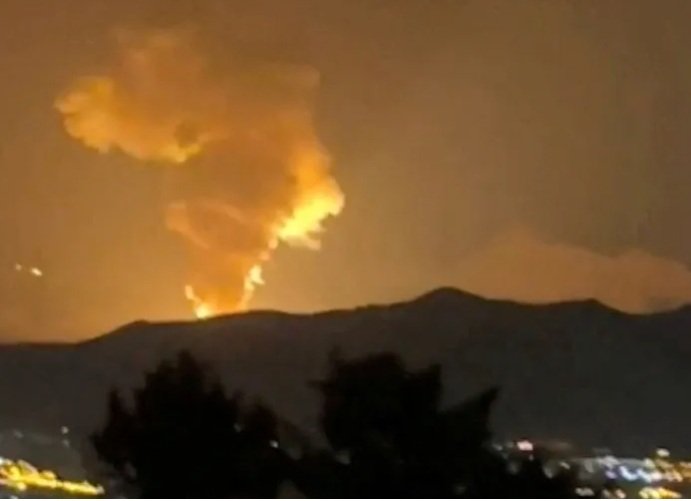
Apr 4 Kuwait’s largest oil refinery, Mina Al-Ahmadi, catches fire following an Iranian drone strike. Two desalination plants were also damaged.
Apr 5 Russia evacuates 200 more staff from Iran’s Bushehr nuclear plant. Iran’s foreign minister warns continued strikes risk radioactive contamination across the region.
Apr 5 Iran strikes the Mahshahr Petrochemical Zone, killing five. More than 30 universities have now been targeted since the war began.
The economic chokepoint
Iran’s closure of the Strait of Hormuz — through which roughly 20 percent of the world’s oil and gas transits — has become the conflict’s most globally consequential act. Iraq, which exports most of its oil through the strait, is in severe economic distress. Kuwait’s refinery fires have added pressure on Gulf energy markets. Approximately 20,000 sailors and thousands of ships remain stranded in the waterway.
Forty nations convened virtually on 3 April to discuss the Strait but agreed on no concrete measures. British Foreign Secretary Yvette Cooper noted that the rest of the world had been left to manage consequences from a war it did not start. French President Macron called the idea of using force to reopen the waterway ‘unrealistic.’ Trump, for his part, told other countries that the blocked strait was not America’s problem.
The munitions question is equally pressing on the coalition side. Analysis from CSIS published in late March found that replenishing US weapons inventory after this campaign will take time — creating a near-term vulnerability that adversaries will be aware of.
The diplomatic landscape
The peace track is not dead, but it is faint. Former Iranian Foreign Minister Javad Zarif has proposed a framework under which Iran would permanently forgo nuclear weapons development in exchange for the lifting of US sanctions. Iranian Foreign Minister Araghchi has acknowledged receiving messages from Washington but says trust is ‘at zero.’ Trump has simultaneously threatened to bomb Iran ‘back to the Stone Ages’ and expressed openness to a new Iranian supreme leader following Khamenei’s death.
The international response has fractured along predictable lines. China’s Foreign Minister Wang Yi called the strikes a violation of international law. Putin and Erdogan jointly called for an immediate ceasefire. The UN Secretary-General warned of a wider war. The US and Israel were not present at the 40-nation virtual summit.
Collateral exposure: two regions to watch
GULF STATES
United Arab Emirates
— Intercepting Iranian missiles and drones daily — Energy infrastructure at direct risk from drone attacks
— Investor confidence and war-risk surcharges rising — Strategic position as US partner making it a retaliatory target
HORN OF AFRICA
Ethiopia
— Red Sea instability compounding existing trade bottlenecks
— Houthi re-entry into war raises Bab al-Mandab risks — Global food and fuel price rises hitting import-dependent economies hardest
— Geopolitical competition in the Horn intensifying as major powers reposition
South Korea — cited by CSIS analysts as the non-combatant country hit hardest economically one month into the war — illustrates how far the conflict’s gravitational pull extends. Countries with no direct stake in the outcome are nonetheless absorbing its costs.
What comes next
The trajectory of the coming weeks will be determined by three variables: whether Trump’s Strait of Hormuz ultimatum produces any Iranian movement; whether the Houthis — who re-entered the war this week — move to block the Bab al-Mandab strait, which would compound the global energy crisis; and whether any third party can construct a credible diplomatic off-ramp before domestic pressures on all sides force further escalation.
Iran is not fighting to win on military terms. It is fighting to impose costs high enough, and for long enough, that the political will sustaining the coalition eventually fractures. The seizure of assets and bank accounts of over 100 Iranians abroad accused of ‘supporting the enemy’ signals that the regime — despite its losses — is tightening internal control rather than softening its posture.
The United States and Israel, meanwhile, face the growing contradiction of a campaign that has achieved its opening objectives — killing Khamenei, degrading military infrastructure — but has not produced the political transformation in Tehran that would constitute a meaningful definition of victory.
“Neither side has a clear vision of what winning looks like. That ambiguity, more than any single military action, is what makes this conflict so difficult to end.”
Sources: UK House of Commons Library · Wikipedia (2026 Iran war) · Al Jazeera live coverage · ACLED Middle East Special Issue, March 2026 · CSIS Latest Analysis · NPR reporting, April 2026
Editor’s Note : Views in the article do not necessarily reflect the views of borkena.com
__
Support Borkena : https://borkena.com/subscribe-borkena/
Join our Telegram Channel : t.me/borkena
Like borkena on Facebook
To submit Press Release, send submission to info@borkena.com
Add your business to Ethiopian Business Listing / Ethiopian Business Directory
Join the conversation. Follow us on X (Formerly Twitter) @zborkena to get the latest Ethiopian News updates regularly.
Strategic Analysis · Iran–U.S.–Israel War ·