
By Anteneh Tesfahun Birhanu
Post updated on April 7 , 2026 at 8: 55 P.M. Toronto Time
For many Amhara, “Fano” is more than a name: it is a shorthand for resistance, a repository of memory, and a living reflex when institutions fail to protect a people. In Ethiopia’s recent tremors the Fano have re-emerged from local custom and history into a force whose consolidation carries consequences far beyond the fields and towns where its rank first mobilized. This essay traces the Fano’s essence and raison d’être, sketches the drivers that animate them, and considers what their unity means for Amhara politics and for the fragile architecture of the Ethiopian state.
- Roots and Essence:
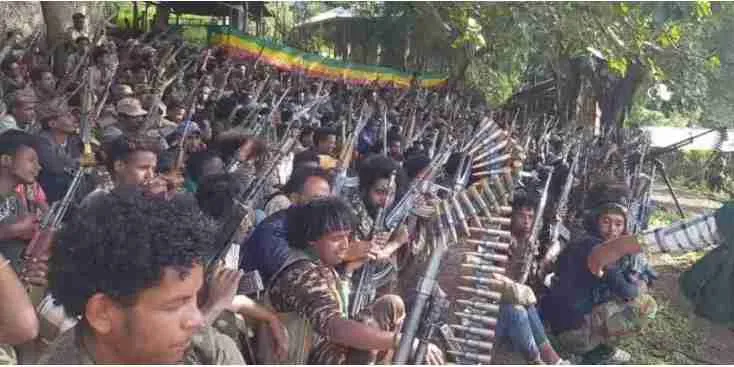
Until very recently, Fano has been best understood as a social phenomenon rather than a conventional organization. Its identity draws on multiple registers: historical memory (the irregular mobilizations that defended communities against external invasion), national pride, and a moral stance of defense when formal institutions fail. Historically invoked in moments of national peril, from local resistance against colonial incursions to ad hoc campaigns against the excesses of local authorities, the Fano tradition is decentralized, adaptive and embedded in community networks. Its members are not professional soldiers but farmers, merchants, artisans, teachers, students and local leaders who take up arms in defense of people and place.
Two features define the essence of the Fano. The first is defensive nationalism: a commitment to protect lives, property, and identity when the state proves unwilling or unable, and as so often the perpetrator of injustice. The second is improvisational solidarity: Fano emerges from local social capital and shared norms; it mobilizes quickly, draws on kinship and neighborhood ties, and dissolves or reshapes itself as circumstances change. This fluidity has been a source of resilience, and of ambiguity, since it complicates efforts to hold individuals or groups accountable under formal command structures.
- Why Organized Insurgency? Grievances, Triggers, and Existential Fears
The rise of a more organized Fano cannot be understood as the product of a single grievance or moment. It is the cumulative effect of political, social and economic pressures that have remade local memories and turned diffuse unease into coordinated mobilization. At the heart of this transformation are intertwined narratives of delegitimization, contested citizenship, territorial dispossession, security failure and structural hardship, each reinforcing the others and together producing a powerful rationale for collective self-defense.
Since the 1990s a shifting political language has recast how Amhara identity is publicly perceived. Where earlier generations framed community ties around shared history and service to the Ethiopian polity, a newer victim–oppressor rhetoric has often painted the Amhara as historical oppressors. Longstanding cultural practices, including the nation’s gun-bearing tradition, have at times been reduced to a pejorative shorthand, “Neftegna”, and used to justify exclusion and targeted attack. Many Amhara experience this as a sustained delegitimization of their identity. For those who embrace the Fano banner, therefore, mobilization is in part corrective: an assertion of dignity and a refusal to accept political marginalization.
The 1995 constitution’s enshrinement of ethnic federalism which was arguably drafted and implemented with limited Amhara participation has, in practice, produced legal and political arrangements that many Amhara experience as alienating and biased. Though the text often uses formally neutral language, three decades of implementation have normalized distinctions that treat communities differently: regional constitutions in Oromia, Benishangul-Gumuz and Harari formalize a division between “natives” and “settlers,” designating particular groups as the “sovereign owners” of a region. That hierarchy restricts political representation and land rights for those labeled outsiders; millions of Amharas living across Ethiopia, especially in Oromia, frequently find themselves denied the rights of self-administration and effective political participation that territorial “owners” enjoy. Coupled with the annexation of historically Amhara districts to other regions, these constitutional categories have translated into concrete dispossession, curtailment of citizenship claims, and structural marginalization within the country’s political economy.
Legal exclusion is further reinforced by hostile narratives that cast Amhara as “Menelik settlers,” “invaders,” or “Neftegna”, language that functions as a dehumanizing code and a pretext for violence. The combined effect of law and rhetoric has been severe: targeted killings and episodes of ethnic cleansing in places such as Arba Gugu, Bedeno, Gura Ferda, Gulisu, Shasamene, Tole and Metekel; widespread displacement and loss of property as Amhara are evicted from homes and land. Because the constitutional framework privileges collective territorial rights over universal individual citizenship, many Amhara labeled “settlers” are left with little effective state protection. For large numbers inside and outside the region, these realities underpin a central grievance: that the post-1995 order has institutionalized their vulnerability and exclusion instead of guaranteeing equal belonging and security. For many Amhara, therefore, Fano’s struggle is a response to an institutional order that denied them full belonging, security, and justice.
These political and legal anxieties are concentrated above all in territorial disputes. Places such as Welkait, Tegede, Telemt, parts of Raya, Derra and Metekel are not abstract lines on a map but repositories of memory, livelihood and identity. Annexation of these Amhara lands into other regional states in the early 1990s are widely experienced as dispossession that has had brutal consequences for the Amhara, from repeated communal attacks in Metekel to the Mai Kadra massacre. For the Fano, the recovery and defense of these territories are red lines: losing them would undermine both the material base and the symbolic core of Amhara communal life, making reclamation of these territories a matter of existential survival rather than mere politics.
Most immediately, the Fano’s resurgence stems from a pervasive security vacuum that left Amhara communities exposed. Repeated targeted attacks and massacres convinced many that federal and regional security institutions were not merely ineffective but, in some cases, complicit or strategically culpable to violence against Amhara civilians. In that gap, local actors organized: Fano units emerged as a self-defense vanguard, at times coordinating with state forces and at other times operating independently to deter and repel attacks. This sense of alienation was compounded by the way the Northern conflict came to an end, and particularly the subsequent Nairobi Implementation Agreement (7–12 November 2022). Although many Amhara initially contested being excluded from the talks, the Pretoria Agreement was nevertheless broadly accepted by Amhara elites and much of the public as a pragmatic end to the northern conflict. However, the less-transparent Nairobi talks fostered a sense among Amhara actors that their interests had been sidelined and that disputed territories were being left ambiguous. Amhara voices that characterized the agreement as a ‘war pact’ were further emboldened by the stalled DDR process and by statements from such officials as Amb. Redwan Hussien, who indicated that the TPLF would not be compelled to disarm due to ongoing security concerns.
Against that backdrop, the government’s April 2023 decision to dismantle regional Special Forces and disarm independently armed Fano units became the last straw. Where disarmament was perceived as selective, coercive, or aimed at neutralizing Amhara security capacity, many Fano commanders rejected unilateral demobilization. The result has been an escalation: what began as defensive local mobilization increasingly confronts federal and regional forces, transforming a community protection effort into a broader contest over control, legitimacy and security in the region, and now the federation.
Finally, underlying and amplifying all of these drivers are deep economic and social pressures. Widespread unemployment, especially among youth, declining public services and limited channels for political redress generate both grievance and opportunity for mobilization. For young men in particular, joining Fano can offer status, purpose and a means to defend kin and claim justice when institutional mechanisms appear closed.
Taken together, these factors create a coherent logic for organized insurgency: a people who feel culturally delegitimized, legally disadvantaged, territorially threatened, physically unprotected and economically marginalized are likely to turn to mobilization and insurgency. The Fano’s move from ad hoc defense groups toward greater organization is therefore not accidental but a predictable response to layered and chronic failures of protection, inclusion, and redress.
- Establishment of AFNM: A Historic Inflection Point
What began as dispersed, locally rooted defense groups steadily moved toward greater unity and organizational coherence, a process that accelerated after 2015 and intensified during the 2020–21 conflicts. Several reinforcing dynamics drove this shift. Shared experiences of violence and perceived state failure produced a clearer, more public narrative of grievance and defense that became ideological glue. Wartime cooperation with federal forces against common enemies in the north created operational familiarity and conferred battlefield legitimacy in the eyes of many Amhara communities. Political entrepreneurs, local leaders, and combat veterans sought to translate episodic mobilization into enduring command structures and disciplinary norms to improve battlefield effectiveness and position Fano as a credible political stakeholder. At the same time, social media and transnational diaspora networks accelerated recruitment, fundraising, and information flows, enabling previously loose networks to coordinate across wider geographies.
For more than two years Fano attempted to build a single, monolithic politico-military organization. Observers, supporters, and critics saw consolidation as double-edged. Greater cohesion promised improved capacity to protect communities, negotiate with state actors, and press political demands, enhancing bargaining power in both Amhara and national politics. Institutionalization, however, carried risks: the militarization of political life, the creation of parallel security authorities that could undermine civilian governance, and the hardening of factional rivalries within the Amhara polity. In practice, these risks and benefits have manifested with varying intensity at almost every stage of consolidation.
Consolidation required reconciling provincial command with the lived geography of politics—control of operating space and the localized politics of kinship and micro-factionalism. For a movement defined by local organization and action, woreda-level and kinship-based factions were powerful enough to threaten survival. These internal challenges were compounded by local party and government agencies that leveraged those factions for their own ends. Nevertheless, Fano overcame these obstacles and brought multiple local organizations into six major provincial groups.
Because the movement is fundamentally bottom-up, tighter organization was expected though not inevitable. In Gojjam, Fano unified the structure and command across the province two years ago. Wollo followed after about a year. In Shewa and Gondar, unification occurred only after the establishment of singular provincial organizations that then unified the various local commands. Once province-wide Fano organizations existed, a unified national command became a condition of survival.
The four provincial formations, Amhara Fano in Gojjam, Wollo, Gondar, and Shewa, eventually came together to form the Amhara Fano National Force (AFNF), overseen by a 13-member Central Command. About a year before AFNF’s creation, two provincial commands (Shewa and Gondar), together with several prominent personalities, had established the Amhara Fano Peoples Organization (AFPO). In fact, AFPO was the product of an earlier, unsuccessful attempt to create a single organization where four of the six provincial commands later withdrew, leaving AFPO a partial and fragile construct.
At this juncture, Fano faced two persistent challenges. First, the conviction that striking a fair balance between the four historical provinces, both symbolically and practically, was necessary but nearly impossible. This narrative seeded doubt among Amhara communities and, arguably, within Fano itself, portraying the establishment of unified Fano as a herculean task. Second, the persistence of strong provincial factional voices, often backed or sponsored by government propaganda machinery. These voices were used to try to bog down the insurgency within the Amhara region and frustrate efforts to form a unified organization.
Amid these challenges and limited battlefield successes, AFNF and AFPO leadership entered protracted, reportedly intense negotiations, with prominent diaspora figures present as witnesses. The process reportedly required 320 hours of talks over four months and culminated in the establishment of the Amhara Fano National Movement (AFNM) on January 9, 2026. AFNM is the first nationwide politico-military organization of the Amhara formed organically by Amharas themselves; the only comparable body, the ANDM, was effectively a renamed EPDM created under TPLF tutelage and patronage in the 1970s.
- Implications of Fano’s Consolidation: AFNM
The establishment of Amhara Fano National Movement (AFNM) marks a consequential inflection in both regional and national politics. It channels longstanding Amhara grievances into a single, more capable actor that can bargain, defend territory, and shape public discourse. However, it also creates acute dilemmas for civilian governance, human-rights protection, and the stability of Ethiopia’s federal compact. Among the key implications of consolidating all Fano groups into AFNM are:
- Consolidated Capacity: Amhara Fano National Movement (AFNM) transforms scattered self-defense groups into a single political-military actor capable of projecting coordinated strategy, messaging and action. That consolidation has allowed Amhara Questions, territorial claims, constitutional exclusion, and security failures, to be canalized into organized bargaining positions.
- Reframing Amhara politics: the AFNM has enabled Amhara leaders to reframe internal politics away from the binary of “Amharaness versus Ethiopianness” as the central fault line in internal politics, and to foreground shared regional demands. Whatever policy choices follow, armed Amhara actors seem to have preferred to address these questions in a more organized and unified manner through AFNM.
- Enhanced bargaining leverage: Organizational coherence, local legitimacy and diaspora support give AFNM concrete negotiating power over constitutional, territorial and security issues. These developments in capacity could also be leveraged to acquire better terms in forging alliances with other state and non-state actors inside and outside Ethiopia.
- Risk of militarization of politics: greater coherence brings the danger that coercive capacity will overshadow civilian institutions. AFNM’s institutionalization may create parallel security structures, weaken civilian oversight, and make questions of command, discipline and accountability the core contest in Amhara politics.
- Legitimacy and human-rights pressures: as AFNM gains influence, it faces intensified scrutiny over adherence to human-rights norms and the rule of law. Internal legitimacy, how elders, civil society and the diaspora judge AFNM’s conduct, will shape whether it is seen as a protector or a predatory power.
- National implications for the federal compact: the rise of a unified, territory-capable AFNM adds a powerful regional actor to Ethiopia’s fraught federal equation. The federal government confronts a binary of tactically costly coercion or politically risky accommodation; predominantly military responses (ENDF deployments and enforced disarmament) have so far hardened Fano’s resolve, to the point of establishing AFMN rather than neutralizing it.
- Feedback loop of escalation and consolidation: selective or coercive disarmament efforts have tended to validate AFNM’s self-defense narrative, accelerating its internal consolidation and permanence. Federal pressure can therefore produce the opposite of its intended effect: greater unity and entrenchment of the movement.
By Way of Conclusion: Conditions shaping trajectories- Integration versus Fragmentation
Three institutional conditions remain central to whether AFNM’s emergence leads to managed integration or deeper fragmentation for the Ethiopian federation: (1) meaningful inclusion in accountable security and political frameworks, including disarmament, demobilization and reintegration (DDR), clear command-and-control, and political participation; (2) substantive redress of constitutional and territorial grievances through inclusive legal and political reform; and (3) stronger civilian institutions and rule-of-law mechanisms that can check coercive actors and guarantee rights. If these conditions are met, the movement can be channeled into legitimate political life; if not, militarized politics and fragmentation are more likely.
But the conflict’s course has shifted the balance of possibility. Repeated fighting and political dislocations have empowered armed actors and narrowed the window for managed solutions. AFNM and other combatants increasingly seek not merely inclusion as subjects or beneficiaries of reform but to be principal architects of political change. In that context the three technical determinants are necessary but no longer sufficient: the decisive factors will be which side can mobilize popular legitimacy, build alliances, sustain resources and shape social norms through persuasive narratives, in short, who can translate coercive capacity and political credibility into durable power.
Anteneh T. Birhanu is an independent political analyst focusing on Ethiopian politics, security, and political economy.
Editor’s Note : Views in the article do not necessarily reflect the views of borkena.com
__
Support Borkena : https://borkena.com/subscribe-borkena/
Join our Telegram Channel : t.me/borkena
Like borkena on Facebook
To submit Press Release, send submission to info@borkena.com
Add your business to Ethiopian Business Listing / Ethiopian Business Directory
Join the conversation. Follow us on X (Formerly Twitter) @zborkena to get the latest Ethiopian News updates regularly.
The latest travel advisory by the US State Department should be heeded to the letter. I’m not surprised by the advisory on Ethiopia. That country has been marred by bloody and violent conflicts in its two largest regions and Tigray for years now. Others have been on shaky grounds all along. Congratulations bigots and connivers.
Meanwhile, I want to say this to my very common citizens of Eritrea. I the same advisory your very dear Eritrea has been rated at par with Western European countries like the UK, Germany, France, Spain and the rest of them. That is because you have chosen the peaceful way and patiently resisting the ruthless despots led by Al-Toweel Isu and the gang. Peaceful struggle is a drawn-out process and the trick is not to lose the nerve and you have not lost that. It shows you have not forgotten the death and destruction violent form of struggle can bring to a society. It shows you’ve gained maturity from those dark days. I have not hidden this from my Eritrean friends who I have known for decades. Hats off to you my dear common citizens of Eritrea except Isu and gangsters.