
My lifetime personal observations with historical references and chronology
Tesfaye Biftu,
Cherry Hill, NJ 08002 USA
Summary of the recurring cycles
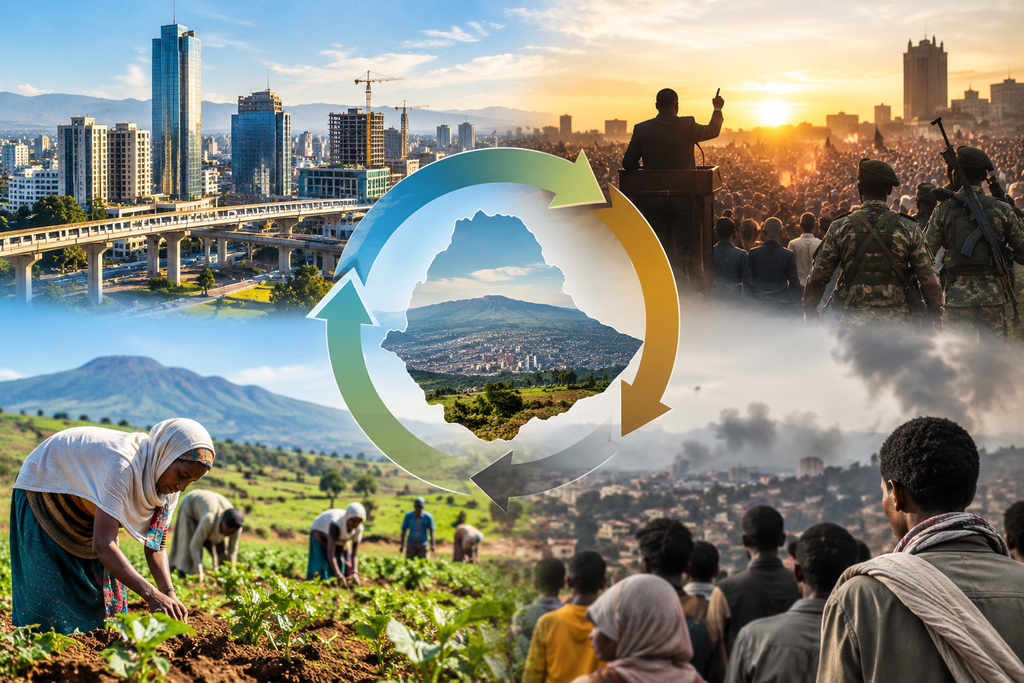
In my lifetime, in the last 70 years, I have observed several recurring patterns in Ethiopia: a government begins a period of development and institution-building; dissatisfaction and political conflict accumulates; a new government takes power; earlier policies or institutions are dismantled or redirected; and a subsequent government again attempts to rebuild growth and stability; and this cycle has repeated for decades. Even before my time, Emperor Menelik and Haile Selassie, before the first and second world war, have experienced the same cycles. The earlier development cycles were sabotages by war with foreign countries, namely Italy (Adwa and Maichew), but the recent three cycles are all due to internally created conflicts, and resulted with major casualties as each cycle continues.
1. Before 1974: Modernization under Haile Selassie
In the years before the fall of Emperor Haile Selassie I in 1974, Ethiopia was pursuing an ambitious program of modernization. The imperial government introduced successive development plans and promoted manufacturing, transportation, agriculture, education, aviation and electrical power. The country’s first Five-Year Development Plan covered 1957–1961, and a Third Five-Year Development Plan covered 1968–1973. During this period, textile factories and other industrial enterprises were established, while hydropower projects expanded electricity generation. For example, the Koka Dam was completed in 1960, Tis Abay became operational in 1964, and Awash II followed in 1966. [1][2][3]
This period is one in which roads, highways, buildings, and other infrastructure in Addis Ababa and provinces were being developed rapidly, graduates of agricultural schools going into the countryside to establish or manage large farms. These fits the broader picture of an imperial government that was actively promoting agricultural and industrial development, although the pace and benefits of development were uneven. Historical economic data also show that Ethiopia experienced substantial growth during parts of the 1950s and 1960s, in par with Asian tigers Singapore, South Korea, Taiwan, … while growth weakened in the early 1970s. [1][4]
2. 1974–1991: The Derg and the socialist period
In 1974, a military committee known as the Derg overthrew Haile Selassie. The Emperor was deposed in September 1974 and died in August 1975. The Derg subsequently established a Marxist-Leninist oriented state and, during 1975, nationalized major parts of the economy. Rural land was nationalized in March 1975; urban land, rentable houses, and apartments were nationalized in July 1975; and banks, insurance companies, and many major enterprises were brought under state control. [5][6]
This period lasted roughly seventeen years, from the 1974 revolution until the fall of the Derg in 1991. The original story describes the period as a major break in Ethiopia’s development and nationalization ultimately did not produce the industrialization and broad economic development that the country needed. The Derg operated a centrally planned economy and that the financial sector which is the engine of growth was overwhelmingly state-owned during the 1970s and 1980s. [5][7]. Towards the end,
the Derge realized the mistakes and began liberalizing certain aspects of private establishments. However, it was too late then.
3. 1991–2012: EPRDF rule and market-oriented reforms
In 1991, the Ethiopian People’s Revolutionary Democratic Front (EPRDF), in which the Tigray People’s Liberation Front (TPLF) was the leading component, took power after the collapse of the Derg. Meles Zenawi became the dominant political leader of the new era, serving first as president of the transitional government and later as prime minister from 1995 until his death in 2012. [8]
The economic direction also changed. Beginning in 1991–1992, the new government introduced market-oriented reforms, including price and trade reforms, changes to the foreign-exchange system, privatization measures, and financial-sector reforms. A particularly important step came in 1994, when legislation permitted privately owned domestic commercial banks to enter the market; the first private bank began operations in 1994–1995. [7][9][10] These reforms did not create a fully free-market economy, but they represented a significant departure from the failed centrally planned system of the Derg.
The Meles era also saw major investments in infrastructure and development, alongside political tensions and controversies. Ethiopia experienced rapid economic growth over much of the 2000s and 2010s, and poverty declined nationally, although the World Bank has documented significant regional and urban-rural differences in the distribution of those gains. [11]
2012–2018: Transition, unrest, and political change
Meles Zenawi died in August 2012, and Hailemariam Desalegn became prime minister. During the following years, Ethiopia experienced substantial political unrest and dissatisfaction, including major protests beginning in 2015–2016 and continuing into 2018. Hailemariam resigned in February 2018, and Abiy Ahmed became prime minister in April 2018. [8][12]
4. 2018 Onward: The PM Abiy government
The beginning of Abiy Ahmed’s government brought significant changes and initially generated considerable optimism. In his first months in office, the government lifted the state of emergency, granted amnesty to thousands of political prisoners, eased media restrictions, and legalized previously outlawed opposition groups. [13] PM Abiy also moved rapidly to improve relations with Eritrea. In July and September 2018, Ethiopia and Eritrea signed agreements that ended the long “no war, no peace” stalemate that had followed the 1998–2000 Ethiopia–Eritrea war. For his efforts to achieve peace and international cooperation, Abiy received the 2019 Nobel Peace Prize. [14]
At the same time, Ethiopia continued major development projects. The Grand Ethiopian Renaissance Dam (GERD), whose construction began in 2011 by PM Meles and completed under PM Abiy’s leadership, became one of the country’s most important national infrastructure projects. The dam is located in the Benishangul-Gumuz region and is intended primarily to expand Ethiopia’s electricity generating capacity. [15] The period also brought continued urban construction and infrastructure expansion, including substantial changes in Addis Ababa and other Ethiopian cities. In addition, major industrialization including Solar Panel production, Textile, Cement and Natural gas production, Oil pipeline, enormous farm development projects, other Hydroelectric dams and over 35 major initiatives were promoted by the new government.
2020–2022: The Tigray War and widening divisions
However, like in the previous two cycles, the reform period was followed by severe political conflict. In November 2020, fighting broke out between the federal government and forces associated with the TPLF in the Tigray region. The conflict subsequently spread into neighboring Amhara and Afar regions and produced a major humanitarian and economic crisis. The World Bank describes the conflict as lasting from November 2020 to November 2022, when a peace agreement was reached. [16][17]
There is supporting evidence for the broader concern about uneven development: a 2020 World Bank regional poverty study found substantial differences in poverty reduction across regions and rising inequality in many regions between 2011 and 2016. [11] The war itself caused extensive displacement, destruction, disruption of livelihoods, and loss of welfare. [16][17]. A similar conflict has also been ongoing with Fano (Amhara), and OLF (Oromo) factions. The previous Meles government also left Ethiopia land locked, which by itself limits growth and initiated new regional conflict.
Recurring cycle continues
What the chronology does make clear is that Ethiopia has repeatedly combined ambitious modernization projects with major political transitions, conflicts, and changes in economic policy.
The larger question raised by this story is whether Ethiopia/Ethiopians can build institutions strong enough to preserve useful economic and developmental policies across changes in leadership, while ensuring that growth is broadly shared and political disagreements do not repeatedly become violent conflict.
The New conflict is much more complex in nature: the Iran and its allies war is affecting the gulf nations on the West side of the Red sea; on the East side Sudan is undergoing major conflict; Egypt has its grudge with Ethiopia over the Nile rive; Ethiopia, the top largest land locked country in the world wants a sea access for its 140 million inhabitants.
Will Ethiopians Unite to save the nation from this looming disaster, and build a strong institution that can for see and abort future cycles , or let the conflict continue till the nation breaks apart like the neighboring countries Sudan and Somalia?
Key Dates at a Glance :
1957–1961: First Five-Year Development Plan.
1960: Koka Dam completed; major expansion of hydropower capacity.
1964: Tis Abay hydropower plant completed.
1968–1973: Third Five-Year Development Plan.
1974: Derg overthrows Emperor Haile Selassie; revolutionary government begins.
1975: Rural land, urban land, rentable houses, apartments, banks, insurance companies, and major enterprises are nationalized in stages.
1991: Derg falls; EPRDF takes power and a transitional government is established.
1994: Legal framework permits private domestic commercial banks; market-oriented reforms deepen. 1995: Federal Democratic Republic of Ethiopia established; Meles Zenawi becomes prime minister. 1998–2000: Ethiopia–Eritrea war.
2011: Construction of the Grand Ethiopian Renaissance Dam begins.
2012: Meles Zenawi dies; Hailemariam Desalegn becomes prime minister.
2015–2018: Major protests and political unrest.
April 2018: Abiy Ahmed becomes prime minister.
2018: Ethiopia and Eritrea restore peace and diplomatic relations.
2019: Abiy Ahmed receives the Nobel Peace Prize.
November 2020: Tigray War begins.
November 2022: Pretoria peace agreement brings the two-year Tigray conflict to a formal end.
Editor’s Note: Views in the article do not necessarily reflect the views of borkena.com
__
Join our Telegram Channel: t.me/borkena
Like borkena on Facebook
To submit a press release, send the submission to info@borkena.com
Add your business to Ethiopian Business Listing / Ethiopian Business Directory
Join the conversation. Follow us on X (formerly Twitter) @zborkena to get the latest Ethiopian news updates regularly.
References
[1] U.S. Library of Congress, Ethiopia: A Country Study.. Useful for the Derg’s 1975 land, housing, and nationalization measures. https://tile.loc.gov/storage
services/master/frd/frdcstdy/et/ethiopiacountrys00ofca_0/ethiopia-countrys00ofca_0.pdf
[2] Oxford Academic, “Modernization, State-Building, and the Hydraulic Mission in Imperial and Revolutionary Ethiopia.”. Provides evidence on hydropower projects including Koka, Tis Abay, and Awash II. https://academic.oup.com/book/58950/chapter/493013774
[3] Ethiopian Government, Third Five-Year Development Plan, 1968–1973.. Contemporary government development-plan source for the late imperial period.
https://books.google.com/books/about/Third_Five_Year_Development_Plan_1961_19.html?id=XN OjXkD_FgG
[4] IMF, Ethiopia: Recent Economic Developments (1994).. Documents the post-1991 move toward a market-based economy and the 1994 banking legislation.
https://www.elibrary.imf.org/view/journals/002/1994/015/article-A001-en.xml
[5] IMF, Ethiopia: Recent Economic Developments (1999).. Documents private banking, privatization, and market reforms during the 1990s.
https://www.elibrary.imf.org/view/journals/002/1999/098/article-A001-en.xml
[6] U.S. Department of State, Background Notes: Ethiopia.. Provides chronology for the fall of the Derg, the EPRDF, and the early 1990s transition. https://1997-
2001.state.gov/background_notes/ethiopia_0398_bgn.html
[7] Nobel Prize, Abiy Ahmed Ali — Facts and 2019 Nobel Peace Prize materials.. Documents Abiy’s accession in April 2018, reforms, and Ethiopia–Eritrea peace initiative.
https://www.nobelprize.org/laureate/981
[8] Nobel Prize, The Nobel Peace Prize 2019 — Press Release.. Details the 2018 Ethiopia–Eritrea peace process and early reforms. https://www.nobelprize.org/prizes/peace/2019/press-release/
[9] World Bank, Ethiopia Achieved Positive Poverty Reduction but Inequalities Persist (2020).. Evidence on poverty reduction, regional differences, and inequality.
https://www.worldbank.org/en/news/press-release/2020/11/18/ethiopia-achieved-positive poverty-reduction-but-inequalities-persist
[10] World Bank, Ethiopia Damage and Needs Assessment — Volume A.. Documents the scale and geographic spread of the 2020–2022 conflict.
https://documents.worldbank.org/en/publication/documents
reports/documentdetail/099062223114085580
[11] World Bank, Conflict and Household Welfare in Ethiopia.. Provides evidence on conflict, displacement, and household welfare.
https://documents1.worldbank.org/curated/en/099122324120026973/pdf/P17948414314e60791b ddc1916bc4acd5d8.pdf
[12] Grand Ethiopian Renaissance Dam official site.. Official project information stating that construction began in 2011 and describing the dam’s purpose and specifications. https://www.gerd.gov.et/about-the-dam
Dear Dr Tesfaye ,
I found this article thoughtful and useful, particularly in the way it traces Ethiopia’s recurring cycles of development, political transition, economic reform, conflict, and institutional disruption over the past several decades. The chronology provides an important reminder that Ethiopia has repeatedly demonstrated the capacity to initiate ambitious development programs, only to see many of those gains disrupted by political instability and conflict.
However, I believe the analysis would be considerably stronger if it went beyond the economic consequences and examined more deeply the political causes of these recurring cycles. Economic failure is often a consequence rather than the original cause. Ethiopia’s central challenge has also involved the nature of its political institutions, the concentration of political power, competing national and ethnic identities, and political philosophies that sometimes place ethnic or tribal interests above the interests of the Ethiopian state as a whole.
This is particularly important because the pattern described in the article did not begin in 1974. From the imperial period through the Derg, the EPRDF era, and the current political period, Ethiopia has repeatedly struggled to establish institutions that can survive changes in leadership and peacefully accommodate competing political interests. Governments have changed, economic policies have changed, and development strategies have changed, but the underlying political problem of how Ethiopians should share power, resources, security, and national identity has remained unresolved.
The article is therefore right to emphasize the importance of institutional continuity. But institutions are not simply economic mechanisms. Strong banks, infrastructure, industries, and development programs cannot by themselves create political stability. Ethiopia also needs political institutions capable of protecting citizens regardless of ethnicity, region, language, or political affiliation and of resolving disagreements without resorting to violence.
particularly we need to examine the role of ethnic and tribal-based political thinking in greater depth. Identity and ethnicity are legitimate parts of Ethiopia’s social and historical reality, but when political competition becomes primarily organized around ethnic or regional interests, it can undermine a shared sense of national citizenship and make political disagreements much more dangerous. The challenge is not to eliminate Ethiopia’s diversity, but to build a political system in which diversity and a strong common Ethiopian identity can coexist.
The present geopolitical environment makes this discussion even more urgent. Ethiopia’s landlocked status, the Nile dispute, instability in Sudan, tensions involving Egypt and Eritrea, and the wider strategic importance of the Red Sea all add external pressures to Ethiopia’s internal political challenges. These circumstances make national cohesion and capable institutions particularly important.
For me, the most important question raised by this article is therefore not simply how Ethiopia can avoid another economic setback. It is whether Ethiopians can develop political institutions and a national political culture strong enough to prevent disagreements over power, identity, resources, and territory from repeatedly becoming armed conflicts.
The article makes a valuable contribution by documenting the recurring economic and developmental cycles. Its argument would be even more compelling if the next step were to examine the political and ideological foundations of those cycles. Understanding why Ethiopia repeatedly destroys or abandons institutions and development achievements may be just as important as understanding what was destroyed.
Ultimately, Ethiopia’s future will depend not only on economic growth, but on whether its diverse peoples can build institutions that command legitimacy across regional and ethnic boundaries and preserve national development beyond the tenure of any individual government. Thank you for the articel.
Mesfin Tegenu
I have listed below comments I personally received from various subscribers of your magazine. I believe, their comments add extra perspective to my recent publication on historical political-economic cycles in Ethiopia. I did not include names of those who sent me their comments privately to preserve the individuals privacy.
Submitted by BB
This is a very thoughtful article. The author condensed mass of information and patterns. Also, as a scientist he focused on the facts which are valuable and missing in the news and commentary these days.
It’s really sad this history keeps repeating in Ethiopia. What the article tells me is that the leadership doesn’t matter in the end; it seems the problem is the culture and the people’s pride. The benefit of this type of thinking is that it helped maintain independence from outside forces. But the consequence of this type of thinking is that they can’t protect themselves from internal issues.
As a lawyer part of me thinks the solution is through the law – following the law are the foundations. There needs to be clear rules and limits on power and accountability. The law also needs to be enforced fairly and consistently. This is the start to lasting institutions.
In addition, part of me thinks the solution lies in creating a new identity. There are so many tribes and ethnic groups and languages which is good like America. But in America citizens have an American identity even though they are of different races and religions. We are all here for “land of opportunity. Ethiopia needs a similar identity that binds the people togrther. So they can focus on this shared identity rather differences. In Ethiopia, there seems to be more pride in ethnic group than the country. They don’t seem to value being together is more valuable than being separate.
I don’t know the solution. But hopefully the right person or group sees this article and goes to the next step and find a lasting solution. I think the question raised at the end is what the people and leaders should always think about. “Whether Ethiopia/Ethiopians can build institutions strong enough to preserve useful economic and developmental policies across changes in leadership”.
Comments by MB
I believe a good political policy is a good economic policy. Slavery is another example of how the county’s economy was good for few but not for everyone.
I am an American and can admit I don’t understand everything about Ethiopia. From what I understand, this civil unrest issue goes back even before the previous Emperors as if the culture does not allow them to abide by a central authority. They also have a lot of pride. They can learn a lot from other nations. For example, India has several tribes, but unlike Ethiopia, they have a peaceful government. Tanzania has many tribes but they ban ethnic political parties. Indonesia shifts power to regional areas. Most of these counties are BRICS members. Ethiopia can learn from them if they put aside their tribal pride.
It is acceptable to make many new mistakes, but don’t make the same mistake twice. Ethiopia has been making the same mistakes too many times as exemplified in this article. The article is a call to break this cycle by redirecting people’s focus on seeking long lasting solution which will benefit the country.