
By Kebour Ghenna
Not long ago, a clever young fellow. Let’s call him Dawit. Sat across from me over a cup of buna and said:
“… If the country is broke, bombed, and boiling, how is GDP going up?”
A good question.
In fact, it’s the kind of question we ought to hear on the floor of parliament. But instead of debate, we get silence. Statistics are waved like magic wands, and the spell seems to work, at least on paper.
In the latest Quarterly Macroeconomic Update, the EEA assures us inflation is falling, growth is rising, and deficits are narrowing. The IMF’s 2025 Article IV review echoes the same. Cheers, everyone. Raise a glass, even if you can’t afford what’s in it.
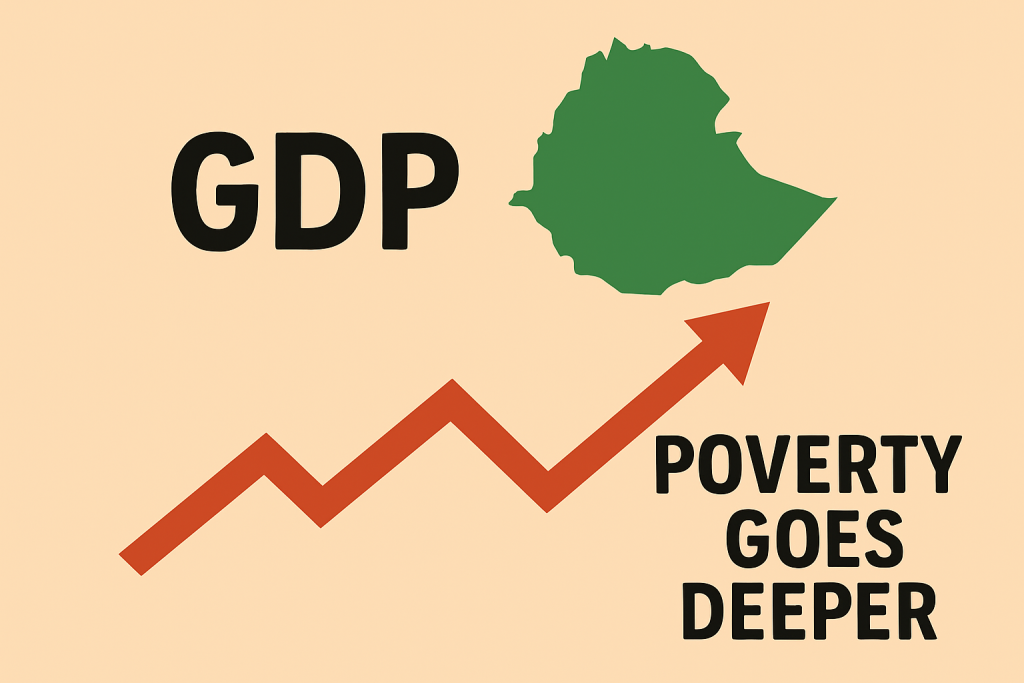
Yes, Ethiopia’s GDP may appear to be growing, but it’s an illusion clouded by skyrocketing debt and deepening poverty. Over the past decade, the country’s public debt has risen 3.5 times, outpacing nominal GDP growth of 2.5 times. The debt-fueled infrastructure boom of the 2010s has now given way to economic hardship: conflict, inflation, forex shortages, and crumbling public services.
Poverty is surging, projected to reach 43% in 2025, up from 33% in 2016. Meanwhile, new borrowing, another $4 billion, is on the table, promoted as a path to growth. But real growth comes from productive activity, not fiscal acrobatics. With the IMF prescribing austerity and liberalization, Ethiopia risks trading one crisis for another. Debt isn’t evil… but piling it on while the economy stumbles and citizens suffer isn’t recovery. It’s a delusion. The numbers might make sense in official reports, but in the streets, the story is very different.
Q. What sense does it make to heap on more debt when the country is already gasping for air? How long can we keep boasting about growth while the ground beneath us crumbles? Asks Dawit.
A. Out there, in the real Ethiopia, the numbers don’t add up. Bank branches are shuttered, farmers duck gunfire instead of rain, and factories hum only when the power decides to stay on. The picture is anything but rosy.
We are, after all, still at war. Not just in Amhara or Oromia, but in a handful of other forgotten places where gunfire still echoes through the night. The violence hasn’t stopped; it’s simply become part of the background noise of daily life.
And now, unbelievably, we’re bracing for something even worse… a return to war with Tigray, maybe even Eritrea. Another round in the same tragic play. And where is the output to support it? It doesn’t exist!!
Q: Dawit frowns again. How can this be?
A: It’s partly a statistical trick. After years of conflict and pandemic shocks, the economy fell so far that even a tiny rebound looks like a boom. Economists call it a base effect – when the hole is deep enough, any step up looks impressive.
The IMF calls it “recovery.”
GDP, after all, doesn’t distinguish between good growth and bad. A bombed factory rebuilt counts just the same as a new one. Inflation pushing up nominal values? Still growth.
Q: Dawit leans in. Maybe coffee and gold are saving us?
A: Not quite.
Yes, gold smuggling is up and coffee exports are holding on, barely. But these aren’t economic engines. They’re lifeboats. Coffee may warm the IMF’s models, but it won’t fix a country where 43% of people – according to the World Bank – will live in poverty next year.
You don’t rebuild a house by polishing the coffee table.
Q: What about the people? Dawit asks.
A: Well, they’re hanging on. Barely.
Wages have risen modestly. But the cost of living has surged. Youth unemployment remains sky-high. Schools lack materials. Hospitals lack medicines. Power outages remain frequent. Businesses complain of red tape, and the black market still sets the real exchange rate.
So while Birr-based GDP rises, real livelihoods shrink.
Welcome to Ethiopia’s New Economy
Here’s how it works:
• The IMF lends us money to pay old debts…
• The National Bank floats the birr until it sinks…
• The EEA smiles at the charts…
• And the rest of us pray the price of teff doesn’t double — again.
The technocrats tell us we must “consolidate gains.” But what gains? For whom? Not for the millions jobless youth roaming the cities. Not for the teachers waiting six months for textbooks. Not for the mothers choosing between school fees and dinner.
What Should We Be Doing? Asks Dawit again.
A reasonable person looks at this and says: stop chasing fiscal purity and start building real capacity.
Invest in rural reconstruction, community enterprises, local credit, and small industry.
Treat social spending as investment, not charity.
Don’t leave the economy to the mercy of a “floating” birr and foreign creditors.
Ethiopia doesn’t need another macro program; it needs a national rebuilding plan, owned by its people, financed by its own productivity, and protected from the violence of both war and austerity.
Final Thought
So yes, GDP is growing. But so is poverty.
Inflation is lower, but the cost of living is unbearable.
Debt is rising, and trust is falling.
If this is recovery, what does collapse look like
Editor’s Note : The article appeared first on the personal social media page of Kebour Ghenna. Views in the article do not necessarily reflect the views of borkena.com
__
Support Borkena : https://borkena.com/subscribe-borkena/
Borkena Ethiopian News Youtube Channel
Join our Telegram Channel : t.me/borkena
Like borkena on Facebook
To submit Press Release, send submission to info@borkena.com
Add your business to Ethiopian Business Listing / Ethiopian Business Directory
Join the conversation. Follow us on X (Formerly Twitter) @zborkena to get the latest Ethiopian News updates regularly.