

By Eyassu Epheraim G Hanna
London UK
When Ethiopian Prime Minister Abiy Ahmed addressed crowds in Hossana on December 8 during the country’s 20th Nations, Nationalities, and Peoples’ Day celebration, the message was officially one of unity. But one phrase collapsed that façade entirely. In a widely circulated video, Abiy vowed to remove his enemies “like head lice” — a dehumanizing metaphor that is shocking not only for its viciousness but because it comes from the head of government of a country already fractured by war. After the remark appeared on official channels, it was quickly scrubbed from social media. But the damage was done.
This was not a slip of the tongue. Nor is it typical political rhetoric in a time of crisis. In societies experiencing violent fragmentation, describing political opponents or ethnic groups as pests, vermin, parasites, or disease is recognized by genocide-prevention experts as a critical warning sign. Ethiopia — where conflict rages or recently raged in Tigray, Amhara, Oromia, and other regions — is precisely the kind of environment where such language is most dangerous.
A Pattern of Dehumanization in Ethiopia
Abiy’s “head-lice” metaphor is not isolated. It follows years of rhetoric that has portrayed groups of Ethiopians as biologically tainted, parasitic, or predatory. During the 2020–2022 Tigray war, human-rights researchers documented extensive use of dehumanizing slurs targeting Tigrayans: “day-time hyenas” (a phrase Abiy himself used publicly in 2018); “cancer”; “invasive weed”; “virus”; “junta”; and “devils,” among others. ¹
These labels appeared across state-linked media, social-media campaigns, and even official speeches. Amnesty International warned in late 2021 of “an alarming rise in online hate speech” directed at Tigrayans and encouraged the government to denounce dehumanizing language. ² Ethiopia Insight and other independent outlets likewise tracked how these metaphors laid the groundwork for discrimination, mass detentions, and ethnic profiling during the war. ³
The phrase “day-time hyena” deserves special emphasis. In Amharic cultural usage, hyenas symbolize shameless predators—creatures outside the boundaries of moral order. Calling human beings “hyenas,” and especially “daytime” ones, signals that they are dangerous even beyond the normal rules of predation. Linguistically, this is intentional dehumanization.
Tigrayan scholars and diaspora communities warned from early in the conflict that such language was creating an atmosphere permissive of atrocity. Later investigations, including UN-mandated inquiries, confirmed that mass detentions, killings, and ethnic cleansing occurred alongside hate speech that framed Tigrayans as existential threats. ⁴
Seen against this background, Abiy’s new metaphor — enemies as “head lice” — fits an established pattern. It is not a rhetorical escalation; it is a continuation.
The Historical Pattern Is Clear
The world has witnessed this sequence before. Where mass atrocities occur, dehumanizing metaphors typically precede them. The connections across history are unmistakable.
Nazi Germany (Holocaust): The Nazi propaganda machine incessantly depicted Jews as “vermin,” “rats,” “parasites,” and “lice.” A 1941 poster distributed across occupied Poland read: “Jews are lice; they cause typhus,” associating Jews with disease and contamination. ⁵ In the logic of genocidal propaganda, extermination becomes framed as public hygiene.
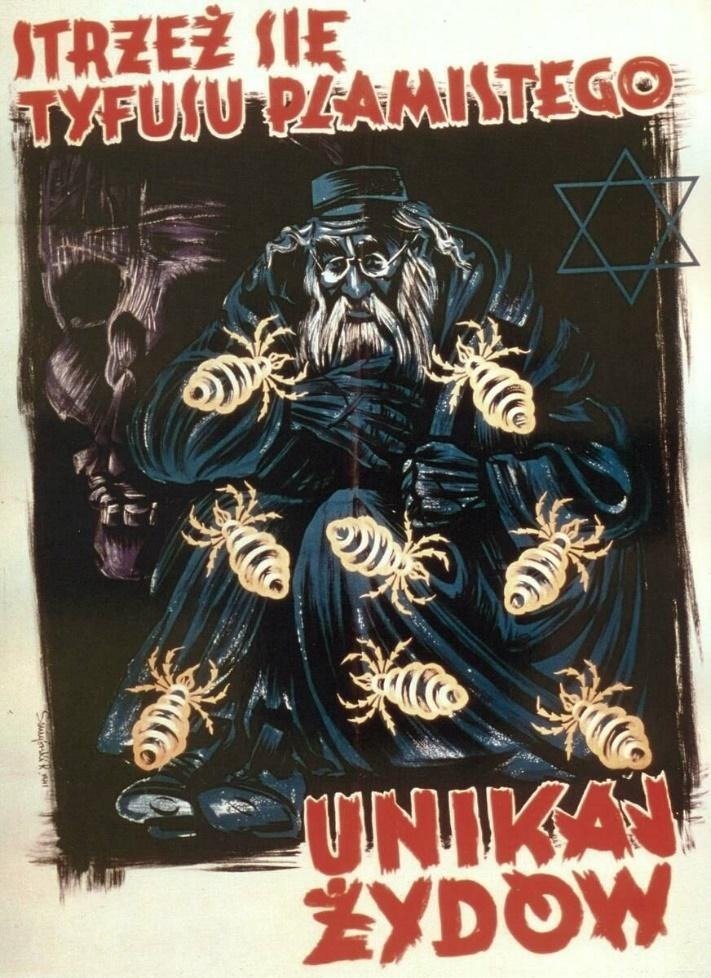
Artist: R. Saniyorski. Muzeum Okregowe w Rzeszowie: Source https://germanhistorydocs.org/
Rwanda (1994): Prior to and during the genocide, extremist political and media voices labelled Tutsis as “inyenzi,” meaning “cockroaches,” and “snakes.” Radio Télévision Libre des Mille Collines (RTLM) repeatedly broadcast calls to eliminate “cockroaches,” a metaphor that helped normalize mass participation in killing. ⁶ Human Rights Watch later concluded that this language played a central role in enabling genocide. ⁷
The Armenian Genocide (1915–1917): Armenians were described in Ottoman rhetoric as “dangerous microbes” contaminating the empire — a discourse that framed deportation and extermination as defensive purification. ⁸
Across these cases, the pattern is consistent: the targeted group is figuratively stripped of humanity first. The shift from political adversary to biological menace — lice, insects, rats, parasites, weeds, disease — is a powerful psychological step. Violence then becomes recast as sanitation. At scale, that logic becomes genocidal.
Ethiopia is not Nazi Germany or 1994 Rwanda. But the mechanisms of dehumanization are comparable, and the consequences can be catastrophic if unchecked.
Why Abiy’s Statement Demands Immediate Global Attention
Dehumanization is not simply offensive. It is instrumental. It primes the public to tolerate, rationalize, or participate in violence. Ethiopia’s political landscape makes this moment particularly combustible:
- Tigray remains effectively self-governing after a devastating war that killed hundreds of thousands.
- The Amhara region is engulfed in conflict between federal forces and Fano militias.
- Oromia faces an ongoing war between the government and the Oromo Liberation Army (OLA).
- The federal state is struggling under economic pressure, internal displacement, and political polarization.
In this environment, when the prime minister labels his “enemies” as lice, the target category is ambiguous — and dangerously broad. Opponents in Tigray, Amhara, Oromia, and elsewhere collectively represent most of the population. Ethnicity, political dissent, and regional identity can be easily collapsed into a single category of “pests.”
That ambiguity is exactly what makes the metaphor alarming. Dehumanizing out-group language with fuzzy boundaries is one of the clearest indicators of potential mass atrocity, according to the UN Office on Genocide Prevention.
What the International Community Should Do
First, document the statement. The rapid deletion of the remark from official channels highlights the need for independent archiving. Video, transcripts, and translations should be preserved by media, researchers, and human-rights monitors.
Second, demand a public retraction or clarification. Domestic civil society, opposition groups, religious leaders, and Ethiopia’s international partners should insist on a formal repudiation of dehumanizing language. Silence normalizes it.
Third, activate early-warning mechanisms. The African Union, United Nations, and regional organizations should treat the statement as a risk indicator, especially given Ethiopia’s ongoing conflicts.
Fourth, impose diplomatic costs for hate speech by officials. Foreign governments and multilateral institutions should make clear that dehumanizing statements from heads of state are unacceptable and will affect bilateral engagement.
Fifth, amplify counter speech. Ethiopian community leaders — religious figures, academics, elders, and diaspora voices — should speak publicly against dehumanization and emphasize the shared humanity of all Ethiopians.
Silence Is Not Neutral
Ethiopia is at a fragile juncture. The country’s diversity is a strength, but also vulnerable to manipulation. When leaders describe opponents as parasites or pests, the moral fabric necessary for coexistence weakens rapidly. Genocide is not inevitable, but history shows that the first steps often come through words — the metaphors of infestation and disease that enable people to imagine violence as purification.
The world has ignored such warning signs before. It must not ignore them now.
Notes & References
- Tghat Editorial Team, “The Rhetoric that Set the Scene,” Tghat, April 2021.
- Amnesty International, “Ethiopia: Sweeping Emergency Powers and Alarming Rise in Online Hate Speech,” Nov. 2021.
- Ethiopia Insight, “The War on Tigray: A Multi-Pronged Assault Driven by Genocidal Undercurrents,” Dec. 2020.
- Tesfa, H. & Van Reisen, M., “Negative Stereotyping and Hate Speech in the Tigray War,” in Panarchy of War (2024).
- United States Holocaust Memorial Museum (USHMM), “Jews Are Lice; They Cause Typhus,” Propaganda Poster, 1941.
- Article 19, “Broadcasting Genocide: RTLM and the Role of Hate Media in Rwanda,” 2003.
- Human Rights Watch, Leave None to Tell the Story: Genocide in Rwanda, 1999.
- Akçam, T., A Shameful Act: The Armenian Genocide and the Question of Turkish Responsibility (2006).
Editor’s Note : Views in the article do not necessarily reflect the views of borkena.com
__
Support Borkena : https://borkena.com/subscribe-borkena/
Join our Telegram Channel : t.me/borkena
Like borkena on Facebook
Borkena Ethiopian News Youtube Channel
To submit Press Release, send submission to info@borkena.com
Add your business to Ethiopian Business Listing / Ethiopian Business Directory
Join the conversation. Follow us on X (Formerly Twitter) @zborkena to get the latest Ethiopian News updates regularly.