
By Ephrem Asebe
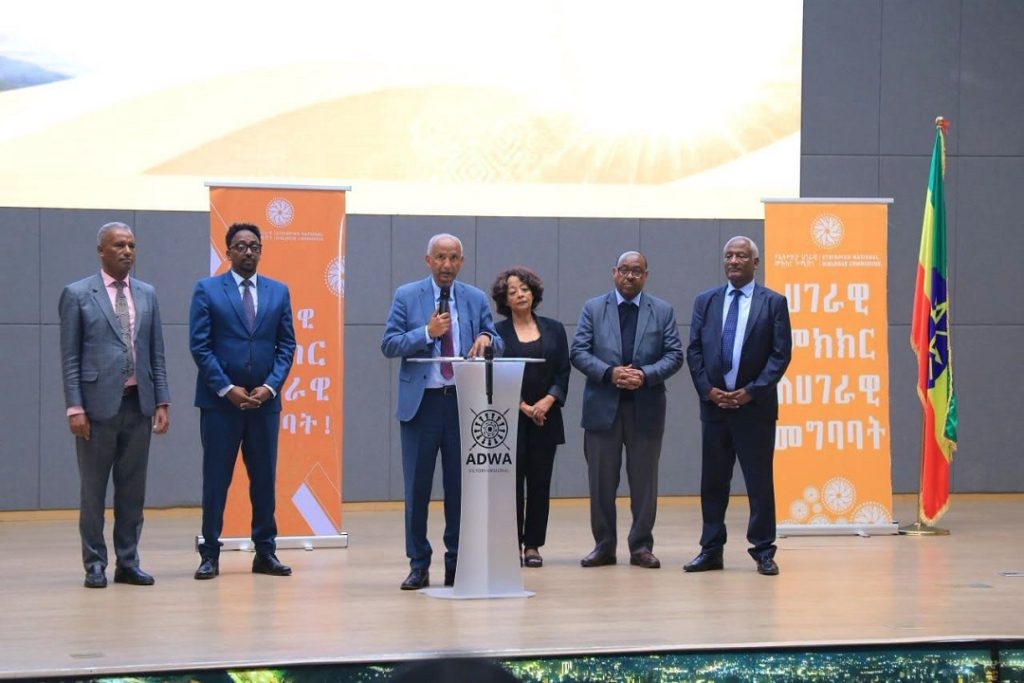
The Ethiopian National Dialogue Commission was established with a serious national mandate. It was not created merely to collect complaints, organize public meetings, or classify public concerns into agenda headings. Its mandate, as set out in Proclamation No. 1265/2021, published in the Federal Negarit Gazeta, begins from the recognition that Ethiopia faces “differences of opinions and disagreements” among political leaders, opinion leaders, and segments of society on the country’s most fundamental issues. The proclamation therefore calls for a broad-based inclusive public dialogue capable of producing national consensus.¹
This legal foundation matters. The Commission’s mandate is not only procedural. It requires more than public consultation. It requires diagnosis. It requires identification of the causes of disagreement, agenda preparation, dialogue facilitation, recommendations, implementation support, and monitoring. In practical terms, the Commission’s mandate implies a theory of change.
A theory of change is not an academic luxury. It is the logic that explains how a country moves from crisis to transformation. In the Ethiopian case, such a theory would need to explain how collected grievances become diagnosis; how diagnosis becomes agenda; how agenda becomes dialogue; how dialogue becomes recommendations; how recommendations become implementation; and how implementation produces a legitimate, stable, inclusive, and durable national order.
The Commission has now announced eight major agenda pillars: state-building, structure and form of government, Addis Ababa and Dire Dawa governance, religious issues, rule of law, institutions and human rights, social and economic issues, corruption and good governance, and peacebuilding and conflict resolution.² These are important issues. No serious observer can deny that they represent real arenas of disagreement in Ethiopia. The problem is not that these issues are irrelevant. The problem is that, as announced, they remain agenda categories rather than a theory of national reconstruction.
From this perspective, the main weakness is that these categories do not clearly identify Ethiopia’s source problem. They organize the crisis into manageable headings. That may be useful for consultation, but it is inadequate for reconstitution. A list of issues can organize dialogue, but only a source diagnosis and theory of change can organize national reconstruction.
This distinction matters. If Ethiopia’s crisis is treated as a collection of administrative, governance, social, and conflict-management problems, then the solution will likely become marginal repair: improve government structure, adjust federal-city governance, discuss religion, strengthen rule of law, reduce corruption, address social grievances, and pursue peacebuilding. All of these may be necessary. But they are not sufficient, because the deeper problem is systemic.
Ethiopia’s current crisis is not marginal malfunction within an otherwise coherent order. It is a systemic coherence failure: a crisis of legitimacy, authority, citizenship, property, security, historical memory, political economy, and national direction. If that is the case, then administrative reform cannot substitute for reconstitution.
Indeed, the Commission’s own establishing law points toward a deeper mandate. Proclamation No. 1265/2021 does not create the Commission merely to classify public concerns. It begins from the recognition that Ethiopia faces disagreements on the most fundamental issues and that these disagreements require broad-based inclusive public dialogue capable of generating national consensus. This legal foundation implies that the Commission’s work must move beyond collecting and grouping agenda items. It must identify the underlying source of the country’s crisis and show how dialogue can lead to durable national reconstruction.
The question, therefore, is not only whether the Commission has selected important agenda items. It has. The question is whether those agenda items are connected to a diagnosis of Ethiopia’s systemic crisis. Without such diagnosis, the dialogue risks treating Ethiopia’s condition as a series of manageable problems rather than as a deeper crisis of legitimacy, state coherence, citizenship, property, security, historical memory, political economy, and national direction. In that case, the agenda may help organize consultation, but it cannot by itself provide a pathway to reconstitution.
The Commission may respond that the agenda came from citizens and that its role is not to impose a theory from above. That concern is understandable. A national dialogue must listen. But listening is not the same as diagnosis. Public concerns must be recorded, but they must also be analyzed. A doctor does not stop after listing symptoms. He must identify the disease. A national dialogue commission cannot stop after collecting grievances. It must explain how the grievances are connected and what structural condition produces them.
Several outside observers have already raised related concerns. ISS Africa has argued that Ethiopia’s national dialogue needs greater credibility and inclusivity, and later called for an interim report to show what has been learned from the collected agenda items.³ SWP Berlin described the process as operating within narrow limits and questioned whether, in its current form, it could address Ethiopia’s structural problems.⁴ Clingendael warned that the process risks becoming ineffective if key opposition and armed groups remain excluded and political space remains restricted.⁵ Other civil-society and policy observers have raised concerns about inclusiveness, procedural fairness, credibility, and transparency.⁶
Most of these critiques focus on process legitimacy: inclusiveness, independence, credibility, transparency, participation, timing, and the conflict environment. These concerns are important. A national dialogue cannot be credible if major actors are excluded, armed conflicts continue, opposition parties distrust the process, or citizens cannot see how agenda items are selected and processed.
But there is an additional conceptual problem. Even if the process became more inclusive, the deeper question would remain: does it possess a theory of change capable of transforming collected grievances into a coherent national settlement? Inclusion is necessary, but inclusion alone does not produce reconstruction. Participation is necessary, but participation alone does not identify the source problem. Consensus is desirable, but consensus without structural diagnosis may only produce temporary language around unresolved contradictions.
The first conceptual weakness, therefore, is the absence of a visible source diagnosis. The agenda identifies where Ethiopia’s crisis appears, but not why the crisis has become systemic. State-building, federal structure, federal cities, religion, rule of law, economy, corruption, and peacebuilding are arenas of crisis. They are not yet the source of the crisis.
The second weakness is the absence of a theory of coherence. The Commission appears to assume that addressing major issues may improve national consensus. But what is national coherence? Is it agreement among elites? Is it constitutional amendment? Is it peaceful coexistence? Is it administrative reform? Is it the legitimacy of the state? Is it citizenship? Is it economic integration? Unless coherence is defined, the dialogue may produce recommendations without producing a durable order.
The third weakness is that the agenda treats issues as parallel rather than causally connected. Ethiopia’s problems do not stand separately. Land affects federalism. Federalism affects minority rights. Minority insecurity affects conflict. Conflict destroys markets. Weak markets strengthen rent-seeking and ethnic entrepreneurship. Ethnic entrepreneurship manipulates historical narratives. False narratives justify exclusion, displacement, and violence. Violence weakens rule of law. Weak rule of law prevents citizenship and property security. A serious dialogue must show how these issues reproduce one another.
The fourth weakness is the failure to distinguish necessary from sufficient conditions. Peace is necessary, but not sufficient. Constitutional reform is necessary, but not sufficient. Federal reform is necessary, but not sufficient. Rule of law is necessary, but not sufficient. Economic reform is necessary, but not sufficient. They become sufficient only when they are aligned into a self-sustaining order. Without such alignment, reforms remain disconnected pieces.
The fifth weakness is the absence of a clearly identified social carrier of reform. A constitution cannot defend itself. A national dialogue cannot implement itself. A state cannot stabilize itself unless there are social forces whose interests are tied to law, production, peace, property, markets, equal citizenship, and institutional continuity. Who will carry the future Ethiopian order? The Commission’s agenda does not clearly answer this question.
The sixth weakness is the underdevelopment of political economy. The agenda includes corruption and good governance, but that is too general. Ethiopia’s crisis is not only a matter of corrupt officials. It is also a system of accumulation through ethnic mobilization, land control, bureaucratic power, security access, administrative fragmentation, and control over narratives. Corruption is not merely an ethical failure; it is part of a political economy.
The seventh weakness is the weak treatment of property and citizenship. The agenda includes social and economic issues, but it does not appear to place land, property security, and productive citizenship at the center. In Ethiopia, land is not just an economic resource. It is tied to belonging, mobility, investment, citizenship, federalism, identity claims, and political power. A national dialogue that treats land only as one socio-economic issue risks missing its constitutional significance.
The eighth weakness is the insufficient centrality of the minority question. In Ethiopian political vocabulary, “the national question” often means the nationality question: recognition, self-determination, language rights, and territorial autonomy. But any serious future order must also ask a harder question: what happens to minorities inside regional states, zones, districts, and cities? Federalism can protect regional majorities while creating local minorities. Decentralization without minority protection can become local tyranny.
The ninth weakness is implementation. The Commission’s mandate includes supporting implementation and monitoring results, but the public agenda does not yet show an implementation architecture. How will recommendations become law? Who will enforce them? How will they be sequenced? How will they be financed? How will they be protected from capture? How will armed actors, courts, constitutional bodies, regional governments, and civil society be involved? Without implementation design, recommendations risk becoming declarations.
The tenth weakness is the absence of a foreign-policy pillar. Ethiopia’s internal crisis cannot be separated from its external environment: the Horn of Africa, Red Sea access, the Nile Basin, Eritrea, Djibouti, Somalia, Sudan, Kenya, Gulf influence, great-power competition, diaspora politics, external finance, logistics corridors, food security, water security, and energy security. A fragmented Ethiopia cannot have a serious foreign policy. A coherent Ethiopia can. If domestic reconstruction is not linked to external survival, the national dialogue remains incomplete.
The eleventh weakness is the absence of a public methodology and findings report. The Commission has publicized its process and announced agenda pillars, but it does not appear to have released a full analytical report showing its research methods, evidence base, coding logic, agenda-selection criteria, root-cause findings, or theory of change. Without such a report, the public cannot know whether the eight agenda pillars emerged from diagnosis or merely from aggregation and classification of submitted concerns.
This is why the call for an interim report is important. An interim analytical report would not be a bureaucratic formality. It would allow the public to see how many agenda items were collected, from whom, from where, through what method, how they were coded, how they were consolidated, what issues were excluded or merged, what root causes were identified, and how the Commission moved from raw public input to the eight thematic pillars.
The twelfth weakness is the risk that the agenda reflects what is administratively manageable rather than what is nationally necessary. Government structure, federal-city status, religion, corruption, social and economic grievances, rule of law, and peacebuilding are all real issues. But they are also issues that a sitting state can process through familiar administrative and governance categories. The deeper question is whether Ethiopia needs only administrative adjustment or a more fundamental reconstitution of state coherence.
This should be stated carefully. The problem is not that the listed issues are unimportant. The problem is that the agenda converts Ethiopia’s systemic crisis into manageable headings. That may make the dialogue easier to organize, but it may also reduce the depth of the national task.
A serious national dialogue must therefore ask: What is Ethiopia’s source problem? Why have repeated regimes failed to produce stable legitimacy? Why has constitutional politics become so contested? Why has land remained politically explosive? Why has ethnic mobilization become a path to power and wealth? Why do federal units often fail to protect internal minorities? Why is violence repeatedly used as a political instrument? Why do public narratives become weapons of exclusion? Why has Ethiopia struggled to build a broad-based productive citizen class? Why does the state repeatedly fail to transform crisis into durable renewal?
These questions are not alternatives to the Commission’s agenda. They are the deeper layer beneath it.
The Commission’s work should not be dismissed. Ethiopia needs dialogue. A country wounded by war, mistrust, displacement, competing historical narratives, economic hardship, and institutional crisis needs mechanisms for peaceful deliberation. The issue is not whether dialogue is necessary. The issue is whether the current agenda is conceptually strong enough to carry the burden of national reconstitution.
For the Commission to fulfill its mandate, it should publish a full analytical report before the national plenary. That report should explain its research method, participant-selection logic, evidence base, coding system, agenda-consolidation process, findings, root-cause analysis, theory of change, and implementation pathway. It should also clarify how the dialogue will address land, property, citizenship, minority protection, political economy, security, historical memory, and external vulnerability.
The Commission should also distinguish between consultation and reconstitution. Consultation asks people what they think. Reconstitution asks what kind of order can hold the country together. Consultation collects voices. Reconstitution builds a system. Consultation identifies grievances. Reconstitution identifies the source problem and the conditions required to overcome it.
The final point is simple: the Commission’s eight agenda pillars may provide a useful framework for discussion, but they are not yet a theory of change. They classify Ethiopia’s crisis, but they do not yet diagnose it. They organize dialogue, but they do not yet show a path to national reconstruction.
A list of issues can organize dialogue, but only a source diagnosis and theory of change can organize national reconstruction.
Notes and References
- Federal Democratic Republic of Ethiopia, The Ethiopian National Dialogue Commission Establishment Proclamation No. 1265/2021, Federal Negarit Gazeta. The proclamation states that Ethiopia faces disagreements among political leaders, opinion leaders, and segments of society on the country’s “most fundamental national issues,” and that broad-based inclusive public dialogue is required to produce national consensus.
- Borkena, “Ethiopian Dialogue Commission Eight Agenda Items,” June 25, 2026; Ethiopian News Agency, “National Dialogue Commission Unveils Eight Major Agenda Pillars to Shape Ethiopia’s Future,” June 24, 2026.
- ISS Africa, “Ethiopia’s National Dialogue Needs Greater Credibility and Inclusivity,” September 20, 2023; ISS Africa, “Ethiopia’s National Dialogue Needs Time and an Interim Report,” August 27, 2025.
- Gerrit Kurtz, “The Narrow Limits of Ethiopia’s National Dialogue,” German Institute for International and Security Affairs / SWP, August 5, 2024.
- Clingendael Institute, “Rethinking Ethiopia’s National Dialogue,” August 6, 2025.
- SIHA Network, “The Ethiopian National Dialogue Commission”; CARD, “Overview of the Ethiopian National Dialogue Process,” August 22, 2024; Addis Standard, “Ethiopian National Dialogue Commission: Monolingual Mediator in Multilingual Country,” March 9, 2026; ACLED / Ethiopia Peace Observatory, “Ethiopia’s National Dialogue Faces High Expectations and Criticism,” May 2024.
Editor’s Note: Views in the article do not necessarily reflect the views of borkena.com
__
Join our Telegram Channel: t.me/borkena
Like borkena on Facebook
To submit a press release, send the submission to info@borkena.com
Add your business to Ethiopian Business Listing / Ethiopian Business Directory
Join the conversation. Follow us on X (formerly Twitter) @zborkena to get the latest Ethiopian news updates regularly.
To Support Borkena : https://borkena.com/subscribe-borkena/—one- time support or small monthly options available. Inquire information about it : info@borkena.com