
By Johannes
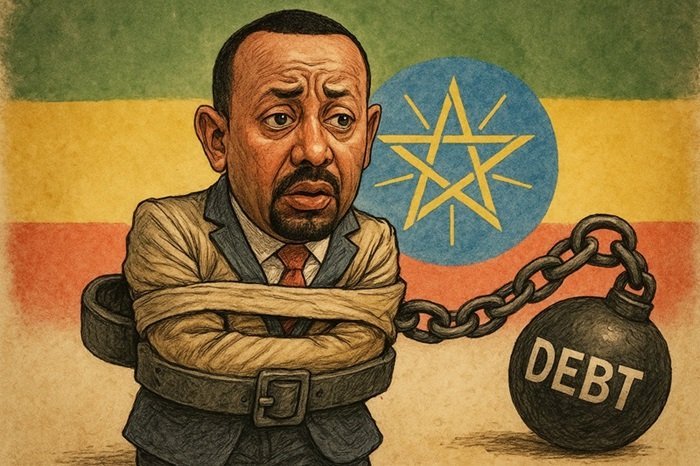
The mathematics of national failure are surprisingly precise. When Ethiopia missed its Eurobond payment in December 2023, it wasn’t just defaulting on debt, it was surrendering sovereignty. The recent Joint Bank-Fund Debt Sustainability Analysis reveals how economic distress has transformed into something far more profound: a diplomatic straitjacket that constrains every decision of Prime Minister Abiy Ahmed’s government, from military strategy to domestic policy, effectively rewriting the fundamental rules of Ethiopian statecraft.
Ethiopia’s descent from Africa’s fastest-growing economy to debt distress represents one of the most dramatic reversals of fortune in recent African history. The numbers paint an unforgiving portrait: $71 billion in total public debt, external debt service consuming 38% of government revenue, and foreign reserves of just $4 billion, barely enough to cover three months of essential imports. For a nation of 120 million people, these figures represent more than fiscal crisis; they signal the collapse of economic autonomy.
The country’s external debt service peaked at $5.3 billion in fiscal year 2025-26, creating what economists term a “debt trap” where servicing existing obligations prevents investment in growth-generating activities. This isn’t merely about numbers on a balance sheet. It means a government that struggles to import medicines and food, let alone fund infrastructure or military operations. The IMF’s assessment pulls no punches: protracted breaches of debt indicators, weak debt-carrying capacity, and complete loss of access to international capital markets.
The path out of this crisis demands what international creditors euphemistically call “structural adjustment” a suite of painful reforms that invariably squeeze ordinary citizens while satisfying external monitors. Exchange rate liberalization has already begun, sending the birr plummeting and inflation soaring. The government must eliminate fuel subsidies that millions depend on, reduce support for state-owned enterprises that employ hundreds of thousands, and implement market-based interest rates that make credit more expensive for businesses and consumers alike.
These measures come with a political price tag that extends far beyond economics. The IMF document explicitly warns of “reform fatigue due to political and social pressures,” a clinical term for the social unrest that typically accompanies austerity programs. For Abiy, this creates an impossible political equation: implement reforms to secure international support, but risk the popular backlash that could topple his government. The medicine required to cure Ethiopia’s debt crisis might prove politically fatal to its administration.
The dependency that has emerged is unprecedented in Ethiopia’s modern history. The country now relies on a complex web of international support totaling over $10 billion: $3.4 billion from the IMF, $3.8 billion in World Bank budget support, and $3.6 billion in debt relief from bilateral creditors under the G20 Common Framework. This level of external dependence effectively outsources crucial policy decisions to creditors in Washington, Paris, and Beijing. Ethiopia,
which once prided itself on never being colonized, now finds its policy space more constrained than many former colonies ever experienced.
This economic straightjacket fundamentally alters Ethiopia’s military calculus. The government currently faces active insurgencies in Amhara, where Fano militias control significant rural territories, and in Oromia, where the Oromo Liberation Army maintains its campaign against federal forces. These conflicts drain resources desperately needed for debt service and essential imports. The DSA explicitly identifies security challenges as a key risk to reform implementation, noting that deterioration in domestic security could “renew economic disruption and derail international support.”
The arithmetic becomes even more stark when considering potential external conflicts. Any major military adventure such as a war with Eritrea to reclaim the strategic port of Assab is rendered virtually impossible by economic constraints. Such a conflict would require massive resources that Ethiopia simply cannot marshal. More critically, it would immediately destroy any prospect of debt restructuring, scare away potential investors, and likely trigger new international sanctions. You cannot wage interstate wars with $4 billion in reserves and a debt service schedule that consumes more than a third of government revenue.
What emerges from this analysis is a new form of economic diplomacy where creditors effectively hold veto power over Ethiopia’s strategic decisions. The conditionality attached to IMF support extends far beyond traditional fiscal measures to encompass governance reforms, exchange rate policy, and implicit constraints on military spending. This represents a fundamental shift in Ethiopia’s strategic autonomy: the country’s policy space is now more severely circumscribed by debt obligations than it ever was by colonial administrators.
The G20 Common Framework process, while providing essential debt relief, institutionalizes this external oversight. Ethiopia must demonstrate continuous progress on reforms to maintain creditor support, creating a monitoring mechanism that extends well beyond traditional loan conditions. The country finds itself subject to quarterly reviews, annual assessments, and constant scrutiny of its domestic policies by international institutions.
For Abiy Ahmed personally, the debt crisis creates an existential political challenge. His Nobel Peace Prize was awarded partly for ending the conflict with Eritrea, but his domestic political survival now depends primarily on his ability to manage economic rather than military crises. The required reform program threatens to undermine the patronage networks that sustain his coalition, while the economic hardships could fuel the very regional tensions he sought to resolve through diplomacy.
The timeline for recovery is unforgiving. The IMF program expects Ethiopia to achieve a “moderate risk of debt distress” rating by 2028 just three years away. This requires sustained implementation of painful reforms while maintaining political stability and social cohesion, a balance that historical precedent suggests is extraordinarily difficult to achieve. The projected
recovery depends on everything from increased tax collection to export diversification, from reduced military spending to improved governance in state-owned enterprises.
Perhaps most critically, success requires a fundamental reorientation of Ethiopia’s political economy away from the centralized, state-driven model that has characterized the country for decades. This transformation, while economically necessary, carries enormous political risks for a government that built its legitimacy partly on delivering rapid economic growth through state-directed investment. The shift toward market mechanisms and reduced state intervention challenges the very foundations of Ethiopia’s development model.
The international community’s commitment adds another layer of uncertainty. The analysis notes significant reductions in development assistance, particularly from the United States, reflecting donor fatigue and changing global priorities. This reduction in external support comes precisely when Ethiopia needs it most, creating additional pressure on an already precarious situation. The country must implement reforms while managing reduced international assistance, a double burden that compounds the difficulty of the transition.
Ethiopia’s debt crisis has evolved from an economic challenge into a comprehensive diplomatic and political straitjacket that constrains government choices across every policy domain. The days of ambitious regional interventions, large-scale military campaigns, or grand infrastructure projects are effectively suspended until debt sustainability is restored. The country that once projected power across the Horn of Africa now finds itself unable to fund basic government operations without external permission and oversight.
For Abiy Ahmed, this represents perhaps the ultimate test of political leadership in the modern era. He must navigate between the demands of international creditors and domestic constituencies, between economic necessity and political survival, between reform imperatives and social stability. The success or failure of this balancing act will determine not only his political future but the trajectory of one of Africa’s most strategically important nations.
The debt sustainability analysis is more than a technical document; it’s a blueprint that will shape Ethiopia’s choices for the remainder of the decade. In a country where politics and economics have always been inseparable, the constraints of debt distress may prove to be the most powerful force shaping the nation’s future. The irony is profound: efforts to modernize Ethiopia’s economy have led to a level of external oversight and constraint that exceeds anything the country experienced during its imperial past. The price of economic development, it turns out, can be the very sovereignty that made independent development possible in the first place.
Editor’s Note : Views in the article do not necessarily reflect the views of borkena.com
__
Support Borkena : https://borkena.com/subscribe-borkena/
Join our Telegram Channel : t.me/borkena
Like borkena on Facebook
To submit Press Release, send submission to info@borkena.com
Add your business to Ethiopian Business Listing / Ethiopian Business Directory
Join the conversation. Follow us on X (Formerly Twitter) @zborkena to get the latest Ethiopian News updates regularly.
Ethiopia’s debt crisis borne out of primarily from previous Tigrayans’s dominated government of EPDRF, while Abey Ahmed Oromo’s dominated government can be blamed for mismanagement in allocations the lmited resources. In international nations economic relations Deb entrapment is part of process, that doesn’t equates with colonialism