
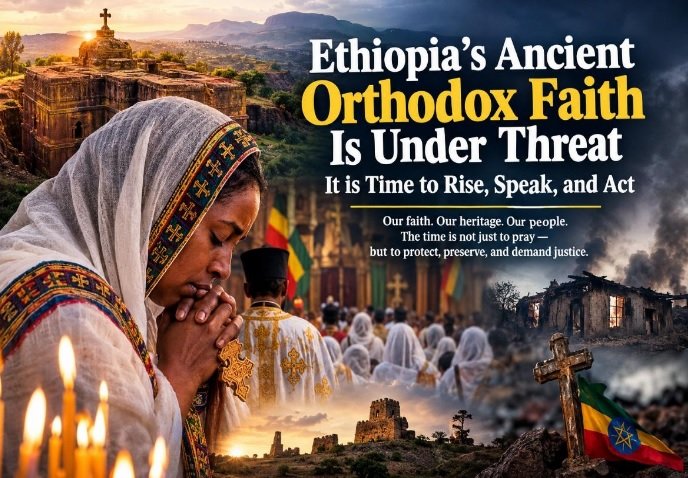
An urgent call to Ethiopian Orthodox Christians to defend their faith, protect their heritage, and demand accountability
By Caleb Ta (Dr.)
Independent Researcher in African Political Affairs; Human Rights Advocate
Introduction: We Cannot Pray While Remaining Silent
Ethiopia is not merely a country where Christianity exists. It is one of the ancient centers of Christian civilization, a land where the Ethiopian Orthodox Tewahedo Church has preserved its faith, traditions, sacred writings, liturgical music, monasteries, and spiritual identity for centuries. The Christian heritage of Ethiopia reaches back to the Kingdom of Aksum, where Christianity became established in the fourth century, long before Christianity became the dominant religion in much of northern Europe.
This heritage is a treasure that generations of Ethiopians have protected through hardship, political upheaval, war, and sacrifice. Yet today, a deeply troubling question confronts Ethiopian Orthodox Christians: What does it mean to inherit an ancient faith if we are unwilling or unable to defend the lives, dignity, institutions, and religious freedom of the people who sustain it?
Reports of repeated killings, abductions, displacement, and attacks affecting Orthodox Christian communities in parts of Oromia, particularly the Arsi Zone, have raised urgent concerns. On October 26, 2026, The Reporter reported that the Ethiopian Orthodox Tewahedo Church’s Holy Synod attributed 60 deaths to attacks across Shirka and Merti. Other reports placed the death toll from the latest Shirka attacks at more than 40, with accounts of burned homes, injured civilians, and families fleeing their communities. The precise figures and responsibility for the attacks require independent verification, but the scale of the reported tragedy cannot be dismissed.
These are not simply statistics. They represent parents, children, priests, farmers, elders, and ordinary people whose lives and futures have been taken or shattered.
I write this article because I believe Ethiopian Orthodox Christians must confront this moment with courage, wisdom, faith, and determination. We cannot allow repeated reports of violence to become so familiar that the deaths of our people no longer shock the national conscience. We cannot allow our churches to become places of mourning while the underlying threats remain unanswered. And we cannot assume that prayer alone will solve problems that also require responsible leadership, civic participation, legal action, public accountability, and practical protection.
My message is not a call to hate Muslims or Oromo people. Neither religion nor ethnicity makes an entire community responsible for the crimes of particular individuals or armed groups. My message is a call to defend our ancient faith, stand beside our suffering communities, demand equal protection, and refuse to surrender our rights through fear or silence.
Prayer is essential to our faith. But prayer must be accompanied by action.
Ethiopia’s Christian Heritage Is Older Than Many People Realize
Ethiopian Orthodox Christians must understand the historical significance of the faith they have inherited.
Christianity became established in the Kingdom of Aksum during the fourth century, associated with the reign of King Ezana. From that early period, Ethiopian Christianity developed its own distinctive spiritual, linguistic, artistic, and liturgical traditions. The Church preserved Ge’ez as a sacred language, maintained a rich manuscript tradition, developed a distinctive calendar and musical heritage, and built institutions that helped carry religious and cultural knowledge across generations.
The churches of Lalibela, the monasteries around Lake Tana, the ancient religious traditions of Tigray, and Orthodox communities throughout Ethiopia are not merely tourist attractions or historical monuments. They are living expressions of a civilization.
For countless families, the Church marks the most important moments of life. It welcomes children through baptism, blesses marriages, comforts the grieving, supports the poor, teaches moral responsibility, and gives communities a sense of continuity with their ancestors.
This history should inspire more than pride. It should inspire responsibility.
If our ancestors preserved their faith through difficult centuries, what responsibility do we have today? Are we teaching our children their history? Are we supporting our priests, monasteries, churches, and religious schools? Are we documenting attacks against our communities? Are we helping displaced families? Are we ensuring that young Orthodox Christians understand both their religious obligations and their civic rights?
An ancient faith does not preserve itself automatically. It survives because people learn it, practice it, teach it, organize around it, and pass it to future generations.
We must therefore defend Ethiopian Orthodox Christianity through knowledge, spiritual commitment, education, community solidarity, and the protection of religious freedom. We must not allow fear to erase the traditions that generations worked so hard to preserve.
Shirka and Arsi: The Human Cost of Repeated Violence
The recent attacks in Shirka Woreda have once again exposed the vulnerability of civilians in parts of Arsi.
Residents described attacks beginning on the evening of October 24 and continuing into October 25 in areas including Chole and Birbo. Residents reported at least 48 deaths and more than 31 injuries. The Ethiopian Orthodox Church’s Holy Synod separately reported 46 deaths in Shirka and 14 in Merti in its account of the attacks. Reports also described homes burned to the ground and civilians, including children, among those affected.
Earlier in October, residents and church representatives had reported additional killings and abductions in Shirka and neighboring areas. The Ethiopian Orthodox Church has raised concerns about recurring violence, displacement, and the destruction of property. In July 2026, the Ethiopian Human Rights Council reported that 458 people had been killed in attacks in Arsi Zone over the preceding four years, according to reporting by BBC Amharic and other outlets.
These figures come from different reports and periods and should not be combined without care. Each allegation requires appropriate verification. Nevertheless, the repeated reports demand a serious, sustained response.
Imagine a family that has lived peacefully in its village for generations. Its members work the land, raise their children, attend church, and contribute to their community. Then armed men arrive. People are killed, homes are destroyed, relatives disappear, and survivors flee without knowing whether they will ever return.
What becomes of the children who witness violence? What happens to elderly people who lose their caregivers? How does a farmer rebuild a life after losing family members, property, and the security of home? How can a priest serve a congregation when worshippers fear attending church?
These questions deserve more than political statements.
The victims deserve to be remembered by name where their identities can be responsibly confirmed. Their families deserve support. Survivors deserve medical and psychological care. Witnesses deserve protection. Displaced people deserve safe conditions in which they can return voluntarily and rebuild their lives.
And the public deserves a credible account of who committed these crimes, why they occurred, and whether warnings or opportunities to prevent them were ignored.
The government must not allow these tragedies to disappear into a cycle of condolences followed by another attack.
Who Is Responsible? Follow the Evidence and Demand the Truth
Reports from Arsi have raised concerns that some attacks may have been motivated by religious hostility, ethnic tensions, or a combination of factors. Some sources have alleged the involvement of armed groups; others have raised questions about the conduct or response of local security institutions.
These are grave allegations. They must be investigated independently, rather than accepted or rejected simply because they support a political position.
Where evidence establishes that individuals or armed organizations deliberately targeted Orthodox Christians because of their faith, those responsible must be held accountable. Where there is evidence of ethnic persecution, that must also be addressed. Where officials ignored credible warnings, obstructed investigations, or participated in crimes, their conduct must be examined through lawful and independent processes.
But we must be careful about the language we use.
It is not accurate or just to blame all Muslims for the actions of armed perpetrators. It is equally wrong to blame all Oromo people for crimes committed by particular individuals or groups. The Oromo population is diverse, including Muslims, Orthodox Christians, Protestants, and people of other beliefs. Many Oromo people reject violence and want their communities to live in peace.
The victims deserve justice, not a new cycle of collective accusation.
A strong Christian response should be morally serious and intellectually honest. We must demand evidence, preserve testimony, support independent journalism, document abuses, and reject misinformation—even when a false claim appears to support our own side.
The purpose of investigation is not to protect powerful people from embarrassment. It is to establish the truth and make accountability possible.
We should ask direct questions: Who planned the attacks? Who carried them out? What evidence identifies the perpetrators? Were authorities warned? What action did they take? Were victims denied protection? Have earlier crimes been investigated adequately? What measures are being implemented to prevent further violence?
These questions should be asked persistently, publicly, and peacefully until credible answers are provided.
Abiy Ahmed and his party the Oromo Prosperity Party Must Be Held Accountable for Public Safety
When Abiy Ahmed became prime minister in 2018, many Ethiopians hoped that political reform would bring reconciliation, freedom, and lasting peace. Those hopes were significant. Yet the years since have brought devastating conflict, displacement, and continuing insecurity in multiple parts of the country.
The government must be judged by the lived experience of its citizens, not merely by its speeches, promises, or political messaging.
The killings reported in Shirka raise serious questions about the government’s ability to protect vulnerable communities. The state cannot prevent every crime, but it has a fundamental responsibility to take reasonable measures to protect civilians, respond to credible warnings, investigate serious offenses, and hold perpetrators accountable.
If communities have repeatedly raised security concerns, what measures were taken? If attacks continued, were those measures effective? If officials failed to respond, why did that happen? If members of security institutions are accused of wrongdoing, will the investigation be independent enough to examine those allegations without political interference?
These questions are not acts of disloyalty. They are legitimate demands made by citizens whose lives depend on public institutions working properly.
The Prosperity Party and the administration led by Abiy Ahmed should explain what they are doing to protect Orthodox Christian communities facing reported threats. They should ensure that investigations are credible, that survivors receive assistance, and that officials are held accountable when evidence establishes wrongdoing.
They must also guarantee that religious freedom and equal protection apply throughout the country, regardless of regional politics or ethnic identity.
The government cannot expect citizens to trust institutions simply because those institutions demand trust. Trust must be earned through protection, transparency, fairness, and results.
If leaders fail to protect communities, citizens have the right to organize peacefully, demand answers, support independent monitoring, engage representatives, and use lawful democratic processes to seek change.
Our response must be stronger than anger. It must be organized, persistent, informed, and focused on protecting human life.
The Warning We Must Hear: A Faith That Does Not Teach Its Children Will Weaken
One of the most important lessons from discussions about religious heritage and cultural survival is that a community can lose its confidence in its own identity long before its institutions disappear.
This is not a claim that one religion is inherently hostile to another. It is a reminder that every community must take responsibility for educating its children, preserving its traditions, and teaching the next generation what its heritage means.
Ethiopian Orthodox Christians must not assume that their children will automatically understand their faith because they were baptized or grew up near a church. Children and young adults need meaningful religious education, access to history, opportunities to ask questions, and examples of adults who live the values they teach.
Our young people should understand the history of Aksum, the significance of the Ethiopian Orthodox liturgical tradition, the role of Ge’ez, the heritage of Ethiopian saints and monastic communities, and the Church’s contributions to art, literature, music, and community life.
The Church and its members should invest in educational programs, youth engagement, digital archives, historical scholarship, language preservation, and support for religious institutions in vulnerable communities.
We should help young people become teachers, researchers, lawyers, journalists, healthcare professionals, public servants, and community leaders who can advocate for their communities with knowledge and integrity.
A faith that is understood, practiced, and passed on with conviction is better equipped to endure difficult times than one that depends on nostalgia alone.
We must not only inherit our faith. We must understand it, live it, teach it, and protect the freedom to practice it.
Defending Our Faith Does Not Mean Attacking Our Neighbors
When a community experiences repeated violence, grief can turn into anger. Anger can become suspicion, and suspicion can expand into the belief that every member of another religious or ethnic group is an enemy.
We must resist that path.
Ethiopian Orthodox Christians have every right to speak openly about attacks against their communities, demand protection, defend their religious institutions, and challenge political leaders. They should not be told to remain silent merely because the subject is sensitive.
But our defense of the Church must not become an excuse to dehumanize Muslims or Oromo people collectively.
There are Muslims who oppose religious persecution. There are Oromo Christians who share the pain of their Orthodox neighbors. There are people from different backgrounds who have protected others during violence, supported displaced families, or spoken against injustice.
Their existence does not diminish the suffering of Orthodox Christians. Instead, it reminds us that justice depends on identifying perpetrators and protecting innocent people rather than assigning guilt by identity.
We must be equally clear that peaceful coexistence does not mean to tolerating violence. Respecting religious diversity does not require us to remain silent about religious persecution. Forgiveness does not mean abandoning the pursuit of justice. Reconciliation does not mean pretending that crimes never occurred.
We can firmly condemn attacks against Orthodox Christians while protecting the rights of Muslims. We can criticize the government without blaming an entire ethnic group. We can preserve our heritage without claiming that others have no right to belong in Ethiopia.
The goal is not to replace one form of exclusion with another. It is to establish a country where no religious or ethnic community can be targeted with impunity.
Prayer Is Essential, but Prayer Alone Is Not a Complete Response
Prayer is at the heart of Ethiopian Orthodox Christian life. We pray for the living and the departed. We pray for peace, healing, wisdom, strength, and the protection of those who suffer. In times of tragedy, prayer connects the faithful and offers comfort that words alone cannot provide.
But we must ask ourselves a difficult question: What does our prayer require us to do when our neighbors are being killed, families are displaced, and communities repeatedly ask for protection?
Prayer should move us toward responsibility.
If we pray for the hungry, we should help feed them. If we pray for the displaced, we should support their shelter and recovery. If we pray for those who are grieving, we should stand beside them. If we pray for justice, we should help document wrongdoing and demand credible investigations. If we pray for peace, we should work to prevent violence and support institutions that protect everyone.
The Church can be a powerful source of organized compassion and civic responsibility. Parishes can coordinate assistance for affected families, maintain reliable records of reported incidents, support vulnerable members, and cooperate with credible human rights organizations. Church leaders can advocate for security and accountability while working with other religious leaders to prevent retaliation.
Orthodox Christians can also participate in public life as citizens. They can learn about candidates and public policies, engage local and national representatives, attend lawful public meetings, support responsible journalism, and advocate for the equal application of the law.
Prayer and action are not enemies. Action can be an expression of faith.
We must pray with our hearts, think with our minds, organize with wisdom, and act with courage.
Stand Up Through Knowledge, Organization, and Peaceful Civic Action
What does it mean to defend an ancient faith in the twenty-first century?
It means more than posting angry messages online. It means building the capacity to protect people, preserve history, and influence the decisions that shape public safety.
First, Ethiopian Orthodox Christians should strengthen religious education. Churches, families, schools, and community organizations should help younger generations understand their faith and heritage.
Second, we should document attacks responsibly. Dates, locations, verified names of victims, eyewitness accounts, photographs where safe and lawful, and records of damage can help independent investigators establish what happened. Information must be handled carefully to protect survivors and avoid exposing witnesses to danger.
Third, we should organize humanitarian support. Families affected by killings and displacement may need food, shelter, medical treatment, transportation, education assistance, and help rebuilding their homes and livelihoods.
Fourth, we should advocate collectively. Church representatives, lawyers, scholars, human rights advocates, journalists, and community members can press authorities for transparent investigations, improved security, and meaningful support for survivors.
Fifth, we should participate in civic life. Citizens must understand how public institutions function, who is responsible for local security, how to submit formal complaints, and how to hold elected officials accountable through lawful political processes.
Sixth, we should build alliances across religious and ethnic communities. A united demand for the protection of civilians is harder to dismiss than an isolated plea. Peaceful Muslim, Orthodox, Protestant, and other community leaders can work together to condemn attacks, protect vulnerable neighbors, and reject collective punishment.
Seventh, we must reject violence and vigilantism. Defending a church or community does not mean taking revenge against innocent people. It means pursuing lawful protection, responsible security, credible investigations, and accountability for proven crimes.
Our strength should be measured by how effectively we protect life and preserve our heritage—not by how much hostility we can generate.
The Church Must Help Lead a National Call for Justice
The Ethiopian Orthodox Tewahedo Church has deep moral authority among its followers and a long history of serving communities across the country. At a time when many Orthodox Christians are fearful, the Church’s leadership is particularly important.
Church leaders should continue to speak clearly about reported attacks and insist that government authorities meet their responsibilities. They should ask for independent investigations, meaningful protection for affected communities, and transparent follow-up on previous complaints.
The Church can also strengthen its support for displaced people, help preserve reliable records of incidents, work with legal experts, and create channels through which survivors can safely share their experiences.
Its advocacy should be firm, consistent, and rooted in the dignity of every human being.
The Church should not have to choose between peace and justice. A genuine commitment to peace requires accountability for violence. A genuine commitment to justice requires resisting revenge and protecting the innocent.
The faithful, in turn, must support their institutions through practical service, education, responsible advocacy, and solidarity with those who are suffering.
We should not expect priests alone to solve a national security crisis. Nor should we assume that political leaders will act effectively without sustained public attention. Religious institutions, civil society, and citizens all have roles to play, each within their responsibilities and abilities.
The purpose of this effort is not to turn the Church into a political weapon. It is to ensure that the rights and safety of its members are taken seriously and that the Church can continue its religious mission without fear.
The International Community Must Not Ignore the Suffering
The plight of Ethiopian Orthodox Christians deserves international attention when credible reports describe repeated killings, displacement, destruction of religious property, or attacks apparently motivated by religious identity.
International human rights organizations, religious freedom advocates, journalists, diplomatic institutions, and relevant international bodies should continue to monitor the situation and press for credible investigations.
Their efforts should include encouraging access for independent investigators, supporting reliable documentation, calling for protection of witnesses, and urging authorities to provide assistance to affected communities.
The international community should also be consistent. No victim should receive less attention because their religion, ethnicity, or location makes their suffering politically inconvenient.
At the same time, credible advocacy requires careful reporting. Casualty figures should be verified where possible, allegations should be identified as allegations, and the identities of perpetrators should not be declared as established facts without sufficient evidence.
This discipline does not weaken the case for justice. It strengthens it.
The suffering of Ethiopian Orthodox Christians should not need to be exaggerated to be taken seriously. The reported killings, injuries, displacement, and fears of affected communities are serious enough to demand attention on their own.
The world should listen to survivors, support independent investigations, and encourage the Ethiopian government to protect all civilians and uphold religious freedom.
The Future of Ethiopian Christianity Depends on What We Do Today
The future of the Ethiopian Orthodox Tewahedo Church will be shaped not only by the challenges it faces but also by the choices its members make.
Will we teach our children their heritage? Will we support the institutions that preserve our faith? Will we stand beside families who have lost loved ones? Will we document abuses carefully? Will we demand accountability when authorities fail? Will we participate in civic life? Will we refuse to let fear divide us from peaceful neighbors?
These questions are urgent because a religious tradition cannot be sustained by memory alone.
We need a generation that knows its history, practices its faith, understands its rights, serves its neighbors, and speaks courageously when injustice occurs. We need religious leaders who are willing to advocate for the vulnerable, professionals who can provide legal and humanitarian support, journalists who investigate responsibly, and citizens who remain engaged long after public attention fades.
We also need to protect the moral character of our own response. We cannot defend the dignity of Orthodox Christians by denying the dignity of others. We cannot build a peaceful future through collective blame. And we cannot demand accountability while rejecting evidence when it challenges our assumptions.
The challenge is to combine conviction with wisdom, courage with discipline, and faith with practical action.
That is how an ancient community can protect its future without abandoning its principles.
Conclusion: Stand for the Faith, Protect the People, and Refuse to Remain Silent
Ethiopia’s Orthodox Christian heritage is a gift preserved by generations of believers. The reported killings in Shirka and the wider insecurity affecting parts of Arsi are a painful reminder that this heritage exists alongside living communities whose safety cannot be taken for granted.
Under Prime Minister Abiy Ahmed and the Prosperity Party, the government must answer legitimate questions about public safety, the protection of religious freedom, the handling of earlier warnings, and the investigation of serious crimes. Where failures have occurred, they must be acknowledged and corrected. Where perpetrators are identified through credible evidence, they must be held accountable under the law.
The Ethiopian Orthodox Church must continue to speak for its faithful and support those who suffer. Civil society and the international community must continue to document credible reports and call for meaningful action. And Orthodox Christians themselves must strengthen their communities through education, solidarity, peaceful civic participation, and the preservation of their religious heritage.
We must not confuse silence with peace, fear with wisdom, or prayer with a complete substitute for action.
I call on Ethiopian Orthodox Christians throughout the country and in the diaspora to stand together not in hatred, not in revenge, and not against innocent people, but for the protection of our faith, the dignity of our communities, and the equal rights of all Ethiopians.
Teach our children who we are. Preserve our history. Support our churches. Help displaced families. Document the truth. Demand independent investigations. Hold political leaders accountable. Participate in public life. Work with peaceful neighbors. Reject collective blame. Protect the vulnerable.
Above all, do not abandon those who are suffering simply because their tragedy is far away or because the headlines have moved on.
Our ancestors preserved this faith through generations of sacrifice. Our responsibility is to ensure that the next generation inherits not only its churches, manuscripts, prayers, and traditions, but also the courage and wisdom to protect the freedom to practice them.
Prayer without responsibility is incomplete. Faith without knowledge is vulnerable. Heritage without preservation can be lost. And a demand for justice without action will remain only a demand.
Let us pray but let us also serve. Let us mourn but let us also organize. Let us forgive where we can but let us never confuse forgiveness with impunity. Let us defend our faith but never abandon our humanity.
Stand for the Ethiopian Orthodox Tewahedo Church. Stand for the people who are suffering. Stand for religious freedom. Stand for justice. And stand peacefully, courageously, and persistently until every Ethiopian can live and worship without fear.
The time to act is not tomorrow. It is now.
Editor’s Note: Views in the article do not necessarily reflect the views of borkena.com
__
Join our Telegram Channel: t.me/borkena
Like borkena on Facebook
To submit a press release, send the submission to info@borkena.com
Add your business to Ethiopian Business Listing / Ethiopian Business Directory
Join the conversation. Follow us on X (formerly Twitter) @zborkena to get the latest Ethiopian news updates regularly.