
Tesfaye Biftu
Ethiopia, the cradle of humanity, is one of the oldest civilizations in the world and one of the most diverse nations in Africa. With more than eighty ethnic groups, multiple languages, and a rich mosaic of cultures, Ethiopia resembles a living human body—made up of many parts, each with a distinct function, yet all dependent on one another for survival. This analogy offers not only a moral insight but also a political and social framework for understanding national unity.
In the human body, the brain coordinates thought and decision-making, but it cannot function without the nerves that transmit signals. The eyes and ears gather information, but without the brain they are meaningless. The heart pumps blood, but without the lungs it cannot oxygenate it. The legs and hands provide movement and labor, but without nourishment from the digestive system they weaken. No organ can claim superiority without endangering the whole body.
This biological truth mirrors Ethiopia’s national reality. Farmers in Oromiyaa, Amhara, and the Southern regions feed urban centers such as Addis Ababa and Dire Dawa. Pastoralist communities in Afar and Somali regions sustain livestock trade and border commerce. Artisans in Harar and Gondar preserve ancient crafts. Scholars and clergy from various regions shape moral and intellectual life. Each group contributes a vital function to the national organism.
Ethiopian wisdom reflects this interdependence. One Amharic proverb says, “Yeand lij yemiyasdegut ayhonim” (One child alone cannot be raised), reminding us that community is essential for survival. Another Oromo saying teaches, “Tokkummaan humna” (Unity is strength). These proverbs are not merely poetic—they are practical instructions for nation-building.
Historically, Ethiopia’s endurance has depended on cooperation across ethnic and regional lines. The victory of Adwa in 1896 was not achieved by one group alone; it was a collective effort of diverse communities resisting colonialism. Trade networks connecting the highlands and lowlands sustained empires and local economies alike. Even cultural expressions such as language, music, food, and clothing reveal centuries of exchange and mutual influence.
From an academic perspective, modern states function best when social capital—trust, cooperation, and shared norms—is strong. Political exclusion, economic marginalization, and cultural disrespect weaken that capital. When one region is impoverished, national productivity declines. When one group is silenced, democratic legitimacy erodes. When one community is stigmatized, social cohesion fractures.
Politically, true federalism or national unity cannot succeed if it is built on zero-sum thinking. Governance must be inclusive, resources distributed equitably, and institutions designed to protect minority rights. Power-sharing is not charity; it is a strategic necessity for stability. A nation that privileges one identity over others behaves like a body that starves one organ to feed another—eventually, the whole system collapses. On the other hand, citizens must take responsibility for their actions and works towards solving problems peacefully without hurting each other.
This understanding demands a shift in mindset. Instead of asking, “How can my ethnic group gain more power?” Ethiopians must ask, “How can we design systems that allow all groups to flourish?” Instead of glorifying difference as a tool of division, we must honor diversity as a shared asset.
In practical terms, this means investing in interregional infrastructure, ensuring equal access to education and healthcare, promoting multilingual public services, and teaching a national curriculum that respects all histories. It means encouraging dialogue over violence, compromise over domination, and cooperation over competition.
Inspirationally, Ethiopia’s future does not lie in fragmentation but in a renewed social contract. Just as the body heals when all parts work together, Ethiopia will heal when its people choose empathy over hatred and unity over suspicion. Our diversity is not our curse—it is our greatest strength, if guided by wisdom and justice.
In conclusion, Ethiopia is not a collection of isolated ethnic units. It is a living body. Every group is an organ. When one suffers, all suffer. When one thrives, all benefit. Only by honoring our mutual dependence can we build a peaceful, prosperous, and dignified future for all Ethiopians.
Pertinent References
1. Putnam, R. D. (2000). Bowling Alone: The Collapse and Revival of American Community. New York: Simon & Schuster.
2. Horowitz, D. L. (1985). Ethnic Groups in Conflict. Berkeley: University of California Press. 3. Markakis, J. (2011). Ethiopia: The Last Two Frontiers. Oxford: James Currey.
4. Bahru Zewde (2001). A History of Modern Ethiopia, 1855–1991. Addis Ababa: Addis Ababa University Press. 5. Pankhurst, R. (1997). The Ethiopian Borderlands. Lawrenceville: Red Sea Press.
6. Central Statistical Agency of Ethiopia (CSA). (2022). Population and Housing Census Reports. 7. Clapham, C. (2002). Ethiopia. In African Guerrillas. Bloomington: Indiana University Press.
Acknowledgment:
I am inspired by my son’s recent book, Relationships, to write this short article
Relationships: The Meaning Of It All : Biftu, Beniam: Amazon.com.au: Books
Tesfaye Biftu, (PhD) is Adjunct Professor, Bahirdar University, and Former Distinguished Professor Adama University. He currently resides In the United States of America.
Editor’s Note : Views in the article do not necessarily reflect the views of borkena.com
__
Support Borkena : https://borkena.com/subscribe-borkena/
Join our Telegram Channel : t.me/borkena
Like borkena on Facebook
Add your business to Ethiopian Business Listing / Ethiopian Business Directory Business Listing Toronto
Join the conversation. Follow us on X (Formerly Twitter) @zborkena to get the latest Ethiopian News updates regularly. Subscribe to YouTube channel To share information or for submission, send e-mail to info@borkena.com
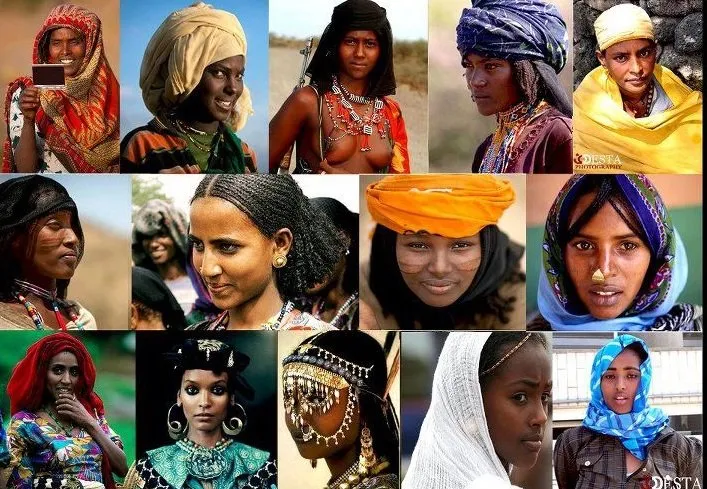
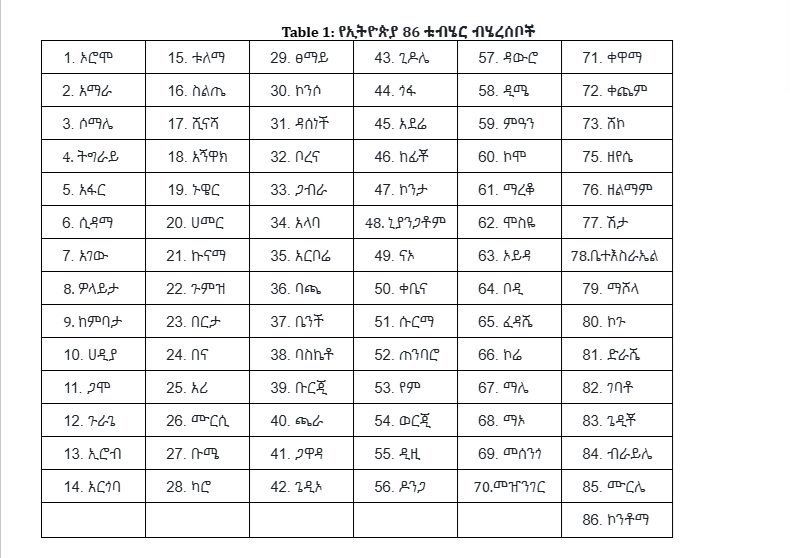
First of all, that picture is such a ridiculous collage. A random assortment of all women, as if men weren’t the ones to build the country. Second, there is always mention of having over 80 ethnic groups but most Ethiopians cannot name 15 groups. The entire country is fixated on the same 5 groups over and over again. More so than that, what’s the point of having diversity if everyone wears the same clothes and have the same names?
Your parents named you Tesfaye and then you named your son Beniam. Both are Israeli names, but you claim to have pride in our country Ethiopia. We are dealing with extreme levels of ignorance from our people, including from those who supposedly are educated.
The IDEA (divide and rule (inject-tribalism)) came from the ‘West’, based on GREED (to get cheaper /FEE-resources ) when people are preoccupied with constant turf-war (tribal-wars) it is easy to get what is under there feet pretty much for free. The Wealth in Congo exploited by dividing and arming each group, as we speak, even after decades since their independence. Trump came in in late 2025 and got US corporation unrestricted-access to Congo’s resources ( one of his ~20 + “PEACE DEALS”, & Norway did not send him his ( ‘well deserved’ ) NPP)
TPLF (MI6/CIA creation, all the FOUNDERS from British run G.W school) ) was assigned that TASK and implemented it in Ethiopia.
WE knew we have diverse cultures for thousands of years,and lived as one people peacefully till 1990s, the fools of today still think it is a NEW-finding and go nuts with it with no concern that their own brother and sister are being TREATED as ‘an-out-sider’ in their own country.
The People going around deciding others:
——————————————————-
In the ‘melting pot’ USA, no mater your tribal-background & where you came from, you are ‘American’ one language ‘one people’ ( until you see, Trump’s post of the Obama’s ‘picture’, and removal of all none white military leaders…Pages on Colin Powell, the first African American chairman of the Joint Chiefs of Staff, were deleted. link = wikipedia.org/wiki/U.S._Department_of_Defense_censorship_of_DEI-connected_material). Before Trump’s 2025, ‘Covid-19 lock-down’ exposed the truth, minorities that work outside (that were not under lock-down) suffered more death…
In Britain, consisting of the countries England, Scotland, and Wales, which includes their offshore islands, This territory, together with Northern Ireland, is considered one country, one people, with one language.
They ‘Divide’ others, but will fight (Norther Ireland) to keep theirs united & one. Asians knew this, but Africans, Ethiopia is their newest project after trying for decades to separate Eritrea, which their poodle TPLF gave-them Eritrea and more.
Fool’s errand.
Be well.