
Ethiopian Floriculture Industry
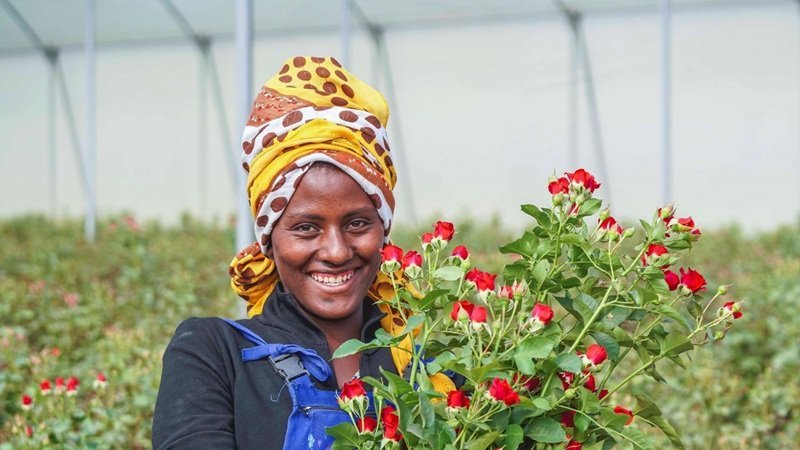
By Mekonnen Solomon
Following President Donald Trump’s new tariff decision, the U.S. customs agents now began collecting tariffs on all imported goods from many countries, with a 10% base line tariff to higher levies on goods from 57 larger trading partners. One of the sectors that would be affected by the USA’s new import tariff regime is the floriculture industry.
The floriculture industry of the United State of America is heavily relying on imports to meet domestic demand, especially for popular blooms like roses, summer flowers and orchids. The daily demand for flowers is very huge which is estimated to be 10 million stems. The country’s domestic flower production satisfies only 20% of local needs and the rest 80% are used to be filled by import . Since the country is unable to meet this supply space, different countries are looking for this potential market to fill this gap.
Ethiopia is one of the African countries which has strived to maximize its gain from the USA flower market for a long time. The most recent statistical information of Ethiopian Custom Commissions and various related reports reveals that out of the top ten flower market destinations of Ethiopia, USA placed in 6th order or rank. For the last 4 consecutive Ethiopian fiscal years, between 2020 to 2024, the volume of flower exported to the USA market grew with an average rate of 25%. The total volume of flower supply to the USA in this fiscal year was about 7,977.00 tons, with total turnover amounting about 45 million USD. This volume seems very large when we compare the actual quantities of flowers supplied to Japan , Italy, Germany, Spain, Canada and neighbouring African countries. Ross, Summer flower, rooted and unrooted cuttings are among the most important types of flower supplied to this market. Farms which supply their flower products are 7 in number and are all foreign owned.
Despite its importance, Ethiopia has not yet made a profound advance to make best use of the United States Flower market for various reasons. The flower exports to the U.S. have started since the beginning of 2005’S, but the country’s market share remains small, standing at less than 3 percent. The number of Ethiopian flower farms who has a strong market linkage to USA market did not exceeds more than 11% In comparison, Latin American country had been more advantageous than Ethiopia to exploit the USA Flower market for various reasons. One reason is Latin American countries’ comparative advantage particularly Colombia and Ecuador, who are the world largest flower producers. Geographical location makes them ideal for exporting large volumes of flowers with relatively cheap freight cost to the US, with quick and cost-effective transportation, ensuring fresh flowers reach the US market quickly. The second reasons are the US has free trade agreements with Colombia and Ecuador, which have facilitated the growth of the flower industry, allowing for duty-free exports and increased competitiveness. The other reason is Colombia and Ecuador decades of experience in the flower industry have led to well-established supply chains and logistics, ensuring a reliable flow of flowers to the US market. Due to these reasons the leading flower producers have substantial comparative advantage than Ethiopian to exploit and reach out the USA large consumer markets,
Like other countries, Ethiopian floriculture is one of the industries that has been cuffed by the Trump administration tariff with 10% of import rate. However, since Ethiopian flower producers have a feeble presence in the US market, being the USA was not their primary market, a tariff threat might not significantly impact its exports and the US floral market. The competitiveness of Ethiopian growers will remain strong as it has been on the global trade arena. Flower farms who have an already established market in the USA have already laid a diversified parallel niche market in Gulf State, Spain, Japan, Canada which would definitely enable them to withstand USA tariff temporary shocks.
On the contrary, the major flower producing and exporting countries are significantly affected even with a base line tariff rate or 10% rate. Colombia, Ecuador are the case in point. What makes Colombia and Ecuador unique from Ethiopia is that their market share in the USA flower business is very big. Colombia supplies about 65% of flowers to the U.S. particularly roses and summer flowers, which are in high demand year-round, especially around public holidays. Similarly Ecuadorian flowers, especially roses, which are essential to the U.S. floral industry, and has a market share not less than 25%. Thus, since the Trump administration-imposed 10% tariffs on these countries it will strain business relations and raise the cost of imports. This would likely impact USA wholesalers and retailers who rely on Ecuadorian and Colombian flowers to meet consumer demands at competitive prices.
Many critics argue that this tariff significantly affects Ecuadorian and Colombian flower producers as the countries have a large market share in the USA flower market channel. This tariff increased the cost of imported flowers goods and eventually passed on to consumers in the form of higher prices. Higher prices can lead to a decrease in demand for flowers as consumers may shift to close substitutes of luxury goods at cheaper alternatives and reduce their spending to buy flowers. This in turn would discourage Ecuadorian and Colombian flower producers to create, supply vacuum and urge US wholesalers and florists to source more flowers domestically, consequently domestic flower growers will develop an appetite to expand and enhance local production. While increased demand may benefit U.S. growers, many will eventually face challenges scaling production quickly. Domestic flower farming is labour-intensive and relies heavily on seasonal workers, often immigrant labour—a sector likely affected by the then immigration policies. Labour shortages could limit the industry’s ability to meet increased demand, potentially leading to supply shortages or higher prices. On other hand, expanding domestic flower production would require significant investment in greenhouses, transportation, and cold storage facilities. For medium and small farms, these costs may not be affordable, especially if labour shortages persist. Additionally, extreme weather patterns in the U.S. can impact varieties availability, further complicating efforts to meet year-round demand without imports. Domestic growers may focus more on seasonal and regionally adapted flowers that thrive in specific climates, promoting a local-first approach to floral arrangements. While this could limit variety, it may appeal to environmentally conscious consumers who value sustainability.
This complex chain of response may reinforce itself through backward and forward loop with no tendency toward equilibrium in short run and each iteration of response reinforce the previous one and the cycle continue in the direction of moments until the market diversification sought This incident serves as a reminder of how interconnected flower trade , local business, immigration policies can create uncertainty. While American flower growers may experience short-term benefits, the long-term implications for sustainable trade and international relations are far-reaching.
The future impact of US Tariff on Ethiopian Flower export business, however, remains to be seen. This is due to its business relation to the Netherlands. Ethiopia flowers rely on the Netherlands market which account for more than 67% share. It is evident that the new import tariff imposes 20% to the Netherlands, Netherlands are noted for re-exporting flowers that were not necessarily produced in the country. The country is a major player in the global flower industry, known for its extensive flower trade, with rose and summer flowers being re-exported. The Netherlands is among the strong flower business allies of Ethiopia not only for its own home consumption but also for its effort to re-export Ethiopian flowers to the rest of the world like the USA. Hence, imposing a 20% tariff on the Netherlands may have a profound impact and significant implication on the opportunity of Ethiopian flower growers to maintain a sustainable supply of flowers to the Netherlands.
However, Ethiopia has a robust and competitive flower industry that would be able to diversify and explore new markets. The industry is rewarding and technologically competent, it has a very well developed Cargo logistics to reach out to Gulf state and European markets and it offers high-quality flowers at competitive prices. If the floriculture sub sector demonstrates these strengths and fine-tune to the U.S. market, there is a good chance to make use of market niche for its roses summer flower and ornamental cuttings
Yet as one prominent critique explains, the floral industry, which is a symbol of beauty and celebration, has now found itself at the centre of a complex geo-business debate—one with consequences that extend well beyond Valentine’s Day bouquets.
Mekonnen Solomon works for the Ethiopian government as Horticulture Export Coordinator He can be reached at : ehdaplan@gmail.com
Editor’s Note : Views in the article do not necessarily reflect the views of borkena.com
__
Subscribe : https://borkena.com/subscribe-borkena/
Join our Telegram Channel : t.me/borkena
Like borkena on Facebook
Add your business to Ethiopian Business Listing / Ethiopian Business Directory Business Listing Toronto
Join the conversation. Follow us on X (Formerly Twitter) @zborkena to get the latest Ethiopian News updates regularly. Subscribe to YouTube channel To share information or for submission, send e-mail to info@borkena.com