
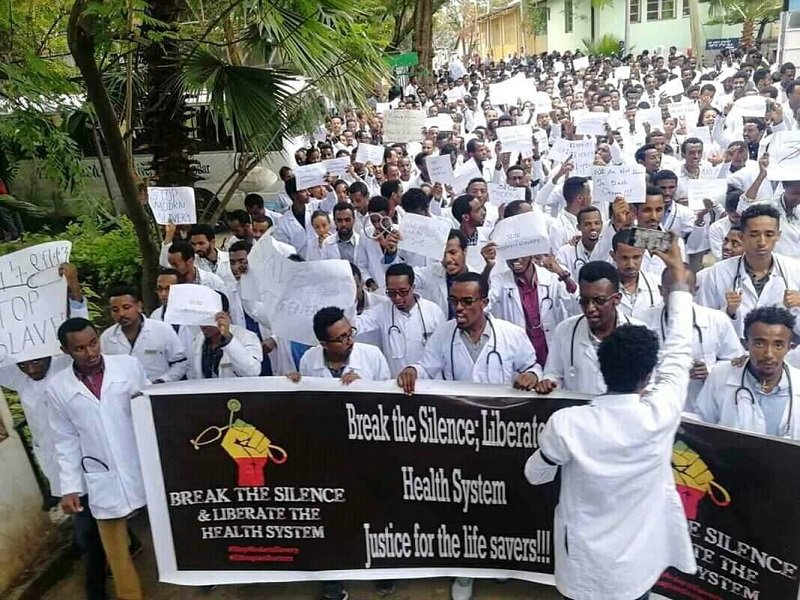
By – Habte H.
The ongoing strike by Ethiopian health workers is not just a cry for justice, it has exposed deep cracks in the foundations of the ruling PP regime. Despite some irregularities, mainly due to the immense pressure and lack of job security by some health workers, the strike has continued and is even spreading faster, reaching more and more health facilities. The demands by health workers are not extreme; they are fair, reasonable, and rooted in survival. Yet, the regime refuses to respond.
In most democratic countries – even in neighboring Kenya – such a strike would have happened long ago. The fact that Ethiopian health workers, despite enduring decades of neglect, chose peaceful means and delayed action this long is a testament to their patience and professionalism. But the PP, intoxicated by control and arrogance, believed it could ignore the rumblings beneath the surface.
Now, things are no longer business as usual. The strike has entered a serious phase. Hospitals are overwhelmed. Clinics are paralyzed. Communities are in despair. Still, the government has not shown a single sign of empathy or commitment to improve the lives of these essential workers. Instead, threats, arrests, and propaganda campaigns have been deployed to suppress the movement. But why does the PP fear the current strike more than any other protest? Why is it so hesitant to make concessions?
Here is why responding to the health workers’ demands feels like regime suicide for the PP:
1. Fear of Precedent: The PP believes that responding to the current demands of health workers’ strike will open the Pandora box or the floodgates. Teachers, other civil servants, and marginalized sectors may soon follow. The regime fears this could set a dangerous precedent in Ethiopia, where mass labor actions are rare. For a party that thrives on control and silence, such a shift would threaten its authoritarian grip.
2. War Before Welfare; The regime is still knee-deep in military conflict across multiple regions. Any shift in budget toward civil service reform means less money for bullets, surveillance, and suppression. In PP’s warped priorities, funding war comes before funding hospitals. Supporting health workers is, in their view, disarming their war machine.
3. Absence of Humanity: The PP has demonstrated, time and again, its complete lack of empathy. This is a regime that stays mute while civilians are killed, displaced, and starved. Its leadership has never publicly mourned the death of innocents or stood by victims of violence. Responding to health workers’ suffering would require a basic sense of humanity – something fundamentally missing in its leadership.
4. Hostility to Knowledge: No modern Ethiopian administration has shown as much disdain for intellectuals and educated professionals as the PP. Many of its top officials flaunt fake degrees and actively promote the idea that leadership does not require education. Health professionals, being among the most educated segments of society, are viewed not as assets but as threats to the regime’s anti-intellectual ethos.
5. Rigid Authoritarianism: Submission to public demand is interpreted as weakness by the PP. This is a government that never negotiates – it dictates. Responding to health workers would symbolize a loss of control, something the regime finds more threatening than a collapsing health system.
6. Obsession with Force: The PP still believes that problems can be crushed, not solved. It views the current strike as a test of strength. Instead of engaging in dialogue, it doubles down on repression, betting that fear will outlast resistance. But this calculation is beginning to fail.
7. Civil Servants Seen as Dispensable: The regime does not view civil servants as part of its core support base. That is why we have seen mass dismissals, home demolitions, and sudden policy shifts that devastate urban workers. In the eyes of the PP, those who serve the public are ruminants of the neftegna regime and lovers of the old era. So, they are expendable unless they serve the party’s propaganda.
8. A Leadership Out of Its Depth: Above all, the crisis reflects the regime’s lack of skill, wisdom, and moral compass to lead a country as complex and ancient as Ethiopia. The current leadership is not just incompetent – it is spiritually and ethically bankrupt. They are like the Pharaohs of old, blinded by ego and power, defying justice until the tide of history swallows them.
The health workers’ strike is more than a labor dispute. It is a turning point – a confrontation between decency and decay, between those who save lives and those who endanger them. The PP sees the act of responding to fair demands not as an act of governance, but as an existential threat. Because once it yields, it risks unravelling the entire illusion of control.
And yet, the writing is on the wall. A government that refuses to listen to its healers is one already infected by terminal rot. Responding is ruin – not because the demands are wrong, but because the regime is too brittle, too unjust, and too afraid to survive justice.
Editor’s Note : The article appeared first on the personal SM page of Kebour Ghenna
__
Subscribe : https://borkena.com/subscribe-borkena/
Join our Telegram Channel : t.me/borkena
Like borkena on Facebook
Add your business to Ethiopian Business Listing / Ethiopian Business Directory Business Listing Toronto
Join the conversation. Follow us on X (Formerly Twitter) @zborkena to get the latest Ethiopian News updates regularly. Subscribe to YouTube channel To share information or for submission, send e-mail to info@borkena.com
Ironic ‘One-Month Ultimatum’: Wage-Benefit Issue [WBI] is age-old. Health Ministry’s budget has already gone where allotted. Fiscal Year is also ending. So, how can Meqdes solve it in just a month? Is this strike really about WBI or is it another Proxy War Front?
Comprehensive Collective Permanent Solutions: A multi-prong approach and collective effort that addresses salary, housing, meals, transport, insurance, etc. It takes Team Work: workers, government, municipalities, housing agencies, transport enterprises, banks, etc.
Blessing-in-Disguise [ሳይደግሥ አይጣላም]: Ironically, the strike presents the opportunity to cleanup the health care system from “The Enemy Within” in health care uniforms fueling the strike to weaken-and-paralyze Ethiopia with “Health Care Workers’ Strike” crap.
Horrific Strike Timing or Proxy War Front (!?): GERD is almost done. Egypt’s domestic proxies have escalated their “Weaken-and-Paralyze Ethiopia” task. Egypt’s neighboring proxies are also ready to invade when Ethiopia is weakened-and-paralyzed from within.