
By Mekuria
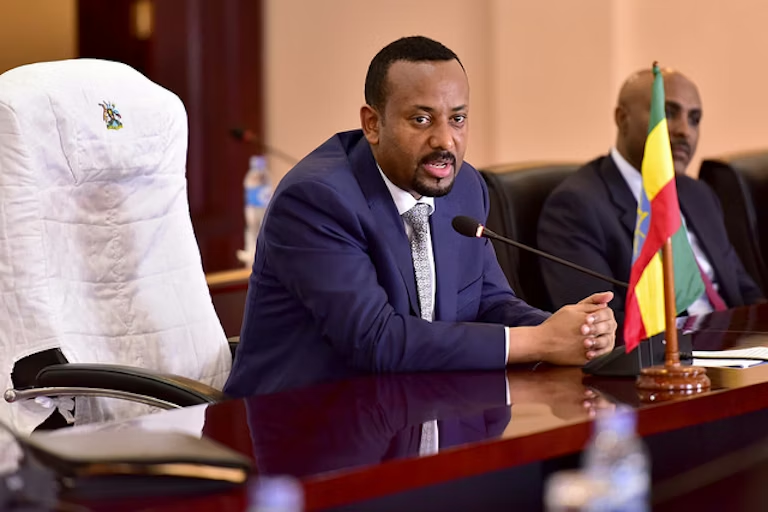
How does an oppressive government maintain power, and why does it persist even when its governance causes profound suffering? In examining the case of Prime Minister Abiy Ahmed, it becomes clear that he does not fit the conventional profile of a dictator driven by ideology or a coherent political doctrine. His governing style reflects a deeper detachment from the moral responsibilities that normally guide leaders. The death of innocent civilians, the collapse of the economy, the disruption of livelihoods, and the emergence of famine appear to have little influence on his political decisions. Even when citizens face severe hunger, his response often minimizes the crisis or dismisses the urgency of people’s suffering.
This raises an important question: How did Abiy Ahmed accumulate and retain such power for years despite widespread discontent and administrative failure? The answer lies in three mutually reinforcing pillars: the military and security apparatus, the bureaucracy, and public disillusionment.
1. The Military and Security Apparatus
The military—ranging from basic rifle units to specialized forces equipped with mortars, ZU-23 anti-aircraft guns, snipers, tanks, aircraft, and drones—forms the backbone of the government’s power. This apparatus functions not merely as an armed body but as an organized institution whose members are paid, equipped, and disciplined through state-controlled resources. Loyalty within this system is sustained through salaries, command hierarchy, and access to resources controlled exclusively by the state.
2. The Bureaucracy
A second pillar of support is the civilian bureaucracy. Despite widespread administrative failures, Ethiopia’s bureaucratic structure continues to function well enough to sustain the government’s basic operations. This administrative continuity—covering tax collection, licensing, land management, and public service delivery—helps project an image of normal governance. The bureaucracy persists partly because its employees rely on the state for their livelihoods and partly because bureaucratic institutions naturally resist rapid change. It is also through the bureaucracy that resources are gathered, foreign trade is conducted, and revenue is generated—providing the essential funding that sustains the military and security apparatus.
3. Public Disillusionment and Fragmentation
The third pillar is public disillusionment. Years of political instability, economic hardship, and competing narratives have fragmented society and weakened collective resistance. Many citizens feel powerless or overwhelmed, unsure of where to place their trust or how to organize effectively. This fragmentation becomes a structural advantage for the government, enabling it to maintain control even as dissatisfaction grows.
4. The Misplaced Assumptions About Peaceful Struggle
A common argument among proponents of peaceful struggle is the comparison to movements in India, South Africa, or the United States. However, such comparisons overlook fundamental differences. Those societies had functional legal systems, institutional avenues for redress, and environments where peaceful resistance could produce tangible results. Ethiopia’s political landscape lacks these structural guarantees. In scientific terms, changing one variable—such as legal protections or institutional neutrality—alters the entire outcome of the equation. Therefore, the assumption that Ethiopia’s struggle can simply mirror the successes of other countries is analytically flawed.
5. What things should be addressed to alter this parameters of oppression?
What factors need to be addressed to change the current conditions of oppression? I am forwarding this question for brainstorming among colleagues in academia and retired military personnel. My own preliminary thoughts—based purely on observation and instinct—are that the country needs decentralized, community-based structures capable of counter-balancing the excessive reach of the state. When local communities manage their own resources, they reduce the state’s ability to extract revenue and exercise unchecked authority. If these community structures become strong, they can weaken the excessive concentration of federal power by limiting the bureaucratic and financial channels that sustain it.
Furthermore, key economic sectors must be examined carefully. When the government depends heavily on certain revenue streams to finance its security machinery, any disruption to transparency, accountability, or oversight in those sectors can make abusive governance more difficult to maintain. The aim is to ensure that resources are not continuously used to sustain repression.
Another issue that must be addressed is the social dynamic that allows a small group of armed officers to intimidate or control a much larger group of civilians. How can five police officers intimidate one hundred people? Why does society accept this imbalance as normal? This points to deeper problems: fear, lack of collective confidence, and the absence of mechanisms that empower citizens to assert their rights confidently.
We need to look for solutions that address this pattern of social fear and passivity. Building civic courage, strengthening community solidarity, and promoting a culture of accountability may help society break out of the cycle of intimidation and develop healthier, more resilient responses to oppression. While groups like Fano have responded to pressures coming from the military structure, there has been little comparable civic or community-based response in regions outside their areas of influence, including those where the OLA operates. This imbalance must change.
Ethiopians everywhere can and should develop the capacity to challenge abusive administrative practices, resist unjust local policies, and assert their rights within their own communities. By monitoring local authorities, improving transparency, and taking collective responsibility for how resources are managed, citizens can gradually limit the state’s ability to rely on unaccountable bureaucratic, financial, and policing structures. In doing so, society can begin to reclaim control over the resources and institutions that the regime depends on for its survival, using organized, and community-driven methods.
Conclusion
The survival of oppressive governance in Ethiopia cannot be understood solely through moral critique; it must be analyzed through the structural forces that sustain it. The military apparatus, the state bureaucracy, and widespread public fragmentation collectively reinforce this system and allow it to reproduce itself, even in the face of mounting human and economic crises. These pillars do not operate in isolation—they function as an interconnected architecture of control, where financial resources feed the security institutions, the bureaucracy channels those resources, and public disillusionment prevents effective collective resistance.
Any meaningful path toward political transformation must therefore address these structures simultaneously. This requires not only institutional reform but also a profound shift in civic culture. Critical thinking, political literacy, and community-level organization are essential if society is to inoculate itself against authoritarian tendencies. A population that cannot question, analyze, and organize becomes vulnerable to manipulation and intimidation, allowing authoritarian resilience to perpetuate itself across generations.
The first step toward change is recognizing that oppression is not merely enforced from above; it is also enabled by the absence of coordinated civic engagement from below. When citizens reclaim agency in local governance, demand transparency, and assert accountability, they gradually erode the very foundations that sustain repressive authority. Strengthening community solidarity, empowering local institutions, and rebuilding trust among citizens are therefore not secondary tasks—they are central strategies for redefining political power in Ethiopia.
In the end, dismantling oppressive governance requires more than moral outrage—it demands counter-attacking the structures that sustain it. By building resilient communities and creating organized civic units capable of protecting resources and rights, citizens can gradually erode the pillars of abusive power. When people overcome fear and act collectively, the imbalance between state authority and society begins to shift. A politically aware, critically thinking population is the strongest safeguard against authoritarianism. Only through such structural and civic transformation can Ethiopia move toward a more just and accountable future.
Editor’s Note : Views in the article do not necessarily reflect the views of borkena.com
__
Support Borkena : https://borkena.com/subscribe-borkena/
Join our Telegram Channel : t.me/borkena
Like borkena on Facebook
Borkena Ethiopian News Youtube Channel
To submit Press Release, send submission to info@borkena.com
Add your business to Ethiopian Business Listing / Ethiopian Business Directory
Join the conversation. Follow us on X (Formerly Twitter) @zborkena to get the latest Ethiopian News updates regularly.
“Conclusion”
Second paragraph, second statement:
‘This requires not only institutional reform but also a profound shift in civic culture.’
Yes, as you eloquently expressed the core issues and solutions to get there, and the three ‘pillars’ ( a few more perhaps) are the key.
My take is, although we have endured five decades of poor governance that characterized by a chain unstable accidental-leaderships, and our focus always has been and still is for the most part ‘how to stop’ the endless-suffering of the people in all areas of life: including economic stability, personal safety, civil rights, freedom of movement, freedom of speech, and freedom of association, etc.. These vital rights have been largely absent since 1974.
However, what is happening, or what this prime minister is prioritizing seems to be just that, building ‘the institutions’ , the ‘pillars’, as you yourself put it, his focus is directed to just those and strengthening the economic-structure to support the ‘pillars’ of society once they are fully developed and become self correcting & fully functional to give the nation the STABILITY it needs to stand strong, irrespective of the governing-body at any given time.
That covers the first part of your statement, the second part ‘civic culture’ needs substantial attention. Fostering a cohesive civic identity in an ethnically divided society, a situation that has been exacerbated by the old British ‘divide and rule’ strategy, is a monumental challenge. This strategy has historical roots, with evidence of its impact visible in active conflict zones worldwide, (including Palestine and Ukraine). These seeds of division were sown at institutions of General Winget Polytechnic College (a cesspool of MI6/CIA) in the early 1970s.
Reuniting our fractured society will require significant effort, sacrifices, and time, but it is an achievable goal. Navigating this path will not be easy, and the processes underlying the ‘pillars’ may initially impose hardships on those they are intended to serve. Pain and suffering are unavoidable in the short term in these process, but minimizing their impact as we progress is essential.
The hope is that, over time, these structures will evolve into efficient, well-oiled machines that genuinely accommodate and serve the interests of all our people.
We must all strive to contribute in a positive and constructive manner, embracing an optimistic outlook.
Thank you!
Be well.
There have been only three governments or regimes since the deposition of Atse Haile Selassie. The way we transitioned from one regime to another has been through either a genuine revolution (Abyot) in the case of the imperial regime; through military defeat in the case of the Derg, and through the general uprising of Ethiopian youth in the case of our current regime. It is remarkable, not to say strange, that technically speaking there has not been a veritable successful golpe or coup d’ état in Ethiopia’s modern history. This is indicative that the security system has been designed and operated always to preempt and defeat any form of popular uprising since at least the middle of the past century. Under the current regime, the security system has been enhanced thanks to the fact that the prime minister is himself a security expert and relies on it for maintaining power. I am not being defeatist, but I am not quite sure how a regime change will take place since it is amply clear that the coming election will likely be rigged as all the previous ones. The only alternative is for all coalition parties to unite to put a serious challenge to the Prime Minister. As we continue to witness, every time a new regime emerges, it prioritizes above all the suppression of the journalists, academics and other independent intellectuals to eliminate any form of criticism. In point of fact, we have so far only transitioned from one form of government to another, all of which were entirely intent at controlling the people. Most of the criticism of the government today as yesterday happens outside the country. That is the sad fact that can only change when all the opposition forces come together and earnestly strive to establish a democratic state after they win an election that hopefully will be monitored by international observers.